Page 1 :
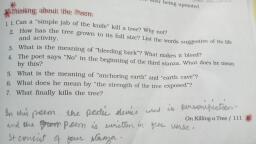
Top of Form, On Killing A Tree, By Gieve Patel, Introduction, The poet sensitizes the reader and highlights the fact that trees are living things. He equates trees with humans to convey that trees should not be cut because destroying trees is just like killing a human being., A tree does not die by merely cutting because it regrows from where it is cut. If it has to be destroyed, then it has to be uprooted., It takes much time to kill a tree,, Not a simple jab of the knife, Will do it. It has grown, Slowly consuming the earth,, Rising out of it, feeding, Upon its crust, absorbing, Years of sunlight, air, water,, And out of its leprous hide, Sprouting leaves., Jab: sudden rough blow, Leprous hide: discolored bark, A simple cut does not destroy a tree. A tree grows gradually, it is rooted in the soil. A plant takes nutrition from the soil to grow into a big tree. The tree is firmly bound with the soil. It takes in sunlight, water and air to grow into a strong trunk and have numerous leaves., So hack and chop, But this alone won’t do it., Not so much pain will do it., The bleeding bark will heal, And from close to the ground, Will rise curled green twigs,, Miniature boughs, Which if unchecked will expand again, To former size., Hack: cut roughly by striking heavy blows, Humans cut and chop the bark of trees into many pieces but that is not sufficient to destroy the tree. The point of the tree which gets cut gives out sap just like a human being bleeds. Gradually, this would heals and from there new branches start growing again., No,, The root is to be pulled out —, Out of the anchoring earth;, It is to be roped, tied,, And pulled out-snapped out, Or pulled out entirely,, Out from the earth-cave,, And the strength of the tree exposed, The source, white and wet,, The most sensitive, hidden, For years inside the earth., Anchoring earth: trees are held securely with the help of the roots in the earth, Snapped out: chopped out, The poet says that in order to kill the tree, it has to be uprooted. One has to separate the tree from the Earth which supports it. The roots of the tree bind the tree with the soil in the pit of the Earth. From there, the most sensitive and hidden part of the tree – the roots have to be detached. The roots are white in colour and are damp., Then the matter, Of scorching and choking, In sun and air,, Browning, hardening,, Twisting, withering,, And then it is done., Scorching and choking: the drying up of the tree after being uprooted, Once the tree has been uprooted, then gradually it withers and dries up with the action of heat and wind. The trunk will become brown, twist and will harden. Finally, the tree will die this way., Literary Devices, 1. No rhyme scheme is there in the poem. It is written in free verse. There is no rhyme or rhythm., 2 Enjambment: When one sentence continues into two or more lines., Not a simple jab of the knife, Will do it. It has grown, Slowly consuming the earth, Rising out of it, feeding, Upon its crust, absorbing, Years of sunlight, air, water,, And out of its leprous hide, Sprouting leaves., The most sensitive, hidden, For years inside the earth., 3. Metaphor : indirect comparison, Leprous hide – the uneven colour of the surface of the trunk of a tree is compared to the skin of a person suffering from leprosy., Bleeding bark – the sap coming out of tree where it is cut is compared to the bleeding from the wound in a human’s body., 4. Alliteration: repetition of a consonant sound in 2 or more closely places words., Bleeding bark – ‘b’ sound, White and wet – ‘w’ sound, 5. Repetition: a word or sentence is repeated to lay emphasis on it., ‘Pulled out’ is repeated, Summary, “On Killing a Tree” is a sensitive poem. The poet persuades the reader not to destroy trees and equates it with “killing” a human being. He says that a plant takes sunlight, water, air and nutrients from the soil to gradually become a huge tree., It develops a strong trunk and gets numerous leaves., Merely cutting the trunk of the tree does not kill it. When a tree is cut, the sap flows out just like a wounded man bleeds. Once the wound heals, new branches and tiny leaves grow from there which grow into trees., In order to destroy a tree, it has to be uprooted., The roots which are white in colour and are damp due to the moisture that they get from the soil are hidden in a pit in the Earth. These roots are the most sensitive part of the tree as they bind it to the earth. In order to kill the tree, these roots have to be detached from the soil., Once the roots are detached, the tree starts dying, It withers, dries up with the action of heat and wind, twists, hardens and finally, dies., NCERT Textbook Questions, Thinking about the poem, (Page 111), I., Que. 1. Can a “simple jab of the knife” kill a tree? Why not?, Ans. No, a simple jab of knife does not have the ability to kill the tree. It has to go through various processes. If its root is not removed from the earth, it will sprout again., Que. 2.How has the tree grown to its full size? List the words suggestive of its life and activity., Ans. The tree consumes the earth, and rises out it feeding upon its crust. It absorbs years of sunlight, air and water., Que. 3.What is the meaning of “bleeding bark”? What makes it bleed?, Ans. ‘Bleeding bark’ means the twigs which are cut mercilessly. They leave a liquid substance. If any part of the human body is cut, it starts bleeding. In the same way the liquid substance comes out from the branch of a tree. The human beings’ axe makes it bleed., Que. 4 The poet says “No” in the beginning of the third stanza. What does he mean by this?, Ans. ‘No’ is used to emphasize the perspective that chopping or hacking will not be sufficient for killing a tree., Que. 5. What is the meaning of “anchoring earth” and “earth cave”?, Ans. It means that the earth protects it like a mother. ‘Earth Cave’ implies a hole inside it. The tree allows its roots to spread underneath. The earth protects it and fosters it. It provides all the essential ingredients to the tree., Que.6. What does he mean by “the strength of the tree exposed”?, Answer:, The stem/root is the strength of a tree. When the tree is pulled out, its strength is exposed., Que. 7.What finally kills the tree?, Ans. Pulling out the tree from the mother earth and scorching and choking it in the sun and air kill the tree. It becomes brown, dry and gets hard. Eventually it dies., Long answer type questions, Que. 1 Write the critical appreciation of the poem ‘On Killing a Tree’?, Ans. The poem itself is modelled as a plant growing from the seed. The first line states “It takes much time to kill a tree.” Then the process of growth of the tree is described. It is presumed that the tree has grown from its seed., The seed develops the root. The root works its way through the rocks and stones of the soil. The trees grows slowly by feeding upon the earth’s crust absorbing years of sunlight, air and water. There is a fight during the development of the tree which is suggested in the poem. The survival of the tree, in spite of the efforts to kill it, is shown by the lines. “And from close to the ground”., Question 2., Describe the pulling out of the roots and the various processes of withering and dying of a tree after it., Answer:, The roots are the most sensitive parts of a tree. They remain hidden inside the earth for years. First root is to be pulled out of the anchoring earth. It is roped tied and pulled out entirely. The strength of the tree is totally exposed. Then starts the process of scorching and choking. The rootless tree is scorched in the sunlight. It is choked as it doesn’t get necessary oxygen for its survival from the air. Then the colour fades and hardens. It loses its proper shape. It twists and withers. Finally, it dies down., .