Page 1 :
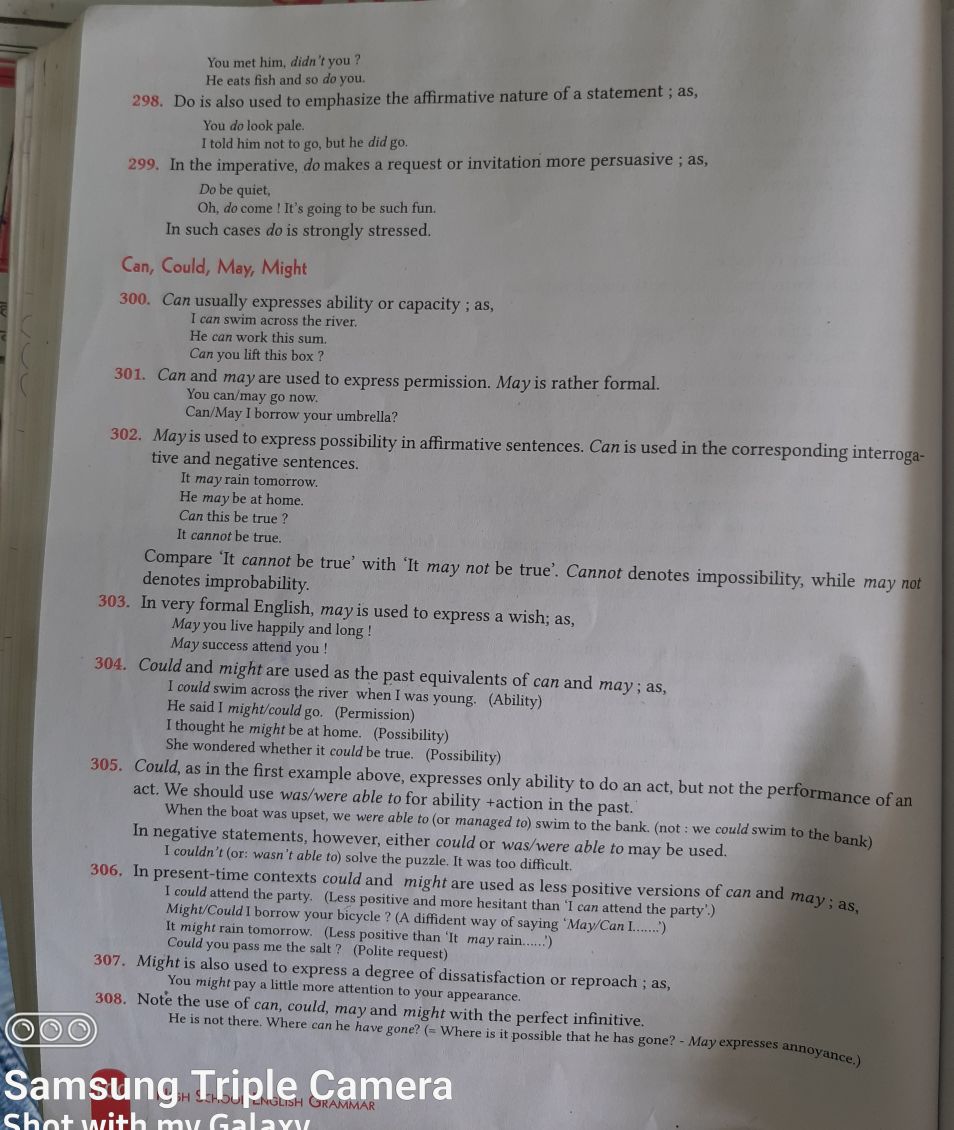
You met him, utes be f. :, Oe of a statement ; as,, 298. Do is is used to emphasize the affirmative nature, , You do look pale. ', told him not to go, but he did go., , invitation ive ; as,, 299. In the imperative, do makes a request or invitation more persuas!, , Dobe quiet,, Oh, do come ! It’s going to be such fun., , In such cases do is strongly stressed., Can, Could, May, Might, , 300. Can usually expresses ability or capacity ; as,, I can swim across the river,, He can work this sum., , , , Can you lift this box ?, , 301. Can and may are used to exp, You can/may go now., Can/May I borrow your umbrella?, , ress permission. May is rather formal., , tive and negative sentences., It may rain tomorrow., He may be at home., Can this be true ?, It cannot be true., , Compare ‘It cannot be true’ wit, denotes improbability., 303. In very formal English, may is, May you live happily and long !, May success attend you !, , 304. Could and might are used as the Past equivalents of can and may ; as,, 1 could swim across the river when I was young, (Ability), He said I mighi/could go, (Permission), Tthought he mightbe at home. (Possibility), She wondered whether it could be true. (Possibility), 305. Could, as in the first example above, expresses onl, act. We should use was/were able to for ability +a, When the boat was upset, we were able to (, In negative statements, however, either, Teouldn’t (or: wasn’t able to) solve the puz:, 306. In present-time contexts could and mi, T could attend the party. (Less positive, Might/Could1 borrow your bicycle ? (A, , It mightrain tomorrow. (Less positi, Could you pass me the salt? (Polite, , th ‘It may not be true’. Cannot denotes impossibility, while may, , used to express a wish; as,, , , , , , ly ability to do an act, but not the pel, ction in the past., , (or managed to) swim to the bank. (not : we could swim |, could or was/were able to may be used., ale, It was too difficult., , ig, an, diffident way of saying ‘May/Can I..., ive than ‘It mayrain.....’), , request), , , , , , , , , , , , , , is 3 as,, You might pay a little more attention, 308. Note the use of can, could, may and might with the perfect infinitive,, He is not there. Where can he have gone? (= Where is it possible that he ‘has gone? - May, , , , , = I, , , , DUI ENGLISH GRAMMAR