Page 1 :
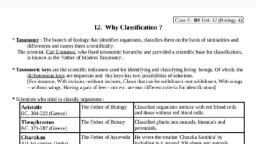
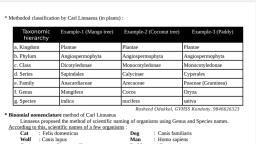
Chapter: 4 WHY CLASSIFICATION?, Standard 8 Biology Worksheet. 2 (2/4), , 1. What is the difference between two kingdom classification and five kingdom classification?, OR Limitations of two kingdom classification and Possibilities of five kingdom classification?, Ans: In two kingdom classification by Carl Linnaeus, organisms were classified under two, large categories namely, Kingdom Plantae (plants) and Kingdom Animalia (animals). He didn’t, consider unicellular organisms like Bacteria, Protozoa and Fungi. This is the limitation of two, kingdom classification., American botanist Robert H. Whittaker later considered these micro organisms, and added into the two kingdom, thus he classified them into five kingdoms known as five, kingdom classification. The kingdoms are Monera, Protista, Fungi, Plantae and Animalia., 2. Write down the difference between (a) Plantae and Animalia. (b) Monera and Protista., 3. Who proposed the six kingdom classification?, 4. Write down the circumstances that led to the formulation of six kingdom classification?, Ans: In the time of Carl Linnaeus and R. H. Whittaker knowledge of the peculiarities of, microorganisms like bacteria was limited. Later, it was found out that the archaebacteria, belonging to the Kingdom Monera are different from other bacteria in cell structure and, physiological functions. Carl Woese divided kingdom Monera into two Kingdoms; namely, archaea and bacteria so forms six kingdom classification., 5. Mention the three domains proposed by Carl Woese?, 6. Complete the following Illustrations., , KINGDOM, , A. Five Kingdom classification, , b, , a, , MONERA, , c, , ANIMALIA, , e, , d, , Amoeba, , g, , Mushrooms, , h, , i, , B. Six Kingdom classification, , Autotrophic,, multicellular,, non-motile, organisms, , b, , DOMAIN ARCHAEA, , KINGDOM, BACTERIA, , a, , f, j, , c, Kingdom – Protista, Kingdom – d--Kingdom – e--Kingdom – f---, , C. Hierarchy of two Kingdom classification, KINGDOM, PLANTAE, , KINGDOM, ANIMALIA, , Kingdom, ----a-------b-------c-------d-------e-------f----, , ----g-------h-------i-------j-------k-------l---Species, PPM Ali, Seethi Sahib HSS, Taliparamba
Page 2 :
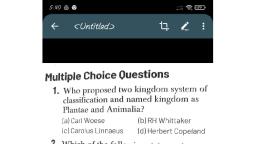
7. Find out the various levels of classification of human being based on the six kingdom, classification and complete the table suitably?, , Domain, , Eukarya, , Kingdom, Phylum, Class, Order, , Primates, , Family, Genus, , Homo, , Species, , Protein coat, , Genetic, material, , 8. Identify the pathogen and write down their structure and peculiarities?, 9. Why cannot be virus included in any of the classification methods?, Ans: Virus is an acellular particle and it is inactive outside the cell and, can only live inside a live cell. So it is not included in any of the, classification methods., 10. How virus cause disease?, Ans: When the virus enter the host cell, it multiplies using the genetic, materials there and destroy that cell. Thus virus cause disease., Pathogen, 11. How can we ensure that the newly identified organisms have, never been identified?, Ans: The scientific world accepts newly identified organisms by classifying them on the basis, of their peculiarities and name them scientifically. We can ensure by observation of, peculiarities of the organism, Verification of details of it, Use of taxonomic keys for, Classification and name them Scientifically., 12. Find out the missing pair:, (a) Man: Homo sapiens; Cat:..............................., (b) Carl Woese: six kingdom classification; ...................................: Five kingdom classification, (c) Monera: Bacteria; ....................: Amoeba, (d).......................: Corvus splendens; Cow: Bos taurus, (e) Cat’s Family: Felidae, Cat’s genus:.........................., (f) Father of Biology: Aristotle; Father of Botany:......................................., (g) Charaka Samhita:Charakan; Historia Generalis Plantarum:........................................, (h) Species: John Ray; Binomial nomenclature:..................................................., , Let us assess: Answers, 1. (a) Carl Woese, (b) Historia Generalis Plantarum, 2. (a) Kingdom Animalia, (b) Kingdom Fungi, (c) Kingdom Protista, (d) Kingdom Plantae., 3. Lion has more resemblances with tiger because the genus name of Tiger (Panthera tigris), and Lion (Panthera leo) are same, Panthera., *Also do Extended activities as possible., , PPM Ali, Seethi Sahib HSS, Taliparamba