Page 1 :
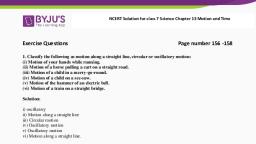
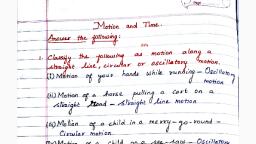
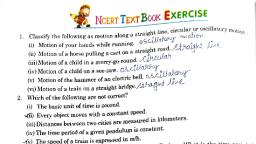
Exercise Questions Pag, , 1. Classify the following as motion along a straight line, circular or oscillatory motio, i) Motion of your hands while running., , i) Motion of a horse pulling a cart on a straight road., , in a merry-go-round., , (iv) Motion of a child on a see-saw., , (¥) Motion of the hammer of an electric bell., , (vi) Motion of a train on a straight bridge., , , , , , Solution:, , i) oscillatory, ii) Motion along a straight line, i) Circular motion, , iv) Oscillatory motion, , v) Oscillatory motion, , vi) Motion along a straight line., , , , 2. Which of the following are not correct?, (i) The basic unit of time is second., , (ii) Every object moves with a constant speed., , (iii) Distances between two cities are measured in kilometres., (iv) The time period of a given pendulum is constant., , (v) The speed of a train is expressed in m/h., , , , Solution:, , Incorrect statements are:, , (ii) Every object moves with a constant speed., , (iv) The time period of a given pendulum is constant., (v) The speed of a train is expressed in m/h., , , , 3. A simple pendulum takes 32 s to complete 20 os 's. What is the time period, Solution:, Number of oscillations = 20, , Total time taken to complete 20 oscillations = 32 s, , Time period = Total time taken, fumber of oscillations