Page 1 :
Poem - 6 (Flamingo), AUNT JENNIFER’S, , TIGERS, BY: ADRIENNE RICH
Page 2 :
About the Poet :, , , ADRIENNE RICH, , , , Adrienne Rich (1929) was born in Baltimore, Maryland, USA., Her claim to fame were her feminist ideas and her wide, involvement in contemporary women’s movement as a poet, and theorist., , She received a number of awards including 1996 Tanning, Award for Mastery in the Art of Poetry, the Lennon, foundation’s 1999 Lifetime Achievement Award, The, Commonwealth Award in Literature and National Book Award.
Page 3 :
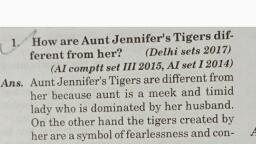
The poem deals with the pathetic condition of, married women all over the world. Aunt Jennifer is, a symbol of all married women, who are suffering, at the oppressive hands of a patriarchal society., , Tone, , The tone appears to be positive and cheerful when, the poet describes the tiger but it becomes sad and, dull at times when describing aunt Jennifer., , About the Poem, , This poem was first published in her anthology, collection, A Change of World (1951)., , In the poem, Aunt Jennifer is sewing, tapestries of beautiful and vibrant, tigers. The speaker contrasts the tigers, against Jennifer's own situation:, , she is an unhappy woman trapped in her, ———nartriage
Page 4 :
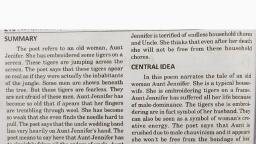
Unlike the tigers, she is not “courageous” or bold,, but instead, lives under her husband's rule., Jennifer eventually dies as a terrified woman, defeated by the difficulties of her life, while the, tigers live on in the image, forever joyful and free., , The poem is an example of Rich's early work,, which was still inspired by poets like Yeats and, Tennyson. Here, this influence shines through in, the traditional meter and rhyme scheme of the, poem, but Rich's later interest in feminist, , thematic is also apparent., , About the characters :1. Speaker :, The title suggests that the speaker is Aunt Jennifer's, niece. However, during the poem, the speaker seems, distant from the action. She describes the scene in, the third person, and calmly predicts her aunt's death., This lack of attachment suggests that the speaker is, probably speaking from a place of remove, perhaps, long after this scene took place. As readers, we know, that by the time of this poem, the speaker has come to, disapprove of Jennifer's marriage, but we also know, , she wasn't able to do anything for her aunt other than, describe her life.

Page 5 :
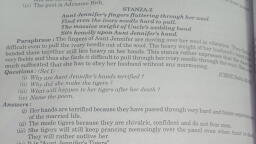
2. Aunt Jennifer :, Aunt Jennifer is portrayed as a woman, dominated by her husband. Her fluttering hands, struggle even to pull a needle through fabric, and, she dies terrified. We aren't lead to believe that, Jennifer was always this way: instead, Rich, emphasizes that Jennifer was weighed down by, her marriage, and "mastered" by its endless, ordeals (a primitive method of determining a, person's guilt)., , 3. The Uncle :, Jennifer's husband looms in the background of, the poem despite never appearing directly in the, text. It's possible that he's abusive, but it is also, possible that Rich is merely writing about the, routine, ordinary power husbands hold over their, wives. Either way, an absent Uncle is still able to, confine Aunt Jennifer within fear and weakness., , 4. The tigers :, Rich characters the tigers as "chivalric,' or having, the characteristics of traditional knighthood. She, also repeatedly emphasizes their fearlessness, as, well as their joyful, free movement through the, world. They are a foil to Aunt Jennifer, who is, terrified and confined.