Assignment of 11 Coaching, Mathematics Complex Number - Study Material
Page 1 :
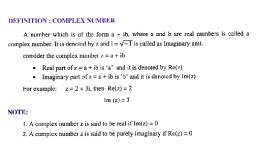
JEEMAIN.GURU, , JEE-Mathematics, , COMPLEX NUMBER, 1., , DEFINITION :, Complex numbers are defined as expressions of the form a + ib where a , b R, , & i = 1 . It is denoted, , by z i.e. z = a + ib. ‘a’ is called real part of z (Re z) and ‘b’ is called imaginary part of z (Im z)., , Every Complex Number Can Be Regarded As, , Purely real, if b = 0, , Imaginary, if b 0, , Purely imaginary, if a = 0, , Note :, (i), , The set R of real numbers is a proper subset of the Complex Numbers. Hence the Complex Number, system is N W I Q R C., , (ii), , Zero is both purely real as well as purely imaginary but not imaginary., , (iii), , i=, , is called the imaginary unit. Also i² = l ; i3 = i, , 1, , ;, , i4 = 1 etc., , In general i4n = 1, i4n+1 = i, i4n+2 = –1, i4n+3 =–i, where n I, (iv), , a, , Illustration 1 :, , ab, , b =, , only if atleast one of either a or b is non- negative., , The value of i57 + 1/i125 is :(A) 0, , Solution :, , (B) –2i, , i 57 + 1/i 125 = i 56 . i +, 14, , , , 4, = i, , NODE6\E\Data\2014\Kota\JEE-Advanced\SMP\Maths\Unit#11\Eng\02.Complex number.p65, , = i, , E, , 2., , i, , (C) 2i, , 1, i, , 124, , .i, , 1, 4 31, , i , , i, , 1, i, i 2 ii 0, i, i, , Ans. (A), , ARGAND DIAGRAM :, Master Argand had done a systematic study on complex numbers and represented, every complex number z = x + iy as a set of ordered pair (x, y) on a plane called, complex plane (Argand Diagram) containing two perpendicular axes. Horizontal axis, is known as Real axis & vertical axis is known as Imaginary axis., All complex numbers lying on the real axis are called as purely real, and those lying on imaginary axis as purely imaginary., , 3., , (D) 2, , ALGEBR AIC, , OPER ATIONS :, , Fundamental operations with complex numbers :, (a), , Addition, , (a + bi) + (c + di) = (a + c) + (b + d)i, , (b), , Subtraction, , (a + bi) – (c + di) = (a – c) + (b – d)i, , (c), , Multiplication, , (a + bi) (c + di) = (ac – bd) + (ad + bc)i, , (d), , Division, , a bi a bi . c di ac bd bc ad i, c di c di c di c 2 d 2 c 2 d 2, , 27, , Imaginary axis, P(z), x, Real axis, O z = x + iy, Re(z)=x, Im(z)=y, y
Page 2 :
JEEMAIN.GURU, , JEE-Mathematics, Note :, (i), , The algebraic operations on complex numbers are similar to those on real numbers treating i as, a polynomial., , (ii), , Inequalities in complex numbers (non-real) are not defined. There is no validity if we say that, complex number (non-real) is positive or negative., e.g. z > 0, 4 + 2i < 2 + 4i are meaningless., , (iii), , In real numbers, if a2 + b 2 = 0, then a = 0 = b but in complex numbers, z12 + z22 = 0 does not imply, z1 = z2 = 0., , Illustration 2 :, , 3 2i sin , will be purely imaginary, if =, 1 2i sin , , , , ,nI, (B) n , n I, (C) n , n I, 3, 3, 3, 3 2i sin , will be purely imaginary, if the real part vanishes, i.e.,, 1 2i sin , , (A) 2n , , Solution :, , , , (D) none of these, , , , 3 4 sin 2 i 8 sin , (3 2i sin ) (1 2i sin ), , =, 1 4 sin 2 , (1 2i sin ) (1 2i sin ), , , , , , 2, , 3 4 sin , 0, 1 4 sin 2 , , , , 3 – 4 sin2 = 0 (only if be real), , 2, , , , 3, sin2 = , = sin , , , , 3, 2 , = n ±, , 2, , , ,nI, 3, , Ans. (C), , Do yourself - 1 :, n, , (i), , 1 i , Determine least positive value of n for which , 1, 1 i , 5, , Find the value of the sum, , (i n i n 2 ) , where i =, n 1, , 3., , 1 ., , EQUALITY IN COMPLEX NUMBER :, Two complex numbers z1 = a1 + ib1 & z2 = a2 + ib2 are equal if and only if their real & imaginary parts, are respectively equal., , Illustration 3 :, , The values of x and y satisfying the equation, (A) x = –1, y =3, , Solution :, , (B) x = 3, y = –1, , (1 i)x 2i (2 3i)y i, , i, 3i, 3i, , (1 i)x 2i (2 3i)y i, , i are, 3i, 3i, (C) x = 0, y = 1, , (D) x = 1, y = 0, , (4 + 2i) x + (9 – 7i) y – 3i – 3 = 10i, , Equating real and imaginary parts, we get, Hence x = 3 and y = –1., , 2x – 7y = 13 and 4x + 9y = 3., Ans.(B), , 28, , NODE6\E\Data\2014\Kota\JEE-Advanced\SMP\Maths\Unit#11\Eng\02.Complex number.p65, , (ii), , E
Page 3 :
JEEMAIN.GURU, , JEE-Mathematics, , Illustration 4 :, , Find the square root of 7 + 24 i., , Solution :, , Let, , 7 24i = a + ib, Squaring a2 – b2 + 2iab = 7 + 24i, Compare real & imaginary parts a2 – b2 = 7 & 2ab = 24, By solving these two equations, We get, a = ±4 , b = ±3, 7 24i = ±(4 + 3i), , Illustration 5 :, , If x 5 2 4 , find the value of x4 + 9x3 + 35x2 – x + 4., , Solution :, , We have ,, , x = –5 + 2 4, , , , x + 5 = 4i, , , , x2 + 10x + 25 = –16, , , , (x + 5)2 = 16i 2, , , x2 + 10x + 41 = 0, , Now,, x4 + 9x3 + 35x2 – x + 4, , , x2(x2 + 10x + 41) – x(x2 + 10x + 41) + 4(x2 + 10x + 41) – 160, , , , x2(0) – x(0) + 4(0) – 160, , , , –160, , Ans., , Do yourself - 2 :, (i), Find the value of x3 + 7x2 – x + 16, where x = 1 + 2i., , 4., , c i, b, 2c, , , where c is a real number, then prove that : a2 + b2 = 1 and, ., ci, a c2 1, , (ii), , If a + ib =, , (i i i ), , Find square root of –15 – 8i, , THREE IMPORTANT TERMS : CONJUGATE/MODULUS/ARGUMENT :, (a), CONJUGATE COMPLEX :, , NODE6\E\Data\2014\Kota\JEE-Advanced\SMP\Maths\Unit#11\Eng\02.Complex number.p65, , If z = a + ib then its conjugate complex is obtained by changing the sign of its imaginary part &, is denoted by z . i.e. z = a ib., Note that :, , E, , (i), , z + z = 2 Re(z), , (ii), , z z = 2i Im(z), , (iii), , z z = a² + b², which is purely real, , (iv), , If z is purely real, then z – z = 0, , (v), , If z is purely imaginary, then z + z = 0, , (vi), , If z lies in the 1st quadrant, then z lies in the 4th quadrant and, , –z, , z, Re, , , , z lies in the 2nd quadrant., (b), , Im, , –z, , z, , Modulus :, If P denotes complex number z = x + iy, then the length OP is called modulus of complex number z. It is, denoted by |z|., OP = |z| =, , x2 y2, , Geometrically z represents the distance of point P from origin. ( z 0), Note :, , z, Unlike real numbers, z = , z, is not correct., , if z 0, if z 0, , 29
Page 4 :
JEEMAIN.GURU, , JEE-Mathematics, (c), , Argument or Amplitude :, If P denotes complex number z = x + iy and if OP makes an angle , , Imaginary, axis, , with real axis, then is called one of the arguments of z., = tan1, , P(x, y), , |z|, , y, (angle made by OP with positive real axis), x, , , O, , Note :, , Real axis, , (i), , Argument of a complex number is a many valued function. If is the argument of a complex, number, then 2n + ; n I will also be the argument of that complex number. Any two, arguments of a complex number differ by 2n, , (ii), , The unique value of such that < is called Amplitude (principal value of the argument)., , (iii), , Principal argument of a complex number z = x + iy can be found out using method given below :, (a), (b), , 1, Find = tan, , y, , such that 0, ., x, 2, , Im, , Use given figure to find out the principal argument according, as the point lies in respective quadrant., , (iv), , Unless otherwise stated, amp z implies principal value of the argument., , (v), , The unique value of = tan1, , (vi), , If z = 0, arg(z) is not defined, , (vii), , If z is real & negative, arg(z) = ., , (viii), , If z is real & positive, arg(z) = 0, , (ix), , If , , (x), , If , , , , , , , , , , Re, , y, such that 0 2 is called least positive argument., x, , , , z lies on the positive side of imaginary axis., 2, , , z lies on the negative side of imaginary axis., 2, , By specifying the modulus & argument a complex number is defined completely. Argument impart, direction & modulus impart distance from origin., , is given by its modulus only., , Illustration 6 :, , Find the modulus, argument, principal value of argument, least positive argument of complex, (c) 1 – i 3 (d) –1 – i 3, , numbers (a) 1 + i 3 (b) –1 + i 3, , Solution :, , (a), , For z = 1 + i 3, , y, , (1, 3 ), , | z| 12 ( 3 )2 2, 3, , , arg (z) = 2n +, ,, 3, , n I, , Least positive argument is, , 60°, 1, , , 3, , x, , If the point is lying in first or second quadrant then amp(z) is taken in anticlockwise direction., In this case amp(z) =, , , 3, , 30, , NODE6\E\Data\2014\Kota\JEE-Advanced\SMP\Maths\Unit#11\Eng\02.Complex number.p65, , For the complex number 0 + 0i the argument is not defined and this is the only complex number which, , E
Page 5 :
JEEMAIN.GURU, (b), , JEE-Mathematics, For z = –1 + i 3, , y, , (–1, 3 ), , |z| = 2, arg (z) = 2n +, , 2, , n I, 3, , Least positive argument =, amp(z) =, (c), , 3, 120°, , 60°, 1, , 2, 3, , x, , 2, 3, y, , For z = 1 – i 3, , x, , 1, , |z| = 2, , –/3, , 5/3, , , arg (z) = 2n –, ,nI, 3, , 3, , 5, (1,– 3 ), 3, If the point lies in third or fourth quadrant then consider amp(z) in clockwise direction., , Least positive argument =, , In this case amp(z) = –, (d), , , 3, y, , For z = –1 – i 3, |z| = 2, , 4/3, , 1, , 2, arg (z) = 2n –, , n I, 3, , –2/3, , 60°, , x, , 3, , 4, Least positive argument =, 3, , (–1,– 3 ), , 2, amp(z) = –, 3, , Illustration 7 :, , Find modulus and argument for z = 1 – sin + i cos , (0,2), , Solution :, , | z| (1 sin ) 2 (cos )2 2 2 sin 2 cos, , NODE6\E\Data\2014\Kota\JEE-Advanced\SMP\Maths\Unit#11\Eng\02.Complex number.p65, , Case (i), , E, , , , sin, 2, 2, , , For 0, , z will lie in I quadrant., 2, 2, , amp (z) = tan, , 1, , , , , , arg z tan 1 tan , 4 2 , , Since, , , , ,, 4 2 4 2 , , , , , , amp (z) = , | z| 2 cos sin , 4 2 , 2, 2, , , Case (ii), , , :, 2, |z| = 0, at , , , , , , , , , , 2 , , 2, , 2, , 2, , cos, sin, cos sin, cos , 1, 2, 2 tan 1, 2, 2, amp (z) = tan, 2, , , , , , 1 sin , cos, , sin, cos sin, , z 0 0i, , amp (z) is not defined., , 31, , 2
Page 6 :
JEEMAIN.GURU, , JEE-Mathematics, Case (iii), , 3 , For ,, , z will lie in IV quadrant, 2 2 , , so amp (z) = –tan–1 tan , 2 4, , Since, , , ,, 2 4 2 , , , 3 , , amp (z) = , , |z| =, 2, 4, , 4 2, , Case (iv), , Case (v), , 3, :, 2, |z| = 2, amp (z) = 0, at , , , , , 2 sin cos , 2, 2, , , z = 2 + 0i, , 3, , For ,2 , 2, , , z will lie in I quadrant, , arg (z) = tan–1tan , 2 4, , Since, , 5 , ,, 2 4 4 , , arg z =, , , 3, =, , , |z| =, 2 4, 2 4, , , , , 2 sin cos , 2, 2, , , Do yourself - 3 :, Find the modulus and amplitude of following complex numbers :, , 5., , 2 2 3i, , (ii), , 3 i, , (i i i ), , –2i, , (iv), , 1 2i, 1 3i, , (v), , 2 6 3i, 5 3i, , REPRESENTATION OF A COMPLEX NUMBER IN VARIOUS FORMS :, (a), Cartesian Form (Geometrical Representation) :, Every complex number z = x + i y can be represented by a point on the cartesian plane known as, complex plane by the ordered pair (x , y). There exists a one-one correspondence between the points, of the plane and the members of the set of complex numbers., Imaginary, axis, , For z = x + iy; | z| x 2 y 2 ;, , z x iy and tan 1, , y, x, , Note :, (i), Distance between the two complex numbers z1 & z2 is given by |z1 – z2|., (ii), |z – z0| = r, represents a circle, whose centre is z0 and radius is r., , Illustration 8 :, Solution :, , |z|, , , O, , Find the locus of :, (a) |z – 1|2 + |z + 1|2 = 4, (b) Re(z2) = 0, (a) Let z = x + iy, (|x + iy – 1|) 2 + (|x + iy + 1|) 2 = 4, (x – 1)2 + y2 + (x + 1)2 + y2 = 4, x2 – 2x + 1 + y2 + x2 + 2x + 1 + y2 = 4 x2 + y2 = 1, Above represents a circle on complex plane with center at origin and radius unity., , 32, , P(x, y), , Real axis, , NODE6\E\Data\2014\Kota\JEE-Advanced\SMP\Maths\Unit#11\Eng\02.Complex number.p65, , (i), , E
Page 7 :
JEEMAIN.GURU, (b), , Illustration 9 :, , JEE-Mathematics, Let z = x + iy, , z2 = x2 – y2 + 2xyi, , Re(z2) = 0, , x2 – y 2 = 0 y = ± x, Thus Re(z2) = 0 represents a pair of straight lines passing through origin., , If z is a complex number such that z2 = ( z )2 , then, (A) z is purely real, (C) either z is purely real or purely imaginary, , Solution :, , (B) z is purely imaginary, (D) none of these, , Let z = x + iy, then its conjugate z x iy, Given that z2 = ( z )2, , , , x2 – y2 + 2ixy = x2 – y2 – 2ixy , , 4ixy = 0, , If x 0 then y = 0 and if y 0 then x = 0., Ans. (C), Illustration 10 : Among the complex number z which satisfies |z – 25i| 15, find the complex numbers z having, , Solution :, , (a) least positive argument, , (b) maximum positive argument, , (c) least modulus, , (d) maximum modulus, , The complex numbers z satisfying the condition, |z – 25i| 15, , , , 2, , 2, , 2, , Ta, n ge, o r i g n t fr o, in m, , are represented by the points inside and on the circle of radius 15 and centre at the point, C(0, 25)., The complex number having least positive argument and maximum positive arguments in this, region are the points of contact of tangents drawn from origin to the circle, Here = least positive argument, and = maximum positive argument, D40i, , 2, , In OCP, OP OC CP 25 15 20, , C 25i, , and, , , , sin , , tan , , OP 20 4, , , OC 25 5, , Q, , , E, , P, , , O , , 4, 4, tan 1 , 3, 3, , N, , NODE6\E\Data\2014\Kota\JEE-Advanced\SMP\Maths\Unit#11\Eng\02.Complex number.p65, , 4, Thus, complex number at P has modulus 20 and argument tan 1 , 3, , E, , , , 4, 3, z p 20 cos i sin 20 i , 5, 5, , , , z p 12 16i, , Similarly zQ = –12 + 16i, From the figure, E is the point with least modulus and D is the point with maximum modulus., , Hence, z E OE OC EC 25i 15i 10i, , and, z D OD OC CD 25i 15i 40i, Do yourself - 4 :, (i), , Find the distance between two complex numbers z1 = 2 + 3i & z2 = 7–9i on the complex plane., , (ii), , Find the locus of |z – 2 – 3i| = 1., , (i i i ), , If z is a complex number, then z2 + z 2 2 represents (A) a circle, , (B) a straight line, , (C) a hyperbola, , 33, , (D) an ellipse
Page 8 :
JEEMAIN.GURU, , JEE-Mathematics, (c), , Trigonometric / Polar, , Repre sentat ion :, , z = r (cos + i sin ) where z = r, , ; arg z = ;, , z = r (cos i sin ), , Note : cos + i sin is also written as CiS , Euler's formula :, The formula eix = cosx + i sin x is called Euler's formula., It was introduced by Euler in 1748, and is used as a method of expressing complex numbers., , (d), , Also cos x =, , e ix e ix, 2, , Exponential, , Representation :, , & sin x =, , e ix e ix, are known as Euler's identities., 2i, , Let z be a complex number such that z = r & arg z = , then z = r.ei, , Illustration 11 : Express the following complex numbers in polar and exponential form :, i 1, , (ii) cos i sin , 3, 3, , 1 3i, (i), 1 2i, (i), , Let z , , 1 3i 1 3i 1 2i, , , 1 i, 1 2i 1 2i 1 2i, , | z| ( 1) 2 12 2, , tan , , 1, , , 1 tan , 1, 4, 4, , , , Re(z) < 0 and Im(z) > 0 z lies in second quadrant., , , , = arg (z) = – = –, Hence Polar form is z =, , 3, , 4, 4, 3, 3 , , i sin, 2 cos, 4, 4 , , , and exponential form is z 2 e 3 / 4, , 2(i 1), i 1, i 1, , =, , 1 i 3 (1 i 3 ), cos i sin, , 3, 3 2, 2, , (ii), , Let z , , , , z, , , , Re(z) > 0 and Im(z) > 0 z lies in first quadrant., , , , 3 1 3 1 , | z| , , , 2 2 , , , , , 2(i 1), (1 i 3 ), , , , (1 i 3 ), , 3 1 3 1 , z , i , , (1 i 3 ), 2 2 , , 2, , tan , , 3 1, 3 1, , tan, , 2, , 2(3 1), 2., 4, , 5, 5, , 12, 12, , 5, 5 , , i sin, Hence Polar form is z 2 cos, 12, 12 , , , and exponential form is z 2e 5 / 12, , 34, , NODE6\E\Data\2014\Kota\JEE-Advanced\SMP\Maths\Unit#11\Eng\02.Complex number.p65, , Solution :, , E
Page 10 :
JEEMAIN.GURU, , JEE-Mathematics, , 8., , IMPORTANT, , PROPERTIES, , OF AMPLITUDE :, , (a), , amp (z1. z2) = amp z1 + amp z2 + 2 k k I, , (b), , z , amp 1 = amp z1 amp z2 + 2 k, z2 , , (c), , amp(zn) = n amp(z) + 2k ; n,k I, , kI, , where proper value of k must be chosen so that RHS lies in ( , ]., 2, , , , Illustration 13 : Find amp z and |z| if z (3 4i)(1 i)(1 3i) ., (1 i)(4 3i)(2i), , , , Solution :, , , , amp z = 2 amp (3 4i) amp(1 i) amp(1 3i) amp(1 i) amp(4 3i) amp(2i) 2k , , , where k I and k chosen so that amp z lies in (–,]., , , , 4 , 3 , amp z 2 tan 1 tan 1 2k , 3 4 3 4, 4 2, , , , , 4 , 1 4, cot 1 + 2k amp z 2 2k , amp z = 2 tan, 2 3 , 3, 3 3, , , , , , , amp z , , , 3, , [at k = –1], , Ans., , Also,, , | z| , , 3 4i 1 i 1 3i , 1 i 4 3i 2i , , 2, , , , 3 4i 1 i 1 3i , , | z| , |1 i| | 4 3i| | 2i| , , , , 2, , 2, , 5 2 2 , 1, |z| = , 2 5 2 , Aliter, , Hence |z| = 1, amp(z) = , , I l l u s t r a t i o n 1 4 : If, , We have,, , , , 2, 2, , , , , , , 3 i, 2 2 3i 1, 3i, z , z=, , 2, 4, 2, 2, , , , , ., 3, , zi, 1 , then locus of z is zi, , (A) x-axis, , Solution :, , , , (B) y-axis, , (C) x = 1, , (D) y = 1, , x i y 1, zi, 1, 1, zi, x i y 1, , x i y 1, , 2, , x i y 1, , 2, , 2, , 2, , 1 x 2 y 1 x 2 y 1 4 y 0; y 0 , which is x-axis, , z , , Illustration 15 : If |z 1 + z 2|2 = |z 1|2+|z 2|2 then 1 is z2 , (A) zero or purely imaginary, (C) purely real, , (B) purely imaginary, (D) none of these, , 36, , Ans. (A), , NODE6\E\Data\2014\Kota\JEE-Advanced\SMP\Maths\Unit#11\Eng\02.Complex number.p65, , , , (3 4i)(1 i) 1 3i, z, 1 i 4 3i 2i , , , Ans., , E
Page 11 :
JEEMAIN.GURU, Solution :, , JEE-Mathematics, , Here let z1 = r1 cos 1 i sin 1 ,| z1 | r1, z2 = r2 cos 2 i sin 2 ,| z 2 | r2, |(z1 + z2)|2 = r1 cos 1 r2 cos 2 i r1 sin 1 r2 sin 2 , , , , 2, , = r12 r22 2r1 r2 cos( 1 2 ) = | z1 |2 | z 2 |2 if cos(1 2 ) 0, , 1 2 , , , , , 2, , amp(z1) – amp(z2) = , , , , , 2, , z, , z , amp 1 1 is purely imaginary, 2, z2, z2 , , , , z 1 2z 2, , Illustration 16 : z1 and z2 are two complex numbers such that, , Ans. (B), , is unimodular (whose modulus is one), while, , 2 z1 z 2, , z2 is not unimodular. Find |z1|., , Solution :, , Here, , z 1 2z 2, 2 z1 z 2, , z 1 2z 2, , =1 , , 1, , 2 z1 z 2, 2, , z 1 2z 2 2 z 1 z 2, , , , z1 2z 2 z1 2z 2 2 z1 z 2 2 z1 z 2 , , , , z1 2z 2 z1 2z 2 2 z1 z 2 2 z1 z 2 , , , , z1 z1 2z1 z 2 2z 2 z1 4z 2 z 2 4 2z1 z 2 2z1 z 2 z1 z1 z 2 z 2, , , , z1, , , , z, , 2, , 4 z2, 2, , 1, , 2, , , , 4 z1, , 4 1 z2, , 2, , , , 2, , , , 2, , z2, , z 1 2z 2, , 2, , , , z1, , 2 z1 z 2, , 2, , z1, , 2, , z2, , 2, , 4 z2, , 2, , 4 0, , 0, , NODE6\E\Data\2014\Kota\JEE-Advanced\SMP\Maths\Unit#11\Eng\02.Complex number.p65, , But |z2| 1 (given), , |z 1 | 2 = 4, Hence,, |z 1 | = 2., I l l u s t r a t i o n 1 7 : The locus of the complex number z in argand plane satisfying the inequality, , E, , 2, | z 1| 4 , , log 1 / 2 , 1 where | z 1| is , 3| z 1| 2 , , 3, (A) a circle, , Solution :, , z 1 4, 3 z 1 2, , , , 1, 2, , (D) none of these, , log a x is a decreasing function if a 1 , , 2 z 1 8 3 z 1 2, , , (C) exterior of a circle, , z 1 4 , 1, log 1 / 2 , 1 log1 / 2 2 , 3, z, , 1, , 2, , , , We have,, , , , (B) interior of a circle, , as, , |z – 1| > 2/3, , z 1 10, , which is exterior of a circle., , Ans. (C), , 4, I l l u s t r a t i o n 1 8 : If z , = 2, then the greatest value of z is z, (A) 1 +, , 2, , (B) 2 +, , (C), , 2, , 37, , 3 + 1, , (D), , 5 + 1
Page 12 :
JEEMAIN.GURU, , JEE-Mathematics, 4, 4 4, 4 4, We have z z z , = 2 +, z, z z, z, z, , Solution :, , , , 2, z 2 z 4 , , , , z 1 5, , z, , , , 2, , 1 5, , z 5 1, , Therefore, the greatest value of z is, , Illustration 19, , 5 + 1 ., , Ans. (D), , : Shaded region is given by (A) |z + 2| 6, 0 arg(z) , , , 6, , C(1+3 3i ), z, , , (B) |z + 2| 6, 0 arg(z) , 3, , (C) |z + 2| 6, 0 arg(z) , , , 2, , A, –2, , 0, , B(4), , (D) None of these, , 1, , , , 3 i, = –2 + 6 cos i sin , Note that AB = 6 and 1 + 3 3i = –2 + 3 + 3 3i = –2 + 6 , 3, 3, 2, 2, , Solution :, , , , BAC =, , , 3, , Thus, shaded region is given by |z + 2| 6 and 0 arg (z + 2) , , , 3, , Ans. (C), , Do yourself - 6 :, (i), , The inequality |z – 4| < |z – 2| represents region given by (A) Re(z) > 0, , (ii), , i, , (C) Re(z) > 3, , (D) none, , (C) ersin, , (D) e–rsin, , iz, , If z = re , then the value of |e | is equal to (A) e–rcos, , (B) ercos, , SECTION FORMUL A AND COORDINATES OF ORTHOCENTRE, CENTROID, CIRCUMCENTRE,, INCENTRE OF A TRIANGLE :, If z1 & z2 are two complex numbers then the complex number z =, , nz 1 mz 2, divides the join of z1 & z2 in the, m n, , ratio m : n., Note :, (i), If a , b , c are three real numbers such that az1 + bz2 + cz3 = 0 ; where a + b + c = 0 and a,b,c are, not all simultaneously zero, then the complex numbers z1 , z2 & z3 are collinear., (ii), If the vertices A, B, C of a triangle represent the complex numbers z1, z2, z3 respectively, then :, , •, •, , z1 z 2 z 3, , Centroid of the ABC =, , 3, , Orthocentre of the ABC =, , a sec A z1 b sec B z 2 c sec C z 3, a sec A b sec B c sec C, , or, , z 1 tan A z 2 tan B z 3 tan C, tan A tan B tan C, , (az 1 bz 2 cz 3 ), (a b c), , •, , Incentre of the ABC =, , •, , Circumcentre of the ABC =, , (z 1 sin 2A z 2 sin 2B z 3 sin 2C ), (sin 2A sin 2B sin 2C), , 38, , NODE6\E\Data\2014\Kota\JEE-Advanced\SMP\Maths\Unit#11\Eng\02.Complex number.p65, , 9., , (B) Re(z) < 0, , E
Page 14 :
JEEMAIN.GURU, , JEE-Mathematics, Illustration, , 20 : Complex numbers z 1, z 2, z 3 are the vertices A, B, C respectively of an isosceles right angled, triangle with right angle at C. Show that (z1 – z2)2 = 2(z1 – z3)(z3 – z2)., , Solution :, , In the isosceles triangle ABC, AC = BC and BCAC. It means that AC is rotated through angle, /2 to occupy the position BC., , z2 z3, e i / 2 i, z1 z 3, , Hence we have,, , , , z2 – z3 = +i(z1 – z3), , , , z 22 z 23 2z 2 z 3 z 12 z 23 2z 1 z 3 , , , , z12 z 22 2z1 z 2 2z1 z 3 2z 2 z 3 2z1 z 2 2z 23, , B(z2), , = 2 z1 z 3 z 3 z 2 , C(z3), , , , Illustration, Solution :, , z 1 z 2 2, , A(z1), , 2 z 1 z 3 z 3 z 2 , , 21: If the vertices of a square ABCD are z1, z2, z3 & z4 then find z3 & z4 in terms of z1 & z2., Using vector rotation at angle A, z z 1 i 4, z 3 z1, 3, e, z 2 z1, z 2 z1, , A(z1), , 4, , z 3 z1 AC and z 2 z 1 AB, Also AC =, , D(z4), , 2 AB, B(z2), , C(z3), , z 3 z 1 2 z 2 z 1, , z 3 z1, z z =, 2, 1, , , , , 2 cos 4 i sin 4 , , z3 – z1 = (z2 – z1) (1 + i), z3 = z1 + (z2 – z1) (1 + i), Similarly z4 = z2 + (1 + i)(z1 – z2), , Solution :, , , z 1 2, arg , , in the Argand plane., z 1 , 3, 3, , 2, z 1, Let us take arg , =, , clearly z lies on the minor arc of, z 1 , 3, the circle passing through (1, 0) and (–1, 0). Similarly,, , , z 1, =, means that 'z' is lying on the major arc of the, arg , , z 1, 3, , (–1, 0), , (1,0), 2/3, , circle passing through (1, 0) and (–1, 0). Now if we take any, point in the region included between two arcs say P1(z1) we get, , , z 1 2, arg , , z 1 , 3, 3, , Thus, , , z 1 2, arg , , represents the shaded region (excluding points (1, 0) and (–1, 0)) ., z 1 , 3, 3, , 40, , NODE6\E\Data\2014\Kota\JEE-Advanced\SMP\Maths\Unit#11\Eng\02.Complex number.p65, , Illustration 22 : Plot the region represented by, , E
Page 15 :
JEEMAIN.GURU, , JEE-Mathematics, , Do yourself - 7 :, (i), , A complex number z = 3 + 4i is rotated about another fixed complex number z1 = 1 + 2i in anticlockwise, direction by 45° angle. Find the complex number represented by new position of z in argand plane., , (ii), , If A, B, C are three points in argand plane representing the complex number z 1, z 2, z 3 such that, z1 =, , z 2 z 3, , where R , then find the distance of point A from the line joining points B and C., 1, , If A(z 1), B(z 2), C(z 3) are vertices of ABC in which ABC =, , (iv), , terms of z1 and z3., If a & b are real numbers between 0 and 1 such that the points z1 = a + i, z2 = 1 + bi and z3 = 0 form, an equilateral triangle then a and b are equal to :(A) a = b = 1/2, , (v), , 11., , Solution :, , NODE6\E\Data\2014\Kota\JEE-Advanced\SMP\Maths\Unit#11\Eng\02.Complex number.p65, , (B) a = b = 2 – 3, , (C) a = b = –2 + 3, , (D) a = b =, , 2 1, , z 1 , If arg , , find locus of z., z 1 4, , DE'MOIVRE’S THEOREM :, The value of (cos + isin)n is cosn + isinn if 'n' is integer & it is one of the values of (cos + isin)n if n is a, rational number of the form p/q, where p & q are co-prime., Note : Continued product of the roots of a complex quantity should be determined by using theory of, equations., , Illustration, , E, , AB, , 2 , then find z in, and, 2, BC, 4, , (i i i ), , 23: If cos + cos + cos = 0 and also sin + sin + sin = 0, then prove that, (a), (b), (c), Let, , , cos2 + cos2 + cos2 = sin2 + sin2 + sin2 = 0, sin3 + sin3 + sin3 = 3sin( ), cos3 + cos3 + cos3 = 3cos( ), z1 = cos + i sin, z2 = cos + isin & z3 = cos + isin., z1 + z2 + z3 = (cos + cos + cos) + i(sin + sin + sin), = 0 + i . 0 = 0 .......... (i), , (a), , Also, , 1, 1, cos i sin cos i sin , z1, , 1, 1, cos i sin ,, cos i sin , z2, z3, , , , 1, 1, 1, , , z 1 z 2 z 3 = (cos + cos + cos) – i(sin + sin + sin) ........ (ii), =0–i.0=0, , Now, , 2, , z 12 z 22 z 23 z 1 z 2 z 3 2 z 1 z 2 z 2 z 3 z 3 z 1 , , 1, 1, 1, = 0 – 2z1z2z3 = 0 – 2z1z2z3 . 0 = 0, z 3 z1 z 2 , or, , cos i sin 2 (cos i sin )2 cos i sin 2 0, , or, cos2 + isin2 + cos2 + isin2 + cos2 + isin2 = 0 + i.0, Equating real and imaginary parts on both sides,, cos2 + cos2 + cos2 = 0 and sin2 + sin2 + sin2 = 0, , 41, , {using (i) and (ii)}
Page 16 :
JEEMAIN.GURU, , JEE-Mathematics, If z1 + z2 + z3 = 0 then z 13 z 23 z 33 3z 1 z 2 z 3, , (b), , (cos + isin)3 + (cos + isin)3 + (cos + isin)3, = 3(cos + isin) (cos + isin) (cos + isin), or, cos3 + isin3 + cos3 + isin3 + cos3 + isin3, = 3{cos() + isin()}, Equating imaginary parts on both sides, sin3 + sin3 + sin3 = 3sin( ), Equating real parts on both sides, cos3 + cos3 + cos3 = 3cos( ), , , (c), Do yourself - 8 :, (i), , If z r cos, , 2r , 2r , i sin, , r 0,1,3, 4,......... , then z1z2z3z4z5 is equal to 5, 5, , (A) –1, (ii), , (B) 0, (B) 0, , (C) 4, , (D) none of these, , (C) 9, , (D) 12, , If ( 3 i) n 2 n , n Z , then n is a multiple of (A) 6, , (B) 10, , CUBE ROOT OF UNITY :, , 1 i 3 2, 1 i 3, ( ) ., () ,, 2, 2, , (a), , The cube roots of unity are 1 ,, , (b), , If is one of the imaginary cube roots of unity then 1 + + ² = 0. In general 1 + r + 2r = 0 ;, r I but is not the multiple of 3 & 1 + r + 2r = 3 if r = 3 ; I, In polar form the cube roots of unity are :, , (c), , Im, , 2, 2, 1 = cos 0 + i sin 0 ; = cos, + i sin, ,, 3, 3, (d), (e), , where, , 4, 4, 2 = cos, + i sin, 3, 3, , The three cube roots of unity when plotted on the argand, plane constitute the vertices of an equilateral triangle., The following factorisation should be remembered :, (a, b, c R & is the cube root of unity), a3 b3 = (a b) (a b) (a ²b), ;, x2 + x + 1 = (x ) (x 2) ;, 3, 3, 2, a + b = (a + b) (a + b) (a + b), ;, , , , 2/3, O, , 1 Re, , 2, , , , a3 + b3 + c3 3abc = (a + b + c) (a + b + ²c) (a + ²b + c), , Illustration, , 24 : If & are imaginary cube roots of unity then n +n is equal to (A) 2cos, , Solution :, , 2n , 3, , (B) cos, , 2n , 3, , (C) 2i sin, , 2n , 3, , (D) i sin, , 2n , 3, , cos 2 i sin 2 , 3, 3, , cos 2 i sin 2 , 3, 3, , n n cos 2 i sin 2 , 3, 3 , , n, , cos 2 i sin 2 , + , 3, 3 , , n, , cos 2n i sin 2n cos 2n i sin 2n , 2n , = , , 3 = 2cos 3 , 3, 3, 3, , 42, , Ans. (A), , NODE6\E\Data\2014\Kota\JEE-Advanced\SMP\Maths\Unit#11\Eng\02.Complex number.p65, , 12., , (D) none of these, , If (x – 1) – 16 = 0, then the sum of nonreal complex values of x is (A) 2, , (i i i ), , (C) 1, , 4, , E
Page 17 :
JEEMAIN.GURU, , JEE-Mathematics, , Illustration 25 : If are roots of x3 – 3x2 + 3x + 7 = 0 (and is imaginary cube root of unity), then find the, value of, , Solution :, , 1 1 1, , , ., 1 1 1, , We have x3 – 3x2 + 3x + 7 = 0, , (x – 1)3 + 8 = 0, , (x – 1)3 = (–2)3, 3, , x 1, , 1, 2 , , , , , , x 1, 1/3, 1 , = 1, , 2 (cube roots of unity), 2, , , x = –1, 1 – 2 1 – 22, Here = –1, = 1 – 2, = 1 – 22, , – 1 = –2, – 1 = –2, – 1 = –22, Then, , 2 2 2 2 , 1 1, 1 1 1, , 2 2 2 2, =, , , = , , 2 , , , , 2, , , 2, , 2, , , , 1 1 1, , Therefore, , 1 1 1, , , = 32., 1 1 1, , Ans., , Do yourself - 9 :, (i), , If is an imaginary cube root of unity, then (1 + – 2)2 equals : (A) , , (ii), , (D) 4, 2, , If is a non real cube root of unity, then the expression (1 – )(1 – )(1 + )(1 + 8) is equal to : (A) 0, , 13., , (C) 2, , (B) –4, , (B) 3, , (C) 1, , nth ROOTS OF UNITY :, If 1 , 1 , 2 , 3..... n 1 are the n , nth root of unity then :, (a), They are in G.P. with common ratio ei(2/n), 2, (b), Their arguments are in A.P. with common difference, n, (c), The points represented by n, nth roots of unity are located at the vertices of a, , 4, , (D) 2, , (2)A3, , regular polygon of n sides inscribed in a unit circle having center at origin,, one vertex being on positive real axis., , NODE6\E\Data\2014\Kota\JEE-Advanced\SMP\Maths\Unit#11\Eng\02.Complex number.p65, , (d), , E, , (e), (f), (g), , k 1, , 6, , Solution :, , , , 26: Find the value sin, , , sin, k 1, , 2 k, 2 k , cos, , 7, 7 , , 2 k 6 , 2 k , cos, =, 7, 7 , k 1, , 6, , sin, k 1, , 2 k 6, 2 k, cos, 1, 7, 7, k 0, , 6, , =, , , , A1(1), , 2/n, , p, p, 1p + 1 + 2p +.... + n 1 = 0 if p is not an integral multiple of n, = n if p is an integral multiple of n, (1 1) (1 2)...... (1 n 1) = n, (1 + 1) (1 + 2)....... (1 + n 1) = 0 if n is even and, = 1 if n is odd., 1. 1. 2. 3......... n 1 = 1 or 1 according as n is odd or even., 6, , Illustration, , A2(), 2/n, 2/n, , (Sum of imaginary part of seven seventh roots of unity), , k 0, 6, , – (Sum of real part of seven seventh roots of unity) +1 = 0 – 0 + 1 = 1, k 0, , 43, , n–1, , An( )
Page 18 :
JEEMAIN.GURU, , JEE-Mathematics, THE SUM OF THE FOLLOWING SERIES SHOULD BE REMEMBERED :, (a), , sin n / 2 , n 1, cos + cos 2 + cos 3 +..... + cos n = sin / 2 cos , , , 2 , , (b), , sin + sin 2 + sin 3 +..... + sin n =, , n 1, sin / 2 sin 2 , If = (2/n) then the sum of the above series vanishes., , Note :, 15., , sin n / 2 , , STRAIGHT LINES & CIRCLES IN TERMS OF COMPLEX NUMBERS :, (a), , , , amp(z–) = is a ray emanating from the complex, point and inclined at an angle to the x axis., , z, , y, , , O, , x, y, , (b), , (a), , (b), (c), , z a = z b is the perpendicular bisector of the segment joining a & b., The equation of a line joining z1 & z2 is given by ;, , O, , x, , y, , z1, z2, , z = z1 + t (z1 z2) where t is a parameter., (d), , z = z1 (1 + it) where t is a real parameter, is a line through the point z1 &, , perpendicular to z1., (e), , (f), , O, y, , x, , z1, , O, , x, , The equation of a line passing through z 1 & z 2 can be expressed in the determinant form as, , z, , z, , 1, , z1, , z1, , 1 = 0. This is also the condition for three complex numbers to be collinear.., , z2, , z2 1, , Complex equation of a straight line through two given points z 1 & z 2 can be written as, , z z1 z2 z z1 z 2 z1 z2 z1 z 2 = 0, which on manipulating takes the form as z z r = 0, where r is real and is a non zero complex constant., (g), , The equation of circle having centre z0 & radius is :, z z0= or z z z0 z z0 z + z0 z0 ² = 0 which is of the form, , , , z0, , z z z z r = 0 , r is real centre = & radius = r ., Circle will be real if r 0 ., (h), , (i), , , z z2 , arg , or (z z1) ( z z 2) + (z z2) ( z z 1) = 0, = ± 2, z z1 , this equation represents the circle described on the line segment joining, z1 & z2 as diameter., , (z), , z, z1, , z2, , z 3 z1 z 4 z 2, Condition for four given points z 1 , z 2 , z 3 & z 4 to be concyclic is, the number z z . z z, 3, 2, 4, 1, is real. Hence the equation of a circle through 3 non collinear points z 1, z 2 & z 3 can be taken as, , z z 2 z 3 z1 , z z1 z 3 z 2 , , is real , , z z 2 z 3 z1 , z z1 z 3 z 2 , , =, , 44, , z z2 z3 z1 , z z1 z3 z2 , , NODE6\E\Data\2014\Kota\JEE-Advanced\SMP\Maths\Unit#11\Eng\02.Complex number.p65, , 14., , E
Page 19 :
JEEMAIN.GURU, Miscellaneous, Illustration, , JEE-Mathematics, , Illustration, , :, z 2, is equal to z, (C) i tan (arg z), (D) none of these, , 27 : If z is a point on the Argand plane such that |z – 1| = 1, then, (A) tan (arg z), Since |z – 1| = 1,, , Solution :, , , , (B) cot (arg z), , let z 1 cos i sin , , Then, z 2 cos i sin 1, , 2 sin 2, , , , , , , , 2i sin cos 2i sin cos i sin .... (i), 2, 2, 2, 2, 2, 2, , and z 1 cos i sin , , 2 cos 2, , , , , , , , 2 cos cos i sin .... (ii), 2i sin cos, , 2, 2, 2, 2, 2, 2, , z 2, , i tan i tan arg z , z, 2, 28 : Let a be a complex number such that |a| < 1 and, such that z k = 1+ a + a 2 + .... a k, then show that, 1, 1, z, , 1a, 1a ., From (i) and (ii), we get, , Illustration, , Solution :, , 2, k, We have, z k 1 a a ..... a , , , , , , , Ans. (C), arg z 2 from ii , z1, z2, ....... , zn be the vertices of a polygon, vertices of the polygon lie within the circle, , 1 a k 1, 1a, k 1, , 1, a k 1, zk , , 1a 1a, , , , a, 1, 1, zk , , , 1a, 1a, 1a, , a, , 1, , , , 1, 1, Vertices of the polygon z 1 , z 2 ,....., z n lie within the circle z 1 a 1 a, If z1 and z2 are two complex numbers and C > 0, then prove that, |z 1 + z 2| 2 (1 + C) |z 1|2 + (1 + C –1)|z 2| 2, We have to prove that : |z1 + z2|2 (1 + C) |z1|2 + (1 + C–1)|z 2|2, , , Illustration 29 :, , NODE6\E\Data\2014\Kota\JEE-Advanced\SMP\Maths\Unit#11\Eng\02.Complex number.p65, , Solution :, , E, , i.e., , |z 1 | 2 + |z 2 | 2 + z 1 z2 z1 z 2 1 C |z 1 | 2 + (1 +C –1 )|z 2 | 2, , or, , z 1 z2 z1 z 2 C z 1, , or, , C z1, , or, , 1, , , z2 0, C z 1 , , C, , 2, , , , 1, z2, C, , 2, , 2, , C 1 z 2, , 2, , z1 z2 z1 z 2 0, , (using Re z1 z2 z1 z2 ), , 2, , which is always true., , Illustration 30 : If [/6, /3], i = 1, 2, 3, 4, 5 and z4 cos1 + z3 cos2 + z2 cos3 + z cos4 + cos5 = 2 3 , then, show that |z| >, , Solution :, , Given that, or, , 3, 4, , cos 1 . z 4 cos 2 . z 3 cos 3 . z 2 cos 4 . z cos 5 2 3, , cos 1 . z 4 cos 2 . z 3 cos 3 . z 2 cos 4 . z cos 5 2 3, 2 3 cos 1 .z 4 cos 2 .z 3 cos 3 .z 2 cos 4 .z cos 5, , , , i / 6, / 3 , , , , 1, 3, cos i , 2, 2, , 45
Page 20 :
JEEMAIN.GURU, , JEE-Mathematics, 2 3, , 3 4, 3 3, 3 2, 3, 3, z , z , z , z , 2, 2, 2, 2, 2, , 3 z4 z3 z2 z, 3 z z 2 z 3 z 4 z 5 .........., 3 , , | z|, 3 – 3|z| < |z|, 1 | z|, , 4|z| > 3, , , , | z| , , 2, , 3, 4, , 1, , 1, , Illustration 31 : If z1, z2, z3 are complex numbers such that z z z , show that the points represented by, 1, 2, 3, z1, z2, z3 lie on a circle passing through the origin., , Solution :, , We have,, , , , z 2 z1 z1 z 3, 1, 1, 1, 1, 2, 1, 1, , , , z z z z, , , z1 z 2 z 3 z1, 1 2, 1 3, z1 z 2 z 3, , z 2 z1 z 2, , z 3 z1, z3, , , , O, , , z2, , z z1 , z , arg 2, arg 2 , z 3 z 1 , z3 , , z3, , , z1, , z z1 , z , arg 2, arg 2 or arg z 3 = , z 3 z 1 , z3 , z2, Thus the sum of a pair of opposite angle of a quadrilateral is 180°. Hence, the points 0, z1, z2 and, z3 are the vertices of a cyclic quadrilateral i.e. lie on a circle., , Illustration 32 : Two given points P & Q are the reflection points w.r.t. a given straight line, , P z1, , if the given line is the right bisector of the segment PQ. Prove that the two, points denoted by the complex numbers z 1 & z 2 will be the reflection, , z z r 0, , if and only if ;, , z 1 z2 r 0 , where r is real and is non zero complex constant., , Solution :, , Q z2, , Let P(z1) is the reflection point of Q(z2) then the perpendicular bisector of z1 & z2 must be the line, ......... (i), z z r 0, Now perpendicular bisector of z1 & z2 is, z z 1 z z 2, or, , (z – z1) z z1 z z 2 z z2 , z z1 z 1 z z 1 z1 z z 2 z 2 z z 2 z2, , or, , ( zz cancels on either side), , z2 z1 z z 2 z1 z z1 z1 z 2 z2 0, , ......... (ii), , , , r, Comparing (i) & (ii) z z z z z z z z , 2, 1, 2, 1, 1 1, 2 2, , , z2 z1 , , ........ (iii), , r z 1 z1 z 2 z2 , , ......... (v), , z 2 z1 , , ......... (iv), , Multiplying (iii) by z1; (iv) by z2 and adding, , z 1 z2 r 0, Note that we could also multiply (iii) by z2 & (iv) by z1 & add to get the same result., , 46, , NODE6\E\Data\2014\Kota\JEE-Advanced\SMP\Maths\Unit#11\Eng\02.Complex number.p65, , points for the straight line, , E
Page 21 :
JEEMAIN.GURU, , JEE-Mathematics, , Hence z 1 z2 r 0, Again, let z 1 z2 r 0 is true w.r.t. the line z z r 0 ., Subtracting z z1 ( z z2 ) 0, , z z1 , , or, , z z2 , , z z1 z z 2 z z 2, , or, , Hence 'z' lies on the perpendicular bisector of joins of z1 & z2., , ANSWERS FOR DO YOURSELF, 1 :, , (i), , n = 4, , (ii), , 2 :, , (i), , –17 + 24i, , (i i i ) ±(1 – 4i), , 3 :, , (i), , |z| = 4; amp(z) =, , ( i v ) | z|, 4 :, , (i), , 1, , 2, 13 units, , ; amp(z) , , 0, , 2, 3, , ( i i ) | z| 2; amp(z) , , 3, 4, , (v), , | z| 2; amp(z) , , NODE6\E\Data\2014\Kota\JEE-Advanced\SMP\Maths\Unit#11\Eng\02.Complex number.p65, , E, , (i), , 3 , , 4 , , , 2, , , 3, , , i 4 , 3 , , , 3, 3 , , 2 2 cos, i sin, ; 2 2e , , 4, 4 , , , , i 3 , 4 , , (ii), , , 4, 4 , , i sin, ; 2e , (ii) 2 cos, , 3, 3 , , , , , , , , i 2 2 , ( i v ) 2 sin cos i sin ; 2 sin e , 2 , 2 2 , 2 2 , 2 , , , 3, 3 , , , 2 cos, i sin, ;, 2e, 4, 4 , , , (i i i ), , (i i i ) | z| 2; amp(z) , , (ii) locus is a circle on complex plane with center at (2,3) and radius 1 unit. (i i i ) C, i, , 5 :, , 5, 6, , 6 :, , (i), , C, , D, , 7 :, , (i), (v), , (ii) 0, (iii) z2 = z3 + i(z1 – z3), (iv) B, 1 (2 2 2 )i, Locus is all the points on the major arc of circle as shown excluding points 1 & –1., Im, , z, /4, c(0,1), , –1, , 8 :, , (i), , C, , (ii), , A, , 9 :, , (i), , D, , (ii), , B, , (i i i ), , O, , Re, , 1, , D, , 47
Page 22 :
JEEMAIN.GURU, , JEE-Mathematics, , EXERCISE - 01, , CHECK YOUR GRASP, , SELECT THE CORRECT ALTERNATIVE (ONLY ONE CORRECT ANSWER), 13, , 1., , The value of the sum, , i, , n, , i n 1, , , , , where i 1 , equals, , [JEE 98], , n 1, , (A) i, , (B) i – 1, , (C) –i, , (D) 0, , 2., , The sequence S = i + 2i 2 + 3i 3 + ...... upto 100 terms simplifies to where i = 1 (A) 50(1 – i), (B) 25i, (C) 25(1 + i), (D) 100(1 – i), , 3., , Let i 1 . The product of the real part of the roots of z 2 – z = 5 – 5i is (A) –25, (B) –6, (C) –5, (D) 25, , 4., , If z1 =, , 5., , 1, 1, , a 0 and z2 =, , b 0 are such that z 1 z2 then ai, 1 bi, (A) a = 1, b = 1, (B) a = 1, b = –1, (C) a = –1, b = 1, The inequality |z – 4| < |z – 2| represents the following region (A) Re(z) > 0, , 6., , (B) Re(z) < 0, , 8., , 9., , (D) none of these, , If (1 + i) ( 1 + 2i) ( 1 + 3i) .... (1 + ni) = + i then 2 . 5 . 10 ... (1 + n ) =, (B) 2 – 2, , In the quadratic equation, , x2, , (C) 2 + 2, , (D) none of these, , + (p +iq) x + 3i = 0 , p & q are real. If the sum of the squares of the roots is 8 then :, , (A) p = 3, q = –1, , (B) p = –3, q = –1, , (C), The, (A), (C), , (D) p = –3, q = 1, , p = 3, q = 1 or p = –3, q = –1, curve represented by Re(z2) = 4 is a parabola, a circle, , (B) an ellipse, (D) a rectangular hyperbola, , i, , Real part of e e is (A) ecos [cos (sin )], , 10., , (C) Re(z) > 2, 2, , (A) – i, 7., , (D) a = –1, b = –1, , (B) ecos [cos (cos )], , (C) esin [sin (cos )], , (D) esin [sin (sin )], , Let z and are two non-zero complex numbers such that |z| = || and arg z + arg = , then z equal, to -, , 1 + z + z 2 + z 3 + ........ + z 17 = 0 and 1 + z + z 2 + z 3 + ......... + z 13 = 0 is (A) 1, 12., 13., , 14., , (B) 2, , (C) 3, , (D) 4, , If |z1| = 1, |z2| = 2, |z3| = 3 and |9z1z2 + 4z1z3 + z2z3| = 12 then the value of |z1 + z2 + z3| is equal to(A) 2, (B) 3, (C) 4, (D) 6, A point ‘z’ moves on the curve | z – 4 – 3i |= 2 in an argand plane. The maximum and minimum values of |z|, are (A) 2, 1, (B) 6, 5, (C) 4, 3, (D) 7, 3, The set of points on the complex plane such that z2 + z + 1 is real and positive (where z = x + iy, x, y R ) is(A) Complete real axis only, (B) Complete real axis or all points on the line 2x + 1 = 0, , 1, 1 3, 3, (C) Complete real axis or a line segment joining points ,, & ,, excluding both., , 2 , 2, 2 2 , (D) Complete real axis or set of points lying inside the rectangle formed by the lines., 2x + 1 = 0 ; 2x – 1 = 0 ; 2y 3 0 & 2y 3 0, , 48, , NODE6\E\Data\2014\Kota\JEE-Advanced\SMP\Maths\Unit#11\Eng\02.Complex number.p65, , 11., , (A) , (B) – , (C) , (D) – , Number of values of x (real or complex) simultaneously satisfying the system of equations, , E
Page 23 :
JEEMAIN.GURU, 15., , 16., , JEE-Mathematics, (1 2 )7 equals, (C) 1282, , If is an imaginary cube root of unity, then, (A) 128, (B) –128, If i , , 1, i 3, , 1 , then 4 5 , 2 , 2, , (A) 1 i 3, , 334, , 1, i 3, 3, , 2 , 2, , (B) 1 i 3, , [JEE 98], (D) –1282, , 365, , is equal to :, , [JEE 99], , (C) i 3, , 17., , (D) i 3, , The set of points on an Argand diagram which satisfy both |z| 4 & Arg z , are lying on 3, (A) a circle & a line, (B) a radius of a circle, (C) a sector of a circle, (D) an infinite part line, , 18., , If Arg (z – 2 – 3i) =, , , , then the locus of z is 4, y, , y, , (2,3), , (2,3), , (A), , (B), , x, , (C), , x, , (D), (–2,–3), , (–2,–3), , 19., , The origin and the roots of the equation z2 + pz + q = 0 form an equilateral triangle if (A) p2 = 2q, , 20., , (B) p2 = q, , (C) z 2 , , 1, 2, 1, 2, , 1, , (1 i)(z 1 z 2 ), , (B) z 2 , , ( 1 i)(z 2 z 1 ), , (D) none of these, , 6, , 6, , 5, , 2, , ( 1 i)(z 1 z 2 ), , 5, , 1 i 3 , 1 i 3 , 1 i 3 , 1 i 3 , , , , , is equal to 2, 2, 2, 2, , , , , , , , , , (A) 1, 22., , (D) q2 = 3p, , Points z 1 & z 2 are adjacent vertices of a regular octagon. The vertex z 3 adjacent to z 2 (z 3 z 1) can be, represented by (A) z 2 , , 21., , (C) p2 = 3q, , (B) –1, , (C) 2, , (D) none of these, , If z and are two non-zero complex numbers such that |z| = 1, and Arg (z) – Arg() = /2, then z is, , NODE6\E\Data\2014\Kota\JEE-Advanced\SMP\Maths\Unit#11\Eng\02.Complex number.p65, , equal to -, , E, , (A) 1, , (B) –1, , (C) i, , (D) –i, , SELECT THE CORRECT ALTERNATIVES (ONE OR MORE THAN ONE CORRECT ANSWERS), 23., , For two complex numbers z1 and z2 : (az1 bz1 )(cz 2 dz2 ) (cz1 dz1 )(az 2 bz2 ) if (a, b, c, d R) (A), , 24., , a c, , b d, , a b, , d c, , (C) | z1 | | z 2 |, , (D) arg(z1) = arg(z2), , Which of the following, locii of z on the complex plane represents a pair of straight lines ?, (A) Re(z2) = 0, , 25., , (B), , (B) Im(z2) = 0, , (C) |z| + z = 0, , (D) |z – 1| = |z – i|, , If the complex numbers z1, z2, z3 represents vertices of an equilateral triangle such that |z 1|=|z2|=|z 3|, then, which of following is correct ?, (A) z1 + z2 + z3 0, , 26., , (B) Re(z1 + z2 + z3) = 0, , (C) Im(z1 + z2 + z3) = 0, , (D) z1 + z2 + z3 = 0, , | x 1 2i| 2, If S be the set of real values of x satisfying the inequality 1 – log2, 0 , then S contains 2 1, (A) [–3, –1), , (B) (–1, 1], , (C) [–2, 2], , 49, , (D) [–3, 1]
Page 24 :
JEEMAIN.GURU, , JEE-Mathematics, If amp (z1z2) = 0 and |z1| = |z2| = 1, then :(A) z1 + z2 = 0, , 28., , 29., , (A) |z 1 | = |z 2 |, , (B) |z 1 – z 2| = |z 1|, , (C) |z 1 + z 2| = |z 1 | + |z 2 |, , (D) | arg z1 – arg z2|= /3, , Value(s) of (–i)1/3 is/are 3 i, , (B), , 3 i, , (C), , 3 i, , (D), , 3 i, , 2, 2, 2, 2, If centre of square ABCD is at z=0. If affix of vertex A is z1, centroid of triangle ABC is/are -, , (A), , (C), , 31., , (D) none of these, , If the vertices of an equilateral triangle are situated at z =0, z=z1, z =z2, then which of the following is/are true -, , (A), 30., , (C) z1 = z2, , (B) z1z2 = 1, , z1, 3, , , , , (B) 4 cos i sin , 2, 2 , , , (cos + i sin ), , z 1 , , , cos i sin , 3 , 2, 2 , , (D), , z 1 , , , cos i sin , 3 , 2, 2 , , If is an imaginary cube root of unity, then a root of equation, , x 1, , , , 2, , , , x 2, , 1, , 1, , x 2, , 2, , , , (A) x = 1, , (C) x = 2, , (B) x = , , ANSWER, , CHE CK Y OU R G R ASP, , Que., , 1, , 2, , 3, , 4, , 5, , = 0, can be :-, , (D) x = 0, , KEY, 6, , EXERCISE-1, , 7, , 8, , 9, , 10, , Ans., , B, , A, , B, , B, , D, , C, , C, , D, , A, , D, , Que., , 11, , 12, , 13, , 14, , 15, , 16, , 17, , 18, , 19, , 20, , Ans., , A, , A, , D, , B, , D, , C, , C, , A, , C, , B, , Que., , 21, , 22, , 23, , 24, , 25, , 26, , 27, , 28, , 29, , 30, , Ans., , A, , D, , A,D, , A,B, , B,C,D, , A,B, , B.C, , A,B,D, , A,C, , C,D, , Que., , 31, , Ans., , D, , 50, , NODE6\E\Data\2014\Kota\JEE-Advanced\SMP\Maths\Unit#11\Eng\02.Complex number.p65, , 27., , E
Page 25 :
JEEMAIN.GURU, , JEE-Mathematics, , EXERCISE - 02, , BRAIN TEASERS, , SELECT THE CORRECT ALTERNATIVES (ONE OR MORE THAN ONE CORRECT ANSWERS), 1., , On the argand plane, let 2 3z , 2 3z & | z | = 1. Then the correct statement is (A) moves on the circle, centre at (–2,0) and radius 3, (B) & describe the same locus, (C) & move on different circles, (D) – moves on a circle concentric with |z|=1, , 2., , The value of in + i–n, for i 1 and n I is (A), , 3., , 4., , 2n, (1 i) 2 n, , (1 i)2 n, 2n, , (1 i) 2 n, 2n, , 2n, (1 i)2 n, , (D), , 2n, 2n, , (1 i) 2 n (1 i) 2 n, , n, , (B) Lim Re x r 0, n , r 1 , , n, , (D) Lim Im x r 0, n , r 1 , , n, , (C) Lim Im x r 1, n , r 1 , , Let z 1 , z 2 be two complex numbers represented by points on the circle |z 1| = 1 and |z 2|=2 respectively,, then (C) z 2 , , (B) min |z1 – z2| = 1, , If , be any two complex numbers such that, , 1, 3, z1, , (D) none of these, , , 1 , then which of the following may be true 1 , , (C) e i , R, , (B) | | 1, , (A) | | 1, 7., , (C), , , If x r CiS r for 1 r n ; r,, n N then 2 , , (A) max|2z 1 + z 2 | = 4, 6., , (1 i) 2 n (1 i) 2 n, , 2n, 2n, , The common roots of the equations z3 + (1 + i)z2 + (1 + i)z + i = 0, (where i = 1 ) and z1993 + z1994 + 1 = 0 are (where denotes the complex cube root of unity), (A) 1, (B) , (C) 2, (D) 981, , n, , (A) Lim Re x r 1, n , r 1 , 5., , (B), , (D) e i , R, , Let z, z and z + z represent three vertices of ABC, where is cube root unity, then -, , 2, 2, (z z), (B) orthocenter of ABC is (z z), 3, 3, (C) ABC is an obtuse angled triangle, (D) ABC is an acute angled triangle, Which of the following complex numbers lies along the angle bisectors of the line L1 : z = (1 + 3) + i(1 + 4), L2 : z = (1 + 3) + i(1 – 4), , NODE6\E\Data\2014\Kota\JEE-Advanced\SMP\Maths\Unit#11\Eng\02.Complex number.p65, , (A) centroid of ABC is, , E, , 8., , (A), 9., , 11, i, 5, , (B) 11 + 5i, , (C) 1–, , 3i, 5, , (D) 5 – 3i, , Let z and are two complex numbers such that |z| 1, || 1 and |z + i| = |z – i | = 2, then z, equals (A) 1 or i, , 10., , (B) i or –i, , (C) 1 or –1, , (D) i or –1, , If g(x) and h(x) are two polynomials such that the polynomial P(x) = g(x3) + xh(x3) is divisible by x2 + x + 1, then (A) g(1) = h(1) = 0, , (B) g(1) = h(1) 0, , (C) g(1) = –h(1), , ANSWER, , BRAIN TEASER S, , (D) g(1) + h(1) = 0, , KEY, , EXERCISE-2, , Que., , 1, , 2, , 3, , 4, , 5, , 6, , 7, , 8, , 9, , 10, , Ans., , A,B,D, , B,D, , B,C, , A,D, , A, B, C, , A,B, C,D, , A,C, , A,C, , C, , A ,C , D, , 51
Page 26 :
JEEMAIN.GURU, , JEE-Mathematics, , EXERCISE - 03, , MISCELLANEOUS TYPE QUESTIONS, , MATCH THE COLUMN, Following question contains statements given in two columns, which have to be matched. The statements in, Column-I are labelled as A, B, C and D while the statements in Column-II are labelled as p, q, r and s. Any given, statement in Column-I can have correct matching with ONE statement in Column-II., 1., , Column-I, (A), , Column-I, , If z be the complex number such that z , then minimum value of, , 1, 2, z, , (p), , 0, , (q), , 3, , | z|, is, , tan, 8, , zn, zn, , is equal to, z 2n 1 z 2n 1, , (B), , |z| = 1 & z2n+1 0 then, , (C), , If 8iz3 + 12z2 – 18z + 27 i = 0 then 2|z| =, , (r), , 11, , (D), , If z1, z2, z3, z4 are the roots of equation, , (s), , 1, , 4, , z4 + z3 + z2 + z + 1 = 0, then, , (z, , i, , + 2) is, , i 1, , Following question contains statements given in two columns, which have to be matched. The statements in, Column-I are labelled as A, B, C and D while the statements in Column-II are labelled as p, q, r and s. Any given, statement in Column-I can have correct matching with ONE OR MORE statement(s) in Column-II., Match the figure in column-I with corresponding expression Column-I, z1, , Column-I, , z2, , (A), z3, , two parallel lines, , (p), , z 4 z 3 z 4 z3, , z 2 z 1 z2 z1 = 0, , two perpendicular lines, , (q), , z 2 z1, z z1, 2, z4 z3, z 4 z3, , (r), , z 4 z1 z 2 z 3, z z1 z2 z3, ., 4, ., z 2 z1 z 4 z 3, z2 z1 z4 z3, , (s), , z1 + z3 = z2 + z4, , z4, , z4, , (B), , z1, , z2, z3, , z1, , z2, , (C), , a parallelogram, z4, , z3, z3, , z4, , (D), , z2, z1, , 52, , NODE6\E\Data\2014\Kota\JEE-Advanced\SMP\Maths\Unit#11\Eng\02.Complex number.p65, , 2., , E
Page 27 :
JEEMAIN.GURU, , JEE-Mathematics, , ASSERTION & REASON, These questions contains, Statement I (assertion) and Statement II (reason)., (A) Statement-I is true, Statement-II is true ; Statement-II is correct explanation for Statement-I., (B) Statement-I is true, Statement-II is true ; Statement-II is NOT a correct explanation for statement-I., (C) Statement-I is true, Statement-II is false., 1., , (D) Statement-I is false, Statement-II is true., Statement-I : There are exactly two complex numbers which satisfy the complex equations |z – 4 – 5i|= 4, and Arg (z – 3 – 4i) =, , , simultaneously., 4, , Because, Statement-II : A line cuts the circle in atmost two points., (A) A, (B) B, (C) C, 2., , Let z1, z2, z3 satisfy, , z 2, 2 and z0 = 2. Consider least positive arguments wherever required., z 1, , z z3 , z1 z 0 , Statement–1 : 2 arg 1, arg , ., z2 z3 , z2 z0 , and, Statement–2 : z1, z2, z3 satisfy |z – z0| = 2., (A) A, (B) B, 3., , (D) D, , (C) C, , (D) D, , Statement-I : If z = i + 2i 2 + 3i 3 + ............. + 32i 32 , then z, z , –z & – z forms the vertices of square, on argand plane., Because, Statement-II : z, z , –z, – z are situated at the same distance from the origin on argand plane., (A) A, (B) B, (C) C, (D) D, , 4., , z z1 , , Statement-I : If z 1 = 9 + 5i and z 2 = 3 + 5i and if arg , then |z – 6 – 8i| = 3 2, z z 2 4, Because, z z1 , ., Statement-II : If z lies on circle having z 1 & z 2 as diameter then arg , z z 2 4, , (A) A, , NODE6\E\Data\2014\Kota\JEE-Advanced\SMP\Maths\Unit#11\Eng\02.Complex number.p65, , 5., , E, , (B) B, , (C) C, , (D) D, , Statement-1 : Let z 1 , z 2, z 3 be three complex numbers such that |3z 1 + 1|= |3z 2 + 1|= |3z 3 + 1| and, 1 + z1 + z2 + z3 = 0, then z1, z2, z3 will represent vertices of an equilateral triangle on the complex plane., and, Statement-2 : z1, z2, z3 represent vertices of an equilateral triangle if z 12 z 2 2 z 3 2 z 1 z 2 z 2 z 3 z 3 z 1 ., , (A) A, (B) B, COMPREHENSION BASED QUESTIONS, , (C) C, , (D) D, , Comprehension # 1 :, Let z be any complex number. To factorise the expression of the form z n – 1, we consider the equation, z n = 1. This equation is solved using De moiver's theorem. Let 1, 1, 2,........ n–1 be the roots of this, equation, then z n – 1 = (z – 1)(z – 1)(z – 2)........(z – n–1) This method can be generalised to factorize, any expression of the form z n – k n ., 6, , 2m , , for example, z 7 + 1 = z C iS , 7 , 7, m 0 , This can be further simplified as, , z 7 + 1 = (z + 1) z 2 2z cos 1 z 2 2z cos 3 1 z 2 2z cos 5 1 ............ (i), , , , , 7, 7, 7, , 53
Page 28 :
JEEMAIN.GURU, , JEE-Mathematics, These factorisations are useful in proving different trigonometric identities e.g. in eqaution (i) if we put, z = i, then equation (i) becomes, , , 3 , 5, , (1 i) (i 1) 2i cos 2i cos 2i cos , , 7 , 7 , 7 , , 3, 5, 1, cos, cos, , 7, 7, 7, 8, On the basis of above information, answer the following questions :, , i.e., , 1., , cos, , If the expression z 5 – 32 can be factorised into linear and quadratic factors over real coefficients as, , z 5 32 z 2 (z 2 pz 4)(z 2 qz 4) ,, (A) 8, 2., 3., , where p > q, then the value of p 2 – 2q -, , (B) 4, , (C) –4, (D) –8, , , cos, By using the factorisation for z 5 + 1, the value of 4 sin, comes out to be 10, 5, (A) 4, (B) 1/4, (C) 1, (D) –1, If (z2n+1 – 1) = (z – 1)(z2 – p1z + 1)........ (z2 – pnz + 1) where n N & p1, p2 ............. pn are real numbers, then p 1 + p 2 + ........... + p n =, (A) –1, , (B) 0, , (C) tan(/2n), , (D) none of these, , Comprehension # 2 :, In the figure |z| = r is circumcircle of ABC.D,E & F are the middle, , (za), , A, , , , points of the sides BC, CA & AB respectively, AD produced to meet, the circle at L. If CAD = , AD = x, BD = y and altitude of ABC, , O, C(zc), , from A meet the circle |z|= r at M, za, zb & zc are affixes of vertices, , D, P, , A, B & C respectively., , L, , On the basis of above information, answer the following questions :, Area of the ABC is equal to (A) xy cos ( + C), 2., , (C) xy sin ( + C), , (D), , (B) z be i(–2B), , (C) zb e iB, , (D) 2z b e iB, , Affix of L is (A) z be i(2A, , – 2), , (B) 2z b e i(2A, , – 2), , (C) zb ei(A, , ANSWER, , M ISCEL L AN E OU S TYP E Q U ESTION, , , (D) 2z b e i(A, , – ), , EXERCISE-3, , 2. (A) (q), (B) (p), (C) (q, s), (D) (r), , A s s er ti o n & R eas o n, 1. D, , , , KEY, , – ), , Matc h th e C o lu mn, 1. (A) (s), (B) (p), (C) (q), (D) (r), , , , 1, xy sin ( + C), 2, , (B) (x + y) sin , , Affix of M is (A) 2z b e i2B, , 3., , M, , 2. A, , C o mp rehe ns i o n, , 3. B, , B as ed, , Comprehensi on # 1 :, , 4. C, , 5. B, , Qu e st i o ns, , 1. A, , 2. C, , 3. A, , C o mp re he n s i o n # 2 : 1. C, , 2. B, , 3. A, , 54, , NODE6\E\Data\2014\Kota\JEE-Advanced\SMP\Maths\Unit#11\Eng\02.Complex number.p65, , 1., , (zb)B, , E
Page 29 :
JEEMAIN.GURU, , JEE-Mathematics, , EXERCISE - 04 [A], 1., , CONCEPTUAL SUBJECTIVE EXERCISE, , Find the modulus, argument and the principal argument of the complex numbers., (a), , z = 1 + cos, , (c), , z =, , 10 , 10 , + i sin , 9 , 9, , 5 12 i , , (b), , (tan1 – i), , 2, , 5 12 i, , 5 12 i 5 12 i, 2, , 2., , Given that, , 3., , z 1 2z 2, Let z 1 and z 2 be two complex numbers such that 2 z z = 1 and |z 2| 1, find |z 1|., 1 2, , 4., , If iz 3 + z 2 – z + i = 0, then prove that |z|=1., , 5., , e 2 iA, If A, B and C are the angle of a triangle D = e iC, e iB, , 6., , For complex numbers z & , prove that, | z|2 | |2 z z if and only if, z = or z 1, , 7., , Let z 1, z 2 be complex numbers with |z 1|=|z 2|=1, prove that |z 1 + 1|+ |z 2 + 1|+|z 1z 2 + 1| 2, , 8., , Interpret the following locii in z C., , 9., , x , y R , solve : 4x² + 3xy + (2xy 3x²)i = 4y² (x /2) + (3xy 2y²)i, , (a), , 1 < z 2i < 3, , (b), , z 2i , Re , 4 (z 2i), iz 2 , , (c), , Arg (z + i) Arg (z i) = /2, , (d), , Arg (z a) = /3 where a = 3 + 4i., 3, , e iC, e 2 iB, e iA, , e iB, e iA, e 2 iC, , 2, , where i =, , 1 , then find the value of D., , 2, , Let A = {a R| the equation (1 + 2i)x – 2(3 + i)x + (5 – 4i)x + 2a = 0} has at least one real root. Find the, value of, , a, , 2, , ., , a A, , NODE6\E\Data\2014\Kota\JEE-Advanced\SMP\Maths\Unit#11\Eng\02.Complex number.p65, , 10., , E, , ABCD is a rhombus in the Argand plane. If the affixes of the vertices be z1, z2, z3, z4 and taken in anti-clockwise, sense and CBA = /3, show that, (a), , 11., , 2z2 = z1(1 + i 3 ) + z3(1 – i 3 ), , &, , (b), , 2z4 = z1(1 – i 3 ) + z3(1 + i 3 ), , P is a point on the Argand plane. On the circle with OP as diameter two points Q & R are taken such, that POQ = QOR = . If 'O' is the origin & P, Q & R are repre sented by the complex numbers, 2, , 2, , Z1, Z 2 & Z 3 respectively, show that : Z 2 cos2 = Z 1. Z 3 cos ., 12., , Let A z 1 ; B z 2 ; C z 3 are three complex numbers denoting the vertices of an acute angled, , triangle., , If the origin ‘O’ is the orthocentre of the triangle, then prove that z 1 z2 z1 z 2 z 2 z3 z2 z 3 z 3 z1 z3 z1 ., 13., , (a), , If is an imaginary cube root of unity then prove that :, 2, , 2, , 4, , 4, , 8, , 2n., , (1 + ) (1 + ) (1 + )..... to 2n factors = 2, (b), , If is a complex cube root of unity , find the value of ;, 2, , 4, , 8, , (1 + ) (1 + ) (1 + ) (1 + )..... to n factors., , 55
Page 30 :
JEEMAIN.GURU, , JEE-Mathematics, , 14., , If the biquadratic x4 + ax3 + bx2 + cx + d = 0 (a, b, c, d R) has 4 non real roots, two with sum 3 + 4i and, the other two with product 13 + i. Find the value of 'b'., If x = 1+ i 3, , ;, , p, , y=1i 3, , p, , & z = 2 , then prove that x + y = z, , CON CEP TUAL SU BJ ECTIVE E X ER CISE, , ANSWER, , p, , for every prime p > 3., , KEY, , EXERCISE-4(A), , 4, 4, 4, ; z = 2 cos, ; Arg z = 2 k , k I, 9, 9, 9, 2, (b) Modulus = sec 1, Arg z = 2 n +(2 – ), Principal Arg z = (2 – ), , 1 . (a), , (c), , Principal Arg z = , , Principal value of Arg z = , Principal value of Arg z =, , , , , 2, , & z =, , 3, , , Arg z = 2n , n I, 2, 2, , , 2, , & z =, , Arg z = 2n , n I, 2, 3, 2, , 3K, KR, 3. 2, 5. –4, 2, 8 . (a) The region between the concentric circles with centre at (0 , 2) & radii 1 & 3 units, 2. x = K , y =, , 1, 1, + 2i and radius, 2, 2, (c) semi circle (in the 1st & 4th quadrant) x² + y² = 1, (b) region outside or on the circle with centre, , (d) a ray emanating from the point (3 + 4i) directed away from the origin & having equation, 9. 18, , 1 3 . (b) one if n is even ; ² if n is odd, , 56, , 14. 51, , 3x y 4 3 3 0, , NODE6\E\Data\2014\Kota\JEE-Advanced\SMP\Maths\Unit#11\Eng\02.Complex number.p65, , 15., , E
Page 31 :
JEEMAIN.GURU, , JEE-Mathematics, , EXERCISE - 04 [B], 1., , (a), , BRAIN STORMING, , SUBJECTIVE EXERCISE, , Let z = x + iy be a complex number, where x and y are real numbers. Let A and B be the sets defined by, A = {z||z| 2} and B = {z|(1 – i)z + (1 + i) z 4}. Find the area of the region A B., , 1, , where i = 1 . If there exist real numbers a, b, c, x i, and d for which f(a), f(b), f(c) and f(d) form a square on the complex plane. Find the area of the square., , (b), , 2., , If, , For all real numbers x, let the mapping f(x) =, , p q, , r, , q, , r, , p 0, , r, , p q, , ; where p , q , r are the moduli of non-zero complex numbers u, v, w respectively, prove, 2, , w u, w, that, arg, = arg , ., v u , v, , 3., , For x (0, /2) and sin x =, , 1, , if, 3, , , , sin(nx) a b b, , then find the value of (a + b + c), where a, b, c are, c, 3n, n 0, , , , positive integers. (You may use the fact that sin x =, 4., , If z1, z2 are the roots of the equation az2 + bz + c = 0, with a, b, c > 0 ; 2b2 > 4ac > b2 ; z1 third quadrant ;, z2 second quadrant in the argand's plane then, show that, , 2 , z , arg 1 2 cos 1 b , 4ac , z2 , 5., , 2m, , Z, r 1, , 1, = –m, r 1, , If (1 + x) = C0 + C1x + ......+ Cnxn (n N), prove that :, n, , (a) C0 + C4 + C8 + .... =, , 1 2 n 1 2 n / 2 cos n , 4 , 2 , , (b) C1 + C5 + C9 + .... =, , (c) C2 + C6 + C10 + .... =, , 1 2 n 1 2 n / 2 cos n , 4 , 2 , , (d) C3 + C7 + C11 + .... =, , NODE6\E\Data\2014\Kota\JEE-Advanced\SMP\Maths\Unit#11\Eng\02.Complex number.p65, , (e) C0 + C3 + C6 + C9 + .... =, , E, , 7., , 1/2, , If Z r , r = 1, 2, 3,..... 2m, m N are the root s of the equation Z 2m + Z 2m–1 + Z 2m–2 +....... + Z + 1 = 0, then prove that, , 6., , e ix e ix, ), 2i, , Prove that :, , 1 2 n 1 2 n / 2 sin n , 4 , 2 , , 1 2 n 1 2 n / 2 sin n , 4 , 2 , , 1 2 n 2 cos n , 3 , 3 , , (a) cos x + nC1 cos 2x + nC2 cos 3x +..... + nCn cos (n + 1) x = 2n. cosn, (b) sin x + nC1 sin 2x + nC2 sin 3x +..... + nCn sin (n + 1) x = 2n. cosn, , n 2, x, . cos , x, 2 , 2, , n 2, x, . sin , x, 2 , 2, , 8., , The points A, B, C depict the complex numbers z1, z2, z3 respectively on a complex plane & the angle B & C of, 1, 2, 2 , the triangle ABC are each equal to ( ) . Show that : (z 2 z 3 ) 4(z 3 z 1 )(z 1 z 2 ) sin, 2, 2, , 9., , Evaluate :, , 10., , Let a, b, c be distinct complex numbers such that, , p, , 32, , 10 2q , 2q , (3p 2) sin 11 i cos 11 ., p 1, q 1, , ANSWER, , BRAIN STOR MIN G SUBJ ECTIVE E X ER CISE, , 1., , (a) – 2, , (b) 1/2, , 3., , a b c, =k. Find the value of k., 1b 1c 1a, , 41, , KEY, 9., , 57, , EXERCISE-4(B), , 48(1 – i), , 10., , – or – 2
Page 32 :
JEEMAIN.GURU, , JEE-Mathematics, , EXERCISE - 05 [A], , JEE-[MAIN] : PREVIOUS YEAR QUESTIONS, , 1., , The inequality |z – 4| < |z – 2| represents the following region, , 2., , (1) Re(z) > 0, (2) Re(z) < 0, (3) Re(z) > 2, (4) none of these, Let z and are two non-zero complex numbers such that |z| = || and arg z + arg = , then z equal, [AIEEE-2002], to, (1) , , (2) – , , (3) , , [AIEEE-2002], , (4) – , , 2, , 3., , Let z1 and z2 be two roots of the equation z + az + b = 0, z being complex, Further, assume that the origin, z3, z 1 and z 2 form an equilateral triangle. then[AIEEE-2003], 2, 2, 2, 2, (1) a = b, (2) a = 2b, (3) a = 3b, (4) a = 4b, , 4., , If z and are two non-zero complex numbers such that |z| = 1, and Arg(z) –Arg() = /2, then z , is equal to, [AIEEE-2003], (1) 1, (2) –1, (3) i, (4) –i, x, , [AIEEE-2003], , (1) x = 4n, where n is any positive integer, (3) x = 4n + 1, where n is any positive integer, , (2) x = 2n, where n is any positive integer, (4) x = 2n + 1, where n is any positive integer, , 6., , Let z, w be complex numbers such that z + i w = 0 and arg zw = . Then arg z equals, , [AIEEE-2004], , 7., , (1) /4, (2) /2, If |z 2 – 1| = |z|2 + 1, then z lies on, (1) the real axis, (2) the imaginary axis, , [AIEEE-2004], , 8., , If z = x – iy and z 1/3, (1) 1, , 9., , 12., , (2), z, , If w =, , [AIEEE-2004], , (3) 2, , (4) –2, , 1, 3, , , , (3) –, , 2, , , 2, , [AIEEE-2005], , i, , The conjugate of a complex number is, , 1, i 1, , If Z , (1) 2, , (4) 0, , and |w|= 1 then z lies on, , (1) a circle, (2) an ellipse, (3) a parabola, If |z + 4| 3, then the maximum value of |z + 1| is(1) 4, (2) 10, (3) 6, , (1), , 13., , (4) an ellipse, , If z 1 and z 2 are two non zero complex numbers such that |z 1 + z 2|=|z 1|+|z 2| then arg z 1 – arg z 2 is equal, [AIEEE-2005], to-, , z–, , 11., , (3) a circle, , (4) 5/4, , x y, p + q , = p + iq, then, is equal to(p 2 + q 2 ), (2) –1, , (1) –, , 10., , (3) 3/4, , (2), , (4) a straight line, [AIEEE-2007], , (4) 0, , 1, , then that complex number isi 1, , 1, i 1, , (3), , 1, i 1, , [AIEEE-2008], , (4), , 1, i 1, , 4, 2 , then the maximum value of |Z| is equal to :Z, , (2) 2 + 2, , (3), , 58, , 3 +1, , [AIEEE-2009], , (4), , 5 +1, , NODE6\E\Data\2014\Kota\JEE-Advanced\SMP\Maths\Unit#11\Eng\02.Complex number.p65, , 5., , 1 + i, If , = 1 , then, 1 – i , , E
Page 33 :
JEEMAIN.GURU, 14., , JEE-Mathematics, , The number of complex numbers z such that |z – 1| = |z + 1| = |z – i| equals :(1) 0, , 15., , (2) 1, , (4) , , (3) 2, , Let , be real and z be a complex number. If, , z2, , [AIEEE-2010], , + z+ = 0 has two distinct roots on the line Re z = 1,, , then it is necessary that :(2) (1, ), , (1) 1, 16., , (3) (0,1), , (4) ( 1,0), , If (1) is a cube root of unity, and (1 + ) 7 = A + B. Then (A, B) equals :(1) (1, 0), , 17., , [AIEEE-2011], , (2) (–1, 1), , If z 1 and, , (3) (0, 1), , [AIEEE-2011], , (4) (1, 1), , z2, is real, then the point represented by the complex number z lies :, z 1, , [AIEEE-2012], , (1) on the imaginary axis., (2) either on the real axis or on a circle passing through the origin., (3) on a circle with centre at the origin., (4) either on the real axis or on a circle not passing through the origin., 18., , 1 z , If z is a complex number of unit modulus and argument , then arg , equals, 1 z , , NODE6\E\Data\2014\Kota\JEE-Advanced\SMP\Maths\Unit#11\Eng\02.Complex number.p65, , (1) – , , E, , (2), , , , 2, , (3) , , ANSWER, , P RE VIOU S Y EARS QU E STION S, , Q ue., , 1, , 2, , [JEE, , (Main)-2013], , (4) – , , KEY, , E XE R CISE -5, , [A], , 3, , 4, , 5, , 6, , 7, , 8, , 9, , 10, , 11, , 12, , 13, , 14, , 15, , 4, , 1, , 3, , 2, , 4, , 4, , 4, , 3, , 3, , 4, , 2, , 2, , Ans, , 4, , 4, , 3, , Q ue., , 16, , 17, , 18, , Ans, , 4, , 2, , 3, , 59
Page 34 :
JEEMAIN.GURU, , JEE-Mathematics, , EXERCISE - 05 [B], 1., , JEE-[ADVANCED] : PREVIOUS YEAR QUESTIONS, , (a) If z1, z2, z3 are complex numbers such that | z 1 | | z 2 | | z 3 | , (A) equal to 1, , (B) less than 1, , 1, 1, 1, , , 1 then |z1 +z2 + z3| is z1, z2, z3, , (C) greater than 3, , (b) If arg (z) < 0, then arg (–z) – arg (z) =, (A) , , 2., , (C) , , (B) – , , (a) The complex numbers z1, z2 and z3 satisfying, (A) of area zero, , (D) equal to 3, , [JEE 2000 Screening) 1+1M out of 35], , , 2, , (D), , , 2, , z1 z 3 1 i 3, , are the vertices of a triangle which is z2 z3, 2, , (B) right-angled isosceles, , (C) equilateral, , (D) obtuse-angled isosceles, , (b) Let z1 and z2 be nth roots of unity which subtend a right angle at the origin. Then n must be of the form, (A) 4k + 1, , (B) 4k + 2, , (C) 4k + 3, , (D) 4k, , [JEE 2001 (Screening) 1+1M out of 35], 3., , (a) Let , , 1, 1, 1, 3, 2, i, . Then the value of the determinant 1 1 , 2, 2, 1, 2, , (A) 3, , (B) 3 ( 1), , 1, 2 is - [JEE 02 (Screening) 3M], 4, , (C) 3 2, , (D) 3 (1 ), , ( b ) For all complex numbers z1, z2 satisfying |z1| = 12 and |z2–3–4i| = 5 , the minimum value of |z1 – z2| is, [JEE 02 (Screening) 3M], (A) 0, (B) 2, (C) 7, (D) 17, ( c ) Let a complex number , 1, be a root of the equation zp+q –zp – zq + 1 =0 where p,q are distinct primes., Show that either 1 + + 2 + ....+ p -1 = 0 or 1 + + 2 + .. + q-1 =0, but not both together., [JEE 02 (Mains) 5M], If | z | = 1 and , (A) 0, , z 1, (where z –1), then Re (w) equals –, z 1, 1, (B) , | z 1|2, , (C), , [JEE 03 (Screening) 3M], , z, 1, ., z 1, | z 1|2, , (D), , 2, | z 1|2, , 1 z 1 z2, 1, z1 z 2, [JEE 03 (mains) 2M out of 60)], , 5., , If z1 and z2 are two complex numbers such that | z1 | < 1 and | z2 | > 1 then show that, , 6., , Show that there exists no complex number z such that | z |, , 1, and, 3, , where |ai| < 2 for i = 1, 2,.......n., 7., , r, , r, , 1, , r 1, , [JEE 03 (mains) 2M out of 60)], 2n, , 4 n, , The least positive value of ‘n’ for which (1 + ) = (1 + ) , where is a non real cube root of unity is (A) 2, , 8., , n, , a z, , (B) 3, , (C) 6, , (D) 4, , [JEE 04 (screening) 3M], Find the centre and radius formed by all the points represented by z = x + i y satisfying the relation, , | z |, K (K 1) where & are constant complex numbers, given by 1 i2 & 1 i2, | z |, [JEE 04 (Mains) (2 out of 60)], 9., , If a, b, c are integers not all equal and is cube root of unity ( 1) then the minimum value of |a + b + c2|, is (A) 0, , [JEE 05 (screening) 3M], (B) 1, , (C), , 60, , 3, 2, , (D), , 1, 2, , NODE6\E\Data\2014\Kota\JEE-Advanced\SMP\Maths\Unit#11\Eng\02.Complex number.p65, , 4., , E
Page 35 :
JEEMAIN.GURU, 10., , JEE-Mathematics, , Area of shaded region belongs to -, , [JEE 05 (screening) 3M], , ), ,2, 2–1, , (, P, , (A) z : |z + 1| > 2, |arg (z + 1)| < /4, A, , (B) z : |z – 1| > 2, |arg (z – 1)| < /4, , (–1,0), , /4, (1,0), , Q(, 2, –1, ,–, , (C) z : |z + 1| < 2, |arg (z + 1)| < /2, , 11., 12., , 13., , 14., , 2, , ), , (D) z : |z – 1| < 2, |arg (z – 1)| < /2, , If one of the vertices of the square circumscribing the circle |z – 1| = 2 is 2 3 i . Find the other vertices of, square., [JEE 05 (Mains) 4 out of 60], w wz, If w = i where 0 and z 1, satisfies the condition that, is purely real, then the set of values of, 1z, z is [JEE 06, 3M], (A) {z : |z|=1}, (B) {z : z = z }, (C) {z : z 1}, (D) {z : |z| = 1, z 1}, A man walks a distance of 3 units from the origin towards the north-east (N 45° E) direction. From there,, he walks a distance of 4 units towards the north-west (N 45° W) direction to reach a point P. Then the, position of P in the Argand plane is :, [JEE 07, 3M], i/4, i/4, i/4, i/4, (A) 3e, + 4i, (B) (3 – 4i)e, (C) (4 + 3i)e, (D) (3 + 4i)e, If |z| = 1 and z ± 1, then all the values of, (A) a line not passing through the origin, (C) the x-axis, , z, , lie on :, 1 z2, (B) |z| = 2, (D) the y-axis, , [JEE 07, 3M], , Comprehensi on (for 15 to 17) :, Let A, B, C be three sets of complex numbers as defined below, , [JEE 2008, 4M, –1M], , A z : Im z 1, B z :| z 2 i| 3, C z : Re((1 i)z) 2 , 15., 16., , NODE6\E\Data\2014\Kota\JEE-Advanced\SMP\Maths\Unit#11\Eng\02.Complex number.p65, , 17., , E, , 18., , The number of elements in the set A B C is (A) 0, (B) 1, (C) 2, (D) , 2, 2, Let z be any point in A B C. Then |z + 1 – i| + |z – 5 – i| lies between (A) 25 and 29, (B) 30 and 34, (C) 35 and 39, (D) 40 and 44, Let z be any point in A B C and let be any point satisfying | – 2 – i| < 3. Then,, |z|–|| + 3 lies between (A) –6 and 3, (B) –3 and 6, (C) –6 and 6, (D) –3 and 9, A particle P starts from the point z 0 = 1 + 2i, where i = 1 . It moves first horizontally away from origin, by 5 units and then vertically away from origin by 3 units to reach a point z 1. From z 1 the particle moves, , 2 units in the direction of the vector ˆi ˆj and then it moves through an angle 2 in anticlockwise direction, on a circle with centre at origin, to reach a point z 2. The point z 2 is given by - [JEE 2008, 3M, –1M], (A) 6 + 7i, , (B) –7 + 6i, , (C) 7 + 6i, , (D) –6 + 7i, , 15, , 19., , Let z = cos + i sin . Then the value of, , Im(z, , 2 m 1, , ) at = 2° is -, , [JEE 2009, 3M, –1M], , m 1, , 1, 1, 1, 1, (B), (C), (D), sin 2, 3 sin 2, 2 sin 2, 4 sin 2, Let z = x + iy be a complex number where x and y are integers. Then the area of the rectangle whose vertices, (A), , 20., , are the roots of the equation zz 3 zz 3 350 is (A) 48, , [JEE 2009, 3M, –1M], , (B) 32, , (C) 40, , 61, , (D) 80
Page 36 :
JEEMAIN.GURU, , JEE-Mathematics, Match the conics in Column I with the statements/ expressions in Column II., Column I, , Column II, , (A), , Circle, , (B), , Parabola, , (P), , The locus of the point (h, k) for which the line, , (C), , Ellipse, , (Q), , Points z in the complex plane satisfying | z + 2 | – | z – 2 |= ± 3, , (D), , Hyperbola, , (R), , Points of the conic have parametric representation, , hx + ky = 1 touches the circle x2 + y2 = 4, , 1 t2, x 3, 2, 1 t, , 22., , z z1, z2 z1, , (S), , The eccentricity of the conic lies in the interval 1 x < , , (T), , Points z in the complex plane satisfying Re (z + 1)2 = | z | 2 + 1, , 0, , (D) Arg(z – z 1) = Arg(z2 – z 1), , Let be the complex number cos, , z 1, , , z 2, 2, , , 24., , 2t, , , y = 1 t2, , , Let z 1 and z 2 be two distinct complex numbers and let z = (1 – t)z 1 + tz 2 for some real number t with, 0 < t < 1. If Arg(w) denotes the principal argument of a nonzero complex number w, then, (A) |z – z 1 |+|z – z 2 |=|z 1 – z 2 |, (B) Arg(z – z 1) = Arg(z – z 2), [JEE 10, 3M], , z z1, (C) z z, 2, 1, 23., , 1, , 2, 1, , 2, 2, i sin, . Then the number of distinct complex numbers z satisfying, 3, 3, , 0 is equal to, , [JEE 10, 3M], , z, , Match the statements in Column-I with those in Column-II., [JEE 10, 8M], [Note : Here z takes values in the complex plane and Im z and Re z denote, respectively, the imaginary, part and the real part of z.], Column I, (A), , (B), , (C), , (D), , Column II, , The set of points z satisfying z i z z i z, is contained in or equal to, The set of points z satisfying, |z + 4| + |z – 4| = 10, is contained in or equal to, If |w|= 2, then the set of points, zw, , 4, 5, , (p), , an ellipse with eccentricity, , (q), , the set of points z satisfying Im z = 0, , (t), , the set of points z satisfying |Im z| < 1, , (s), , the set of points z satisfying |Re z| 2, , (t), , the set of points z satisfying |z| 3, , 1, is contained in or equal to, w, , If |w| = 1, then the set of points, zw, , 25., , [JEE 2009, 8M], , 1, is contained in or equal to, w, , Comprehension (3 questions together), Let a,b and c be three real numbers satisfying, , (i), , 1 9 7 , , , a b c 8 2 7 0 0 0 , ...(E), 7 3 7 , If the point P(a,b,c), with reference to (E), lies on the plane 2x + y + z = 1, then the, value of 7a+b+c is, (A) 0, (B) 12, (C) 7, (D) 6, , 62, , NODE6\E\Data\2014\Kota\JEE-Advanced\SMP\Maths\Unit#11\Eng\02.Complex number.p65, , 21., , E
Page 37 :
JEEMAIN.GURU, (ii), , JEE-Mathematics, , Let be a solution of x, , 3, , – 1 = 0 with Im() > 0. If a = 2 with b and c satisfying (E),, , 3, 1, 3, b c is equal to a, , , , (A) –2, (B) 2, (C) 3, (D) –3, (i i i ) Let b = 6, with a and c satisfying (E). If and are the roots of the quadratic equation, , then the value of, , , , 2, , ax + bx + c = 0, then, , (A) 6, 26., , 1 1, , , , n 0 , , n, , is -, , (B) 7, , (C), , 6, 7, , (D) , , [JEE 2011, 3+3+3], If z is any complex number satisfying |z – 3 – 2i| < 2, then the minimum value of |2z – 6 + 5i|, is, , 27., , [JEE 2011, 4M], i / 3, , Let e, , and a, b, c, x, y, z be non-zero complex numbers such that, a + b + c = x, a + b + c2 = y, a + b2 + c = z., , | x|2 | y|2 | z|2, is, | a|2 | b|2 | c|2, Match the statements given in Column I with the values given in Column II, Column I, , , ˆ b ˆj 3kˆ and c 2 3kˆ form a triangle,, (A) If a ˆj 3k,, , , then the internal angle of the triangle between a and b is, Then the value of, , 28., , b, , (B), , If, , (ƒ(x) 3x)dx a, , 2, , a, , [JEE 2011, 4M], Column II, , , b 2 , then the value of ƒ is, 6 , , (p), , , 6, , (q), , 2, 3, , (r), , , 3, , 5 6, , 2, sec( x)dx is, n3 7 / 6, , (C), , The value of, , (D), , 1 , The maximum value of Arg , for, 1 z , , (s), , , , |z| = 1, z 1 is given by, , (t), , , 2, , NODE6\E\Data\2014\Kota\JEE-Advanced\SMP\Maths\Unit#11\Eng\02.Complex number.p65, , [JEE, , E, , 29., , 2011,, , 2+2+2+2M], , Match the statements given in Column I with the intervals/union of intervals given in Column II, Column I, Column II, (A), , 2iz , , : z is a complex number, | z| = 1, z 1 , The set Re , 2 , 1 z , , is, , (p), , ( , 1) (1, ), , (B), , 8(3) x 2 , The domain of the function ƒ(x) sin 1 , is, 2 ( x 1 ) , 1 3, , , (q), , ( ,0) (0, ), , (C), , 1, tan , 1, , , 1, tan , then the set ƒ( ) : 0 is, If ƒ( ) tan , 2, , , 1, tan , 1, , (r), , [2, ), , (D), , If ƒ(x) = x3/2(3x – 10), x 0, then ƒ(x) is increasing in, , (s), , ( , 1] [1, ), , (t), , ( ,0] [2, ), , [JEE, , 63, , 2011,, , 2+2+2+2M]
Page 38 :
JEEMAIN.GURU, , JEE-Mathematics, , 30., , 2, , Let z be a complex number such that the imaginary part of z is nonzero and a = z + z + 1 is real. Then, a cannot take the value (A) –1, , 31., , 1, 3, , (B), , 1, 2, , (C), , (D), , 1, 2, 2, 2, 2, 2, 2, lie on circles (x – x0) + (y – y0) = r and (x – x0) + (y – y0) = 4r respectively., , 2, 2, If z 0 = x 0 + iy 0 satisfies the equation 2|z 0| = r + 2, then || =, [JEE(Advanced) 2013, 2M], , 1, (B), , 2, , 1, , 1, 2, , (C), , (D), , 7, , 1, 3, i+j, , Let be a complex cube root of unity with 1 and P = [p ij ] be a n × n matrix with pij = . Then, 2, , P 0, when n =, , [JEE(Advanced) 2013, 3, (–1)], , (A) 57, 33., , 3, 4, , Let complex numbers and, , (A), 32., , [JEE 2012, 3M, –1M], , (B) 55, , (C) 58, , (D) 56, , 1, 3 i, , 1 , , n, and P = {w : n = 1, 2, 3, .....}. Further H1 = z C : Re z and H 2 z C : Re z , ,, 2, 2, 2 , , , , Let w , , where C is the set of all complex numbers. If z1 P H1, z2 P H2 and O represents the origin, then, z 1 Oz 2 =, , [JEE-Advanced 2013, 4, (–1)], , , 2, , (A), , (B), , , 6, , (C), , 2, 3, , (D), , 5, 6, , Paragraph for Question 34 and 35, , , z 1 3i , Let S = S 1 S 2 S 3 , where S 1 = {z C : |z| < 4}, S 2 z C : Im , 0 and, 1 3i , , , , S3 = {z C : Re z > 0}., , min|1 3i z|, , (A), 35., , [JEE(Advanced) 2013, 3, (–1)], , z S, , 2 3, 2, , (B), , 2 3, 2, , (C), , 3 3, 2, , (D), , Area of S =, (A), , [JEE(Advanced) 2013, 3, (–1)], , 10 , 3, , (B), , 20 , 3, , (C), , ANSWER, , P RE VIOU S Y EARS QU E STION S, , 1 . (a) A (b) A, , 3 3, 2, , 2., , (a) C, (b)D, , 3., , (a) B ; (b) B, , 16 , 3, , (D), , 32 , 3, , KEY, , E XE R CISE -5, , 4., , A, , 7., , 9., , B, , 10. A, , [B], , B, , 2, , 8., , k , 1, &, | k 2 |2 (k 2 | |2 | |2 )(k 2 1), 2, 2, 1k, k 1, , 1 1 . ( 3 i ) , (1 3 ) + i and (1 3 ) – i, , 12. D, , 13. D, , 14. D, , 15. B, , 16. C 17. D, 18. D, 19. D, 20. A, 21. A (P) ; B (S, T) ; C (R) ; D (Q, S), 2 2 . A,C,D, 23. 1, 2 4 . (A) (q,r), (B) (p), (C) (p,s,t), (D) (q,r,s,t), 2 5 . (i) D, (ii) A, (iii) B, 26.5, 2 7 . Bonus, 28. (A) (q); (B) (p) or (p, q, r, s, t); (C) (s); (D) (t), 2 9 . (A) (s); (B) (t); (C) (r); (D) (r), 34.C, , 30. D, , 35. B, , 64, , 31. C, , 3 2 . B,C,D, , 3 3 . C,D, , NODE6\E\Data\2014\Kota\JEE-Advanced\SMP\Maths\Unit#11\Eng\02.Complex number.p65, , 34., , E



 Learn better on this topic