Page 1 :
Poem - 4, 'Childhood' by Markus, Natten (Hornbill), , Extract-Based Questions :, Q. 1. Read the following extracts, carefully and answer the questions, that follow., , A. When did my childhood go?, , Was it the day | ceased to be eleven,, Was it the time | realised that Hell, and Heaven,, , Could not be found in Geography,, And therefore could not be,, , Was that the day!, , (a) At what age does the poet think, that he has lost his childhood?, , Ans. The poet thinks that he has lost, his childhood after he crossed the, age of eleven., , (b) What did the poet realise?, , Ans. The poet realised that Hell, and Heaven cannot be found in any, geographical places., , (c) What is the poet curious to know, in the above stanza?
Page 2 :
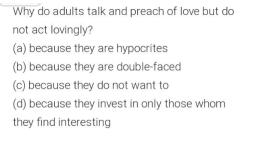
Ans. The poet is curious to know, when did his childhood go., , (d) How did the poet conclude that, Hell and Heaven were imaginary, places?, , Ans. The poet concluded that Hell, and Heaven were imaginary places, because there is no mention of, places like Hell or Heaven in any, geographical books., , (e) What is ‘ antithesis '? In which line, has this poetic device been used?, Ans. When two opposite words are, used together in a sentence, it is, called antithesis. This poetic device, has been used in the third line of the, stanza- Hell and Heaven’., , B. When did my childhood go?, , Was it the time | realised that adults, were not, , all they seemed to be,, , They talked of love and preached of, love,, , But did not act so lovingly,, , Was that the day!, , (a) What does the poet realise?, Ans. The poet realises that the adults
Page 3 :
are not what they seem to be., , (b) Why is the poet confused?, , Ans. The poet is confused because, he does not seem to understand, when he lost his childhood., , (c) Explain, ‘ But did not act so, lovingly «., , Ans. It means that adults talk about, love but their actions are not loving., , (d) What does the poet think about, adults?, , Ans. According to the poet, adults are, full of hypocrisy., , (e) What does the poet think about, the preaching and practice of adults?, Ans. The poet thinks that the, preaching and practice of adults are, contradictory., , C. When did my childhood go?, Was it when | found my mind was, really mine,, , To use whichever way | choose,, Producing thoughts that were not, those of other people,, , But my own, and mine alone, , Was that the day!
Page 4 :
(a) Explain, ‘ my mind was really, mine., , Ans. It means that the poet's mind, was not influenced by others., , (b) What does the poet realise?, Ans. The poet realises that his, , mind is his and he has his own, individuality., , (c) What do you think is the most, important step towards adulthood?, Ans. Having an independent mind, free from any outside influence, is, the most important step towards, adulthood., , (d) How did the realisation of being, the master of his own mind help the, poet?, , Ans. The realisation of being the, master of his own mind made the, poet self - confident., , (e) How has the poet become, independent now?, , Ans. The poet has gained, individuality in his own thoughts., Thus, he became independent.
Page 5 :
D. Where did my childhood go?, , It went to some forgotten place face,, That's a hidden in an infant's face,, That's all | know., , (a) What is the poet poet's is curious, to know in the above stanza?, , Ans. The poet is curious to know, where did his childhood go., , (b) Where did the poet's childhood, go?, , Ans. The poet's childhood went to, some forgotten or unknown place., , (c) Where does the poet think that his, childhood is hidden?, , Ans. The poet thinks that his, childhood is hidden in an infant's, face., , (d) What does the first line of the, above stanza indicate?, , Ans. The first line indicates a shift in, the thoughts of a growing child., , (e) Which poetic device has been, used in the second line of the, stanza?, , Ans. 'Personification’ has been used, in the second line of the stanza.