Page 1 :
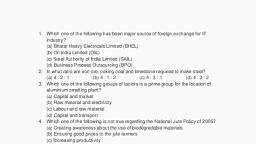
CHAPTER 6: MANUFACTURING INDUSTRIES, Manufacturing: Production of goods in large quantities after processing the raw materials into more valuable products is called manufacturing., Importance of Manufacturing, Or, “The economic strength of a country is measured by the development of manufacturing industries”. Justify this statement with four examples., Or, Explain why the manufacturing sector is considered the backbone of development in general and economic development in particular. Give four reasons., Manufacturing industries help in modernizing agriculture; which forms the backbone of our economy., Apart from this, manufacturing industries also reduce the heavy dependence of people on agricultural income. This becomes possible because of creation of new jobs in secondary and tertiary sectors., Industrial development helps in eradication of unemployment and poverty., It help in reducing regional disparities. That is why gov. tries to open more and more manufacturing industry in tribal and backward area., Export of manufactured goods expands trade and commerce and brings in much needed foreign exchange., A country with high level of manufacturing activities becomes prosperous., Agriculture and industry are complementary to each other. How?, Or, “Agriculture and industry are not exclusive of each other. They move hand in hand.” Justify this statement with examples., Ans. Agriculture and industry both depend on each other Agriculture supplies-raw material for the manufacturing industries. Shortage of these raw materials can spell doom for the industry. Agriculture gets its basic inputs form the manufacturing industries. In this way agriculture offers a big market for industrial products, fertilizers, water pumps, tractors, farm equipment etc. In short agriculture and industry are not exclusive of each other they more hand in hand., How our industries will be able to compete in the international market in the present day world of globalization?, Ans. Our industry needs to be more efficient and competitive. Self-sufficiency alone is not enough. Our manufactured goods must be at par in quality with those in the international market. Only then, will we be able to compete in the international market., Contribution of Industry to National Economy, The share of manufacturing sector in the GDP (Gross Domestic Product) has been stagnant at 17% over the last two decades. The total contribution of industry to the GDP is 27% out of which 10% comes from mining, quarrying, electricity and gas., The growth of the manufacturing sector had been 7% in the last decade. Since 2003, the growth rate has been 9 to 10% per annum. The desired growth rate over the next decade is 12%., The National Manufacturing Competitiveness Council (NMCC) has been set with the objectives of improving productivity through proper policy interventions by the government and renewed efforts by the industry., Factors which are responsible for location of industries, Explain the factors which are responsible for location of industries?, Ans. Industries main purpose is to maximize profits by reducing costs. Therefore industries are located where the costs are minimum. The factors influencing are:, PHYSICAL FACTORS, Availability of raw materials : This factor is specially important in case of raw material based heavy industries like iron and steel and cement. Even in case of sugar mills it is essential that the raw material is available in close proximity., Availability of power resources: Power is basic necessity to run the machinery. Proximity to thermal power and hydro power always attracts more industries., Availability of water: Almost all industries require huge quantity of water. Water cannot be transported over long distances. Availability of water at the site will attract more industries., Favorable Climate : Hostile climatic condition generally deter the prospective entrepreneur while gentle climate invites them for example growing concentration of electronic industry in Bangalore., HUMAN FACTORS, Labor-Availability of skilled and unskilled labor induces more industries. For industries that require plenty of labor, densely populated areas are ideal location, as labor is cheap and abundant in such areas., Market – Proximity to market is essential as transportation involves not only expenditure but also delays. Industries tend to cluster around the areas where a market for the manufactured product exists. Industries producing perishable or fragile goods are usually located near their respective markets so that the product can reach the market with minimum delays or damages., Government Policy -Above all these physical and human factor, the most important factors is the government policy. The enthusiasm and zeal shown by the government in the southern states to attract software industry is a living testimony to the positive role that a government can play in the location of any industry., Transport Facility – An efficient transport network help raw material to reach factories and finished goods to reach markets. Thus, regions that are well connected by transport routes are ideal sites for industries. Coastal location with shipping facilities is particularly suitable for industries using imported raw material or producing goods for export., Capital - Every industry need capital for purchasing machines, power and raw materials, and also for paying wages and meeting transportation costs. Areas where money is locally available and people are willing to invest in industries are, therefore, ideal locations for industries., Why do industries tend to locate themselves near cities or urban centers?, Ans. Some industries tend to locate near urban centers because of:, i. Cities provide markets., ii. Cities provide services such as banking, insurance, transport, labor, consultants and financial advice, etc. to the industry., iii. In the pre-Independence period, most manufacturing units were located in urban places from the point of view of overseas trade such as Mumbai, Kolkata, Chennai, etc., Agglomeration economies, What do you mean by agglomeration economies?, Ans. Industries are located near urban areas. Many industries tend to come together to make use of the advantages offered by the urban centers known as agglomeration economies., Classification Of Industries:, On the basis of raw materials:, Agro Based Industries: Cotton, woolen, jute, silk textile, rubber, sugar, tea, coffee, etc., Mineral Based Industries: Iron and steel, cement, aluminium, petrochemicals, etc., According to their main role:, Basic or Key Industries: These industries supply their products or raw materials to manufacture other goods, e.g. iron and steel, copper smelting, aluminium smelting., Consumer Industries: These industries produce goods which are directly used by consumers, e.g. sugar, paper, electronics, soap, etc., On the basis of capital investment:, Small Scale Industry: If the invested capital is up to Rs. one crore, then the industry is called a small scale industry., Large Scale Industry: If the invested capital is more than Rs. one crore, then the industry is called a large scale industry., On the basis of ownership:, Public Sector: These industries are owned and operated by government agencies, e.g. SAIL, BHEL, ONGC, etc., Private Sector: These industries are owned and operated by individuals or a group of individuals, e.g. TISCO, Reliance, Mahindra, etc., Joint Sector: These industries are jointly owned by the government and individuals or a group of individuals, e.g. Oil India Limited., Cooperative Sector: These industries are owned and operated by the producers or suppliers of raw materials, workers or both. The resources are pooled by each stakeholder and profits or losses are shared proportionately. AMUL which is milk cooperative is a good example. The sugar industry in Maharashtra is another example., Based on the bulk and weight of raw materials and finished goods:, Heavy Industries: Iron and steel., Light Industries: that use light raw materials and produce light goods such as electrical industries., AGRO BASED INDUSTRIES, Textile Industry (It’s Importance), Q.9 Why the textile industry occupies unique position in the Indian economy?, It contributes 14 percent to industrial production., It provides and generates employment for 35 million persons directly., It earns 25 per cent of foreign exchange., It contributes 4 per cent towards GDP., It is the only industry in the country, which is self-reliant and complete in the value chain i.e., from raw material to the highest value added products., Cotton Textiles:, History of Cotton Textiles industry in India, In ancient India, cotton textiles were produced with hand spinning and handloom weaving techniques. After the 18th century, power-looms came into use., Our traditional industries suffered a setback during the colonial period because they could not compete with the mill-made cloth from England., The first successful textile mill was established in Mumbai in 1854., In the early years, the cotton textile industry was concentrated in the cotton growing belt of Maharashtra and Gujarat. Availability of raw cotton, market, transport including accessible port facilities, labor, moist climate, etc. contributed towards its localization., Importance of cotton textile industry in India, Q.14 State the importance of cotton textile industry in India., Cotton textile industry has close links with agriculture., It provides a living to farmers, cotton boll pluckers and workers engaged in ginning, spinning, weaving, dyeing, designing, packaging, tailoring and sewing., The handspun khadi provides large scale employment to weavers in their homes as a cottage industry., This industry creates demands and supports many other industries, such as, chemicals and dyes, mill stores, packaging materials and engineering works., India exports yarn to Japan. Other importers of cotton goods from India are U.S.A., U.K., Russia, France, East European countries, Nepal, Singapore, Sri Lanka, and African countries., India has the second largest installed capacity of spindles in the world, next to China., Drawbacks and problems of cotton textile industry in India, Q.16 Mention the major drawbacks and problems of cotton textile industry in India., The world trade of cotton yarn (25%) is much larger than the trade of cotton garments (4%)., Our spinning mills are competitive at the global level but the weaving, knitting and processing units cannot use much of the high quality yarn that is produced in the country., Most of the textile production is in fragmented small units, which cater to the local market., Many of our spinners export cotton yarn while apparel/garment manufactures have to import fabric. We need to import good quality staple cotton., Power supply is erratic., Machinery needs to be upgraded in the weaving and processing sectors in particular., Low output of labor and stiff competition with the synthetic fiber industry., Q.10 How was the cotton textiles produced in ancient India?, Ans. In ancient India, cotton textiles were produced with hand spinning and handloom weaving techniques. After the 18th century, power-looms came into use., Q.11 Why our traditional cotton textile industries suffered a setback during colonial rule?, Ans. Our traditional industries suffered a setback during the colonial period because they could not compete with the mill-made cloth from England., Q.12 When was the first textile mill established in India?, Ans. The first successful textile mill was established in Mumbai in 1854., Q.13 Why in early years the cotton textile industry was concentrated in the states of Gujarat and Maharashtra?, Ans. In the early years, the cotton textile industry was concentrated in the cotton growing belt of Maharashtra and Gujarat. Availability of raw cotton, market, transport including accessible port facilities, labor, moist climate, etc. contributed towards its localization., Q.15 Give two differences between spinning and weaving of cotton yarns in India., Ans. Spinning and weaving are the two important component of cotton textile industry:, i. While spinning continues to be centralized in Maharashtra, Gujarat and Tamil Nadu, weaving is highly decentralized in other states., ii. India has world class production in spinning, but weaving supplies low quality of fabric., Jute Textiles, Importance of jute textile industry in India, Q.State the importance of jute textile industry in India., i. The jute industry supports 2.61 lakh workers directly., ii. It also supports another 40 lakhs small and marginal farmers who are engaged in, cultivation of jute and mesta., iii. India is the largest producer of raw jute and jute goods and stands at second place, as an exporter after Bangladesh., Why most of our jute mills are located along the banks of the Hugli River in West Bengal?, Ans. Factors responsible for their location in the Hugli basin are:, i. Proximity of the jute producing areas,, ii. Inexpensive water transport,, iii. Support of a good network of railways, roadways and waterways to facilitate, movement of raw material to the mills,, iv. Abundant water for processing raw jute,, v. Cheap labour from West Bengal and adjoining states of Bihar, Orissa and Uttar, Pradesh., vi. Kolkata as a large urban centre provides banking, insurance and port facilities for, export of jute goods., The challenges faced by the jute industry in India, Q.What are the challenges faced by the jute industry in India?, i. Stiff competition in the international market from synthetic substitutes., ii. Stiff competition from other competitors like Bangladesh, Brazil, Philippines, Egypt and Thailand., iii. The internal demand needs to be increased; however it has increased recently due, to the Government policy of mandatory use of jute packaging., iv. There is urgent need to increase the jute productivity and the quality., v. The jute farmer needs to get good prices for their jute crops., vi. The yield per hectare needs to be improved., vii. To stimulate demand the jute products needs to be diversified., What are the objectives of the National Jute Policy formulated in 2005?, Ans. The National jute policy was formulated in 2005 for:, i. Increasing jute productivity,, ii. Improving its quality,, iii. Ensuring good prices for crops to the jute farmers, iv. Enhancing the yield per hectare of jute crops., Name any four countries to which we export Jute products., Ans. The main markets are U.S.A., Canada, Russia, United Arab Republic, U.K. and, Australia., Sugar Industry, FECT : INDIA IS THE 2ND LARGEST PRODUCER OF SUGER ,BUT IT OCCUPY 1ST POSITION IN THE PRODUCTION OF GUR AND KHANDSARI., Q.Explain the factors which influence the location of sugar industry in India., Or, Explain why 60% of sugar mills are located in Uttar Pradesh and Bihar., Ans. Sugar industry is located in the sugarcane growing regions because:, i. The raw material (sugarcane) used in this industry is bulky and difficult to, transport at low costs., ii. The sucrose content in the sugarcane reduces during its transportation., iii. Cooler climates allows the longer crushing season., iv. Sugar industry is ideally suited for cooperative sector because it’s a seasonal, industry., v. Sugarcane grows well during hot and humid climates only., vi. Most of the Sugar mills in the country are in two states of Uttar Pradesh and Bihar. Other important states are Maharashtra, Karnataka, Tamil Nadu, Andhra Pradesh and Gujarat., Why the sugar industry is ideally suited to the cooperative sector?, Ans. The sugar industry is seasonal in nature so, it is ideally suited to the cooperative sector. Crushing of sugarcane is limited to days which are cooler and sugarcane grows well during hot and humid climates only., Why in recent years the sugar mills have shifted to southern and western states?, Ans. The sugar mills in recent years have shifted and concentrated in the southern and, western states, especially in Maharashtra, This is because -, i. The cane produced here has higher sucrose content., ii. The cooler climate also ensures a longer crushing season., iii. The cooperatives are more successful in these states., What are the major challenges faced by the sugar industry in India?, Ans. The major challenges include:, i. The seasonal nature of the industry,, ii. Old and inefficient methods of production,, iii. Transport delay in reaching cane to factories, iv. The need to maximize the use of baggase.( baggase mean- the dry pulpy residue left after the extraction of juice from sugar cane.), MINERAL BASED INDUSTRY, Iron and Steel Industry, Why the iron and steel industry is called the basic industry?, Ans. The iron and steel Industry is the basic industry because:, i. All the other industries — heavy, medium and light, depend on it for their machinery., ii. Steel is needed to manufacture a variety of engineering goods, construction material, defence, medical, telephonic, scientific equipment and a variety of consumer goods., Why the iron and steel industry is called the heavy industry?, Ans. Iron and steel is called a heavy industry because all the raw materials as well as finished goods are heavy and bulky. It involves heavy transportation costs., Name the raw material needed to produce the steel., Ans. Iron ore, coking coal and lime stone are required in the ratio of approximately 4: 2: 1. Some quantities of manganese, are also required to harden the steel., PRODUCTION AND CONSUMPTION OF STEEL, Production and consumption of steel is often associated with the development of the country., India’s rank is 9th in world crude steel production .However it is the largest producer of SPONG IRON.( Sponge iron is a metallic product produced through direct reduction of iron ore in the solid state. It is a substitute for scrap and is mainly used in making steel through the secondary route. The process of sponge iron making aims to remove the oxygen from iron ore. ), China is the largest producer and consumer of steel., Inspite of large quantity of production of steel ,per capita consumption per annum is only 32 kg.why?, Ans. Because india has so far only 10 primary integrated steel plant and rest are mini steel plants., Give one point of difference between mini and integrated steel plants., Ans. Mini steel plants are smaller, , use steel scrap and sponge iron. They produce mild and alloy steel of given specifications., An integrated steel plant is large, handles everything in one complex – from putting together raw material to steel making, rolling and shaping. E.g SIAL , TISCO, Explain why most the iron and steel industry are concentrated in Chotanagpur plateau region., Ans. Chotanagpur region has relative advantages such as:, i. This region is rich in the raw material needed to produce the steel such as iron ore, coal, limestone, etc., ii. These raw material are heavy and bulky therefore difficult and costly to transport to the plant., iii. This region has well connected railway lines which offer easy transportation of the finished products for their distribution to the markets and consumers., iv. This region gets its power supply from Damodar valley., v. Availability of cheap labour from surrounding regions., Explain why India is not able to produce steel as per its full potential., Ans. Though, India is an important iron and steel producing country in the world yet, we are not able to perform to our full potential largely due to:, (a) High costs and limited availability of coking coal, (b) Lower productivity of labour, (c) Irregular supply of energy and, (d) Poor infrastructure., What should be done to reach full potential ?, Ans – 1.support FDI in the sector, 2.involve more and more research and development in the sector., Automobile Industry, Which factors lead to the growth in the Automobiles industry of our country?, Ans. Automobile industry expanded in last 15 years due to:, i. New economic policy of Liberalization., ii. Coming in of new and contemporary models., Liberalization and the coming of new and contemporary models stimulated the demand for vehicles in the market., iii. Foreign Direct Investment brought in new technology., iv. Industry is now globalised., At present, there are 15 manufacturers of passenger cars and multi-utility vehicles, 9 of commercial vehicles, 14 of the two and three-wheelers. The industry is located around Delhi, Gurgaon, Mumbai, Pune, Chennai, Kolkata, Lucknow, Indore, Hyderabad, Jamshedpur and Bangalore, Information Technology and Electronics Industry, Which city of India is known as the electronic capital of India?, Ans. Bangalore., Name the products of electronic industry., Ans. The electronics industry covers a wide range of products from transistor sets to television, telephones, cellular telecom, pagers, telephone exchange, radars, computers and many other types of equipment required by the telecommunication industry., What are software technology parks?, Ans. The software technology parks provide single window service and high data communication facility to software experts., What is the significance of IT industry?, Ans. The significance of IT industry can be judged by:, i. It is the major employment generating industry of India. Upto 31 March 2005, the IT industry employed over one million persons. This number is expected to increase eight-fold in the next 3 to 4 years., ii. It is encouraging to know that 30 per cent of the people employed in this sector are women. iii. This industry has been a major foreign exchange earner in the last two or three years because of its fast growing Business Processes Outsourcing (BPO) sector., Industrial Pollution and Environmental Degradation, Name the four types of pollution caused by industries., Ans. Industries are responsible for four types of pollution: (a) Air (b) Water (c) Land (d) Noise., What is air pollution? Explain how air pollution is caused by the industries. What are the effects of air pollution?, Ans. Air pollution is caused by the presence of high proportion of undesirable gases, such as sulphur dioxide and carbon monoxide., Air pollution is caused by, Airborne particulate materials which contain both solid and liquid particles like dust, sprays mist and smoke., Smoke is emitted by chemical and paper factories, brick kilns, refineries and smelting plants, and burning of fossil fuels in big and small factories that ignore pollution norms., Toxic gas leaks can be very hazardous with long-term effects. Example the Bhopal Gas tragedy. Air pollution adversely affects human health, animals, plants, buildings and the atmosphere as a whole., How is water and land pollution caused? Which industries causes the water and land pollution? What are the effects of water and land pollution?, Ans. Water and land pollution is caused by organic and inorganic industrial wastes and affluents discharged into rivers and pits., The main industries which cause water and land pollution are:, paper, pulp, chemical, textile and dyeing, petroleum refineries, tanneries and electroplating industries that let out dyes, detergents, acids, salts and heavy metals like lead and mercury pesticides, fertilisers, synthetic chemicals with carbon, plastics and rubber, etc. into the water bodies., Fly ash, phospo- gypsum and iron and steel slags are the major solid wastes in India., Thermal pollution of water occurs when hot water from factories and thermal plants is drained into rivers and ponds before cooling., The effects are:, Wastes from nuclear power plants, nuclear and weapon production facilities cause cancers, birth defects and miscarriages., Dumping of wastes specially glass, harmful chemicals, industrial effluents, packaging, salts and garbage renders the soil useless., Rain water percolates to the soil carrying the pollutants to the ground and the ground water also gets contaminated, Which industrial units cause noise pollution? What are the effects of noise pollution?, Ans. Main source of noise pollution are:, Industrial and construction activities,, machinery, factory equipment,, generators, saws, pneumatic and electric drills., Noise pollution not only results in irritation and anger, it can also cause hearing impairment, increased heart rate and blood pressure among other physiological effects. Unwanted sound is an irritant and a source of stress., Control of Environmental Degradation, How can the industrial pollution of fresh water be reduced?, Ans. Industrial pollution and degradation can be controlled by:, Minimizing use water for processing by reusing and recycling it in two or more successive stages., Harvesting of rainwater to meet water requirements., Treating hot water and effluents before releasing them in rivers and ponds., Overdrawing of ground water reserves by industry where there is a threat to ground water resources also needs to be regulated legally., Particulate matter in the air can be reduced by fitting smoke stacks to factories with electrostatic precipitators, fabric filters, scrubbers and inertial separators., Smoke can be reduced by using oil or gas instead of coal in factories., Machinery and equipment can be used and generators should be fitted with silencers., Almost all machinery can be redesigned to increase energy efficiency and reduce noise., Noise absorbing material may be used apart from personal use of earplugs and earphones., Explain the three phase of treatment of industrial effluents., Ans. Treatment of industrial effluents can be done in three phases., Primary treatment by mechanical means. This involves screening, grinding, flocculation and sedimentation., Secondary treatment by biological process, Tertiary treatment by biological, chemical and physical processes. This involves recycling of wastewater., Manufacturing Industry: NCERT Solution, Solve the puzzle (given in NCERT Book), Textiles, sugar, vegetable oil and plantation industries deriving raw materials from agriculture are called…, Answer: AGRO-BASED, The basic raw material for sugar industry., Answer: SUGAR CANE, This fibre is also known as the ‘ Golden Fibre’. , Answer:JUTE, Iron-ore, coking coal, and limestone are the chief raw materials of this industry. , Answer: IRON STEEL, A public sector steel plant located in Chhattisgarh., Answer: BHILAI, Railway diesel engines are manufactured in Uttar Pradesh at this place., Answer:VARANASI, Manufacturing Industry: NCERT Solution, Answer the following questions:, Which one of the following industries uses limestone as a raw material., Aluminium, Cement, Sugar, Jute, Answer: (b) Cement, Which one of the following agencies markets steel for the public sector plants?, HAIL, SAIL, TATA Steel, MNCC, Answer: (b) SAIL, Which one of the following industries uses bauxite as a raw material?, Aluminium, Cement, Jute, Steel, Answer: (a) Aluminium, Which one of the following industries manufactures telephones, computer, etc., Steel, Aluminium, Electronic, Information Technology, Answer: (c) Electronic, What is manufacturing?, Answer: Production of goods in large quantities after processing the raw materials into more valuable products is called manufacturing., Name any three physical factors for the location of the industry., Answer: Three physical factors which affect the industrial location are as follows:, Availability of raw materials, Availability of water, Availability of infrastructure, Name any three human factors for the location of an industry., Answer: Three human factors which affect the industrial location are as follows:, Labour, Capital, Market, What are basic industries? Give an example., Answer: The basic industries supply their products or raw materials to manufacture other goods, e.g. iron and steel, copper smelting, aluminium smelting., Name the important raw materials used in the manufacturing of cement?, Answer: Limestone, silica, alumina and gypsum, How are integrated steel plants different from mini steel plants? What problems does the industry face? What recent developments have led to a rise in the production capacity?, Answer: An integrated steel plant does all the activities involved in the value chain of steel manufacturing. Such plant begins from making steel from iron ore and end up in making steel products which are needed by the industry. Mini steel plants, on the other hand, buy finished steel from larger plants and produce various goods from that; like utensils, tools, etc., How do industries pollute the environment?, Answer: Industries mainly pollute the air and water. Factories emit smoke which contains harmful gases. These gases cause air pollution. Factories produce effluents and release them into rivers and pond. Thus, water pollution is cause by factories. Many factories; like thermal power plant; also cause thermal pollution of water by releasing hot water into rivers and ponds. Additionally, factories also play a major role in soil pollution., Discuss the steps to be taken to minimise environmental degradation by industry?, Answer:Preventing Environmental Degradation by Industry:, Water should be reused and recycled in the industry. This will help in minimizing the use of freshwater., Rainwater harvesting should be promoted., Hot water and effluents should be treated before being released in rivers and ponds., Chimneys should be fitted with electrostatic precipitators to prevent release of suspended particulate matters.