Page 1 :
SUBJECT: CHEMISTRY, , DAY – 5, , HYBRIDISATION, , Q.1) Hybridization is due to the overlapping of, a) Orbitals of different energy levels, b) Orbitals of different energy content, c) Orbitals of same energy content, Q.2), , The bond angle is minimum in, a) H2Te, , Q.3), , d) None of the above, , b) H2Se, , c) H2O, , d) H2S, , The two types of bonds present in B2H6aer covalent and, a) Three centre bond b) Hydrogen bond c) Two centre bond d) None of the above, , Q.4), , The number of unpaired electrons in O2 molecule is, a) 0, , Q.5), , c) CH4, , d) PH3, , b) Non-planar, , c) Spherical, , d) Linear, , b) sp2hybridized, , c) sp hybridized, , d) unhybridized, , Which one has sp2-hybridization?, a) CO2, , Q.9), , b) HI, , The two carbon atoms in acetylene are, a) sp3hybridized, , Q.8), , d) 3, , The structure of H2O2 is, a) Planar, , Q.7), , c) 2, , In which compound, the hydrogen bonding is the strongest in its liquid phase, a) HF, , Q.6), , b) 1, , b) N2O, , c) SO2, , d) CO, , Which species do not have sp3 hybridization?, a) Ammonia, , b) Methane, , c) Water, , d) Carbon dioxide, , Q.10) The structure of PF5 molecule is, a) Tetrahedral, , b) Trigonal bipyramidal, , c) Square planar, , d) Pentagonal bipyrmidal, , Q.11) In diborane, the H – B – H bond angle is 1200. The hybridization of boron is likely to be, a) sp, , b) sp2, , c) sp3, , d) dsp2

Page 2 :
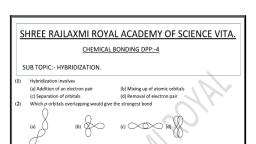
Q.12) Shape of XeF4 molecule is, a) Linear, , b) Pyramidal, , c) Tetrahedral, , d) Square planar, , Q.13) The shape of IF7 molecule is, a) Octahedral b) Pentagonal bipyramidal c) Trigonal bipyramidal, , d) Tetrahedral, , Q.14) The molecule of CO2 has 1800 bond angle. It can be explained on the basis of, a) sp3 hybridisation b) sp2 hybridisation c) sp hybridization d) d2sp3 hybridisation, Q.15) Compound formed by sp3d hybridization will have structure, a) Planar, , b) Pyramidal, , c) Angular, , d) Trigonal bipyramidal, , Q.16) Among the following compounds which is planar in shape, a) Methane, , b) Acetylene, , c) Benzene, , d) Isobutene, , Q.17) Hybridisation involves, a) Addition of an electron pair, , b) Mixing up of atomic orbitals, , c) Removal of an electron pair, , d) Separation of orbitals, , Q.18) XeF2 involves hybridization, a) sp3, , b) sp3d, , c) sp3d2, , d) None of these, , Q.19) Compound having planar symmetry is, a) H2SO4, , b) H2O, , c) HNO3, , d) CCL4, , Q.20) Q.20) Number of shared electrons in between carbon-carbon atoms is ethylene molecule is, a) 2, , b) 4, , c) 6, , d) 3, , Q.21) Which of the following molecules has trigonal planar geometry?, a) IF3, , b) PCl3, , c) NH3, , d) BF3, , Q.22) The geometry and the type of hybrid orbital present about the central atom in BF3 is, a) Linear, sp, , b) Trigonal planar, sp2, , c) Tetrahedral, sp3, , d) Pyramidal, sp3, , Q.23) Be in BeCl2 undergoes, a) Diagonal hybridization, , b) Trigonal hybridization, , c) Tetrahedral hybridization, , d) No hybridization, , Q.24) The bond angle in water molecule is nearly or Directed bonds in water forms an angle of, a) 1200, , b) 1800, , c) 1090 28’, , d) 1040 30’, , Q.25) When two pairs of electrons are shared, bond is?, a) Single covalent bond, , b) Double covalent bond, , c) Dative bond, , d) Triple bond
Page 3 :
Q.26) sp3d2 hybrid orbitals are, a) Linear bipyramidal, , b) Pentagonal, , c) Trigonal bipyramidal, , Q.27) Carbon atoms in diamond are bonded to each other in a configuration, a) Tetrahedral, , b) Planar, , c) Linear, , d) Octahedral, , Q.28) In benzene, all the six C – C bonds have the same length because of, a) Tautomerism b) sp2 hybridization c) Isomerism d) Inductive effect, Q.29) The nature of hybridization in the NH3 molecule is, a) sp, , b) sp2, , c) sp3, , d) sp3d, , Q.30) The geometry of the molecule with sp3d2 hybridised central atom is, a) Square planar, , b) Trigonal bipyramidal, , c) Octahedral, , d) Square pyramidal, , d) Octahedral
Page 4 :
Answer key:, Q.1) c, Q.2) a, Q.3) a, Q.4) c, Q.5) a, Q.6) b, Q.7) c, Q.8) c, Q.9) d, Q.10) b, Q.11) c, Q.12) d, Q.13) b, Q.14) d, Q.15) d, Q.16) c, Q.17) b, Q.18) b, Q.19) c, Q.20) b, Q.21) d, Q.22) b, Q.23) a, Q.24) d, Q.25) b, Q.26) d, Q.27) a, Q.28) b, Q.29) c, Q.30) c