Page 1 :
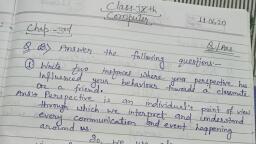
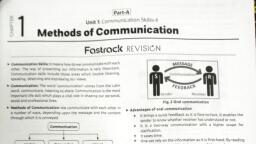
CLASS IX, , SUB IT, , Communication Skills, Introduction, Communication skills are those skills which are needed to speak and write properly. A person who is able, to speak appropriately whilst maintaining eye contact with the audience, uses varied vocabulary and, articulate speech to suit the need of the audience is generally said to be an effective speaker. Similarly, an, effective writer should be able to use written words in various styles and techniques to communicate, his/her message and ideas to the readers. One should have the ability to listen carefully and write and, speak clearly in any situation. Therefore good reading, writing, speaking and listening skills are essential for, effective communication., As a student, you may study any language, but it is important that you are able to read, write, speak and, listen well in order to communicate properly. Speaking more than one language can help you to, communicate well with people around the world. Learning English can help you to communicate with, people who understand English besides the language you have been exposed to speaking the language, from easly childhood, for example, your mother tongue. In the present time, a thorough knowledge of the, language with communication skills is very important in any occupation or to set up a business., The word ‘Communication’ comes from the Latin word commūnicāre, meaning ‘to share’., Importance of communication, Your ability to communicate clearly and share thoughts, feelings and ideas will help you in all your, relationships. Communication skills are needed to:, � Inform: You may be required to give facts or information to someone. For example,, communicating the timetable of an exam to a friend., � Influence: You may be required to influence or change someone in an indirect but usually, important way. For example, negotiating with a shopkeeper to reduce the price or helping a friend, to overcome stress due to exam or any other reason., � Express feelings: Talking about your feelings is a healthy way to express them. For example,, sharing your excitement about doing well in your exams or sharing your feelings with your parents, and friends., Elements of communication, Communication is a two-way exchange of information, i.e., giving and receiving (Fig. 1.2). Speaking and, writing to someone are examples of giving information. Reading and listening to someone are examples of, receiving information., Perspectives in communication, Perspectives are ideas, views, or fixed ways of thinking. These sometimes affect our communication. For, example, if you have a fixed idea that your teacher or father is strict, even when they are being friendly,
Page 2 :
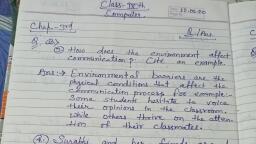
you may think they are scolding you even though they are polite. In the same way, others may also have, fixed ideas about you, which affect whatever you say to them., Factors affecting perspectives in communication, Factor, , How the factor can become a barrier, , Language, , In case of use of incorrect words, unfamiliar language and lack of detail,, language can act as a barrier to communicate what one wishes to convey., For example, language can act as a barrier when an Indian who only knows, Hindi and Chinese who has the knowledge of Mandarin only want to, interact with each other., , Visual Perception, , Visual perception is the brain’s ability to make sense of what we see, through our eyes. For example, completing partially drawn pictures with, visual perception whereas they may be something else., , Past Experience, , Letting our earlier experience stop us from understanding or communicating, clearly. For example, “This shopkeeper cheated me last time. Let me be, careful or “I scored low marks in my Maths exam, so I am scared to ask and, answer questions in class.”, , Prejudice, , Fixed ideas, such as thinking “No one in my class likes me” may stop a, student from communicating openly in the class., , Feelings, , Our feelings and emotions, such as lack of interest or not trusting the other, person affect communication. For example “I am not feeling well, therefore,, I don’t want to talk.”, , Environment, , Noise or disturbance in the surroundings may make communication difficult., Example, talking to a friend in a function where there is loud music being, played by the orchestra., , Personal factors, , Personal factors include your own feelings, habits and ways of thinking., For example, fear, and low confidence may make communication difficult., , Culture, , Signs’ which have a different meaning in different cultures, such as showing, a thumb may mean ‘good job’ done for some people but may be insulting to, others., , Effective communication, Effective communication can happen if we follow the basic principles of professional communication skills., These can be abbreviated as 7 Cs, i.e., Clear, Concise, Concrete, Correct, Coherent, Complete and, Courteous.
Page 3 :
There are different methods of communication, which include non-verbal, verbal and visual., Session 2: Verbal communication, , Verbal communication is the sharing of information by using words. It is what most people use as, a method of communication. Verbal communication is important because if you do not use the, right words, you will cause confusion and you will not be able to communicate what you want., The important forms of verbal communication are given below., Type of Verbal Communication, � Oral or Spoken Communication: Communication which involves talking Face-to-face, conversation: When you can see the listener. For example, group discussion, talking to, family member at home, conversation with public through speeches, etc., � Written Communication: Communication which involves written or typed words. Writing letters, notes,, email, etc. SMS (Short Message Service): These can be sent through a phone to a person or a group., Advantages of verbal communication, Verbal communication is easy and quick. You can say what you want and get a quick response. It is an easier, form of communication when you have to exchange ideas. You keep changing your communication as per the, other person’s reply., Disadvantages of verbal communication, The most common disadvantage of verbal communication is the cultural differences between the sender and, receiver of the information. These differences may be due to the use of different languages, inability to, understand the colloquial phrases used by the other individual, and the accent. Since verbal communication, depends on words, sometimes the meanings become confusing and difficult to understand if the right words are, not used., Public speaking, Speaking in front of a large group makes most people nervous. You can use the 3Ps (Prepare, Practice, Perform), method to get over your fears, and become a confident and effective speaker., 3Ps of Public Speaking, Prepare, , Practice, , Perform, , Think about your topic, Think about what your listeners need to know about the topic, Think about the best way to make your listeners understand your topic, Write what you plan to say, Practice by yourself first, talk in front of a mirror, Talk in front of your family and friends and ask them what they think, Speak clearly, loudly and at the right speed (not very fast nor very slow), Take a few deep breaths if you are feeling nervous, Think about what you have prepared and start speaking confidently, , Check Your Progress
Page 4 :
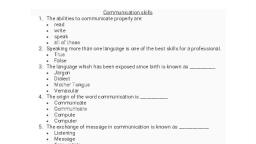
A., , Multiple choice questions, , Read the questions carefully and circle the letter (a), (b), (c) or (d) that best answers the question., 1., , What is the purpose of communication?, , (a), , Inform (tell someone about something), , (b), , Influence (get someone to do something you want), , (c), , Share thoughts, ideas, feelings, , (d), , All of the above, , 2., , Which of the following methods are used to receive information from the sender through a letter?, , (a), , Listening, , (b), , Speaking, , (c), , Reading, , (d), , Writing, , 3., , How do you receive information on phone?, , (a), , Listening, , (b), , Speaking, , (c), , Reading, , (d), , Writing, , 4., , Choose the correct example of oral communication., , (a), , Reports, , (b), , Newspapers, , (c), , Face-to-face conversation, , (d), , Notes, , 5., , When we communicate verbally, we should use ., , (a), , difficult words, , (b), , simple words, , (c), , confusing words, , (d), , abbreviations
Page 5 :
6., , Why do we send emails?, , (a), , To reach on time, , (b), , To share documents and files, , (c), , To talk to each other, , (d), , To meet each other, , B., , Match the columns, , Column A:, , Column B:, , Communication Barriers, , Examples, , 1. Language, , A. Trying to read a book when somebody else is watching TV in the same, room., , 2. Emotional, , B. In some cultures, wearing shoes and walking inside the kitchen is, considered rude and disrespectful., , 3. Environmental, , C. Talking in Hindi when others know only Tamil., , 4. Cultural, , D. Parent is not talking to the child., , C., , Short answer question, , 1., , Write down the seven factors affecting perspectives in communication., , 2., , Give an example of the following:, (a) Clear communication, (b) Complete communication, , 3., , Write down the different types of verbal communication. Give an example for each type.