Page 1 :
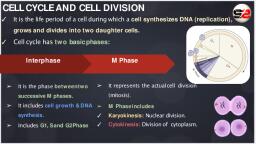
Cell Cycle and Cell Division, Phases of Cell Cycle, Cell Cycle, •, , The sequence of events by which a cell duplicates its genome, synthesises other cell, constituents, and eventually divides into two daughter cells., , •, , The events of the cell cycle are under genetic control., Phases of Cell Cycle, , •, , Duration of the cell cycle varies from organism to organism, and from cell to cell., Duration of the cell cycle in humans is 24 hrs, and in yeast is 90 min., , •, , Phases of the cell cycle are:, , •, , Interphase represents the phase during which a cell prepares itself for division, grows, and DNA is replicated in it. Interphase occupies more than 95% of the duration of the, cell cycle., , •, , It is divided into three phases − G1, S and G2., , •, , G1 (Gap 1) phase is the phase between the end of mitosis and the initiation of DNA, replication. The growth of the cell takes place in this phase.
Page 2 :
•, , S (synthesis) phase is the phase of DNA replication. DNA content doubles (from 2C to, 4C), but chromosome number remains the same. (remains diploid; 2n only). In this, phase, the centriole also duplicates in animal cells., , •, , G2 (Gap 2) phase is the phase in which the proteins needed for mitosis are, synthesised. Cell growth continues in this phase., , •, , G0 phase is the quiescent stage in which the cells that do not divide further enter after, exiting from the G1 phase. In this phase, the cells do remain metabolically active, but do, not proliferate unless required., , •, , M phase represents the phase where the cell actually divides. It starts with nuclear, division and ends with the division of the cytoplasm., Significance of Cell Division, , •, , It is the mean of asexual reproduction in unicellular organisms., , •, , It is essential for the growth of a single celled zygote into a whole new multicellular, organism., , •, , It helps in the repair of injuries and worn out tissues., , •, , It replaces dead cells of the body and thus is essential for growth of organism.
Page 3 :
•, , In sexual reproduction, meiosis occurs. This type of cell division not only results in, production of gametes, but also brings new combinations of genes, thus resulting in, variations among a population. This also leads to evolution of a species., , Mitosis - Events and Significance, Mitosis (M Phase), •, , Also called equational division as number of chromosomes in parent and progeny, remain the same, , •, , Mitosis (M phase) is divided into 4 stages., , •, , Prophase (1st stage), , •, , Metaphase, , •, , Anaphase, , •, , Telophase (Last stage), , Phase, , Prophase, , Characteristic features, , → Follows S and G2 phases of interphase, → Chromosome material condenses and untangles., → Centriole, duplicated during S phase, starts moving towards, opposite poles., → Mitotic spindle starts assembling., → Microtubules appear., , Metaphase, , → Chromosomes condense completely., → Sister chromatids held together by centromere
Page 4 :
→ At the surface of centriole, kinetochore appears. Here,, spindle fibres attach., → Chromosomes lie at centre (equator) with each sister, chromatid attached to spindle fibre of their respective poles with, the help of kinetochore. [The plane of alignment of the, chromosomes at metaphase is called Metaphase plate], , Anaphase, , → Here, chromosome splits and daughter chromatids separate., → Chromatids move towards opposite poles., → Centromere leads and arms follow., , Telophase, , → Chromosomes reach at opposite poles., → Chromosomes start losing their individuality., → Chromatin material collects at poles., → Nuclear envelope appears around chromosome clusters., → Cell organelles such as ER, Golgi complex, etc reappear., → This phase is followed by interphase of next cycle., , Cytokinesis, •, , Cyto (cell) kinesis (division) follows the process of karyokinesis (nuclear division)., , •, , Process of cytokinesis in plant cell:, , •, , New cell wall begins to form with precursor cell plate equivalent to middle lamella.
Page 5 :
•, , This new cell wall grows outwards., , •, , Organelles such as mitochondria and plastids also get distributed between two daughter, cells at the same time., , •, , Process of cytokinesis in animal cell:, , •, , Furrow appears in the cell membrane., , •, , This furrow deepens and joins in the centre to divide the cytoplasm into two., , •, , If cytokinesis does not follow karyokinesis, then cell becomes multinucleate, leading to, the formation of syncytium., Significance of mitosis, , •, , Results in formation of diploid genetically identical daughter cells, , •, , Growth in multicellular organisms takes place by mitosis., , •, , Cell repair and replacement of worn out tissues, , •, , Maintenance of nucleo-cytoplasmic ratio, , •, , Vegetative reproduction in plants takes place by mitosis., , Meiosis, •, , Specialized kind of cell division that reduces the chromosome number by half (thus, called reductional division) resulting in production of haploid daughter cells (gametes), , •, , Haploid gametes fuse in sexual reproduction to give rise to diploid cells., , •, , Meiosis I starts after DNA has been replicated in S phase. Meiosis I is followed by, meiosis II at the end of which four haploid cells are formed., Meiosis I, , •, , Meiosis I is divided into 4 phases.
Page 6 :
•, , Prophase I − longest phase and is further sub-divided into 5 phases, , •, , Leptotene − Condensation makes chromosomes become distinct and compact., , •, , Zygotene − Homologous chromosomes start pairing together by a process, called synapsis to form a complex structure called synaptonemal complex. Two, synapsed homologous chromosomes form a complex called bivalent or tetrad., , •, , Pachytene − Longest phase of prophase I, Recombination nodules appear in this stage at the sites where crossing over has to take, place between non-sister chromatids of homologous chromosomes., , Actual reason for genetic difference in progenies, Crossing is mainly responsible for the genetic difference. Crossing over is the, exchange of genetic material between two homologous chromosomes with the help of, enzyme recombinase. It results in recombinant homologous chromosomes., , •, , Diplotene − Synaptonemal complex dissolves and recombinants separate from each, other except at crossover sites to form X-shaped structure called chiasmata., , •, , Diakinesis − Chiasmata terminalises and chromosomes condense. Meiotic spindle, assembles and nucleolus and nuclear envelope disappear., , •, , Metaphase I − Bivalent chromosomes align on the equatorial plate and spindle fibres, appear and attach to the homologous chromosomes., , •, , Anaphase I − Homologous chromosomes separate; sister chromatids remain attached, at their centromeres., , •, , Telophase I − Nuclear membrane and nucleolus reappear. Cytokinesis follows.
Page 7 :
•, , Interkinesis − Stage between meiosis I and meiosis II, , Meiosis II − Resembles Mitosis, •, , Prophase II − Chromosomes become compact and nuclear membrane disappears., , •, , Metaphase II − Chromosomes align on equatorial plate and spindle fibres appear and, attach to kinetochores of sister chromatids., , •, , Anaphase II − Centromere of each chromosome splits and sister chromatids move, towards opposite poles of the cell., , •, , Telophase II − Nuclear envelope reappears and cytokinesis follows, resulting in, formation of a tetrad (4 haploid cells)., , Significance of Meiosis
Page 8 :
•, , It results in reduction of chromosome number by half in gametes, which again doubles, during fertilization. Therefore, it helps to conserve the chromosome number of species, from generation to generation., , •, , Crossing-over, occurring in pachytene stage of meiosis I, is a source of genetic, variability in sexually reproducing organisms., , •, , The variation thus formed serves as the raw material for evolution.