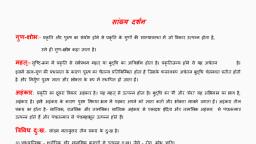
Notes of बी. ए. प्रथम वर्ष, भारतीय - पाश्चात्य दर्शन & दर्शनशास्त्र indian-philosophy-eng.pdf - Study Material
Page 4 :
4, , Indian Philosophy, A RESPECTFUL SUBMISSION, , “Bharathiya Darshan” may appear to be a small book, by ordinary standards but it contains a wealth of revelations about, the absolute principles of the Divine Vedas, which have emanated, verily from the mouth of God Himself. This Book also contains, an accurate description of the real nature of the main ‘Darshanas”, or Visions of Absolute Truths or Systems of Philosophy leading, to direct knowledge of Reality that have originated in the Land, called Bharat. What actually is this Indian Vision of Absolute Truth, or Reality? What are its different manifestations, their respective inherent forms and nature? Which of these have the capacity, to illuminate the truth? In practice, how useful are these systems, of philosophy in day to day life? How does this knowledge of, truth really benefit us in our material as well as spiritual lives?, How essential or relevant is this vision of absolute truth or reality in the present Age? All these questions have been satisfactorily resolved in this little Book. If we read it seated alone in, solitude, we will surely realise how advanced the Science of, Knowledge actually was in India thousands of years ago. These, “Darshanas” contain profound contemplations of the inherent, characteristics and natures of all types of beings starting with the, bodies made up of the five gross-elements and going right up to, the divine nature of the Paramâtma., It is generally accepted that there are 12 main Darshanas, or Systems of Philosophy in Bharat. Of these 6 are categorised, as ‘Nâstik’ or Godless or Atheistic and the other six as ‘Âstik’ or, Theistic. Amongst the Nâstik Darshanas or Visions, the first one
Page 5 :
Indian Philosophy, , 5, , is “Chârvak” which deals only with the Science of the Body. This, particular Darshana was unable to contemplate anything beyond, the body. While expounding the truths, each Darshana after the, other has, to varying degrees, stated that beyond the body there, exist the Mind, the Intellect, the Âtma or the Soul and the, Paramâtma or the Super-Soul. The last Darshana is the “Uttar, Mimâmsa” in which there is a definitive exposition of the true, nature of entities from bodies to the ultimate truth which is the, Paramâtma. In the Jain, the Buddhist and other Darshanas such as, the Nyâya-Vaishesika, the Sânkhya-Yoga and the Purva-Mimâsa, also, the truths concerning entities beginning with bodies and, going gradually right up to the Paramâtma are duly clarified along, with all the intermediate truths., Knowledge of the Truth or Reality is an integral part of, Dharma. If not an integral part, it is an essential principle without, which Dharma cannot remain intact. Hence Dharma is not merely, an external practice or show but it is a sacred code of conduct or, performance or accomplishment which is closely linked with the, Knowledge of Truth. Just as food enables the body’s growth and, development, knowledge of the truth facilitates the growth and, evolution of mind, the intellect, and the knowledge of the Self., The development of the knowledge of the Self to its fullest extent means acquiring knowledge of the fundamental nature of the, Self which leads to the emancipation of the Self., It is only after emancipation of the Self that the Paramâtma, can be attained. The practice of Dharma, the striving for the, Knowledge of the Truth, the emancipation of the Self, and the, final attainment of the Paramâtma are all possible only in the
Page 6 :
6, , Indian Philosophy, , Bharathiya or Indian Darshanas and the Truths expounded therein., The devotee who possesses true knowledge is considered as best, or pre-eminent as per the Srimad Bhagavad Geetha. Bhagavan, Sriswaminarayan, in his “Vachnâmrut” also regards such a devotee as the most excellent. The devotee who truly knows the real, nature the Âtma or the Self and the Paramâtma is called the “Jnâni, Bakht” or the Devotee with True Knowledge. There are many, Tenets or Doctrines in this World but they deal exclusively with, the Science of the Body. They are not even aware of the possible, existence of any entity or concept of truth higher than the gross, body let alone contemplating a search for it. The Indian Darshanâs, contain answers to many such profound questions. The search, for the truth is the final object of the Darshanâs of Truth. The, search for the “I” (the Âtma or the Self) is but the search for the, Paramâtma. What is the nature of the relationship between the, Material World and the Âtma and the Paramâtma? If there be a, relationship, then why has it been broken and how could it be, restored? All such doubts have been clarified through the, Darshanâs. Our Rishis were not only great scholars but also constantly strived for perfection in actual practice. They have not, only spoken about the material word but also dealt with many, things therein which can be obtained after a thorough search. The, Science of the Material World, the Science of the Self and the, Paramâtma have been clearly explained in these Darshanas., In this little Book, we are introduced to the 12 Indian, Darshanâs. We are also acquainted with the religious and philosophical tenets or doctrines of the Âdi Jagadguru (The First World, Teacher) Sri Sankarâcharya, Sri Râmânujâchârya., Sri, Madhvâchârya, Sri Nimbârkâchârya, Sri Vallabhâchârya, Sri
Page 7 :
Indian Philosophy, , 7, , Chaitanya Mahâprabhu Bhagavan, Sri Swaminârayan which are either established and time –tested or are currently being established., We do not feel as much liking for a stranger we have just, met as we do for a person with whom we are well acquainted. In, the same way, until we get to know God properly, God remains a, stranger or an unknown entity and we do not experience any tangible liking for Him. But when the knowledge arises that one, possess such intimate relationships with Him as expressed in, statements such as “My Father-Son”, “Master-Servant” etc, then, one begins to develop love for God. Thus, with the help of, Tattvagyân or Knowledge of the Truth, the relationship between, the devotee and God becomes deeper and more profound. When, the realisation dawns upon the devotee that he is a Servant of, God, that he is a Son of God, then true love for God arises in that, devotee. Therefore, Rishis, Thinkers, Âchâryas and the incarnations of God have all strived to clarify and reveal the true nature, of the relationships between God, the Jiva and the Material World, through these Darshanâs., The Hindu Systems of Knowledge of Truth or Reality are, not just a matter of traditional reverence or blind faith. It is the, end product of the most advanced and lofty thinking, and a unique, special science. The Darshanas contain the fundamental values, of Sanâtana Dharma or the Ancient Eternal Code of Conduct. The, Rishis and Âchâryas who created all these Darshanâs did so out, of their actual first-hand experiences of these Truths. All the, Darshanâs are based on the Vedas. The repeated application in
Page 8 :
8, , Indian Philosophy, , real life of the teachings of the Darshanas facilitates the eventual, understanding of the Vedas with relative ease. In short it may be, said that application of the teachings of the Vedas, the Upanishads, and Holy Texts such as the Sri Geeta and others can only be done, through the repeated practice of the teachings of these Darshanâs., I am hopeful that the readers of this little Book who are, ardent seekers of the Truth will certainly find it useful and further, whatever misconceptions about some Darshana or the other,, which may have formed in their minds, will be removed because, all Doctrines/Tenets (Darshanâs) have been formulated primarily to make human minds fit and capable of understanding the, Truths., Dr Swami Satya prasâd Dâsji, Vedântâchâya, Sri Swaminârâyan Mandir – Bhuj.
Page 11 :
Indian Philosophy, , 11, , Shree Swaminarayano vijayteteram, , H, INDIAN PHILOSOPHY, In the Land of Bharath (India), there are different traditions of religion and philosophy handed down in regular succession. Although the exposition and interpretations of all the, Darshanâs are different from one another, they have a common, goal which is to acquire knowledge of the highest truth and to, attain supreme bliss. All the Darshanas have their own separate, codes of conduct and propriety. Consider a tree which has many, different branches and although they are not all alike, some being, small and some being big, the flavour of all the fruits of that tree, is the same. This is because all the branches have the same roots., In the same way, the roots of all the different Darshanâs are the, Vedâs. Whereas if some Darshanâ contains the direct testimony, of the Vedâs, in some other Darshanâ, we will find the testimony, of the Vedâs in an indirect way through the traditional teachings, handed down in regular succession of Âchâryâs of that order., However, in all the Darshanâs, we find an elaboration of the Vedâs
Page 12 :
12, , Indian Philosophy, , alone. The Vedâs are without beginning and they are eternal., They cannot be comprehended fully by ordinary people. Therefore, from time-to-time, verily God Himself as well as great men, have made efforts to explain the tenets or established truths of, the Vedâs. As a result of their efforts, various Darshana traditions arose and began to be passed down in regular succession., What is the actual form and nature of these Darshanâs? How did, they arise and become prevalent and how did they expand and, spread? Who were responsible for this?, It is necessary to know all this. For this purpose a proper, study of the Scriptures together with instruction by a Guru are, both absolutely essential. But nowadays who has the time to undertake a deep and extensive study of the Scriptures? Bearing, this in mind, an attempt has been made in this little Book, to progressively explain a profound and vast subject in a concise manner by dealing with twelve of the main Darshanâs together with, the Vaishnava Âchâryâs and Vaishnava Traditions., , THE MEANING OF PHILOSOPHY, The word ‘darshan’ terminates in the verb ‘drush’ which is, ‘to see’. The word ‘darshan’ means to know, to inspect or examine, or to view with due respect. The Sanskrit saying ‘Îëà²¼ï ¥ÝïÝ, §ç¼ Îà¢üÝ}¢ì’ “Drushyate anena iti darshanam” defines darshan as, that which enables one to see. One can see in two ways namely, the large, coarse viewpoint or the minute, subtle, and delicate, viewpoint. When we see with our external eyes, it is called the, macro or coarse vision. When we see with our subtle internal, eyes, which are also termed as ‘divine eyes’, ‘the eyes of knowl-
Page 13 :
Indian Philosophy, , 13, , edge”, or the ‘eyes of wisdom”, it is called the micro or fine, vision. The macro and the micro visions constitute the instruments used in the study of anything. In other words, if any truth, exists, one can determine its veracity only by examining it with, both the macro as well as micro visions., , ENUMERATION OF THE, PHILOSOPHY, According to the Indian System of Philosophy, 12, Darshanâs or Visions are considered the most important. These, 12 Darshanâs are divided into two categories. The first category, is the one which has faith in and reverence for the Vedâs and considers the Vedâs as being beyond the need for proof or verification. The other category is the one which has no belief in the, Vedâs and does not consider the Vedâs as infallible or authoritative and seeks independent proof. On this basis, the Darshan Shâstra, or Scriptures of Indian Philosophical Vision are divided into two, main groups namely Âstik or Theist (Believers) and Nâstik or, Atheist (Non-Believers). It is generally accepted that the, Darshanâs which repose absolute faith in the authority of the, Vedâs and who draw conclusions based on the heard scriptures, i.e. the Vedâs are the Âstik Branches of Indian Philosophy. The, other category; in which the respective founder Âchâryas, not, accepting the Vedâs as the authority, have drawn conclusions based, on their own intellect and reasoning; constitutes the Nâstik, Branches of the Darshanâs., In the Âstik Branches there are six Darshanâs as follows:1. Nyâya., 2. Vaisheshik. 3. Sânkhya.
Page 14 :
14, , Indian Philosophy, , 4. Yoga., 5. Purvamimâmsa., 6. Uttaramimâmsa., The Nâstik Branches consist of six Darshanâs as follows:1. Chârvak., Baodh or Buddhist Darshana which is sub-divided into, four schools as under:2. Mâdhyamik., 3. Yogâchâr., 4. Sautrântik., 5. Vaibhâshik. and lastly,, 6. Jain, In this manner, the twelve main types of Darshanâs of Indian Philosophy are generally classified., , Indian Philosophic Vision and Science, The present age is dominated by science. Whatever is, proved by science is readily accepted by most people. Science, too has made progress. Science has attempted to investigate the, veracity of certain aspects previously mentioned only in our Scriptures, and has achieved success to a certain extent. Modern science & technology has created robots to perform many day-today chores. To travel long distances, planes, trains, and motor, vehicles have been manufactured. For travelling across the seas,, large ships have been built. For communicating far and wide,, satellite-based phones, mobiles have been invented. It appears, that nowadays there is no need for a Guru for learning since one, can learn directly from computers. For transmitting video images over vast distances, the Television has been invented and, installed. Not just that, with the help of science man has been, able to leave the Earth and visit other planets. We do not know, the full extent of the amazing changes that have been made so far
Page 15 :
Indian Philosophy, , 15, , to achieve progress and what will continue to be done in the future as well. If someone should speak about an ancient philosophic vision or spirituality in front of those who are caught up in, this upward flight of science, such a speaker may well become an, object of laughter and ridicule. Nevertheless, however extraordinary science might be, one truth is certain and that is that without philosophic vision and spiritual thinking, science will still be, incomplete and harmful. If we concentrate exclusively on science, then mankind will become totally dependent on machines,, instruments and gadgets. This dependency on machines, instruments and gadgets implies loss of human freedom. A Darshana, or Philosophic Vision is vital to preserve our identity as human, beings. Therefore, Science and Philosophic Vision should be, considered complementary to each other for ensuring the welfare of mankind., Without science, Dharma is incomplete and without, Dharma so is Science. For instance, scientists of certain nations, have developed nuclear weapons. These weapons have so much, destructive potential that a single bomb can destroy an entire city., This happened in Japan. If the persons responsible for dropping, the atomic bombs had previously been taught about spirituality, and a code of ethics, such a thing would not have occurred. Even, today, all nations should be given spiritual instruction so that the, use of nuclear weapons can be prevented. The world will be destroyed if these weapons are in the wrong hands. Spiritual power, alone can neutralize the forces of evil. India has repeatedly declared that she has made nuclear weapons solely for her own protection and not for destroying any other nation. If the spirit of, this message is clearly understood by the whole world, then no
Page 18 :
18, , Indian Philosophy, , H, Nâstik Darshanas, , CHARVAKPHILOSOPHY, The Meaning of the “Chârvak”, There are various opinions regarding the origin of the term, ‘chârvak’. According to certain scholars, this Darshana has, “chârvak’ – ‘châru’ or ‘beautiful’ and ‘vâk’ or ‘words’. Virtuous, merit, sin, hell-heaven, and such other intangible or invisible concepts or entities are ‘charvan’ or ‘destroyed’ by its tenets. In other, words, since this darshana does not accept all these entities, it is, termed ‘chârvak’ as such., According to some scholars, Chârvak Rishi (Sage) is said, to have propagated this philosophy, and hence it acquired the name, ‘chârvak’. Some other learned people hold that the word ‘chârvak’, rests in the verb ‘™±ü’ ‘charva’. The word ‘charva’ means ‘to chew,, to masticate’. Thus in this Darshana greater emphasis is given to, eating and drinking. The chârvaks believe in the dictum, ‘çÐÏ¢, ¶¢Î, ™ ±ÚH¢ï™Ýï’ “peeba, khad cha varlochane’ which means “eat and, drink whatever is beautiful to behold”. For this reason, it acquired the name “Chârvak”.
Page 19 :
Indian Philosophy, , 19, , According to some philosophers, the meaning of the term, ‘chârvak’ is given by ‘charuvak’ which means ‘sweet speech’ or, ‘sweet words’. They say that ordinary people found this Darshana, sweet to listen to. Hence, it came to be called ‘chârvak’. The, second name for the Chârvak Darshana is ‘Lokâyat. This is because this Darshana had spread widely. Since it had diffused all, over the ‘lok’ or ‘country’, it got the name ‘Lokâyat’., This Darshana accepts the evidence of the senses or sense, –perception as the only source of valid knowledge or authority., It is ‘jadvâd’ or ‘matter based’ which means that ‘jad’ or ‘matter or, material’ is the only truth. Not accepting the validity of other, truths such as the Soul, God, Dharma, Sin-Virtue etc, they acknowledge everything which can be experienced in terms of fundamental matter alone. Thus this Darshana came to be called by, names such as ‘chârvak’, ‘lokâyat’, and ‘jadvâd’., Some scholars are of the opinion that the author of this, Darshana is Âchârya Brihaspathi. But the truth is that this doctrine has neither any chief preacher nor any institution or organisation. Nor has it any written holy text of its own. We find references to it only in the written texts of other Darshânas in the, course of refutations of this Darshanâ. A brief introduction to, this Darshana is found in the ‘Shadadarshan Samucchaya’ written, by Haribhadra Suri. A more detailed account may be found in, Sâyan Madhav’s ‘Sarvadarshan Sangraha’., In this manner, despite having no valid sources of knowledge, this Darshana has spread extensively. This is because the
Page 20 :
20, , Indian Philosophy, , main tenet of this philosophy is to secure material happiness in, the present life by any means. Everyone seems to be abiding by, the following ‘chârvak’ dictum:-, , ‘²¢±Á…è±æ „é¶æ …è±ïó¢¢çS¼ }¢ëy²¢ïÚx¢¢ï™Ú:, |¢S}¢è|¢ê¼S² ÎïãS² ÐéÝÚ¢x¢}¢Ýæ ÜUë¼: JJ’, Yâvajjivam sukham jeevennaasti mrutyourgocharaha I, Bhasmibhutasya dehasya punarâgamanam kutaha II, In other words, as long as one is alive, one should live, happily. There is no one who will not meet with death. Once the, body is burnt, how can it come back again? The innate tendency, of man is towards acquisition of wealth and enjoyment of pleasures. Thus man has a natural tendency to be attracted towards the, Chârvak philosophy., Consequently, it appears that even without any formal, teaching or propagation, people of their own accord tend to drift, towards the Chârvak doctrine. Hence the other name given to this, Darshana, namely ‘Lokâyat’, seems to be appropriate. In this, world, its import has spread far and wide. According to the Chârvak, doctrine, the body is made up of four ‘mahâbhutas’ or ‘fundamental elements’, namely earth, water, fire, and air. The existential, truth of the fifth element i.e. ‘âkash’ or ‘sky or ether’ is not accepted because it cannot be perceived directly by the senses. The, sky or the ether cannot be directly seen with the eyes; it can only, be proved or established indirectly by inference. According to, the Chârvak belief, the body itself is the ‘âtma’ or ‘soul’. The, essential truth of self-consciousness experienced by the body of, a sentient being is nothing different from the body and there is no, truth like the soul. Not only that, consciousness arises from the
Page 21 :
Indian Philosophy, , 21, , four truths (fundamental elements). Just as ‘kinva’, a drug or seed, used for fermentation while making spirits and other intoxicants, generates the power of intoxication, in the same manner, when, the fundamental elements of matter are transformed into a body,, it is from the combination of same four truths that intelligence, or consciousness arises. When the consciousness of the body is, destroyed, the body perishes automatically. This is called death., After death, consciousness has no existence. Thus, the above, mentioned body endowed with intelligence or consciousness is, alone called the self or the soul. The body itself is the self or the, soul. Consequently, the destruction of the body constitutes, ‘moksha’ or ‘release from the bondage of material existence’., There are no separate worlds like hell or heaven. The sorrows, that arise due to various reasons connected with matter alone constitute hell and likewise happiness alone is heaven. The Universe, comes into being and also ceases to exist of its own accord., Therefore as regards the world, there is no ‘Ishvara’ or ‘Supreme, God’ who is the Controller, the Creator, the Sustainer, and the, Destroyer who grants re-birth. The Ruler of the Land alone is, ‘Ishvara’., Ishvara has no role or influence in the life of a sentient, being. Hence, only sentient beings have independent lives. Each, sentient being gets a life once only. The body is created out of, the four truths (fundamental elements) and the power of intelligence or consciousness, Arises therein. So long as the power of consciousness exists in the body, it has life. No sooner the power or force of con-
Page 22 :
22, , Indian Philosophy, , sciousness ends, the body is destroyed. Therefore, the body, (life) has no link or connection with the past. Keeping this principle in mind, Chârvak says, ’«‡¢æ ÜUëy±¢ {ë¼æ çбï¼ì’ “Hrunam krutva, dhritam peebet” or “borrow if need be to consume ghee”. This, implies that if you don’t have funds or good things of life with, you, you should borrow from others to ensure a happy life of, enjoyment. This is because after death, consciousness has no existence. In that case, the question of repayment of debts does not, arise., , Analysis of the Chârvak Philosophy, Chârvak Darshana is rooted in materialism. It accepts the, direct evidence of the senses as the only valid source of knowledge. In this world, whatever we experience with our sense organs is deemed as direct perception. Therefore, basic matter is, regarded as the only philosophical truth in the Chârvak Darshana., Ishvara, soul, heaven, hell, eternal life as also ‘mâya’ or ‘cosmic, illusion or nescience’ etc are directly imperceptible. Consequently Chârvaks do not accept such concepts as valid., As direct perception is the cornerstone of Chârvak philosophy, intangible or invisible things not directly connected with, the body are not relied upon. The feeling of consciousness that is, experienced within the sentient body is in reality a characteristic, quality of the body itself., The coming together of the four basic elements results in, the creation of the body and along with it, the intelligence or, consciousness is also formed. If it be asked as to how intelligence could possibly arise from inert matter, the Chârvak replies, that it does just as the power of intoxication arises when ‘kinva’
Page 23 :
Indian Philosophy, , 23, , and other intoxicants are mixed with food., As mentioned in the Sarvadarshana Sangraha‘çÜU‡±¢çÎ|²¢ï }¢Îà¢çQU±¼ì ™ñ ¼ ‹²}¢é Ð …¢²¼ï ’ “Kinvâdibhyo, madshakthivat chaitanyam upajâyate”, just as the combination of betel leaves, betel nuts, and edible lime produces a red, colour, in the same way, the coming together of the four fundamental elements gives rise to intelligence or consciousness in, the body. Therefore, the body and intelligence are not different, principles or truths. They are essentially the same. In our daily, lives, almost all people go about under the assumption that the, âtma or soul and the body are one. Their utterances such as, “I am, fat”, “I am thin” proves the point. A question may be raised by, other Darshanas that if intelligence is said to arise from the four, fundamental truths of matter, and if the sentient being ( body), gets life thereby and if the body (life) has no connection with the, past, then all existing sentient beings should be of the same, form and nature. But it is not so. If some are happy from birth,, then others are unhappy from the day they are born. If someone is, a Master then another is a servant. Some are intelligent while, others are dullards. Some are wealthy and some are poor. Even, after working hard, day and night, some are unable to procure, enough food for one meal while some others are able to get all, that they may desire without any effort., In answering the objection raised by this question, the, Chârvak says – “Putting faith in intangible or invisible things, men, strive to attain the invisible or illusory happiness of heaven which, they will never secure. Nor will they experience the perceivable, happiness of the present world. These are the unhappy people., They will remain servants all their lives. And those who accept
Page 24 :
24, , Indian Philosophy, , the evidence of their senses and do not sacrifice the enjoyment, of material things are truly happy people. Thus man alone has, created this adverse contrast”., , The Basis of the Nâstik Belief, We consider ourselves as great Âstiks (Dhârmik or Righteous People). But it is essential to realize one thing and that is, that the emergence of any Darshana takes place only when there, is adverse mismatch or imbalance between materialism and spirituality. When a path in which faith, devotion, trust has been transformed into blind faith, that path (doctrine) is refuted or challenged by the emergence of a new Darshana. This Chârvak, Darshana may have come into being under the circumstances for, similar reasons as given below., When in this World, in the name of the âstik ethos, people, may have become trapped in blind faith. And there may no longer, be any relationship whatsoever between the spiritual and material, sides of life. Also people may have started running their businesses of profit under the cover of a pious way of life. People, who consider themselves âstiks (spiritual minded), while openly, refuting materialism, might themselves have become deeply immersed in a material existence. When the pettiest problems in, life,which could easily have been resolved through wisdom and, understanding, instead of applying their minds, people may have, started using ‘tantra-mantra’ (black-magic/incantations, spells),, rites/rituals from the ‘Karmakânda’ (the ritualistic portion of the, Vedas). People may have started portraying common problems,
Page 25 :
Indian Philosophy, , 25, , well within the scope of normal human intellect and reasoning,, as something very big and serious. For instance, while walking, a, vessel being carried by a person may have slipped from the hand, and fallen down; or the person may have himself have fallen down;, today the buffalo may have given less milk; last night the window, may have made a strange and unexpected sound; someone’s voice, may have been heard at night; the child be crying repeatedly; and, so on. For solving even such apparently trivial and transparent, problems, rather than applying their minds and searching for practical solutions, people may have begun to turn to ‘yagnya’ (sacrificial rites), ‘pooja’ (elaborate rituals of worship), penance, atonement rites and such other elaborate and weighty rituals/ceremonies, and begun to run here and there seeking the help of black, magic and incantation spells and may have also started actually, using the same. As a result of this, Society may have become, totally dependent or enslaved. It may have become crippled. The, state of society may have become just like ’¥æ{ïÝ Ýè²}¢¢Ý¢: ²ƒ¢, ¥æ{:’ “Andhene niyamânaha yatha andhaha” or the blind leading, the blind. Under these circumanstances, the life of human beings, may have become neither spiritual nor materialistic. Life may, have become insipid. It may have become a life only in name., Under similar conditions, the Chârvak Darshana emerged. In order to protect people from blind spiritual dogmas, the material, path was clearly enunciated by this doctrine giving prominence, to material values., Whenever human society finds itself in such a state, then, a materialistic ethos or philosophy (like the Chârvak Darshana)
Page 26 :
26, , Indian Philosophy, , evolves and spreads. Therefore, the basis of the Chârvak Darshana, is spiritual philosophy superficially and only in name., Why did Chârvak Philosophy not survive as a, Darshana?, The Chârvak Darshana could not attain any special place, in our society. This is because men generally live by faith and, hope. If there is no hope, there is no life. Whenever man meets, with failure in his life, he blames it on some divine power, and if, he is successful, then also he attributes it a divine power. Verily, this is proof of the existence of the abiding creed of faith. Men, are idealists by nature but there is no place for faith and hope in, the Chârvak Darshana. Consequently, except for certain concepts,, the Chârvak Darshana could not make any impact upon the majority of people whose inherent inclination has always been towards, faith and hope., A second reason could be as follows. If you look into the, history of successive Indian traditions, you will come to know, that the extremely influential, spiritually surcharged thoughts and, ideas of the incarnations of God as well as those of great persons, have kept faith alive in the hearts of the people. Wherever, there is the powerful influence of hope, atheism cannot take, hold., Today, no matter how loudly a man might proclaim that he, is an atheist or a non-believer, still belief remains an integral part, of his essential nature. Further, should efforts be made to follow, the atheistic creed in practice, even so, man can become an atheist only superficially He can, at best, only pretend to be an athe-
Page 27 :
Indian Philosophy, , 27, , ist. Man’s intellect is limited and he is also bound by the canons, of propriety. Therefore, time and again he is compelled to act on, the basis of faith and hope. Thus even when someone has met, with failure again and again in some endeavour, he still retains, hope of success in the future. As a result, in life he does not, ever give way to hopeless despair. Faith and hope are the cutting, edges of life. Verily these are components of spiritualism. The, Chârvak Darshana does not teach this. Hence, people are not, particularly impressed with this Darshana. The lives of men are, filled with faith alone. In olden times, atheism was looked down, upon with disgust. But in this age, it has become fashionable to, call oneself an atheist. Now, to satisfy this fad a person may talk, about atheism but spiritualism and faith alone will abide in that, person’s heart. Consequently, by not accepting the concepts of, faith and hope, the Chârvak Darshana made a superficial impression on the lives of the people. Hence, when compared to other, Darshanas, the Chârvak Darshana could not touch the hearts of, men. Nevertheless, one thing is clear and that is that the Chârvak, Darshana, whether as a proponent of our fundamental material, roots or as an advocate of a purely materialistic life, is alive and, present in this World even today., *****
Page 29 :
Indian Philosophy, , 29, , kshnabhanguramcha sakalam vaibhâshiko bhâshet II”, , }¢¢Š²ç}¢ÜU - Mâdhyamik - They accept as empty/void both, external as well as internal substances / entities ., ²¢ïx¢¢™¢Ú - Yogâchâr - They accept that external substances/, entities are empty/void but hold that internal substances such as, intelligence etc are not empty/void but truths., „¢ñ~¢¢ç‹¼ÜU - Sautrântik - They do not accept external substances / entities as being empty /void but regard them as inferable. They also hold that internal substances/entities are not, empty/ void but truths. In other words, they consider both internal as well as external substances / entities as truths., ±ñ|¢¢ç¯¼ - Vaibhâshik - They also consider that both internal and external substances/entities are real., These four schools are firmly rooted in their respective, statements and doctrines. To recapitulate, we see that in -}¢¢Š²ç}¢ÜU - Mâdhyamik-everything is empty/void., ²¢ïx¢¢™¢Ú - Yogâchâr - only external substances/entities, are empty/void., „¢ñ~¢¢ç‹¼ÜU - Sautrântik - we get knowledge of external substances/entities through inference., ±ñ|¢¢ç¯¼ - Vaibhâshik - we get knowledge of external substances directly through our senses., Although Bhagawan Buddha was the sole teacher, due to, intellectual differences of opinion in interpretation amongst those, who were taught, these four divisions took place. This is similar, to the analogy of how a lover, a thief, and a reader of the Vedâs
Page 31 :
Indian Philosophy, , 31, , true. The interconnected seer, the object, and the act of seeing, are all like a three-dimensional dream or illusion, nevertheless, compared to the four boundaries of truth (truth, untruth, eternal, truth, and non-eternal truth), the experience of emptiness or void, is unusually different and cannot be described in words. Only in, order to explain the world, concepts like ‘mâya -shakti’ or ‘the, illusory creative force’ and practical-existence have to be accepted., These do not exist in fact., It is therefore said:, , “ÐçÚ±í¢Åì ÜU¢}¢éÜU-à¢êÝ¢}¢ïÜUS²¢æ Ðí}¢Î¢¼Ý¢ï J, ÜUéЇ¢: ÜU¢ç}¢Ýè |¢ÿ² §ç¼ ç¼d¢ï ç±ÜUËÐÝ¢: JJ ”, “Parivrât kâmuk-shunâme kasyâm pramadâtanau I, Krupanaha kâmini bhakshya iti tistro vikalpanaha ”, A woman’s body is viewed by a ‘sanyâsi’ or ‘ascetic’, a, lover, and a dog with different perspectives. For instance, the, ascetic views it as a mere skeleton. The lover looks upon with, pining and the dog views it as something to eat. In the same way,, in this World, people see in the same emptiness various different, things like a vessel, a garment, or a book, each according to their, own imagination and pursue their daily activities accordingly. In, fact there is nothing other than emptiness. All the substances that, are in this world whatsoever did not exist at the very beginning,, and will not exist at the very end. Whatever is seen or experienced in between are nothing more than a dream. They exist but, for the moment for our knowledge alone. Subsequently, they, will all become empty or void. For example, a vessel did not, exist before it came into being. It will not exist after its destruction. In between, knowledge of the vessel arose and afterwards
Page 32 :
32, , Indian Philosophy, , this knowledge of the same vessel was also destroyed. Consequently, external as well as internal substances and entities are, both void and empty. When all sorrowful thoughts and desires, are eliminated, then ‘moksha’ supreme (final) liberation from the, bondage of Karma will be attained., In this traditional order, there are other Âchâryas too. One, is Âryadev who was a disciple of Nâgarjuna. He has written texts, such as ‘Chatuhashatak’, ‘Chittavishudhiprakaran’ and others. In, ‘Bhâvavivek’ he has made a compilation of the Madhyamika philosophy and clarified the code of conduct. He has given expositions through treatises such as ‘Chandrakirti’, ‘Shastashati’,, ‘Madhyamikâvatar’, ‘Prasannapada’ and others and has written a, commentary on the ‘Chatuhushatak’. There were Âchâryas like, Shantidev, Shantirakshit, and others., , YOGÂCHÂR TRADITION, (PHILOSOPHY), Yogâchâr affects a union between Yoga (Proficiency of, the State of the Mind) and it’s Practice. By means of Yoga, the, substance of the mind belonging to the ‘âlayavigyan’ or ‘the universal storehouse of consciousness’ alone is accepted and all, external substances or entities are removed or eliminated. According to the tenets of Yogâchâr, both consciousness and the, mind are regarded as true. In the Mâdhyamik doctrine, all substances both internal as well as external have been considered as, void or empty whereas in the Yogâchâr teaching, while all external substances are regarded as void or empty, internal substances
Page 33 :
Indian Philosophy, , 33, , or entities like, consciousness, the mind etc are considered to, be true and valid. This is the difference between these two traditions., The Yogâchâr tradition holds that just like external substances, if we regard internal substances such as the mind etc as, empty or void, there will be no existence of the knower himself., Hence, at least self-knowledge or ‘svayamvedan’ must be accepted, as true. If not, a context will arise in which we may have to regard, the entire world as blind. Should our knowledge or the knowledge of the very knower be void or empty, then everything imaginable would be void or empty. Who will then be remaining to, know this in any case? Therefore, Yogâchâr proposes that the, very intellect with which we perceive all external substances as, empty should at least be considered as true. Consequently, the, intellect, the mind, and consciousness alone ought to be considered as true substances., Acceptance of consciousness as a true substance or entity is the reason why this Darshana is called ‘Vigyânavâda’ or, ‘The Theory of Consciousness’. The fundamental precept of the, Darshana which we call Advaita today is possibly the same as that, of Vigyânavada because there appears to be no significant difference between the two. Both these Darshanas hold that the universe is unreal. There is no real existence of the world. It is, illusory. It is a false idea or impression. The ‘âtma’ or soul is, true. However, in the Yogâchâr doctrine, the soul is momentary,, whereas in Advaitâ, the soul is considered to be eternal. This is, but the only difference between the two.
Page 34 :
34, , Indian Philosophy, , According to the Yogâchâr philosophy, the world has no, real existence. The soul alone has real existence. The world that, we see is an illusion; it is untrue, because there are no means of, obtaining valid knowledge or proof thereof. There are no cognizable defining characteristics. Without means of valid knowledge and without characteristics, how could we accept any substance as true? Âchâryâs who consider the universe as true or, real have questioned this doctrine as follows: those substances, which we can actually see in front of us come within the ambit of, our direct experience. How can we, then, say that they are not, substances at all? How can we term them as illusory? Therefore,, the Universe is real and true., This is answered as follows. According to this tradition,, as a result of the intellectual strength derived from the four, thoughts in the mind or mind constructs of momentariness, sorrow, self-nature , and emptiness, all the ‘vâsanâs’ or ‘subconscious, impressions from the past which constitute latent tendencies’ get, destroyed. In consequence, the different aspects of the various, sense-objects which give rise to illusory knowledge are all dissolved. False knowledge disappears. Pure knowledge is born. The, Âtma ceases to exist because it is also wiped out. That is itself, ‘moksha’ or ‘final release from samsâra or the bondage due to, Karma’. This tradition has the following Chief Âchâryâs or Preceptors:-, , çÎÇÝ¢x¢ - Didanâg - (The Founder of Buddhist Logic) whose works, include ‘Pramân Samucchay Tathâ unki Vritti’,, ‘Âlamban-Pariksha’,‘Hetumchakranirnaya’,
Page 38 :
38, , Indian Philosophy, THE INTERPRETATION OF TRUTH, , This Darshana has accepted that the World is real or true., This is because the World is momentary and, according to it, that, which is momentary alone can be true. They say that verily this is, the hallmark of truth. ”»±æ ¥ƒü çRU²¢ÜU¢çÚy±æ „y²y±}¢ì” “Evam artha, kriyâkâritvam satyatvam I” which means that alone is the truth, which is an object, which has activity or appearance, and which, has the ability to perform a function. Thus a substance which is, endowed with activity or appearance is true. The World is filled, with activity, hence the World is true. The flow of thoughts of, the mind ‘for instance, is also true because in that too there is, continuous activity. However, according to this interpretation of, truth, the âtma is not true because it is without action., , NIRVANA, The aim of all ‘jivâtmâs’ or souls is to attain nirvâna or, final liberation from worldly existence due to the bondage of, Karma. The literal meaning of the word ‘nirvâna’ is ‘that which, has been extinguished’. Nirvana implies that the fire of the, ‘vâsanâs’ or ‘the impressions from the past which give rise to, latent tendencies’ has been put out or extinguished. This is equivalent to reaching the state of true wisdom. The Buddhist Doctrine, says that in the state of nirvâna, the âtma or soul ceases to exist., In other words, the flow of consciousness also ends. It is just, like the light of the burning lamp which is automatically put out, as soon as the oil runs out. In the same way, when the oil in the, form of the ‘vâsanâs’ is exhausted, the flow of consciousness of
Page 41 :
Indian Philosophy, , 41, , In this manner, Yashomitra has written very clearly throwing light on this Darshana. The older name of the Vaibhâshik, Darshana is ‘„±¢üçS¼±¢Îè’ ‘Sarvastivâdi’ because they accept the existence of everything. In their doctrine, fundamental elements, such as earth, water, fire, air, etc and other external material, manifestations of these elements as also the mind and the internal manifestations of the mind can all be cognized and proved, through direct perception. Only after direct perception, can any, substance be proved through inference. In other words, only if a, substance is directly perceived through the senses can something, can be inferred about it. Thus, the proof of external substances, can be attained through direct perception and those of internal, ones through inference., In the Sautrântik Darshana, external substances cannot be, cognized through direct perception by the senses but only by inference. On this premise, the Vaibhâshiks contend that until external objects are not fully accessible and attainable through direct perception, their existence cannot be proved through any, other means. It must first be cognized by direct perception. Only, thereafter, can anything be inferred about it. Take the case of a, person who has never before cognized fire directly. Such a person would not be able to infer the possible presence of fire on, the basis of the smoke being seen by him. This is because he has, never perceived both fire and smoke as companions of the same, event. In the absence of any cognitive association with any external substance in the conceptual world of the mind, that particular, external substance can never be grasped or retained. Thus only, after external substances are accepted through direct perception
Page 42 :
42, , Indian Philosophy, , can they really materialise., The Chief Âchâryas of this Tradition are as follows:Vasubandhu - He is the author of such texts as, ‘Paramârthasaptathi’, ‘Tarkashâstra’, ‘Vâdviddhi’ etc., Sanghabhadra - He has written works called ‘Kutiyâ’,, ‘Abhidharma’, ‘Nyâyânusâr or Koshkarka’,, ‘AbhiDharmâsamayadeepika’ and others., In this manner, in Buddhist Religious Philosophy, the supreme goal of man’s life has been described from four different, philosophic viewpoints. These are individually famous as Bauddh, Mâdhyamik, Yogâchâr, Sautrântik, and Vaibhashik respectively., These four stand firmly upon the solid foundations of their respective doctrines. To sum up, we may say that the Bauddh, Mâdhyamik tradition believes that everything in the Universe is, empty. Yogâchâr holds that only external substances are empty., The Sautrântik doctrine says that external substances are cognised through inference. Vaibhashiks believe that external substances are known through direct perception., Thus we see that because of four differing profound intellectual viewpoints, each approach was accorded the status of a, separate Darshana. Now, therefore amongst the six Nâstika, Darshanas, Chârvak is the first, the second, third, fourth, and fifth, are Mâdhyamik, Yogâchâr, Sautrântik, and Vaibhâshik counted in, that order while the sixth is the Jain Darshana. This is how the, six nâstik darshanas are reckoned in the Bharathiya System of, Philosophy.
Page 43 :
Indian Philosophy, , 43, , H, *****, , JAIN DARSHANA, (PHILOSOPHY), The Meaning of the Word “Jain”, The word “jain” is derived from the word “jin” which is, formed from the verb “ji” which in turn means ‘to win” or to “overcome”. A “jin” is one who is victorious. That is to say, one who, has brought under self-control the flow of the wandering mind., The Founders of the Jain Darshana, The founders of the Jain doctrine are said to be the 24, Tirthankars which means those who have crossed the ocean of, worldly life. Of these, according to the opinion of Jain scholars,, the first founder of the doctrine is ‘¥¢™¢²ü «¯|¢Îï±’ Âchârya, Rrushabdev. However, Bhagawan Mahâvir the 24th Tirthankar is, said to the most influential of the exponents. A Tirthankar alone, is called a ’ç…Ý’ ‘Jin’ or one who has conquered anger and similar
Page 44 :
44, , Indian Philosophy, , defects or faults which are 18 in number. Those people who worship or adore the holy ‘Jins or Tirthankars’ are called ‘…ñÝ’ ‘Jains’., People of this religious faith believe that an infinite number, of Tirthankars have arisen in their traditional order in the past and, will continue to do so in the future as well. However, it is believed that in the current age, there have been 24 Tirthankars in, the Jain order. They lived in succession in their respective clearly, established times. This flow of the Thirthankars existed in the, past and will continue in the future too. However, the 24th, Tirthankar was Vardhmân Mahâvir who lived in 60 BC. Tirthankars, are themselves not God but human beings who through successive births in countless wombs developed the highest qualities of, karma, penance & religious austerity, knowledge, indifference to, worldly attractions etc and thereby attained the status of, Tirthankars. However, in this religious faith, the Tirthankars are, worshipped as God virtually. This is because, according to Jains,, there is no God as such, who is the Creator of the Universe, and, who bestows the fruits of karma., The Concept of Moksha in the Jain Doctrine, In the Jain faith, release from the bondage of Karma is, itself considered as moksha. Eight main categories of Karmas, are believed to be the cause of bondage as follows:-, , ‘¥Ý¢±Ú‡¢è² ÜU}¢ü’ ‘Gnânavarneeya Karmas’ (Knowledge, 1), Obscuring Karmas) which are of five types namely, ‘Shrut’, (Scriptures Study-Knowledge Obscuring Karmas), ‘Avadhi’
Page 46 :
46, , Indian Philosophy, , 7), ‘x¢¢ï~¢ÜU}¢ü’ Gothra Karmas (Birth-Status Determining, Karmas) – These Karmas determine whether an individual will be, born in a family of high or low rank and status., , ’±ïÎÝè² ÜU}¢ü’ Vedneeya Karmas (Worldy Pleasure or Pain, 8), Karmas) – These are Karmas which give rise to pleasure or pain., They obstruct the natural tendency towards happiness that is inherent in the self., Freedom from the bonds of Karma constitutes the highest and best path to Moksha. In the lexicon of this Darshana, the, means towards this end is called ‘Triratna’ or ‘The Three Jewels’., Moksha can be secured only by these means., THE THREE JEWELS, All the precepts or rules of observance of this Darshana, are founded on three principles, namely, (1) ‘„}²ÜUÎà¢üÝ’ Samyakdarshan (Right Perception), (2) ‘„}²ÜU¿¢¢Ý’ Samyakgyân (Right Knowledge), (3) ‘„}²ÜU™çÚ~¢’ Samyakcharitra (Right Conduct), which are, termed as ‘The Three Jewels”. All three act together to clear the, path to Nirvâna (the final release from the bondage of worldly, existence leading to the highest bliss). They do not act separately or individually to open up the path to Moksha. For instance, they do not operate on the basis of ‘¼ë‡¢¢Ú燢}¢ç‡¢‹²¢²’, ‘Trunârnimaninyâya’ or ‘The Straw-Fire-Loadstone Logic’. Thus, ‘trun’ or ‘straw’ can be a cause of fire. Similarly, ‘arani’ or ‘a, piece of wood or flint’ can independently be the cause of a fire
Page 47 :
Indian Philosophy, , 47, , and likewise, ‘mani’ or ‘loadstone’ can, of its own accord, be used, to make a fire. All three together do not collectively constitute, the cause of a fire but each of them individually has the potential, to start a fire. The ‘Three Jewels’ do not conform to the, ‘Trunâranimaninyâya’ but to the ‘Dandachakradi nyâya’ or ‘The, Logic of the Effort-Wheel’. For example, physical energy, the, potter’s wheel, thread, clay etc have to act together to manufacture a pot. In the same way, the ‘The Three Jewels’ operate, jointly to prepare the path to Nirvâna. Therefore, in this Darshana,, these three are regarded as the means for attainment of Nirvâna., 1. ‘„}²ÜUÎà¢üÝ’ Samyak Darshan (Right Perception) – According to the Jain Darshana, the nature of all Jeevas etc as well, as of all substances should be ascertained by viewing and examining them in precisely the same form in which they exist according to the Laws of Nature. One should have true and firm, conviction in the Principles of Jainism, as they are, along with, reverence or belief. Belief does not imply blind faith. A totally, integrated approach is involved., 2. ‘„}²ÜU¿¢¢Ý’ Samyak Gyân (Right Knowledge) – When, the knowledge of ‘Jivas’ (Living Beings), ‘Ajivas’ (Non-Living, Matter), ‘Asrava’ (Influx of Karmas), ‘Bandh’ (Bondage of, Karmas), ‘Sambandh’(Bondage of Attachments), ‘Nirjar’ (Eradication of Karmas), and ‘Moksha’ (Final Liberation ) ,as they are, in their natural state, is acquired free of delusion, it is called as, ‘Samyak Gyan’. This knowledge is of 5 categories – ‘Mati’ (Sensory), ‘Shruti’ (Study of Scriptures), ‘Avadhi’ (Clarivoyance),, ‘Man-Paryâya’ (Telepathic), and ‘Kevala’ (Omniscient).
Page 48 :
48, , Indian Philosophy, , 3. ‘„}²ÜU™çÚ~¢’ Samyak Charitra (Right Conduct) – When, the stock of all worldly Karmas get exhausted, in the case of that, determined person endowed with faith and knowledge, in order, to destroy sins, the discarding of all sinful Karmas is termed, ‘samyakcharitra’., , DISCUSSION ON KARMAS, This Darshana is one of the most energetic and firm advocates of the Âtma, and even amongst them, it is extremely pro Âtma. Every Jiva is considered inherently accomplished and perfect. Not due to any trick or title given but due to its own power, and sway. This Darshana regards the Jiva as the doer and the, enjoyer. The fruits of the Karmas of every Jiva are inevitable., These fruits cannot be destroyed without enjoying or suffering, them. One has to pay the penalty for one’s own Karmas. Each, Jiva gets the fruits strictly according to its own Karmas and there, is no reality like Ishwara in between, who dispenses the fruits of, the Karmas., Hence, God is not the arbitrator or dispenser of, the fruits of Karmas. As the Jiva performs Karmas, so will the, Jiva reap the fruits thereof in strict accordance with the Karmas, done, for this Darshana does not accept that there exists any reality such as Ishvara in between who controls the allotment of the, fruits of Karma. The doctrine of Karma is quite clear. Karma, does not spare anyone.
Page 49 :
Indian Philosophy, , 49, , THE NEED FOR KNOWLEDGE, In the Jain Darshana, knowledge is given as much importance as austerity and penance. In this Darshana, the following, tenets are generally accepted:1. God is not the Creator, Upholder, and Destroyer of the Universe., 2. The Âtma does exist. There is a different âtma in every, body. Hence, the principle of multi-âtmas and not one single-âtma is accepted., 3. The Âtma is capable of contracting and expanding. Hence,, in a smaller body, the âtma is smaller and in a larger body, it, is proportionately bigger. For instance, in the body of an, ant, the âtma is ant-sized whereas in the body of an elephant,, the âtma is elephant-sized., 4. The Universe is real but it has no creator. The Universe is, without a beginning and an end., 5. The doctrines of life-after-death, merit-sin, the worlds of, hell-heaven etc are considered as real or true., 6. There is moksha (final liberation) but until all the karmas, are completely destroyed, moksha cannot be attained. The, Digambara Sect believes that nudity is essential for ensuring the destruction of all Karmas. For this reason, they hold, that if you are born as a female, you cannot strive for moksha, and only if you are born as a man can your efforts to attain, moksha meet with success., 7. The Tirthankars are themselves worthy of worship in the form, of God. The Tirthankars are perfect, all-knowing, and fully, accomplished. According to the interpretation of this doc-
Page 52 :
Indian Philosophy, , 52, is not”, , 4.‘S²¢Î±QUò’ Syâdavaktavya—”in some ways it is indescribable”, 5.‘S²¢ÎçS¼ ™¢±QUò’ Syâdâsti châvaktavya—”in some ways it is and, it is indescribable”, 6.‘S²¢ó¢¢çS¼ ™¢±QUò’ Syâdnâsti châvaktavya—”in some ways it is, not and it is indescribable”, 7.‘S²¢ÎçS¼ ™ Ý¢çS¼ ™¢±QUò’ Syâdasti cha nâsti châvaktavya—”in, some ways it is and it is not and it is indescribable”, Accordingly, in the Jain Texts of Logic, the above set of, arguments or propositions have been set out in a collection of, seven phrases which is called the ‘Sapthabhangi Nyâya’. The, word ‘bhang’ means breaking up or destroying something which,, in this context, refers to the collection of standpoints given above., Thus ‘Saptabhangi Nyâya’ refers to the collection or assembly, of viewpoints such as existence and non-existence and such like, conflicting viewpoints together. Excepting the Jains, all other, doctrines are absolutistic or monistic who regard their doctrines, as definitive. These are of seven types of predications, and logic, by which these are broken up or refuted is collectively termed, ‘Saptabhanginyâya’., THE MAIN RELIGIOUS GROUPS OF, THE JAIN FAITH, DIGAMBARAND SHWETÂMBAR SECTS, In the Jain Faith, there are two main sects – Digambar and, Shwetâmbar. These two sects emerged and became prevalent only
Page 53 :
Indian Philosophy, , 53, , after the passing away of Bhagawân Mahâvir Swami., There is not much difference between these two sects as, far as their doctrines are concerned but there are considerable, differences as regards actual practice. Digambar followers do, not wear any clothes and remain totally nude. The Shwetâmbar, sect is of the opinion that it is not practical to remain totally nude, all the time. Further, they believe that it is also abnormal and, impractical to keep the idols of the Tithankars in the nude state., Therefore, this led to the beginning of the Shwetâmbar sect. In, this order, the idols of the Tirthankars are dressed in white clothes, and made to look presentable. There are greater numbers of Sâdhus, (Monks) and Sâdhvis (Nuns) in this Sect. In the Digambar Sect,, the idols of the Tirthankars are kept in the nude and worshipped,, whereas in the Shwetâmbar Sect the idols of the Tirthankars are, suitably clothed and adorned and worshipped., There is another difference in the tenets of these two sects., The Digambar Sect avers that a female cannot become a Tirthankar, and consequently she cannot get ‘mukti’ or ‘liberation’ whereas, the Shwetâmbar Sect does not accept this. They say that the 19th, Tirthankar named Malli was a woman. She is counted amongst, the Tirthankars. Hence, women have the right to participate in, religious practices and women can also get ‘mukti’., Sometime later, another sect came into being which became well known as ‘Sthânakvâsi’ (those who do not worship in, Temples but in ‘Sthâns’ or Places called Prayer-Halls). In this, order, white clothes are worn but there is no worship of idols., They believe that there is no scriptural authority for idol worship
Page 54 :
54, , Indian Philosophy, , and as the idols cannot protect themselves in any case, how could, they protect others? Therefore they have no faith in idol worship. They also feel that it is not mandatory to worship idols in, the spiritual life. Out of this sect, another sub-sect arose which, came to be known by the name of ‘Terapanthi’ (a ‘panthi’ or sect, which follows ‘tera’ or thirteen principles stressed by Âcharya, Bhikkanji). In both these sub-sects the numbers of Sâdhus and, Sâdhvis are very large. All the Sâdhus and Sâdhvis tie a white, strip of cloth to cover their mouths so that small or tiny insects, may not be swallowed accidentally and they remain ever watchful., , *****
Page 55 :
Indian Philosophy, , 55, , H, DARSAHN, Before we introduce the six âstik (Vedic) darshanas, it is, essential to know what exactly is ‘vaidik tattvagyân’ or ‘the vedic, knowledge of the truth or reality’. A brief explanation of the vedic, knowledge of truth or reality is as follows., ‘Vaidik Tattvagyân ‘or ‘Vedic Knowledge of Truth or Reality’, The Vedic Knowledge of the Truth or Reality lies at the, very root of the Vedic Dharma and the Vedic Faith or Tradition., Without knowledge of the truth or reality, neither Dharma nor, the Faith or the Tradition can survive and last. Bhagwân, Sriswaminarayan in his ‘Vachnâmrut’ has said that without knowledge, the Faith or Tradition cannot survive. Therefore, ‘Vaidik, Tattvagyân’ is regarded as an indispensible part of Dharma. If, Dharma upholds or maintains some substance or living being, then, ‘Tattvagyân’ or ‘Knowledge of the Truth or Reality’ reveals the, inherent form and nature of that substance or living being and its, secrets. Dharma teaches us about life and Tattvagyân teaches us
Page 56 :
56, , Indian Philosophy, , about death. Dharma and Tattvagyân are as closely related to each, other as Life is to Death. Without life, death is not possible, and, without death life is impossible. In the same way, without Dharma, there is no Tattvagyân, and without Tattvagyân, there is no Dharma., Both together take the Jivâtma or the Soul beyond life as well as, death. They bestow immortality and everlasting bliss. Tattvagyân, are the roots and Dharma constitutes the branches. Without the, roots, the branches cannot exist, and without the branches, the, roots cannot exist. These two are not different actually. We cannot separate them even if wish to do so. Some people may think,, “We are gyânis (those who possess true spiritual knowledge). We, are Pundits. We are Scholars. What need do we have of Dharma?”, Or some people may say, “We are dhârmiks (those who truly adhere to Dharma). Why do we need Tattvagyân? Without, Tattvagyân, we shall obtain immortality.” Both groups of people, who think in this manner are under a delusion., THE USEFULNESS OF TATTVAGYÂN, IN DAILY LIFE, Tattvagyân is like a seed of origin in all the practical daily, necessities of man. In a man’s life, when from moment to moment, he is attacked by matters beyond sensory perception;, Tattvagyân alone defeats the extra sensory objects and protects, his life, and reveals to him the secrets of death, immortality, the, true nature of the self, the creator and the creation. When in a, man’s life, he becomes desirous of learning about some topic or, becomes curious to know about something, Tattvagyân alone helps, him to realise that desire to learn or satisfies that curiosity. With
Page 57 :
Indian Philosophy, , 57, , Tattvagyân, a man’s life acquires a progressive outlook. It finds, articulation. It gets a direction conducive to the good. This leads, to freedom from bondage and advancement towards the highest, goals of life., Certain doubts and questions pertaining to right knowledge often arise in the minds of people whose answers they have, to seek by themselves. The explanations apparently contained in, the examples of salvation or deliverance of someone else is of, no use here. It is only with the help of Tattvagyân or Right Knowledge of the Truth or Reality, can one search for satisfactory answers to such questions., The questions pertaining to knowledge of the truth or reality which arise in the mind by themselves could be as follows., What is this Universe? Does the Universe have any mystery or, secret behind it or not? Is the Universe real or just a dream? Is, the Universe true or merely an illusion or a hazy reflection? Does, the Universe have a creator or not? If there is a Creator, then, what is the Creator like? What is the essential form and nature of, this Creator? Is there any mutual relationship between the Creator of the Universe and the Jivâ or the embodied soul? If so, then, what is the nature of this relationship? Are there any means of, obtaining freedom from the cycle of births and deaths? Is there, any truth like the Brahman? If so, then what is essential form and, nature of ‘Brahman’ or ‘The Absolute Reality’? Is it ‘nirguna’, (attributeless and indeterminate) or ‘sahguna’ (with attributes and, cognizable)? What is the difference between the ‘Nirguna’ and, the ‘Sahguna’ Brahmans? What is material nature? What is the
Page 58 :
58, , Indian Philosophy, , mind? What is the nature of the truth of the Âtma (The Self or the, Soul)? What is life? What is death? Why do we have very limited knowledge? Why are we entangled in happiness and sorrow?, Will this created Universe ever end or never? If this Universe is, to end, then how will it end and when?, The process of searching for and discovering the answers, to such questions is itself Tattvagyân. No sooner Tattvagyân or, Knowledge of the Truth or Reality is acquired, and then all the, answers to all these questions are found automatically. In other, words, all such problems can be resolved only through Tattvagyân., TATTVAGYÂN TEACHESABOUT DEATH, No matter how happy a human being might be, he or she, still shows fear when death is mentioned. No man desires that, his death should occur. He is ever desirous of living. This is, because the face of death appears to be very fearsome. But the, truth is that death is but the first step in the ladder to reach, Tattvagyân. Death is not some anecdotal entity heard from the, grandmother. Death is the honourable measure of life. Now, he, who acquires Tattvagyân attains the state of complete satisfaction. He is no longer afraid of death. The Man of Knowledge of, the Truth or Reality declares – “O Mankind! There is a higher and, immortal life beyond this perishable existence. So do not be, afraid of death. Death is no one’s enemy, death is essential and, unavoidable. Death is true. It is ancient and eternal. Death alone, can grant us eternal life beyond. It can liberate us from worldly, existence. Therefore, be not fearful of death. Await death pa-
Page 59 :
Indian Philosophy, , 59, , tiently. Treat death with respect.”, In this manner, the Man of True Knowledge becomes fully, self-satisfied and goes beyond death., THE DIFFERENT DARSHANAS OF TATTVAGYÂYAN, It is absolutely essential for those who are desirous of, acquiring Tattvagyân and those who are striving for perfection to, clearly understand the nature of the relationship between the Jivâ, and the Paramâtma (Absolute Reality). So far, great efforts have, been made by the ‘Tattvagyânis’ (Knowers of the Truth), ‘Rishis’, (Transcendental Sages), ‘Dharmachintakas’ (Thinkers of Dharma),, Âchâryâs (Preceptors), and ‘Dharmaveers’ (Champions of, Dharma) to explain the nature of the relationship between the, Jiva and the Paramâtma as well as between the Paramâtma and, Creation (The Material Universe). Each one of them has described, the right way based on personal experience and in a manner bearing in mind the intellectual capabilities of the people of their, respective times. Therefore, Tattvagyân was not restricted to just, preaching but reached the level of practical experience. Thus the, edifice of Tattvagyân, made perfect by such direct experience, and suitable for expression in pithy aphorisms, is standing on solid, pillars in the form of the Vedas. The creators of this edifice of, Tattvagyân, so complementary to and so closely following the, Vedas, were the Seers of the Truth, namely the Rishis. These, Rishis revealed simpler and easier ways to comprehend this, Tattvagyân. As a result, numerous separate Darshanas and Sects/, Traditions came into being. Among them in general, there are six, main Darshanas.
Page 60 :
60, , Indian Philosophy, THE SIX DARSHANASAND THEIR ÂCHÂRYÂS, , The main message of the Vedas is the revelation of the, absolute truth. But this message of the Vedas is extremely vast,, and diffused. It is eternal. It is not at all easy for the average, intellect to understand the import of the Vedas. Therefore, the, Âchâryâs who adored the Vedas, in order to explain the message, of the Vedas more easily, revealed paths which follow the teachings of the Vedas in simpler terms. The flow of thoughts from, all the Âchâryâs, each according to his own personal experience,, and in accordance with the intellectual capacity of the people to, understand and assimilate the teachings, formed doctrines which, we now recognise as the Darshanas. Thus there are many, Darshanas which follow the Vedas. However, here we shall generally deal with Sânkhya, Yoga, Nyâya, Vaisheshik, Purvamimâsa,, and Uttarmimâmasa., 1., , The First Âchâryâ of Sânkhya Darshana is Maharishi, Kapil., 2., The Âchâryâ of Yoga Darshana is Bhagawan Patanjali., 3., The Âchâryâ of Nyâya Darshana is Gautam Rishi., 4., The Âchâryâ of Vaisheshik Darshana is Maharishi Kanâd., 5., The Âchâcryâ of Purvamimâsa is Âchâryâ Vyâs’s disciple Jaimini., 6., The Âchâryâ of Uttarmimâsa is Bhagawan Bâdarâyan., All these Âchâryâs showed the way to reach the same truth,, each according to his individual viewpoint.
Page 61 :
Indian Philosophy, , 61, , SINGLE GOAL & DIFFERENT ROUTES, The aim or the goal of all the Darshanas founded by the, Âchâryâs is the same. Just as there are different routes to reach, the same town and there are also different means of travelling., But all the roads take the traveller to the same town. There are no, restrictions on travelling by any specific route. But it must be, remembered that the traveller’s aim should be fixed on the same, town., Though the banks of a river are different from place to, place, the flow of water is the same. Sitting by the side of any, bank, a thirsty person can satisfy his thirst by drinking water., Exactly in the same manner, through the medium of any Darshana, based on the Vedas, one can know the Truth and the Paramâtma, provided the aspirant’s goal is certain., In order to reach the Supreme Truth, while some may desire to adopt the Bhaktimârg (Path of Devotion), others may, choose the Yogamârg (Path of Yoga), still others may reach by, Karmayoga (Path of Selfless Action). Some may travel on the, Gyânmârg (Path of Knowledge) in search of the truth. For this, reason, because the minds and ways of thinking of men are varied, the Âchâryâs who could see the past, present, and future, clearly, by means of different Darshanas showed different suitable paths. Despite the fact that each Darshana has its own unique, and special features, there is unity in all the Darshanas. They are, steps of the same ladder. Therefore for the people of Bharat in, general, and for the followers of the Vaidik Dharma in particular,
Page 62 :
62, , Indian Philosophy, , it is essential to put into practice the teachings of the Vaidik, Darshanas so as to avoid a context where intellectual differences, and confusion have arisen in the mind. Even in the case of such, people, if the fundamental sutrâs of all the Darshanas are practiced, properly, Tattvagyân will become clear, and rising quickly above, the level of contradictory and confusing knowledge, they will find, the search for the Supreme Truth rendered simpler., Common Aspects of the Darshanas in Sets of Two Each, The basic tenets of the six Darshanas are grouped into three, scriptures as follows:1. Sânkhya and Yoga precepts are together known as, Sânkhyashâstra (Sânkhya Precepts)., 2. Nyâya and Vaisheshik are jointly known as, Tarkshâstra (Precepts of Logic & Reasoning)., 3. Purvamimâsa and Uttarmimâsa together known as, Mimâmsashâstra (Precepts for Inquiry/Investigation)., *****
Page 64 :
64, , Indian Philosophy, , Darshana contains such deliberation and contemplation upon, truths., In this Darshana, Pratyaksh (Direct Perception through the, Sense-Organs), Anumân (Inference or Cognition following some, other Knowledge), and Shabda (Verbal Testimony) are the three, accepted pramânâs (sources of valid knowledge or methods of, knowing truly). For instance, the Nyâyikâs (Followers of the, Nyaya Darshana) have accepted four Pramânâs, the Mimâsakâs, (Followers of the Mimâsa Darshanas) have accepted six pramânâs., Similarly, in the Sânkhya Darshana, three Pramânâs have been accepted as valid., Founded by Maharshi Kapil, this Darshana is the most ancient. It is a matter of regret that not a single text or treatise, written by Maharshi Kapil, Âsuri, Panchashik, and others are available today. A text written by Ishwar Krishna called the, ‘Sânkhyakârika’ is the principle reliable source of knowledge in, this Darshana. It is written in Aryan Chand (A Type of Ancient, Sanskrit Poetry Meter) and contains 72 kârikâs (collection of, memorial verses on a philosophical subject) which renders the, Sânkhya Siddhânt ( Sânkhya Doctrine) clear and explicit., In this Darshana, although it is customary to ascribe the, authorship of the basic Sânkhya Sutrâs to Maharshi Kapil, no evidence is available that Maharshi Kapil actually wrote it. Therefore, this work is not as authoritative as the Sânkhya Kârikâs., Scholars feel that some learned person might have written the, Sânkhya Sutrâs and Sânkhyasamâs Sutrâs in the name of Maharishi Kapil. This is because there is no mention of these two texts
Page 67 :
Indian Philosophy, , 67, , tal Self or Pure Consciousness). Thus we have 25 Truths in all., In the Sânkhya philosophical treatise, the 25 Truths mentioned above have been classified as follows – 1. Some entities, are purely primordial matter. 2. Some entities are both primordial matter as well as entities evolved out of it. 3. Some entities, are exclusively those which have evolved out of primordial matter. 4. Some entities are neither primordial matter nor an entity, which has evolved out of primordial matter (Purusha)., In this Darshana, fundamentally there are only two truths, or realities. They are Prakruti and Purusha. The Purusha is chetan, (a sentient, conscious entity) and Prakruti is jada (insentient inert matter). All actions in the world are also jada. In the functioning of the Universe, the Purusha cannot be the cause of any, substance or entity. The Purusha is actionless. It is only the, witness. Prakruti is the sole cause of whatever there is in this, Universe perceptible or hidden., , PRAKRUTI, The existence of the three Gunas namely, Sattva (an aspect of physical reality which is pure and fine and leads to happiness and harmony), rajas (an aspect of physical reality which causes, desires, ambitions and restless activity), tamas (an aspect of physical reality which leads to indolence and inertia) in a state of harmony or dynamic equilibrium is called Prakruti. These three, gunas exist in a state of harmony or dynamic equilibrium before, the creation of the Universe. During the period of existence of, the Universe, the three gunas are in a state of discord or agitation
Page 69 :
Indian Philosophy, , 69, , surveying the effects thereof., , THE THREE GUNAS, According to the Sânkhya Darshana, Prakruti is composed, of three Gunas. Sattva, Rajas, and Tamas are the three Gunas., The meaning of the term ‘Guna’ is ‘Sutrâ’ (logic, precept or a, thread). These three Gunas are the mediating truths of Prakruti., The Purusha is bound by these truths alone. The Universe which, is manifested from Prakruti is also bound by these Gunas alone., In all substances, however, these three Gunas evidently do not, subsist in equal measure., Just as Brahman is full of infinite and all pervasive bliss, according to Vedânta, in Sânkhya, Prakruti is pervaded by the three, Gunas. The three Gunas exist together for all times. Between, themselves, they mutually constitute both the source of support, and that which exists on some support or is fit to be supported., Just as the lamp exists only when the wick, the oil, and the light, co-exist together, in exactly the same way, the manifestation or, rise of the three Gunas alone is creation and their disappearance, alone is dissolution or complete destruction of creation., The Gunas are knowable substances. The Purusha is the, Knower or the Witness. As soon as the evolution of Prakruti begins, the first Mahatattva (Great Truth) which is Buddhi (Intellect) is produced. Ahankâr, which is the agency of action, is created out of Buddhi. The FromAhankâr is created the Mind, which, carries out all the work of Ahankar through the Karmindriyâs, (Organs of Action). This is matter of trial and error. Both to, gather experiences as well as perform karmas are the tasks of the
Page 70 :
70, , Indian Philosophy, , Mind. As per the Sânkhya Doctrine, the Mind creates the, Panchaprânas along with the Indriyâs (Organs). In other words,, the Prâna is a change of form or a derivation of the Indriyâs alone., As per Vedânta, the Prâna has been regarded as a separate Truth, or Reality. But in this Darshana, the Prana is considered as just a, modification or derivation of the Indriyâs. Without the Indriyas,, the Prana has no basis for a separate existence., , The Characteristics of the Gunâs, In every sentient or living being, these three Gunâs (Sattva,, Rajas, and Tamas) exist in unequal proportions. When the proportion of sattva gunâ is more, then people have a peaceful disposition and are more inclined towards divinity and God. When, the Rajas Guna predominates, men undergo a transformation towards attraction and aversion. And when the Tamas Guna is on, the ascendant, they become careless, indolent, and inactive., , PURUSHA, Purusha is completely separate and different from, Prakruti. It has no beginning. It is has no end. It has no attributes., It is extremely subtle. It is all pervasive. It is different from, Buddhi (Intellect), Mind and the Organs. It is also beyond space,, time, and the sense of agency in any action. It is the ancient and, eternal witness. It is whole and imperishable. It is of the form of, pure consciousness. The Purusha is not the doer but the one who, experiences though it also only the witness. Consequently, it, experiences happiness and sorrow. If the Purusha is not the doer
Page 71 :
Indian Philosophy, , 71, , and also not the one who experiences anything but just a witness,, then it would be like a piece of clear glass through which one can, see the same colour as that of the object kept below it. In reality,, the clear glass has no colour of its own for it is by itself colourless. In the same way, the Purusha is basically not connected, with Prakruti but after it is born in this world, it becomes intimately connected with Prakruti. This is how the Purusha has become entangled in Prakruti. Actually, the Purusha has been called, the Witness, the Seer, the Mediator, and the Emancipated, the, Unconcerned etc in the Sânkhya Scriptures. But when it is in, conjunction with Prakruti, it experiences happiness and sorrow., Once it acquires enlightenment and wisdom through the knowledge of discrimination, it is able to attain Moksha. Moksha is the, Purusha’s ultimate goal. Until Moksha is secured, the Purusha, will continue to rotate in the worldly-wheel (cycle) of life and, death and it will continue to derive the fruits of its actions., , ISHVARA OR GOD, Godless Sânkhya or Sânkhya without Ishvara, There are two Schools in the Sânkhya Darshana. One is, Atheist or Godless and the other is Theist or Believers in God., For the followers of the Godless Sânkhya School, the Kârikas, are very clear about God’ stating explicitly that for obtaining both, Birth as well as Moksha, there is no necessity for God. For the, process of creation and its subsequent evolution also, God is not, required. The Karmas themselves dispense the fruits to the, Purusha. Therefore God is not required to control and direct the
Page 72 :
72, , Indian Philosophy, , dispensation of the fruits of Karmas. With enlightenment, the, Purusha can attain Moksha of its own accord. (Moksha will be, discussed subsequently). This School feels that it is necessary, to have faith in the words of Kapil and other all-knowing men., Thus, according to this particular School of Sânkhya, the Purusha, can, of its own accord, live as well as secure Moksha. In the, opinion of other Doctrines, the outright rejection of God in this, manner is the biggest blunder of the Sânkhya Darshana. They, feel that not only is Prakruti unable to act independently but that, it acts according to the will of Ishvara. Therefore, the creation, and evolution of the Universe is carried out through Prakruti according to the will of Ishvara and not independently by Prakruti., THEIST SÂNKHYA OR SÂNKHYA WITH ISHVARA, There is another School of Sânkhya which is famous by, the name of ‘Seshvara Sânkhya’ or the Theist Sânkhya (Sânkhya, with Ishvara). This sub-sect is the one which believes in God., Along with the various tenets of the Sânkhya Doctrine, it accepts, Ishvara also. The founder of the theistic Sânkhya Doctrine is, Bhagawan Patanjali. This doctrine is famous by the name of, Patanjali Yoga Darshana (This Darshana will be discussed at, length subsequently). In this Darshana, it is stated that Ishvara is, not made of any reality or substance out of which life is created, because living beings are subject to sorrow and pain and they are, also not free from the results or consequences of their actions., Whereas, Ishvara is forever free from sorrows and pain, from the, fruits of karmas, as well as from the effects of sub-conscious, impressions of past actions on the mind. The liberated Purusha
Page 74 :
74, , Indian Philosophy, , row-happiness which is the inevitable outcome of its intimate, contact with Prakruti. But why does the Purusha need Prakruti, in any case? The answer to this question is given with profound, insight in the above Sânkhya Kârika. For instance, consider two, persons, one lame and the other blind, who are traveling as part, of a group. Due to some calamity of divine origin, the two of, them get completely separated from the group. The poor chaps, wander about separately in fear when due to divine providence, they accidentally meet each other. The blind man is able to walk, and the man who is lame is able to see. Together they work out, a way of reaching their destination. The blind man carries the, lame fellow on his shoulders and the lame man guides the blind, man along the route to their desired destination., Similarly, the cause of creation can be attributed to the, Pradhân (Primordial Prakruti) and the Purusha coming together, because of their mutual expectations. As stated earlier, the, Pradhân looks forward to the Purusha with hope and expectation, in order to exhibit all the Karmas. The Purusha looks forward to, the Pradhân with hope and expectation for the sake of attaining, kaivalya. In this way, their mutual relationship from which creation takes place can be compared to that of two persons, one who, is the lame and the other who is blind The lame person does not, have the power of movement. He therefore looks forward to, meeting an individual capable of walking who can help him to go, his intended destination. The blind person does not have the capacity to see. And he is eager to get the help of a lame person, who can see. Here, since the Purusha is inherently actionless, he, is like the lame person, and the Pradhân being insentient is like
Page 75 :
Indian Philosophy, , 75, , the blind person in our analogy. Just as the blind person is able to, travel on the desired path In association with the lame person,, due to the relationship with the Purusha, the Pradhân is able to, evolve.Just as the lame person is able to reach the desired destination with the help of the blind person, the Purusha due to the, association with the Pradhan is able to use the knowledge of enlightenment to secure moksha. In this context, other Darshanas, have said as follows., The Buddhist Doctrine of Cause & Effect, The Buddhist Doctrine of Cause & Effect stipulates that, until any substance, which is the cause is not fully destroyed, the, corresponding substance, which is the effect, cannot arise. This, is because as long as the causal substance exists, how could its, effect arise? For instance, only after the seed ceases to exist can, the plant sprout. Likewise, only after the ball of clay looses its, identity and existence, can the earthen-pot come into being. In, this manner, more and more substances in the nature of effects, arise as the corresponding former causal substances are destroyed., The Buddhist Doctrine of Momentariness as well as the nature, of Cause & Effect is explained in this manner., The Concepts of Cause & Effect in Nyâya & Vaisheshik, Doctrines, The Nyâyik and Vaisheshik Darshanas follow the, Asatkâryavad Doctrine. They contend that within the cause, the, effect or the result cannot subsist from the beginning itself. For
Page 76 :
76, , Indian Philosophy, , example, within the ball of clay, the earthen-pot cannot exist from, the outset. This means that in mud, the earthen pot is untrue, for, otherwise both would have the same name or they would both be, considered different words with the same meaning. Within atomic, and similar causes, the macro-effects represented by combinations of atoms cannot inhere. From causes like atoms and others, at that level, the much larger effects arise in an entirely new form., It is not correct to say that only after the causal substance is destroyed, can the effect arise. The causal substance continues to, exist while the effect comes into being in a totally new form., The Concept of Cause & Effect in the Advaita Doctrine, According to Advait Vedânta, Brahman is the sole truth,, and all substances existing in this World are false. Due to ignorance, the nature and properties of the entire World appears to be, superimposed on the Brahman. Just as in darkness, we see the, illusion of a snake in a rope. When there is illumination, the, illusion is dispelled and we come to know the rope actually as a, rope. When the fetters of Mâya are broken by means of the Knowledge of the Truth, and the Mind is established in the awareness of, the Highest Spiritual Truth which is Brahman, the entire wellknown World at large will appear as an illusion. This means that, the cause (Brahman) is the Truth but the effects (world at large), are the aggregate of the Brahman and not the consequence or, result. Because it is illusory, the effects have no spiritual existence, no spiritual domain, but only worldly existence and sway., In Nyâya and Vaisheshik Doctrines, the eternal, unchangeable nature of substances is accepted. This is so in the case of Sânkhya, also. However, in Vedânta, substances are considered unreal or, illusory.
Page 77 :
Indian Philosophy, , 77, , The Refutation of the Cause & Effect Doctrine &, ‘Satkâryavâd’, The Sânkhya System, the tenet of ‘Satkâryavâd (cause &, effect being different temporal aspects of the same thing or the, pre-existence of the effect in the cause) has been accepted. They, say that he who accepts the proposition that something true can, emerge from something false, is not a reliable advocate or authority for his side. This is because whatever is false or unreal is, beyond description like the horns of a rabbit which has no existential reality. The import of this is that firstly, an unreal or false, substance cannot be the causes of anything for how could any, substance give rise to any effect when that substance itself has no, existence? Secondly, it is impossible for the true and the untrue, to have a relationship because the untrue category is formless, and the true category has some tangible form. The idea of the, earthen-pot which originated previously may alone be the material cause of the earthen-pot that is to occur subsequently but, when non-existence or non-entity, being untrue and formless,, cannot have any mutual causal relationship with any future effect,, then how could the contingency arise of something being the natural or material cause and something being the appropriate effect, thereof? Now therefore, the untrue or unreal cannot be the cause, of the true or the real. Therefore this tenet of cause and effect is, incredible and unacceptable., The Sânkhya Doctrine accepts the tenet of ‘Satkâryavâd’, in the process of creation. It is the belief of Sânkhya that just as, the cause is real or true; in the same manner the effect is also real
Page 78 :
78, , Indian Philosophy, , or true. The term ‘cause’ in this context implies ‘upâdân kâran’ or, a cause which is itself transformed into an effect. For example,, the natural, immediate cause of the earthen-pot is mud. This mud, existed before the pot was created and the pot came into being, subsequently. In other words, previously the pot was untrue or, unreal; subsequently the potter made the pot from the mud, and, the pot became a reality. Keeping this viewpoint in mind, it is, stated in the Nyâya and other Shâstras that out of a true or real, cause an unreal or untrue effect arises. In other words, from an, existing truth (mud), an untruth (the pot at that point of time), came into being. In Sânkhya, we find a statement diametrically, opposed to this Doctrine. The Sânkhyans contend that from the, real or the true only the real or the true can arise. In reality,, nothing is created. That which was not within our experience, earlier comes within our experience now. We call that alone as a, substance that has come into being. This like some substance, which is hidden behind a curtain, and when the agent draws the, curtain aside, the substance can be seen. In the same way, the, effect is already hidden in the cause, the agent merely exposes it., The agent actually does not create it. He merely makes it visible., When the effect was invisible, even then it was present in the, cause. Therefore, like the cause, the effect is also true or real., This line of argument or debate is also called ‘parinâmvâd’, (the transformation argument). The term ‘parinâm’ impels that, the material cause itself gets transformed into the form of the, effect. “„±ïü çã ÐçÚ‡¢¢ç}¢Ý¢ï |¢¢±¢: «¼ï ç™ç¼à¢QUï:” “Sarve hi parinâmino, bhavaha hrute chitishakteha” which means that with the exception of the truth of the animate thing or the life principle, every-
Page 79 :
Indian Philosophy, , 79, , thing else is subject to conversion or transformation. This transformation to future states takes place all the time. The followers, of Nyâya say that from milk is created curds but the Sânkhyans, say that milk is transformed into the form of curds. In other words,, the milk gets converted into curds. In the Nyâya Doctrine, milk, is the material cause and curds are the effect thereof. In the opinion of Sânkhya, milk merely changes form into curds. Hence, there can be no presumption of the rationale of cause and effect., And because, the milk gets transformed into the shape of curds,, this logic is called ‘parinâmvâd’., The Concept of ‘Moksha’ in Sânkhya, In the Sânkhya Doctrine, the attainment of ‘moksha’ is not, regarded as the attainment of anything particularly special because when the Purusha, with the help of the knowledge of discrimination, frees itself from prakruti that by itself is deemed, moksha. Although, it is Prakruti which is subject to bondage and, not the Purusha, yet it appears as if the Purusha is in bondage. It, is because of this ignorance that the Purusha is unable to remember that it is different from prakruti. This is called bandhan, (bondage). And when with the help of the knowledge of discrimination, the knowledge of the differences is clearly understood, that is moksha. In the Sânkhya Teaching, moksha does not, mean reaching a formless state with no attributes. It is separation from Prakruti which is verily moksha., The main aim of Sânkhya is to free the Purusha from the, bonds of Prakruti. After understanding the true nature of the 24
Page 80 :
80, , Indian Philosophy, , Truths as they really are, the subsequent realisation that the 25th, Truth is not bound by these 24 Truths is the very knowledge which, secures mukti (freedom or moksha). Actually, the Âtma-Purusha, is not bound nor is it free nor is it caught up in the wheels of birth, & rebirths. It is Prakruti which is subject to rebirths., Just as some dancer takes leave from the stage after entertaining an audience, in the same manner, Prakruti and Purusha, after exhibiting their forms, take leave by themselves., *****
Page 83 :
Indian Philosophy, , 83, , Yoh apâkarot tam pravaram muniinâm patanjalim, pânjalirântoasmi II”, This shloka states that by means of Yoga, the mind is rendered pure and wholesome, by means of Mahâbhâshya (Grammar) speech is rendered pure and wholesome, and by means of, the Vaidya (âyurvedic practitioner) the body is made pure and, wholesome. Let there be salutations with joined hands to, Bhagawan Patanjali who is instrumental in the purification of the, mind, speech, and body, all the three in this manner. The fundamental sacred text of this Darshana is the ’Т¼TH²¢ï x ¢Îà¢ü Ý ’, ‘Pâtanjalayogadarshana’ composed by Maharishi Patanjali. In this, there are Four Chapters or Books called ‘Samâdhi’ (state of perfect blissful, spiritual absorption of thought); ‘Sâdhan’ (discipline, or practice); ‘Vibhuti’ (might or greatness); and ‘Kaivalya’ (state, of being absolutely and complete free and alone)., In the First Book, ‘²¢ïx¢çpœ¢±ë眢çÝÚ¢ï{:’ ‘Yogaschittavrittinirodhaha’ – Arresting the ideational-choice making movements of the mind is Yoga., After giving out the characteristic definition of Yoga in this Sutrâ,, instructions with regard to Samâdhi have been given in great detail. In the Yoga Treatise, two types of Samâdhi have been mentioned– “Sampragnyât’ (conscious samâdhi) and, ‘Asampragnyât’ (supraconscious samâdhi). Separating oneself, from all doubts, misapprehensions, contrariety, to remain completely absorbed in the inherent nature of the comprehended object is called Sampragnyât Samâdhi. In the state of Asampragnyât, Samâdhi, the distinction between the one meditating and the object of meditation, namely God, is obliterated.
Page 86 :
86, , Indian Philosophy, , and the mind and makes them act also. Therefore, the abandonment of cruelty in thought, word, and deed for all times is complete form of ahimsâ., ‘„y²’ Satya, Satya is the second limb or portion of Yama. Whosoever, is the same in thought, word, and deed, whose speech has an agreeable purpose, whose mind infers anything exactly based on what, is actually seen and who comes to any conclusion only with the, help of the intellect or who speaks with the same voice and concentrates on the intellect, is regarded as truthful. It implies that, when the speech, conduct, etc of a man who while enlightening, another individual according to his own knowledge, is found to, be treacherous or which is meant to cause delusion, even towards, such a man, to show compassion or in other words not to harbour, a murderous attitude. That speech which causes pain or injury to, any living being is not accepted as truthful; in fact it is a sin. Such, truthfulness in the garb of merit can only result in trouble. Thus,, after careful examination of all aspects, speech uttered which is, conducive to the good of all is alone truthfulness. There can be, no other clarification of truthfulness more lucid than this one., , ‘¥S¼ï²’ ASTEYA, Asteya is the third limb of the practice of Yama. The term, ‘steya’ means ‘to make one’s own anything unauthorised’. Discarding this tendency in thought, word, and deed as well, is called, ‘asteya’. Seizing or accepting anything belonging to another in, violation of the injunctions of the Scriptures is ‘steya’. Not entertaining the slightest thought about taking anyone else’s property is defined as ‘Baudhik Asteya’( Non-Covetousness of the
Page 87 :
Indian Philosophy, , 87, , Mind). Not discussing anything about seizing or taking anybody, else’s property is termed ‘Vâchik Asteya’ (Non-Covetousness, of the Mind). In accord with the practice of asteya in one’s thought, and speech, not using one’s body in any activity to steal, rob or, otherwise take possession illegally in any other manner, anything, belonging to another is called ‘Shârirk Asteya’ (Non-Covetousness of the Body)., , ‘Ï¢ír¢™²ü’ BRAHMÂCHÂRYA, This fourth limb of Yama is of great importance. In this, Doctrine, considerable emphasis is laid on the observance of, ‘Brahmâchârya’ (celibacy or continence). The term, ‘Brahmâchârya’ implies the practical observance such a mode of, life as well conduct as will continuously take the aspirant closer, and closer to God. The observance of Brahmâchârya should be in, thought (mind), word (speech), and deed (bodily)., , ‘Ï¢¢ñçhÜU Ï¢ír¢™²ü’ ‘Baudik Brahmâchârya’ (celibacy/continence of the mind) – Not allowing any sensual thought to form or, take root in the mind constitutes abstention with regard to celibacy/continence of the mind., , ’±¢ç™ÜU Ï¢ír¢™²ü’ ‘Vâchik Brahmâchârya’ (celibacy/continence of speech) – Keeping one’s speech under control, never, discussing sensuous topics is deemed abstention by celibacy/, continence of speech., , ‘ࢢÚèçÚÜU Ï¢ír¢™²ü’ ‘Shâririk Brahmâchârya’ (celibacy/continence of the body) – Observance of celibacy/continence with
Page 88 :
88, , Indian Philosophy, , respect the organs of generation and other organs of the senses, is deemed abstention by celibacy/continence of the body., , ‘¥ÐçÚx¢íã:’ APARIGRAHA, This is the fifth limb of Yama. ‘Aparigraha’ (non-possessiveness, non-hoarding) should also be observed with regard, to all the three aspects, namely thought, word and deed. Nonacceptance of objects of enjoyment is also ‘Aparigraha’. Not, acquiring and hoarding things like wealth, grains, articles, land, etc more than what is actually necessary is termed the abstention, by practicing non-possessiveness and non-hoarding., , ’çݲ}¢’ NIYAMA, Maharishi Patanjali considers ‘Niyama’(rules of observance) as the second limb of Yoga. This limb is also divided into, five categories. ‘Saucha santosh tapaha svâdhyâya, ishvarapranidhânâni niyamâha” (Yog.2/32). Maintenance of, the purity/cleanliness of the mind and the body is ‘Saucha’. Not, having greed or burning desire is ‘Santosh (contentment). The, discipling of the body means of fasting and other austerities is, ‘Tapaha’ (austerity, self-discipline). Regular recitation of the, Vedas and other Holy Texts in the prescribed manner is called, ‘Svâdhyâya’ (self-study). Surrendering or handing over all your, karmas to Ishvara is called ‘Ishvarapranidhan’., *****
Page 90 :
90, , Indian Philosophy, , are given considerable importance. Nyâya Darshana’s Âchârya is, Bhagawan Gautam and the Âchârya of Vaisheshik Darshana is, Kanâd Rishi. In both these Darshanas, the sources of valid knowledge and the topics to be proved or discussed have been dealt, with extensively. Both these Darshanas differ in their fundamentals but in the present times, they appear to be almost alike. But, both follow the analytical methodology for investigation of the, truth., THEAIM OF NYÂYA, The main aim of Nyâya is to enter into the investigation of, any topic by first considering the etymology of the fundamental, constituents defining that topic. Topics pertaining to right knowledge should be tested using the tenets of logic. Spiritual questions should be pondered with discrimination, distinguishing truth, from falsehood. In the Nyâya Darshana, the Science of Psychology, the Science of Logic, The Science of Spirituality, and the, Vedânta Scriptures have been discussed. Nyâya Darshana is also, called ‘Tattva Vidya’ (Science of Knowledge) or ‘Vâd Vidya’ (Science of Discourse or Debate). ‘Tarka’ (Dialectics & Logic) is a, special part of Nyâya. It should be noted that Nyâya is not just, the Science of Dialectics & Logic but it is a Science of Analysis,, Reasoning & Judgement. Therefore, Nyâya Darshana is regarded, as the seed of progress in all fields. The aim, characteristics, and, scrutiny of all substances have been done in this treatise. The, dictum that we should accept whatever is written in the various, Treatises or Texts without thinking is unacceptable to the Nyâyikâs, (followers of Nyâya). Whatever is written in a Treatise or Text
Page 91 :
Indian Philosophy, , 91, , should be supported by the Vedas. It should satisfy logical analysis and reasoning. The methods of revelation of all the Darshanas, have been influenced by the Nyâya Darshana. All the Darshanas, are compelled to seek the help of the Nyâya Darshana., It is said in Sanskrit –‘ÜU‡¢¢Îæ Т燢Ýè²æ ™ „±üàS~¢¢ïÐÜU¢ÚÜU}¢ì’, “Kânâdam pâniniiyam cha sarvashâstropakâram I”. It means, that the Sciences of Nyâya of Kanâd and Grammar of Panini are, indispensable for understanding all the Darshanas. Nyâya is a, pillar of support in the study of Sanskrit. It is the entrance door, for all knowledge of truth or reality. Without study of Nyâya, the, mind cannot become sharp as well as subtle or very fine. Without a subtle or very fine mind, it would be difficult to comprehend the Vedas. It is mentioned in the Upanishads – “Îë಼ï y±x¢í²¢, Ï¢éÎ슲¢ „êÿ}¢²¢ „êÿ}¢Î<à¢ç|¢:” “Drishyate tvagrayâ buddhyâ suksmayâ, suksmadarshibhihi I”. This means that without a very fine and, subtle vision, the extremely subtle and minute form of the Âtma, cannot be experienced., Nyâya Shastra contains the requisite scientific methodology for due consideration and deliberations on all the systems of, logic, doctrines, the knowledge of truth or reality etc contained, in the entire corpus of human knowledge. The main tenet of Nyâya, is the preservation of all the doctrines of creation. Nyâya strives, to understand the special nature of the various substances or entities of creation such as the ‘panchabhutas’ (the five fundamental elements), ‘kâla’ (time), ‘disha’ (space), ‘prakruti’ (insentient matter), ‘kâran chit’ (causal mind), ‘anu’ (the atoms), and, the experience of the ‘âtma’ (the soul), etc.
Page 94 :
94, , Indian Philosophy, , Pratyaksh, That knowledge, which is obtained through the organs of, perception and due to proximity of substances, and further which, is free from delusion and is inherently conclusive like the knowledge of a pot obtained by seeing it through the eyes, is called, ‘Pratyaksh’ (direct perception)., Anumâna, Anumâna is the inference drawn from recollection, reflection, and consideration of the ‘ling’ (symptoms or the evidence). That which gives knowledge or understanding of the substance with the help of ‘vyâpti’ (inherent relationship between, cause and effect) is termed ‘ling’ or ‘hetu’ (cause). ‘Vyâpti’ is, the principle of concomitant relationship that exists between cause, and effect like the presumption that wherever there is smoke there, must be an underlying fire. In this manner, using the principle of, concomitant relationship, seeing the symptoms we establish, ‘sâdhya’ or the cause., Upmâna, ‘Upamâna’ (analogy or comparison) is the use of existing knowledge of the relationship between a word and a particular substance, by remembering which, we are able to derive knowledge of a new substance similar to the given substance., Shabda, ‘Shabda’(verbal testimony) – The words uttered or statement made by a reliable spokesman (trustworthy) is called, ‘Shabda’. For instance, after listening to the words of the Vedas, on the Âtma, when one gets knowledge of the Âtma, it is the, ‘Shabda’ source of right knowledge.
Page 95 :
Indian Philosophy, , 95, , Thus, the four pramânas as described above are accepted, in Nyâya Darshana., Nav Dravya (The Nine Dravyas), Amongst the nine ‘Dravyas’ (substances which have different states/modifications or which serve as the substratum of, all the respective associated states/modifications), five are the, ‘panchamahâbhuts’. Amongst these, four such as the earth etc are, eternal at the atomic level but transitory or perishable the practical aggregate level. The fifth one ‘Âkâsh’ is eternal. ‘Kâl’ (time),, ‘Disha’ (space), ‘Âtma’ (soul), and ‘Man’ (mind) are also eternal., ‘Kâl’ is unitary and a continuous whole but for practical purposes,, it is divided into past, present, and future., Space also is a continuous whole but for practical purposes, space has been divided into ten directions. We use the, various directions such as east, west, north, south etc artificially, divided by us for practical usage. Therefore, as such, space has, no particular preferred orientation., Âtma (soul) is of two types. They are the ‘Jivâtma’ (soul), and the ‘Paramâtma’ (Supreme Soul or God). The Jivâtma is different in every body, and it is eternal. It has limited knowledge., The Paramâtma is one only and unique. He is all knowing., He is all pervading. He is all powerful. In this manner, Nyâya, Darshana accepts that the Jivâtma and the Paramâtma are two separate and distinct entities. Nyâya Darshana is a proponent of duality. This concept of duality has been accepted Sânkhya, Yoga,, Mimâsa and all the other Vishnava Drshanas.
Page 96 :
96, , Indian Philosophy, , Ishvara, Nyâya recognises the existential reality of God. God dispenses the fruits of karmas to every sentient being strictly according to their respective karmas. The operation of this principle is not directly visible; nevertheless, it takes place according, to the will of Ishvara and under His stewardship. Ishvara alone is, the Creator of the Universe, its Upholder, and Destroyer. However, Ishvara is but the symbolic cause. The natural or effective, cause is the atomic system. Certain Darshanas regard Ishvara as, the symbolic as well as the natural or the effective cause. But the, followers of Nyâya consider Ishvara as only a symbolic cause, and attribute actual creation to the atomic system. Actually, according to this Darshana, Ishvara is a special Âtma endowed with, suitable power who runs the Universe. He is all pervasive. He is, of the nature of existence, knowledge, and bliss of infinite endowment. He is forever free of false knowledge, delusion, carelessness, negligence, errors, and is yoked to learning and effort., The process of creation as confined to the aggregation of atoms, also takes place according to Ishvara’s wish alone., Jivâtma, According to the Nyâya Darshana, the Jivâtma (soul) is, but a ‘dravya’ (substance). It is ancient and eternal. This means, that it is without a beginning and without an end. Desire, aversion, intention or resolve, sorrow, happiness, intellect, and knowledge are qualities or attributes of the soul. The Âtma experiences, ego-consciousness. Without the Âtma, no organ of the body can, function. The Âtma alone runs the body. The organs of the body, are present only in the form of certain available means or tools, for a purpose. Without the Âtma, the organs become useless or
Page 97 :
Indian Philosophy, , 97, , unusable. For instance when an object is seen with the eyes, its, cognition is by the Âtma and not by the eyes. Even after the eyes, are shut, the mental recollection, “I saw such an object” is due to, the knowledge acquired by the Âtma only. In other words, knowledge is an attribute or quality of the Âtma. The body perishes, but, despite the destruction of the body the existential reality of the, Âtma continues which means that the Âtma is everlasting., The Parmânu (Atomic), Hypothesis of Nyâya, In the Bharathiya Darshana Tradition, followers of all, Darshanas consider that amongst Prakruti or Purusha or Ishvara,, one of them is the chief or the principle cause of the creation of, the Universe. For instance, Sankhya holds that Prakruti is the, principle cause for the emergence of the Universe. Mimâmsa, Darshan contends that the prakruti endowed Paramâtma alone is, the principle cause of the birth of the world. However, the Âchârya, of Nyâya Darshana, Kanâd was the first to declare that the creation of the Universe is not due either to Prakruti or prakruti endowed Paramâtma but due to the inherent atomic system. It was, Maharishi Kanâd who first proposed that the smallest reality, defined as anything which has no constituent parts or which cannot, be sub-divided further, is the atom. In this manner, the scienceminded Rishis of Bharath were the first to propound the Atomic, Theory of Matter. When two atoms combine, they form a, ‘dvayanuk’ (a molecule of two atoms or a dyad, namely the principle of a pair), when three combine, we get a ‘trasarenu’ (a triad
Page 98 :
98, , Indian Philosophy, , molecule), and when four combine, we get a ‘chaturnak’ (quadruple molecule). In this manner, innumerable atoms and molecules, as described above combine with each other to form the earth,, the moon, the sun and the stars whose movements are visible to, us. When they separate, it results in the destruction of the earth, and other heavenly bodies. The concept of creation through atoms has been acknowledged in the Buddhist and Jain Darshanas., But Maharishi Kanâd alone has presented a refined and sophisticated atomic theory., *****
Page 100 :
100, , Indian Philosophy, , The term ‘Vaisheshik’ has originated from the word, ‘Vishesh’ (particular variety or individuality or special). Kanâd, Rishi has accepted six ‘padârthas’ (category of realities), one of, which is ‘Vishesh’. Although other Darshanas do not recognise, such a ‘padartha’, because the Nyâya and Vaisheshik Darshanas, accept this particular ‘padârtha’, the latter Darshana came to be, named as ‘Vaisheshik Darshana’. ‘Vishesh Padârthas’ are not accessible through the sense organs or by experience. They can, only be grasped by the intellect., The Sutrâs of Kanâd Rishi, There are ten chapters in the Kanâd Sutrâs The first chapter contains a description of the padârthas (categories of reality)., In the second, the ‘dravyâs’ (substances) are discussed. In the, third, the ‘âtma’(soul) and ‘buddhi’ (intellect) are analysed. In, the fourth, the body and its constituents have been considered. In, the fifth, the tenets of karma have been revealed. In the sixth,, Dharma as expounded in the Shrutis (heard scriptures) has been, described in detail. In the seventh, ‘samvâya’(inherence or the, relationship between the whole and its constituents, qualities and, modifications) is examined. In the eight, there is a discussion, about knowledge and its nature and forms. In the ninth chapter,, special knowledge has been dealt with, and the tenth, contains a, description of the qualities of the Âtma., In this Darshana, the main emphasis is on ‘padârthas’. Nevertheless, Rishi Kanâd has commenced his sacred treatise with, ‘Dharmajignyâsa’ (inquiry into dharma). This is because in order, to understand the true nature of substances, knowledge of dharma
Page 101 :
Indian Philosophy, , 101, , is a fundamental prerequisite., Padârthas, Vaisheshik Darshana like Nyâya accepts seven types of, ‘Padârthas’ (categories of realty). These are ‘Dravya’, ‘Gunas’,, ‘Karma’, ‘Sâmânya’, ‘Visesh’, ‘Samavâya’, and ‘Abhâva’. It may, be noted that ‘Dravya’, ‘Guna’, and ‘Karma’ belong to the ‘Dravya’, group. In other words they are exact and accurately estimated., The remainder ‘padârthas’ are mental constructs which are intellectual topics., Dravya, In this category too, nine types are recognised. They are, earth, water, light, air, ether, time, space, âtma, and the mind., In this manner, just like Nyâya Darshana’ Vaisheshika, Darshana also accepts Guna, Karma, Sâmânya, Visesh, Samvâya,, andAbhâva., Rishi Kanâd’s doctrine is that by acquiring true knowledge of the padârthas as they actually are, man will be able to, arise, make progress and secure moksha or final liberation. In, his treatise, Kanâd Rish has not made any mention of ‘Ishvara’., According to him, the creation of the Universe is due to an unseen cause. Further, the atoms as well as the âtmas are also subservient to this unseen cause. It appears that later his disciples, substituted ‘Ishvara’ for the ‘unseen cause’. This is probably due, to the fact that because the creation of the universe was hitherto, attributed to an insentient and inert entity like the system of atoms which was incapable of doing anything by itself, the need
Page 102 :
102, , Indian Philosophy, , was felt to attribute creation to a sentient being. And that could, only be a sentient Ishvara. For this reason, Ishvara is accepted in, this Darshana. It is by the wish of Ishvara that activity in the atomic, system begins, and therefore the atoms are dependent upon, Ishvara., Thus by acknowledging the reality of the Jivâtma as well, as Ishvara, Vaisheshik Darshana is a advocate of duality., *****
Page 104 :
104, , Indian Philosophy, , The ‘Karmakând’ described in the opening part of the Vedas, has been discussed in the Purvamimâmsa. The Purvamimâsa, comes first not just chronologically but from the development, or evolutionary aspect also, Purvamimâsa comes before the, Vedânta Darshana of Uttaramimâmsa. We shall now take up the, discussion on Purvamimâsa., The Âchârya of this Darshan is Maharishi Jaimini. He is, the founder of the Purva Mimâmsa Scriptural Science., The Mimâmsa Scriptural Science as a whole consists of, twenty chapters. Of these, sixteen deal with Purvamimâsa and, the remainder four only pertain to Uttaramimâsa. The meaning, of the term ‘Mimâsa’ is ‘deliberation or the exercise of judgement or reason’. In the main, this Mimâsa deals with the, ‘Karmakânda’ (ritualistic) topics. Consequently, it presents difficulty in comprehension as it is pregnant with esoteric and enigmatic teachings. This scriptural treatise is largely the province, of the Brahmin priests. From the point of view of Hindu custom, and practice, this Mimâsa Darshana is very useful. The mission, of this Mimâsa doctrine is to examine the mutual connection and, applicability of all opposing or contrary doctrines in various heard, scriptures and thereby firmly establish the validity of the, Karmakânda., This Darshana was propounded to enable the correct interpretation and practice of the many enjoined karmas like ‘yagnya’, (sacrificial rites), ‘homa’ (offerings into a consecrated fire), etc,, the intent performers, the authorities, the opportune times and
Page 105 :
Indian Philosophy, , 105, , other related topics., Shabar Swami has written a ‘Bhâshya’ (traditional classical commentary quoting and making clear each term) on this scriptural science. Kumârila, the guru of Bhavabhuti, has written a, ‘vartik’ (detailed commentary on whatever is mentioned, not mentioned and wrongly mentioned) on both the Jaimini Sutrâs as well, as the Shabar Bhasya. After this, many commentaries and monographs were written., The Indifference to Ishvara, Jaimini restrains or puts a stop to dialectics concerning, the intellect as well as Ishvara. He regards the Vedas alone as, Ishvara. There is no God other than the Vedas. The Vedas are, ancient and eternal. The Vedas are independent. The Vedas themselves constitute the valid source of right knowledge. It needs no, other source of right knowledge., The foundations of Dharma are the Vedas. All Doctrines, are also based on the Vedas. Since all the doctrines, with the aim, of revealing their viewpoints through the Sutrâs of their respective sacred texts, begin their opening Sutrâs with , ‘¥ƒ¢¼¢ï {}¢üç…¿¢¢„¢, J ¥ƒ¢¼¢ï |¢çQU ç…¿¢¢„¢ J ¥ƒ¢¼¢ï Ï¢ír¢ç…¿¢¢„¢’J “Athâtho dharmajignyâsa, I Athâtho bhakti jignyâsa I Athâtho brahma jignyâsa I” (Now, therefore the inquiry into Dharma/ Now therefore the inquiry, into Bhakti/ Now therefore the inquiry into Brahman) and similar Sutrâs ; it is clear that whether one performs sacrificial rituals, or practices devotion, or acquires knowledge of the Brahman, it, should be right in accordance with the Vedas. According to the
Page 106 :
106, , Indian Philosophy, , tenets of Purvamimâsa, the fruits of the performance of ordained, karmas yields dharma. In this system, there is no need for Ishvara., Mimsakâs (followers of Purvamimâsa) are not proponents, of one supreme Ishvara. They are advocates of multiple Gods. In, one portion of the Purvamimâsa, many different Gods have been, pointed out. Oblations of sacrificial rites are to be offered to, these Gods. Here, there is no necessity for a supreme Ishvara., For the proper observance of Dharma also there is no need for, one supreme Ishvara. This is because, by giving these Gods all, the oblations and offerings, Dharma can be properly observed., They believe in propitiating different Gods, ‘Grahas’ (planetary, deities), ‘Yakshas’ (a class of demi-gods or spirits of nature),, ‘Râkshasâs’ (Demons), ‘Bhut-Pretâdi’ (ghosts, manes, and other, spirits), and in overcoming their difficulties or troubles by making sacrifices. The acceptance of 33 crores of Gods in the Hindu, Dharma is basically due to the awareness generated by the, Mimâsakâs., The Eternal Nature of the Vedas, The Vedas are not subject to time. They have no epoch or, era. Consider for instance, a book about which certain questions, are usually asked like when was it written, where was it written,, and so on. Such questions are easily answered by providing information about the period and the place, etc. Many have asked, similar questions about the period and the place pertaining to the, composition of the Vedas. There is but one answer to that. The, Vedas are timeless. It is ancient and eternal. It is without a beginning and an end. It did not come into being like other books.
Page 107 :
Indian Philosophy, , 107, , That which has no beginning is ‘anâdi’ (without a beginning) and that which has no end is ‘anant’ (without an end). Just, as the Vedas are without a beginning, the Vedas have no end either. They can never come to an end. In other words, the Vedas, can never be destroyed. Yes, the Vedas can remain temporarily, hidden or become lost or concealed from view. But given the, opportune moment and the right Purusha, they will always emerge, again and spread far and wide., The Vedas are of Divine Origin, The Vedas have not been created or written by any ‘Purusha’, (mortal being). God himself has sung the Vedas from his lotus, lips. Therefore the Vedas are not of mortal origin. For instance,, whatever works we see in the world has some human being or the, other who is the ‘karta’ (agent of action or the doer) behind, those works or actions. Hence such works are called ‘paurusheya’, (of human origin or agency). But the work done by Bhagawan, cannot be of mortal origin., The Vedas are therefore not the creation of any purusha., Therefore they are ‘apaurusheya’ (of divine origin)., The Doctrine of ‘Apurva’, (Link between Karma & Fruits), Âchârya Jaimini’s tenet is that the fruits of karmas automatically accrue to the doer. God is not needed in this dispensation. This is because if someone observes an aspect of Dharma,, a corresponding ‘Apurva’ (a potential, imperceptible force which, will act as the essential link between the work and the ordained
Page 108 :
108, , Indian Philosophy, , fruits thereof) is created. It is this ‘shakti’ (potential force) which, allots the fruits of karmas. That ‘Shakthi’ is called ‘Apurva’., However, this ‘Apurva’ tenet has been opposed by most, thinkers. Their contention is that the so called ‘Apurva Shakti’, (potential force) is itself ‘jad’ (inert non-sentient matter). In that, case, how could it dispense the fruits of actions? But the, Mimâsakâs initially regarded this reasoning as subsidiary or of, secondary importance. Subsequently, they accepted that the, ‘apurva’ force that arises is in a sense given direction by Ishvara., This was as far as the Mimamsa went with regard to according a, place for Ishvara., The Âtma, The Âtma is entirely different from the body, the senseorgans, and the intellect. It is the ‘kartâ’ (agent) and the (bhoktâ),, the one who experiences or the enjoyer. In order to experience, the joys and sorrows of the body, it is but a temporary resident, therein. The sense-organs are only instruments which enable this, experience. Yoked to the intellect, the Âtmas acquire knowledge., The Âtma experiences both internal as well as external joys and, sorrows. The body is the creation of Prakruti. The Âtma runs the, body. Nevertheless, the Âtma is distinctly different from the body., It is the ‘drushtâ’ (seer) and the enjoyer. It is omnipresent. It is, eternal. It is indestructible. It is countless in number. With the, destruction of the body, it does not get destroyed., Moksha, The Mimâmsa Treatise is a proponent of the philosophy, of karma (action). The fruits of karma must necessarily be suf-
Page 109 :
Indian Philosophy, , 109, , fered or liquidated by experiencing. Karmas in accordance with, Vedic injunctions yield happiness while those against, cause sorrow. That in itself is termed ‘Punya’ (merit) and Pâp’ (sin or demerit). The place for experiencing the fruits of merits is “Svarga’, (Heaven) and that for sin is “Narka’ (Hell). Hence, in the Mimâmsa, belief, apart from this World, there is acceptance of other worlds, like Heaven and Hell. The concept of Moksha as given in the, Uttaramimâmsa is not accepted here. Nevertheless, Rishi Jaimini, considers the attainment of Svarga as moksha. Svarga alone is, the goal of worldly existence. Dharma alone is the means of, attaining Svarga. And the Vedic Karmas such as ‘Yagnya’ (sacrificial rites) etc alone constitute Dharma. The Âtmas of those who, have performed all ordained Vedic Karmas alone ascend to Svarga., By means of karmas performed in the form of sacrificial and, other rituals as per Vedic injunctions, moksha in the form of Svarga, is obtained. But this moksha is not everlasting. This is because,, no sooner the fruits of the karmas get exhausted, one has to return to the ‘mrutyu lok’ (the world where there is death or the, perishable world). This contention of Rishi Jaimini is a noteworthy line of thought. But after that, according to the line of, thinking by other Mimâmsaks like Kumaril and Prabhakar, the, Âtma’s realisation of its own true nature is moksha., The Redundancy of Sanyâs, (Total Renunciation or Asceticism), The Mimâmsakas have not accepted the necessity of, ‘sanyas’ (total renunciation or ascetism). They consider that, both, for obtaining knowledge as well as moksha via knowledge, the, very concept of sanyâs is meaningless and fruitless. This is because the only means of securing moksha is the performance of
Page 110 :
110, , Indian Philosophy, , karmas like yagnya etc. The various utterances in the Vedas concerning ‘vidhi’ (sacred precepts or rules of observance) and the, ‘nished’ (prohibitions) are proofs or valid means of right knowledge in their own right. Other utterances are only explanatory in, nature. They do not carry any special importance. Therefore,, one’s entire life should be spent in performing ‘agnihotra’ (vedic, ritual of offering oblations in a consecrated fire for desired ends,, healing etc). However, in the Sanyâsi’s state it is definitely impossible to perform agnihotra karmas. Hence, the Mimâmsakas, have not accepted the concept of sanyâs. Now then, being in, ‘grahasthâshram’ (the householder’s state) the continued performance of agnihiotras for securing Svarga is the chief aim of life., Mimâmsa Darshana in Brief, The Âchârya of the Mimâmsa Darshana is Jaimini Muni., He regards the Vedas alone as Ishvara. For him, that verily is the, supreme truth. The supreme goal of life is the attainment of, heaven. The observance of Dharma is the means of attainment of, heaven. The various karmas like yagnya, etc, which are in accordance with the Vedas, constitutes Dharma. The Âtma alone is the, doer and the enjoyer. It is omnipresent and countless. It is mysterious. The Universe is without a beginning., One gets the feeling that this Darshana is not fully satisfactory or lacking in some essential aspects. This is because, in, this Darshana, there is no discussion about the real nature of Truth,, the Âtma, and Prakruti. The Mimâsakas have not been able to go, beyond the Karmak ânda and the pursuit of heavenly happiness., *****
Page 111 :
Indian Philosophy, , 111, , H, UTTARAMIMÂMSA DARSHANA, (PHILOSOPHY), Amongst the Vedic Darshanas, the sixth and final Darshana, is the Uttaramimâsa Darshana. Its other name is ‘Vedânta, Darshana’. The meaning of the term ‘Vedânta’ is ‘the end of the, Vedas’. Here the word ‘anta’ implies ‘the essence or esoteric, philosophy ’. In other words, this is the Darshana which tells us, about the essence or the philosophic teachings of the Vedas. This, Darshana deals with the doctrines propounded in the Upanishads., The main set of sacred texts of this Darshana is called, ‘Prasthânatraya’ (literally three points of departure but in this, context it refers to three canonical sacred texts). Amongst these,, the foremost is the ‘Brahma Sutrâ-Shâririk Sutrâ’ (the aphorisms dealing with Brahman & the aphorisms dealing with the, Âtma living in the body) composed by Krishnadvaipâyan Bâdarâyan., In this Veda Darshana, mantras pertaining to adoration and worship and those concerning pursuit of knowledge have been duly, connected and explained., It is generally agreed that the ‘Prasthânatraya’ comprises, of the Upanishads, the Brahma Sutrâ, and the Srimad Bhagavad
Page 113 :
Indian Philosophy, , 113, , Sutrâs in the light of their respective doctrinal perceptions and, made their own compilations of the meanings accordingly., Amongst these commentaries, the Bhâshya written by Sri, Shankarâchârya seems to have been most widely propagated probably because it was the earliest. The Brahma Sutrâs is mainly a, treatise on devotion and accomplishment. In this treatise, written to inquire into the real nature of Brahman, there is discussion, of related contextual topics but the main thrust is on the understanding of the real nature of Brahman., This treatise has four ‘adhyâya’ (chapters). These are, titled ‘samanvaya’ (coordination and integration of all the passages of the major Upanishads), ‘avirodhi’ (the refutation of contrary doctrines), ‘sâdhanâs’ (endeavours to attain moksha), and, ‘phala’ (the fruit to be sought, namely moksha). The first chapter, discusses the Brahman, the Jivâtma, and the Universe, where do, all three stand with respect to one another, and their mutual relationships. In the second chapter, Sânkhya, Yoga, Vaisheshik and, other Darshanas have been refuted. In the third chapter, there is a, discussion regarding the seekers of knowledge of the Brahman., The fourth chapter throws light on the fruit which results from, the knowledge of Brahman. All the chapters contain 4 ‘pâdas’, (sections) each. In all the pâdas, different topics have been discussed. In the first chapter; the first four Sutrâs namely; “athâtho, brahmajignyâsâ” [now therefore the inquiry into Brahman],, “janmâdhyasya yataha” [(from Brahman proceed) the origin, and other things (like sustenance & dissolution also) of this (Universe)], “shâstrayonitvât “ [the scriptures (alone) being the means, of right knowledge (concerning Brahman)], “tattu samanvayât”
Page 115 :
Indian Philosophy, , 115, , Buddha and Mahavir, non-Vaidic beliefs had spread far and wide., Almost everyone had become a ‘shunyavâd’ (believer or proponent of emptiness or nothingness). Atheism had also spread because the Vedâs, Ishvara, the Âtma, etc were not being accepted, as true. Then, Shankarâchârya was born in this world, and by his, abiding faith in God and his intellectual prowess, he was able to, defeat the proponents of emptiness in various debates, and out of, that very emptiness or void, he created a Brahman. He declared, most emphatically and convincingly the truth of Brahman. The, Vedic Traditions were re-established. After this, the incarnation, of Sri Râmânujâchârya took place. Sri Râmânujâchya affirmed, the, reality of the Brahman, the Universe, and the Jiva. Thus, the Vedic Traditions which Sri Shankarâchârya re-established were, further strengthened and carried forward by Sri Râmânujâchârya,, Sri Madhvâchârya, Sri Vallabhâchârya, and others. It is clear from, this that the doctrines of all the Âchâryâs were essentially the, same, and that was to impart Vedic Knowledge and show the Vedic, Way. Yes indeed! But because the methods of imparting Vedic, Knowledge were different in each case, apparently different traditions came into being., *****
Page 116 :
116, , Indian Philosophy, , H, Sri Shankarâchârya, Sri Shankarâchârya was born in a pious Brahmin family in, the State of Kerala. His mother and father had performed severe, austerities and penance to propitiate Bhagawan Shankar and had, sought the boon of an extremely intelligent and effulgent son., With his most extraordinary genius and splendour, Sri, Shankarâchârya completed the study of all the truths contained in, the Vedas and the Upanishads by the age of five. He observed that, throughout Bharath, Vedic Knowledge had disappeared and everyone was abandoning Vedic Knowledge and becoming proponents of ‘shunyavâdi’ (emptiness or voidity). At the age of sixteen, that sanyâsi who was verily Vedic –Dharma incarnate, set, out to re-establish the lost Vedic Dharma. On the one hand,, throughout the Land of Bharath, the Buddhist Doctrine with its, tenet of emptiness or voidity was widely prevalent. On the other,, there were the greedy and bogus so-called priestly-class who were, engaged in the sacrifice of living beings in sacrificial rites for, the sake of obtaining material happiness. Atheistic people who, did not believe in Ishvara and rebirth were preoccupied in the, enjoyment of various pleasures. In these circumstances, he engaged in discussions and debates about matters based on the Vedas
Page 119 :
Indian Philosophy, , 119, , exists. Apart from Brahman, nothing else exists. In other words,, Brahma is ‘advaita’ (non-dual). That is how this doctrine got the, name ‘Advaita’ (non-dual). The implication of the advaita doctrine is given by the following shloka:-, , “çm{¢ |¢¢±¢ï mñ¼}¢ì J ¥ç±l}¢¢Ý¢ï çm{¢ |¢¢±¢ï ²çS}¢‹¼¼ì ¼Îï± ç„h¢‹¼:”, “ Dvidhâ bhâvo dvaitam I avidyamâno dvidhâ bhâvo, yasmimstat tadeva siddhânta I, This means that there is no duality, no plurality, and no, variety., The Universe, According to Shankarâchârya’s tenets, the Universe is not, a manifestation of some part of Brahman but it seems to be there, for practical usage. Due to Mâya (delusion or ignorance), we see, the Universe as such. In reality, only Brahman is there. Mâya, cannot be real because once knowledge arises, Mâya disappears., Therefore Mâya is unreal., The Nature of the Jiva & the Means of Moksha, The Jiva is only relative truth, being one of two enties who, have a mutual need or interest. In reality, it is not different from, the Brahman. Because of ignorance only, the Jivâtma considers, itself as separate from Brahman. Again, due to ignorance, that, the Jiva considering the body and the sense-organs along with, itself as its own self, begins to accept and differentiate between, entities such as ‘Deva’ (God), ‘Manushya’ (human beings), ‘Shudra’, (a member of the working caste), ‘Murkha’ (a Fool), ‘Vidwân’, (a Scholar), ‘Sukhi-Dukhi’ (a happy or sad person), ‘Kartâ’ ( a
Page 120 :
120, , Indian Philosophy, , doer), ‘Bhokta’ (an Experiencer or Enjoyer). The identification, of the intellect with the Âtma is itself called erroneous knowledge. Ignorance alone is the reason why the Universe appears to, be real. Because of Mâya, we seem to differentiate between life, and the world. In reality, there is but one Brahman who is ‘akhand”, (whole), ‘shuddha’ (pure), ‘buddha’ (all knowing), ‘nitya’ (eternal), ‘niranjan’ (blemishless), ‘vigyânânandghana’ ( a mass of consciousness and bliss), and the symbolic ‘âtmatattva’, (truth of, the Âtma). This is spiritual knowledge or plurality or the knowledge of Mâya (cosmic illusion). The Upanishads declare ‘¼¼ì y±}¢ì, ¥ç„’ “Tat tvam asi” or “That thou art”. This is just like waves, which arise in the ocean which look different initially, but when, they subside, they merge with the rest of the ocean. Pots baked, from the mud of the earth may be of innumerable sizes and shapes, but in reality, they all constitute mud alone. In the same manner,, this world which can be perceived by the sense organs in different forms is nothing but the pure, all knowing, and the one and, only Brahman. This realisation alone is knowledge. So long as, this knowledge is not realised, the mass of accumulated false, knowledge is not destroyed. Consequently, the realisation that ‘}¢ñæ, ãè Ï¢ír¢ ãê¡’ “Main hi Brahmâ hun” or “I alone am that Brahman”, also does not arise. The Jivâtma continues to regard himself to, be of a form and nature different from the Brahman due to Mâya, (ignorance or false-knowledge). ‘Shravan’ (hearing), ‘Manan’, (meditation or contemplation), and ‘Nidhidyâsan’ (repeated recollection or remembrance) are the means of acquisition of wisdom. When the inquisitiveness or desire to know the truth of the, Âtma arises firmly, then by constant practice and observance of, one’s Dharma appropriate to one’s ‘varnâshrama’ (the class and
Page 121 :
Indian Philosophy, , 121, , stage of a person), results in complete purification of all of one’s, internal aspects. Because of this purification, one gets release, from ignorance and false knowledge. Consequent to this release, from false knowledge, the feeling that the Jivâtma is different, from the Paramâtma and such other delusions are completely, removed and both merge into one. This is called ‘mukti’ or ‘final, release from bondage’., The Advaita Doctrine, Founder: - Bhagawân Sri Shankarâchârya, Birth:- Samvat 845 (disputed), Doctrines:(1) “Brahma Satyam” - Brahma alone is truth., (2) “Jaganmithya”- The Universe is illusory & false., (3) “Jeevo Brahmaeve nâ aparaha” - The Jiva alone is Brahma,, there is nothing else apart from Brahma., The Means - Dirt/filth, confusion/perplexity, and the covering, obscuring knowledge to be removed one by one. With enlightenment; with freedom from worldly desires or passions; with the, seven forms of wealth, namely, ‘shama’ (quiet of mind, indifference), ‘dama’ (self-restraint), ‘titiksha’ (forbearance), ‘shraddha’, (faith), ‘samâdhân’ (religious meditation), ‘uparti’ (indifference),, and ‘mumukshutâ’ (desire for final release); with these four categories of attainments, taking refuge in a Guru and taking instruction. With the help of ‘shravan’ (hearing), ‘manan’ (contempla-
Page 124 :
124, , Indian Philosophy, , One day, Sri Râmânuja was tending to his guru Sri Yadava, Prakâsh. Just then a certain disciple expressed a desire to know, the meaning of the Upanishadic mantra, ’¼S² ²ƒ¢ ÜUŒ²¢„æ, Ðé‡ÇÚèÜU}¢ï±}¢çÿ¢‡¢è’ “Tasya yathâ kapyâsan pundarikam evam, kshini”. Explaining the meaning of this mantra, Sri Yadava, Prakâsha said that both the eyes of that Parama Purusha Parmâtma, are like the buttocks of a monkey. When Sri Râmânuja heard this, explanation, attributing to the mantra the use of base or a common place similie to describe a profound aspect of the Lord, he, was deeply upset. Sri Râmânuja told his Guru that such a description; in which the beauty of the face of the lotus eyed Paramâtma, who is endowed with every wealth, happiness prosperity, good, fortune and who is the embodiment of all beauty; whose image is, pervaded with truth and bliss; is compared to the buttocks of a, monkey, is a sinful transgression against the Paramâtma. Hearing these words of the young boy, Sri Yâdava Prakâsha started, laughing and said that, “I too am unhappy with your arrogance. If, you are so proud of your knowledge, then tell us what the real, meaning of this mantra is.” Thereupon Sri Râmânuja said with, the utmost humility, “With your blessings, I shall explain the real, meaning of this mantra. The meaning of ‘ÜUŒ²¢„æ’ “Kapyâsam”is, not the degrading aspect of a monkey but it is ‘ÜUæ …Hæ çÐÏ¢¼èç¼ ÜUçÐ:’, ‘kam jalam pibati kapihi’. The reference is therefore to Surya, (the Sun). And from the progressive verb ‘asa is derived the the, word ‘âru’, which in turn implies that the word ‘kapyâsam’ actually refers to the lotus which is transformed by the Sun. In this, way, the eyes of the golden-hued Purusha which are endowed with, so much beauty; and who is in the centre of the ‘savitrumandal’;, are compared to the Lotus which is brought to full bloom by the
Page 130 :
130, , Indian Philosophy, , Bharath Desh, he returned to the Sri Ranga Region and began to, reside in close proximity to Bhagawan Govindaraj. In order to, ensure the continued propagation and spread of devotion to Sri, Vishnu and the Doctrine of Vishistadvaita, he nominated 72 disciples for this purpose. Even today, that tradition is being maintained., The Special Qualities of the Âchârya and his, Largeheartedness., He gave people of the lower castes who had been shunned, for thousands of years, the right to serve Bhagawan and practise, devotion to him. Even today, their descendents continue to worship and serve the Lord with devotion. This one hundred percent, pure Âchârya explained to an agitated and displeased society that, if any human being desires to serve the Lord and to practise devotion to Him, Bhagawan surely accepts his or her devotion. Everyone has a right to attain mukti (final liberation). In this Râmânuja, Order (Vaishnava- Sri Religious Tradition), everyone has equal, rights to the devotional service of the Lord and this is the uniqueness of this Tradition., The Vishistâdvaita Doctrine, Vishistâdvaita believes that the one non-dual Brahman is, endowed with infinite auspicious qualities. According to Sri, Sankarâchâryâ’s tenets, Brahman alone is the real truth and Universe is an illusion (unreal or untrue). Apart from Brahman everything else is illusory (unreal or untrue). The Jiva (soul) is not, an independent (of its own accord) truth. When in ignorance or
Page 131 :
Indian Philosophy, , 131, , when enveloped by ignorance, one gets the impression that the, Jiva exists. Actually, when this ignorance is eliminated or removed, then the realisation arises that “I alone am Brahman”. The, Universe is not a reality separate from Brahman. The Universe at, large, which we observe is a dream, an illusion. Therefore, Brahman alone exists in reality and it is ancient and eternal., Sri Râmânujâchârya accepts three truths as valid. They, are Brahman, Jivâtma and Maya (The Universe) are the truths defining the Brahman. The Jivâtma is again real or true and the, Universe also, being an attribute or qualification of Brahman’ is, like Brahman, also a truth or reality and everlasting., The Truth or Reality of Brahman, In Sri Râmânujâchârya’s philosophy of religion, Brahman, qualified by sentient and insentient creation in both the ‘sthula’, (expanded) and ‘sukshma’ (subtle) states, is alone Ishvara (Supreme Lord or the Parabrahman). In other words, the Jivâtma and, the Universe from part of the ‘Sharira’ (body) of Brahman. Brahman is the indwelling soul of everyone. Sri Shankarâchârya has, accepted the existence of only ‘Nirguna Brahman’ (Brahman, without name, form or any attributes whatsoever). But Sri, Râmânujâchârya has not accepted any such differentiation of the, Brahman such as ‘Saguna’ (with attributes) and the ‘Nirguna’, (without attributes) Brahman. Brahman is always with attributes, and is always characteristically or distinctly different. The Jiva, forms a ray (integral part) of Brahman. Mâya (prakruti or inert, matter) is the power or potency of the Brahman. The Brahman is, the repository or store house of boundless, infinite and whole-
Page 132 :
132, , Indian Philosophy, , some auspicious qualities/ attributes like ‘Sarveshvaratva’ (the, Supreme Deiety or the Supreme God of all) ‘Sarvaseshitva’, (Lordship of all, the Master or Ruler of everything),, ‘Sarvakarmarâdhyatva’ (to whom all actions are done to propiate, and please), ‘Sarvakarmaphalapradatva’ (who dispenses the, fruits of all actions), ‘Sarvakâryotpâdakatva’ (who is the generator or originator of all causes), ‘Samastadravya Shariratva’, (whose body includes all substances) etc which constitute his, attributes are His distinguishing marks. The special or distinctive dormant aspect of the Brahman wherein the sentient and insentient are in the subtle or dormant state is the ‘upâdâna kârana’, (material cause) of the Universe while Brahman’s potential aspect characterised by will/resolve is the efficient or instrumental cause of the creation of the Universe. This means that the, Brahman is the undifferentiated efficient or instrumental as well, as the material cause. The same Brahma is the creator of all creation, the dispenser of the fruit of all Karmas, the controller and, the inner self of everything. He is referred to by names such as, Brahman, Ishvara, Nârayana, Vishnu etc., Ishvara is the creator, upholder and destroyer of all. He, exists in various existential manifestations such as ‘Para’ (The, Supreme or Eternal Transcendent Form), ‘Vyuha’ (Material or, Manifested Forms derived from the ‘Para’ form), ‘Vibhava’ (the, ‘Avatâras or Incarnations), and ‘Antarayâmi’ (The Inner Self of, all Souls as well as the Beatific Presence of the Godhood Principle enshrined in every heart). He is the bearer of the ‘Shanka’, (Divine Conch),’Chakra’ (Discuss) and ‘Gadâdhâri’ (Holder of, the Mace) and has FourArms. Sri Devi and Bhudevi always abide
Page 133 :
Indian Philosophy, , 133, , in Him, and he is endowed with superhuman glory and powers not, only related to his play or sport but also those of transcendental, divinity. He is adorned with a crown, garlands and other embellishments., The Doctrine of Vishistâdvaita, According to the foregoing concepts, the nature of the, relationship between Ishvara and ‘Chit-Achit’ (Sentient and Insentient Entities) is similar to the mutual relationship that exists, between the Âtma and the Body. Thus sentient and insentient, entities together form the body of the Ishvara. It follows that, both sentient and insentient entities are special and distinctive, attributes of Ishvara. Attributes always co-exist with the characteristic differences or distinctions. Thus, the attributes endowed, with characteristic differences or in other words ‘vihista’ (distinctive or special or distinguished) is a term that also connotes, the underlying unity of all differentiations. Brahman (Ishvara) is, therefore a special or distinctive form of a non-dual entity because both sentient and insentient beings are not separate/apart, from the corporeal (the one having a body) Ishvara., Sriman Nârâyana alone is the Creator of the Universe, Who is the creator or maker of this World? How was it, created? When was it created? With regard to these questions,, different doctrines of the various Darshanas accept different precepts. However, in the Vishistâdvaita Darshana, it has been established clearly on the basis of the ‘Srutis’ (The Heard Scriptures), and ‘Nyaya’ (The Science of Logic and Reasoning) and expounded
Page 134 :
134, , Indian Philosophy, , accordingly that the one and only Shriman Nârayana is the undifferentiated efficient or instrumental as well as the material cause, of the creation of the entire Universe., There are numerous Darshanas in Bharat. Amongst these,, only twelve have been accorded special importance by Indian, Scholars. Six of these are Non-Vedic and six are Vedic., The Non Vedic Darshanas, These are Chârvak, and Buddhism consisting of four, branches namely Sautrântik, Vaibhâshik, Yogâchâr and Mâdhyamik,, and, lastly, the Jain Darshana., 1. In the Chârvak Darshana, the very concept of cause and, effect has not been recognised as such., 2. According to all the Four Schools of Buddhism everything is void or zero, and therefore there is no clearly definable, efficient /instrumental cause or a material cause. Consequently,, in this Darshana as a whole, there is no discussion about the cause, of the Universe., 3. According to the Jain Darshana, the Universe has no, beginning as such. Therefore there is no necessity of any underlying cause., VEDIC DARSHANAS, These are Nyâya, Vaisheshik, Sânkhya, Yoga, Purva, Mimâmsa and Uttara Mimamsa. Amongst these, from the conceptual point of view, Nyâya and Vaisheshik Darshana together, form a Nyâya Darshana, as it were. The Sânkhya and the Yoga, Darshanas, both together constitute a Sânkhya Darshana. And the, Purva Mimâmsa and Uttara Mimâmsa Darshana jointly form a
Page 135 :
Indian Philosophy, , 135, , Mimâmsa Darshana. Thus we see that amongst the Bharatiya (Indian) Vedic Darshanas, there are essentially three main Darshans., 1. According to the Nyâya and Vaisheshik Darshanas, the, system of atoms is the material cause of the Universe and Ishvara, is the efficient cause thereof., 2. As per Yoga (Theistic Sânkya) Darshana, Ishvara is the, ‘Sakrut’ (Joint) (but not independent) cause along with ‘Pradhân’, (The Primordial Dormant Inert Matter), 3. According to the Atheistic Sânkhya Darshana, Prakruti, (Insentient Matter) is the independent material cause of the Universe., 4. The Dvaita Doctrine contends that the atomic system, is the material cause of the Universe and the Paramâtma is the, efficient or instrumental cause thereof., 5. The Advaita Doctrine’s contention is (Brahman, Vivartavâd or The Argument that everything is an Illusory Form, of Brahman) “Brahmeva jadâtmana vivartate” or “Brahman alone, in various altered states appears as all matter/âtmas in the Universe”., 6. According to Vishistâdvaita Darshana, Sriman Nârâyana, is the undifferentiated efficient, instrumental as well as the material cause of the Universe., Six non-Vedic Darshanas have not accepted the concept
Page 136 :
136, , Indian Philosophy, , of cause and effect with regard to creation. Therefore instead of, discussing them further, we will now examine the tenets of cause, and effect which have been established by the different Vedic, Darshanas. On the basis of the Nyâya (Logic) which are in accordance with the relevant Sutrâs (Aphorisms of Sacred Texts), 1. Nyâya and Vaisheshika Darshanas:, Inference of the cause after due examination of the effects is to establish or prove validity through universal experience. Accordingly, if the form and nature of the Universe is the, effect, then surely it should have some effective cause and some, material cause or the other. On the basis of this experience, the, Nyâya and Vaisheshika Darshanas have inferred that with regard, to the effect which is of the shape of the world, the material cause, is the atom (atomic system) and the efficient /instrumental cause, is Ishvara. In this way, this Darshana has established its relevant, tenets on the basis of the logic of inference alone., 2. Yoga (Theistic Sânkhya) Darshana:, In this Yoga Darshana founded by Maharishi Patânjali, the, cause of the Universe is Prakruti (Insentient Matter) but it is not, totally independent because it is the joint cause along with, Paramâtma. Thus Prakruti is the material cause and Paramâtma, is the efficient /instrumental cause of the World. As Ishvara has, been accepted in this Darshana, it has become famous by the name, of ‘Sveshvar Sânkhya’ or ‘Theistic Sânkhya’.
Page 138 :
138, , Indian Philosophy, Vishistadvaita Darshana, , According to the Vishistâdvaita Darshana, Sriman, Nârayana, who is distinguished or qualified by sentient and insentient entities, is the undifferentiated efficient /instrumental, as well as the material cause of the Universe. In Bhagawan Sri, Râmânujâchârya’s Darshana, since the ‘tattvatraya’ (triad of truth, and reality that is the Paramâtma, the Jivâtma and Prakruti) are, eternal, this triad would remain in concord in ‘shrustikâl’ (at the, time of creation) as well as in ‘Pralayakâl’ (Time of Dissolution). Nevertheless there would be ‘ekatva’ (unity) at the time of, dissolution and ‘nânatva’ (plurality/differentiation) at the time, of creation. The term ‘ekatva’ (unity) implies the absence or, want of ‘Nâm–Roop’ (name and form). Characterisation or differentiation on the basis of ‘Nâm-Roop’, describes the states of, separation /plurality, unity and the causal state. Bhagawan Sri, Ramânujâchârya says that this Doctrine stands proved on the basis of the words of Vedânta which were propounded with inherent, logic., Purvamimâmsa is famous as being endowed with the power, and lustre of the word ‘Nyâya’ (Science of Logic and Reasoning). Therefore when we ponder on the words of the Vedânta, based on nyâya as described in the Purvamimâmsa, it becomes, clear that Sriman Nârayana, distinguished by sentient and nonsentient entities, is the undifferentiated efficient /instrumental, as well as the material cause of the Universe. ‘„Îï± „¢ñ}²ïÎ}¢x¢í ¥¢„è¼ì’, ‘Sadeva sowmyodamagra âsiit”. In this Shruti, ‘Sat’ (being) is, the word which points to the Brahman alone because,
Page 140 :
140, , Indian Philosophy, , The Dream-State in Vishistadvaita, In this context certain questions can arise as follows:(1) What exactly is a dream? (2) Who actually sees or, views a dream? (3) Why do dreams occur? (4) Who creates, dream? (5) Why are dreams created? (6) Are dreams real?, There are three states of existence of a Jiva (Sentient Being) namely ‘Jâgrut’ (State of Being Awake), ‘Svapna’ (the dream, strate) and ‘Sushupti’ (State of Deep sleep). The state in which, external actions are performed is called the ‘Jagrut Avasthâ’, (State of Awakening). The state in which dreams are seen during, sleep is called the ‘Svapnâvasthâ’ (The Dream State). The state, of deep sleep is called ‘Sushupti’., This has been the understanding regarding the subject of, dreams since ancient times and it has astonished all students of, this subject. Even today for psychologists and researchers, this, field is full of surprises. In this world, every individual, whether, intelligent or ignorant, great or humble, all of them have, in their, lives, experienced some dream or the other which after some, time has surely come true before them in real life. The dreamstate is one strange state regarding which various Bharthiya Seers have propounded their respective doctrines. However, in the, Vishistadvaita Darshana, just as the external world is considered, as real and subject to the experiencing or enjoyment of the fruits, of karmas, the dream state is also considered as real and each and, every Jiva is bound to experience the results of karmas in this, state also., If we seek answers to the above mentioned questions in, consonance with the appropriate Sutrâs and on the basis of peo-
Page 141 :
Indian Philosophy, , 141, , ple’s experiences, then the fact that the dream state is real and, that the fruits of karmas are experienced therein, will both be, proved., There are many Darshanas in Bharat. Amongst these, if, some Darshanas consider dreams as illusory, some others regard, it as baseless. If some feel that dreams are indescribable, still, others consider it as true (actually real)., We shall now examine the nature of dreams based on the, scriptures and on the personal experiences of various people,, In Advaita Vedânta it is said that, ‘brahma satyam, jaganmithya’ which means that aside from Brahman, everything, else is a mirage or an illusion., In Vishistadvaita Vedânta it is held that:(1) For every individual, dreams are separately created, (2) The Jivâtma sees these dreams (3) Each Jivâtma sees dreams, in accordance with its own related karmas (4) Dreams are created by the Paramâtma to enable each Jiva to enjoy or experience, the fruits of individual karmas. (5) Just as the external world is, found to be real in the state of awakening, in the same manner the, world in the dream state is also true., Actually, the Jivâtma has four overall states of being/existence. These are ‘Jâgrat’, ‘Svapna’, ‘Shushpti’, and ‘Turiya’, (the Fourth State). In each of these states, the Jivâtma experiences joys or sorrows according to its karmas. Amongst these, states, dreaming constitutes one such state of existence. It is
Page 144 :
144, , Indian Philosophy, , “This Purusha while (we are) asleep keeps awake making, various, desirable objects. Verily that alone is pure, that is Brahman, and that alone is called the immortal”, In this manner, the Parampurusha Paramâtma is the one, who creates dreams. The Jivâtma does not create any dreams, because at the time of the dream, the Jivâtma is unaware of anything. Therefore the Jivâtma cannot be the creator of dreams., Thus it is proved in consonance with the Shâstrâs (Scriptures), that the Paramâtma is the creator of all dreams., Why does the Paramâtma Create Dreams? And what, Types of Dreams does He create?, Although the Paramâtma is the creator of all dreams, the, Jivâtma is the one who sees and experiences those dreams. When, all the sense-organs are concentrated in the prâna, then from the, state of deep sleep coming to the prâna state, the Jivâtma sees the, dreams. It may be said that whatever the Jivâtma has seen or heard, in the state of awakening, he sees and hears the same in the dream, state. But there is no rule that whatever one sees and hears in, one’s life, one should always see the same in a dream because, there are some dreams in which we see and experience things we, have never before seen or heard or which have never occurred, earlier. Such experiences do happen in a lifetime., As the Jivâtma performs Karmas in the state of wakefulness, even so it receives the fruits thereof in the same state of
Page 145 :
Indian Philosophy, , 145, , wakefulness. However, certain karmas bearing merit or sin performed by the Jivâtma are such that their appropriate fruits cannot be experienced in the state of wakefulness. Therefore the, Paramâtma creates situations in the dream state such that happiness or sorrow caused thereby can be experienced by that Jivâtma, alone who is seeing those dreams and by no one else. This is, because such experiences are generated only during the period, of the dreams and they last only as long as the dream continues., Take the case of someone who has performed a degree of meritorious karma whose appropriate fruit is that he should become a, King for a few moments and enjoy the resulting happiness or, consider the case of another person who has performed a sinful, karma whose fruit is such that he should experience some fearful, sorrow for a few moments only. Is there any country in which, any Jivâtma could become the King for some moments only and, experience the resulting happiness? Or experience a most fearful sorrow only for a few moments? This is not possible in the, state of awakening. Under these circumstances, in order to enable a Jivâtma to experience the happiness of being the King for, a few minutes, the Paramâtma who is the dispenser of the fruits, of all karmas creates a dream world, and in that the Paramâtma,, appropriate to the karmas, creates a country, a city, servants, maids,, palaces and other things endowed with grandeur, wealth and show., That dream world can be seen or experienced be seen or experienced only by that Jivâtma who is to get the commensurate fruits, of its Karmas. There, for instance, for some fleeting moments, only, the Jivâtma becomes a King and enjoys that happened and, gets the fruits of his very little merit. And for that Jivâtma who, has committed a little sin, such circumstances are created in which
Page 146 :
146, , Indian Philosophy, , the Jivâtma experiences for a few moments only, same terrible, sorrow and thereby gets the fruits of sinful Karmas in the dream, state., In this way, to enable every Jivâtma to experience the fruits, of its own karmas, the Paramâtma creates strange, wonderful or, terrible dreams strictly in accordance with every Jivâtma’s individual karmas. Therefore, bad dreams are the fruit of bad karmas,, and good dreams are the fruits of good karmas. Thus the, Paramâtma creates dreams to dispense the fruits of karmas in the, case of every Jiva., Are Dreams Real ?, Various Darshanas have their own respective tenets with, regard to the subject of dreams. If some consider dreams to be, unreal or illusory, some others contend that it is baseless. If, some believe that dreams are indescribable, then others consider, it as true (real). In Vishistâdvaita the Famous Doctrine of Realism has been accepted. This well known doctrine is supported by, the concepts of ‘The Three Instrumental Causes’ or ‘The Five Instrumental Causes’ as given in the Upanishads, which is acceptable to all Darshanas. These are the fundamental proofs of the, reality of Dreams. Thus, just as the World of Brahman is real and, can be experienced as the fruit of karmas, so too the Worlds of, dreams are true and can be experienced by every Jivâtma in accordance with its own karmas., The Concept of Brahman in the Doctrines of Sri, Shankarâchârya and Sri Râmânujâchârya and Discussion on, the Comparative Differences in Viewpoint
Page 147 :
Indian Philosophy, , 147, , In Sri Shankarâchârya’s Doctrine, 1. Brahman is alone and is the non-dual reality., 2. The Brahman is completely devoid of all differences, pertaining to kind or class or species, or of outcasts or non-class, or kind and of difference within itself., 3. TheBrahman is without distinctions and without attributes., 4. Because of the deceptive limitation imposed by Mâya, (the illusory power of the Lord), Brahman is called Ishvara and, because of the deceptive limitation of ignorance or false knowledge, Brahman is called the Jiva., In Sri Râmânujâchârya’s Doctrine., 1. Brahman differentiated from the sentient and non-sentient entities that form his body, is the truth. Apart from the Brahman and sentient and non-sentient entities that form part of his, body, there is no other truth or reality., 2. Even though the Brahman is devoid of distinctions of, class/kind/species and of non-class or outcastes, he has differences generated from within him., 3. The Brahman is possessed of excellent/superior distinctions or specialities. In other words Brahman is ‘saguna” (with, attributes). He is endowed with every imaginable auspicious quality and free of all worldly attributes., 4. The Brahman alone is Ishvara. The Jiva and the Universe are different from the Brahman and are also eternal. Thus, the Brahman, the Jiva and the Universe, all these three truths or, realities are eternal.
Page 148 :
148, , Indian Philosophy, , The Jiva, According to Sri Râmânujâchârya’s tenets, the Jiva and the, Brahman are not the same truths. The Brahman is a sentient truth, or reality and the Jiva is also a sentient truth or reality, and therefore Brahman and the Jiva do not possess differences of class/, kind/species. However, they do have distinctions that arise from, within themselves. For instance, the Jiva is a part of the Brahman’s body and the Brahman is the body, as it were. If the Brahman is all mighty and all pervading, the Jiva is atomic. Brahman, is the whole and the Jiva is a part thereof. The Brahman is the, Lord and the Master, and the Jiva is the Servant. The Brahman is, all knowing, and the Jiva has very limited knowledge. The Jiva is, differentiated by the body, the sense organs, the prâna etc. The, Jiva is everlasting. In every body, there is different Jivâtma. In, other words, the Jivas are infinite in number. Actually, the Jiva’s, inherent nature is full of bliss, knowledge, and happiness but due, to ignorance or false knowledge, due to deceptions/limitations, of the World, and due to indulgence in worldly enjoyments, it is, unhappy. The Jiva alone is the doer, the enjoyer and the indweller, of the corporeal body. Differences of location are the reason for, categorisation of Jivas as ‘Baddha’ (Bound in Samsâra), ‘Mukta’, (Liberated Fully), ‘Nityas (The Ever-free) and so on., The Universe, In Sri Ramânujâchârya’s Doctrine, the Universe is not a, mirage or an illusion, but it forms the body of Brahman. The, Universe is true and real but it is subject to transformation. The, Universe is the Brahman’s body. The Brahman and the Jiva are
Page 149 :
Indian Philosophy, , 149, , sentient truths but Prakruti is an insentient truth. It is the will of, Ishvara that according to the karmas of the Jivâtma, that prakruti, assumes the form happiness or sorrow. Prakruti has no capability, to do anything at all independently., Prakruti is devoid of knowledge and of a nature subject to, change. It is also famous by the name of ‘Achit’ (Insentient Matter). In this truth or reality are included the ‘Panchmahâbhut’ (Five, Primordial Elements) such as earth, water, fire or light, air, and, ether. The means of enjoyment/experiencing the triad of all pervasive powers are also included in Prakruti. The ‘Achit Tattva’, (insentient truth or reality) is divided into 3 types as follows:, 1. ‘Suddha Sattva’ (Pure Sattva), 2. ‘Mixed Sattva’ (Mixed Sattva), 3. ‘Sattva Shunya’ (Completely devoid of Sattva), Suddha Sattva, The bodies of the Paramâtma, the Nityâtmas, the, Muktâtmas etc, their places of enjoyment as well as the means of, enjoyment, and the Heavenly Worlds are all of Suddha sattva not, being of worldly origin., Mishra Sattva, The entire Universe is made up of ‘Mishra Sattva’ i.e. a, mixture of sattva, rajas and tamas gunas (qualities) and is a Sattva, predominant insentient truth., Sattva Shunya, ‘Kala’ (Time) is considered a ‘Sattva Shunya’ (completely
Page 150 :
150, , Indian Philosophy, , devoid of Sattva) type of insentient reality., In this manner the insentient substances of the entire Universe have been classified amongst the insentient truths., The Attainment of Mukti, Bhagavadpâd Sri Râmânujachârya closely follows the concept of the Grace of God (Divine Grace) and the Words of God, in the matter, in explaining the means of securing mukti., By properly observing the Dharma prescribed in the Vedas,, the body becomes duly purified and after the body is purified, the, desire to know about Brahman arises. According to this belief,, before ‘Gnyânmimâmsa’ (Enquiry into Knowledge), the Study, of ‘Karmamimâmsa’ (Deep Reflection on Work/Duties) is essential. From knowledge acquired by right action arises devotion. Devotion to the Lord in the form of remembrance of Ishvara, like the uninterrupted flow of a stream of oil alone becomes the, cause of mukti (final liberation) but without taking refuge in God,, firm and exclusive devotion to God cannot develop. Therefore, Bhagawan has said,, , “Îñ±è sﯢ x¢é‡¢}¢²è }¢}¢ }¢¢²¢ ÎéÚy²²¢, }¢¢}¢ï± ²ï ÐíÐl‹¼ï }¢¢²¢}¢ï¼¢æ ¼Ú狼 ¼ï” JJ (x¢è¼¢ -7-14), “Daive hi esha gunamayi mama mâya duratyayâ I, Mâm eva ye prapadhyante mayametâm, tarantite II” (Bhg. Gita 7/14), “This divine Mâya of mine endowed with the Gunas is, hard to traverse l, Those who take refuge in me alone can swim across this Mâyâll”
Page 153 :
Indian Philosophy, , 153, , The Doctrine in Brief, The Main Founder:- Sri Râmânujâchârya, Birth:Vikram Samvat 1075, Tenets:- The Brahman is real. The Universe (Prakruti) is not, illusion but subject to transformation and being a part of Brahman, it is also true & real. The Jiva is atomic and is true & real., The Means:- Devotion to Sri Vishnu yoked to Karma or to Knowledge, and ‘Sharanâgati’., Mukti:- Attainment of Vaikunta (the Realms of Sri Vishnu)., Mukti is of four types:(1) ‘sâlokya’ (identity of abode in which the Jiva resides, in the same realm as Bhagawan)., (2) ‘sârupya’(in which the Jiva assumes the same form as, Bhagawan leading to transformation and deification)., (3) ‘sâshti’ (in which the Jiva is in ‘sâmipya’(close proximity) to Bhagawan which leads to fellowship)., (4) ‘sâyujya’ (in which the Jiva is in intimate union with, Bhagawan and enjoys the bliss of communion)., Main Texts:- The Sri Bhâshyam on the Brahma Sutrâs;, Harivamsha; The Mahâbharathâ & the Vishnu Purânâs; and all the, Scriptures as well as the ‘Tattvatrayam’ & other Holy Texts which, expound and establish devotion to Sri Vishnu., *****
Page 155 :
Indian Philosophy, , 155, , He was then named Purnapragnya. After becoming a Sanyâsi,, Purnapagnya studied the Vedas and other Scriptures under, Achyutapreksha. During the course of these studies, questions, posed by Purnapragnya regarding logic and reasoning would often perplex his Guru. In attempting to answer such questions,, Achyutapreksha who was a follower of the Advaita Doctrine, found, that his knowledge was scattered and inadequate. However, he, was immensely pleased with Puranpragnya’s great scholarship and, brilliance, and bestowed upon him the title of ‘Vedânta Sâmrât’, (The Emperor of Vedânta). Around this time, Puranpragnya became famous by the name of Ânandatirtha. Sometime later,, Ânandatirtha accompanied his Guru on a pilgrimage. They visited various holy places. Enroute, they had debates and discussions regarding the Shâstras with many Scholars and Learned Men., Because of their own learning and intellectual brilliance, they, were able to defeat many Scholars, and in due course reached, Trivandrum. At that place, there was a debate with Vidyâshankar, of Sringeri Matha. Thence, after visiting the Holy Region of, Srirangam, they returned to Udupi. Here, Ânandatirtha wrote a, Bhâshya (Commentary) on the Bhagawad Geetha and founded the, Dvaita Philosophy of Religion. Subsequently, he wrote a Bhâshya, on the Vedânta Sutrâs., Taking this Bhâshya along with himself, he set out on a, pilgrimage to Kâshi. At Kâshi, he held discussions with many, Scholars on various aspects of the Scriptures. Thereafter, he proceeded to Haridwar and stayed there engaging himself in fasting,, vow of silence, and intense meditation. Sometime later, he set, out on a pilgrimage to Badarikâshrama (Badrinath). There he pondered deeply over the Scriptures and in the process, he crystal-
Page 156 :
156, , Indian Philosophy, , lised the tenets of the Dvaita Doctrine. From Badarikâshrama he, returned back to Haridwar. Although he had initially composed, the Commentary on the Brahma Sutrâs at Udipi , at Haridwar he, was able to refine it further on the basis of his discussions at, Kâshi and his own deep reflections at Badarikâshrama, and gave, the Commentary a firm and definitive shape. At the same place,, Ânandatirtha accepted a disciple of the faith, and after initiating, that disciple into the order of the Sanyâsis, named him, Padmanâbhatirtha. Later, the same disciple was to become the, successor., The Âchârya built a Temple to Sri Krishna at Udupi. This, temple is considered to be the main centre of pilgrimage for followers of the Madhvâ Traditional Order. This Âchârya lived on, Earth for 79 years, 6 months and 20 days. But under what circumstances did his demise actually take place? Where did it take, place? No evidence regarding these questions have been found, so far but it is known that after nominating Padmanâbhatirtha as, his successor, and after handing over the care of the Sri Krsihna, Temple at Udupi to eight of his disciples, the Achârya left Udupi, one day without informing anyone. Some scholars are of the, opinion that, according to old history, the Âchârya may have proceeded to Badarikâshrama and may have expired there., , THE DOCTRINE OF SRI MADHAVÂCHÂRYA, Just as the doctrine of Sri Râmânujâchârya is famous by, the name of Sri Vaishnava Tradition, the doctrine of Sri, Mâdhavâchârya is well known as the ‘Sadsampradâya’ (The True, Tradition). Whereas, the Sri Râmânuja Tradition is based on the, trio of different truths, the Sri Mâdhavâchârya Tradition is based
Page 157 :
Indian Philosophy, , 157, , on the five different truths., Brahman, The Paramâtma is endowed with infinite auspicious attributes. Compared to Sri Lakshmi and the Jiva, the attributes, possessed by the Paramâtma such as knowledge, power, bliss etc, are infinitely larger. He is the ‘Karta’ (doer or instrumental agent), of the eight- fold activity of creation, maintenance, destruction,, control, knowledge, repetition, bondage and liberation. He is, entirely different from inert, insentient matter, the Jivas, and, Prakruti (considered as Mahalakshmi here). All the limbs/aspects of Bhagawan are pervaded with knowledge and bliss., Whereas the bodies of human being are full of bones, flesh etc, the body of the Paramâtma is filled with auspicious attributes, like knowledge etc to an infinite degree. Bhagawan is by himself, completely independent. There is but one Ishvara. Vâsudev,, Sankarshan, Padhyumna, and many other forms are adopted by, Him alone., Sri Lakshmi, Sri is different from the Paramâtma. but is dependent upon, the Paramâtma. She is the ‘charanasewak’ (loving, devoted, and, intimate servant) of Ishvara. She is eternally liberated. She is, free of the corporeal body which means that she possesses a divine, transcendental image or form. She is all pervading in space, and time like the Paramâtma., Jiva, The Jiva is associated with worldly or material life. In its, worldly existence, it is subject to defects like ignorance etc. Jivas, are infinite in number. Jivas can classified into three categories,
Page 159 :
Indian Philosophy, , 159, , the Universe. It is also verily the material cause of Time and the, Gunas. This Prakruti is of inert, insentient nature, and it is eternal and ‘avyâpta (non-pervasive). Its presiding deity is Goddess, ‘Ramâ’. Prakruti is the ‘lingasharir roop’ (of the form of the, subtle frame or body) of all Jivas and is at the same time different from the body. The creation and expansion of the three gunas, as well as elements such as ‘Mahat’ and others are due to this, Prakruti alone., Of the three gunas mentioned above, the ‘shuddha, sattvaguna’ (the pure quality of sattva) is of use for the ‘lilâsharir, (the body meant for sport or pastime) of the liberated Jivas. Creation proceeds from the ‘Rajoguna’ (the quality of Rajas whose, main characteristics are activity and passion). The Presiding Deity, of Sattvaguna is Goddess Lakshmi, that of the Rajoguna is the, Deity of the Earth and Sri Durga is the Deity of Tamasguna. Out, of these three Gunas, ‘Mahat’ (The Great Principle or Buddhi or, Intellect) emerges and it is the body of Brahma. From ‘Mahat’, arises ‘Ahankâr’ (The Ego Principle). Ahankâr has three forms,, namely, ‘Vaikârik’ (the principle of evolution and expansion),, ‘Tejas’ (the principle of light/energy and ‘Tamas’ (The Principle, of Indolence & Delusion). Of these, the Deity of the Principle, of Evolution and Expansion is Sri Garuda. The Deities of ‘Tejas’, is Sri Sesh and that of ‘Tamas’ is Sri Rudra., The Concept of Moksha or Final Liberation, ‘Upâsana’ (Worship and Adoration) is the main expedient for securing ‘moksha’. There are two aspects of ‘upâsana’,, one is the form of adherence to and practice of the injunctions, contained in the Scriptures and the other is of the form of medi-
Page 160 :
160, , Indian Philosophy, , tation. Continuous study of the Scriptures results in knowledge, as it actually is. Meditation is the setting aside of all thoughts, related to material aspects of life and focusing one’s thoughts, entirely upon Bhagawan. This alone is called ‘Nidhiabhyâs’., Reflection upon the Scriptures, listening and recollection, gradually dispels ignorance, doubts, and illusory or false knowledge., The conviction expressed by the phrase “that is exactly so” is, also called ‘Nidhiabhyâs’. In this manner, through ‘Nidhiabhyâs’, we get the higher or divine knowledge. And from such knowledge, we develop intense devotion., The Dvaita Doctrine (in brief), The Founder :Sri Madhvâcharya born in Samvat 1255, The Tenets: Brahma, the Universe and the Jiva are three, different and separate, Truths/realities, The Means for Liberation: ‘Navadha’ (Nine types of, Devotion) endowed with ‘karma’ (right action/conduct) and right, knowledge., The Attainments or Results: To proceed to Vaikunta, (The CelestialAbode of Sri Vishnu) and to serve Bhagawan in the, spirit of a true servant., The Recognised/Accepted Texts: The Dvaita Commentary on the Brahma Sutra; The Srimad Bhâgawatam, The, Vishnupurana, The Vishnusahasranâma, and other Scriptures and, Purânas which generate devotion to Sri Vishnu.
Page 162 :
162, , Indian Philosophy, , of Bengal. It has not been possible to ascertain the exact year of, Nibârkâchârya’s birth despite all the research so far. But there is, sufficient evidence to indicate that his birth took place after, Âchârya Râmânunjâchârya. Âchârya Nibârkâ’s disciple,, Harivyâsdev has written in one of his texts that the Âcharyâ’s birth, took place on the auspicious third day of the half of the lunar, month of Vaishâk. But the year of birth has not been mentioned, therein. Scholars say that the Âchârya lived on the earth in the, year Samvat 1164. The Âchârya has written a treatise on the, Vedânta Sutras called the ‘Vedântapârijâtasaurabh’. He has also, written a sacred text called the ‘dashashloki’ or ‘Sidhânta Ratna’., The Doctrine of Dvaitâdvaita, Brahma, The Universe, the Jiva and Brahman are the objects of enjoyment/experience, the enjoyer/the one who experiences and, the controller respectively. They are actually different from each, other. The inherent form or nature of the Universe as well as the, Jivas as also their present states and future transformations are, all dependent on the will of Brahman and are pervaded by the, Brahman. In this way, the Universe and the Jivas exhibit identity, with the Brahman. It is by the desire and resolve of Ishvara, who, is beyond thought, who is eternal, and who is a past master in, generating events that have not happened before, that the Universe is created. Therefore the Universe is the consequence of, Brahman. Sri Râmânujâchârya’s Doctrine states that the Brahman is the one efficient cum material cause. This tenet is explained by Nimbârkâcharya as follows: Sentient and insentient, substances in their subtle states and in possession of their inher-
Page 163 :
Indian Philosophy, , 163, , ent powers are created in the most fundamental form by the Brahman using his own powers, and therefore Brahman is the material, cause. Further, because Ishvara gives Jivas knowledge about the, fruits of their karmas which they must necessarily enjoy or experience, having become otherwise unfit for true knowledge being, bound helplessly by their past deeds and suffering contraction of, remembrance (of auspicious things) and, further because Ishvara, also introduces to the Jivas the means for such enjoyments/experiences, He becomes the efficient cause as well., Jiva, The Jiva (individual soul) is of the intrinsic nature of knowledge, self-luminous, of the nature of consciousness/intelligence, and atomic in size. It is also the knower, the doer, and the enjoyer/, or the one who experiences. It is entirely dependent upon Sri, Hari. In each body, the Jiva is quite different from the other which, means that the Jivas are innumerable., These essential characteristics of the Jivas are obscured by Mâya, since times without a beginning. As a result, each Jiva is unable, to recognise its true nature. Nevertheless, by God’s grace devotees can realise their true inherent nature. Jivas are of three types., These are ‘baddh’ (bound), ‘mukta’ (liberated) and ‘baddhamuktha’ (bound-free). All jivas are the Paramâtma’s ‘sphulinga’, (a flame or spark of a fire). Just as ‘Sphulingas’ arises from a, fire, just as waves arise in the ocean, in the same way, Jivas arise, from the Paramâtma. Therefore Jivas are both different from the, Paramâtma and identical too. Since the Jivâtma is embodied, it is, different from the Paramâtma but because the Jivâtma within the
Page 164 :
164, , Indian Philosophy, , body has arisen from the Paramâtma, like the spark of a fire or, waves of the ocean, the Jivâtma also has an essential identity with, the Paramâtma., The Universe, In the opinion of Nibârkâcharya, the Universe is not an, illusion but is real and true. It is the consequential effect of Brahman. Without the Brahman and by itself, the Universe has no, independent existential reality. From this point of view we may, say that the Universe is, in a way, not real. The ‘Pradhân Tattva’, ((truths about primordial matter) are three in number as follows:(1) ‘¥Ð¢ÜUë¼’ ‘Aprâkrut’ (non-material, spiritual stuff which, is the eternal superhuman creation of Ishvara), (2) ‘ÐíÜUëç¼’ ‘Prakruti’ (inert, insentient matter) endowed, with the ‘sattva’, ‘rajas’ and ‘tamas’ gunas., (3) ‘ÜU¢H’ ‘Kala’ (Time)., Just as the countless Jivas are eternal, these three truths, are also without a beginning or an end., Discussion on Moksha, Ignorance is without beginning and eternal. Karmas impelled by ignorance or obscure the pure nature of the Jivâtma. It, is only by the merciful grace of Ishvara that it becomes possible, for the Jivâtma to dispel ignorance. Ishvara’s merciful grace, manifests itself from constant loving devotion., Prapatti (self surrender to God) or delivering/ entrusting, the Âtma or the Self to Ishvara is the only way to moksha (final, liberation from transmigration and worldly existence). Even in
Page 165 :
Indian Philosophy, , 165, , the state of moksha, the Jivâtma remains distinct from Ishvara., Nevertheless, because the Jivâtma is, at the same time, a projection or an emanation of Brahman, it is identical with the Brahman. This is the essence of the ‘Bhedâbhed’ (difference in non, difference) Doctrine. In the state of moksha, the Jivâtmas are, identical in form with the Brahman but they do not get dissolved, into Brahman nor do they get fully absorbed in Brahman and further, the processes of creation of the Universe as well –its dissolution remain the domains of action of the Brahman and not the, Jivâtmas., Hence, viewed from this perspective, Brahman and the Jivas, are different realities but because the Jivas has been created out, of Brahman, they are also non-different from the Brahman., The Dvaitâdvaita (Duality in Unity) or Bhedâbhed (Difference in Non-Difference) Doctrine in Brief, Founder: Sri Nimbârkâcharya, Birth : Eleventh Century, The Tenets: The Universe, Jivas, and Brahman are the objects of enjoyment/experience, the enjoyer/experiences, and the, controller in that order. Despite the fact that all are different, the, Jivas and Prakruti are dependent on the Brahman and subsist in, the Brahman., The means for Moksha: the singing of hymns and devotional songs and worship of the Parabrahman Purushottam (The
Page 169 :
Indian Philosophy, , 169, , ances in ‘Vraja Bhumi’ (The Holy Land of Brindavan, Mathura, and surrounding areas), is verily the Parabrahman himself. In this, manner, let the Shuddhâdvaita Doctrine grow and flourish in the, hearts of the devotees., According to Sri Vallabhacharya, there are three acceptable truths or realities namely Brahman, the Universe and Jivas., Brahman, Lord Sri Krishna exists at all times everywhere. He is all, knowing and all pervading. The perishable Universe is the primordial material manifestation of the Lord. All contrary or hostile Dharmâs are also part of the Lord. This means that all Dharmâs, have divine elements in them. Despite being completely independent, the Lord is dependent upon his devotees. Even though, the Lord is birthless, He takes birth in the Universe countless, times. Although He is ‘Atmârâm’ (a yogi who is completely content with the knowledge of the self or the realisation of the Self),, he yearns for His devotees. Three forms of Brahman have been, described. These are ‘Âdhidaivik’ (of divine origin), Âdhyâtmik’, (relating to the self, spiritual) and ‘antaryâmi’ (the inner controller). Accepting Purushottam Sri Krishna alone as the Parabrahman,, contemplation of innumerable beautiful forms and delightful, sports has been regarded as the hymns for the manifestation of, bliss in one’s life. The Universe is the ground for the Brahman’s, sports and dalliances. The entire Universe is the Brahman’s own, creation caused by His sporting activities., , ‘„}¢¢ï }¢à¢ÜUïÝ, „}¢¢ï Ý¢x¢ïÝ J, ¥‡¢¢ïÚ‡¢è²¢Ýì }¢ã¼¢ï }¢ãè²¢Ýì JJ, ’ “Samo mashkena, samo nâgena l, Anorniyân mahato mahiyân ll”
Page 170 :
170, , Indian Philosophy, , Forms smaller than the smallest particle and bigger than, the biggest are assumed by the Lord. The Lord is free of all material aspects. The Paramâtma is the doer of everything, the, enjoyer of everything and all Scriptures, Doctrines and Sciences, are vested in Him., Jiva, Whenever the desire arose in the Lord to indulge in some, sport or dalliance, concealing his supremely blissful nature, He, manifested himself as His Ray or Emanation, in the form of a, Jiva. In the embodied state in worldly life, along with its blissful, nature, the Jiva’s other virtues such as its glory etc all disappear., With the disappearance of ‘aishvarya’ (glory, grandeur), ‘veerya’, (strength, power), ‘yash (fame, renown) and ‘sri’ (fortune, prosperity), other qualities such as ‘parâdhinata’ (dependence, servility), ‘deenata’ (poverty, apathy, meekness) and all such inferior, mean or vile qualities arise in the Jiva. With the disappearance of knowledge and detachment, attachment to wordly things, increased. In other words, the Jiva turns away from ‘aishwarya’,, ‘veerya’, ‘yash’, and ‘sri’ and becomes attached to ‘parâdeenatha’,, deenata, and ‘sarvahinatva’., , “}¢}¢ñ±¢æà¢æ …è±H¢ïÜUï …è±|¢ê¼: „Ý¢¼Ý:”, In the Srimad Bhagavad Gita (ch 15/7), Bhagawan himself, said that in the World, the ancient and eternal Jivâtma is a part of, Him (a ray or emanation)., , “»¯¢ïù‡¢éÚ¢y}¢¢ ™ï¼„¢ ±ïçμò:”, “Esho anurâtmâ chetasâ veditvyaha”, It has been said in the Shruti as stated above that this Jiva, is atomic in size and can be realised through consciousness.
Page 172 :
172, , Indian Philosophy, , In determining the nature of the relationship of Brahman, with the Jivas and Universe, Srivallabhâchârya contention was that, the Jiva is a real part of Brahman and the World is also a real part, of Brahman. Because there is no difference between the part and, the whole, the Jivas, the Universe, and the Brahman are not different from each other. The only difference is that in the Jiva that, portion, which is a part of the Brahman’s bliss, remains covered, and hidden whereas in the case of inert matter both the portions, representing Brahman’s bliss as well as consciousness remains, hidden., The Material World or the Universe, The World is real because the Lord has himself assumed, that form., , ’„¼ì »± „¢ñ}²ïÎ}¢x¢í ¥¢„è¼ì’, “Sat eva saumyedamagra â sit I”, O saumya! This world is real-it is the form of Krishna, , ‘„ ¥¢y}¢¢Ýæ S±²}¢ÜUéL¼ï’, “sa âtmânam svayamakurute I”, The Lord himself has assumed the form of this World., ’„ãñ¼¢±¢Ý¢„’ “sa hai tâvânâsa I”, Because a desire arose in Him to engage in sports and, dalliance, the Lord assumed the form of the Universe., ‘„±Z ¶ç˱Îæ Ï¢ír¢’ “Sarva khalvidam brahma l”, This Universe that we behold is a form of the Brahman., , ¥ãæ ÜUëyFS² …x¢¼: Ðí|¢± JJ (x¢è¼¢ ¥. 7 -6), “Aham krutsnasya jagataha prabhavaha ll”, I am the originator of the entire Universe (Gita 7/6, In Sri Vallabhâchârya’s doctrine, there is a clear distinc-
Page 173 :
Indian Philosophy, , 173, , tion between the Material World and Wordly life. The Material, World is not an illusion, it is real and true. The Material World is, a form of Ishvara. However, wordly life is an illusion, of the, form of a delusion. Wordly life is defined in terms of the, ‘Ahambhava’; the Jivâtma forgets its basic nature which is akin to, Brahman. Ishvara is both the material as well as efficient cause, of the World. Ishvara creates the World, by His will or resolve, but does not undergo any change in His essential form. He is, alone as the Creation and He is alone also the Creator., Shuddhâdvaita (In Brief), The Founder : Srimad Vallabhâchârya, Birth : Samvat 1401, The Doctrine: The Brahman is true, the Universe is true, and the Jiva is a part of the Brahman., The Means: ‘Navadhâ Bhakti’ (The Nine-Forms of Devotion); ‘Sevâvidhi’ (The Prescribed Ways of Service) ;, ‘Sharanagati’(Complete surrender to God) ; and upâsana’ (Worship and Adoration). Devotion filled with love and particularly, the worship and adoration of the childhood forms of Sri Krishna, Paramâtma., Muktidham: (The Abode of Liberation): Golakvâsa, The Accepted texts: Prasthânchatushtaya (Upanishada,, Vyâs sutras, srimad Bhagavadgita, and Srimad bhagavatam and other, Ssacred Texts of the Sampradâya), *****
Page 174 :
174, , Indian Philosophy, , H, THE RÂMÂNANDI TRADITION, There is no clear record of the life-history of Râmanandaji, but according to a text written by devotees, Râmânandaji hailed, from South India. However, as per “Ú¢}¢¢ÝæÎçÎçx±…²” “RâmânandDigvijay”, Râmânandaji was born in Samvat 1356 in the holy place, of Prayâg. His father’s name was Punyasadan and his mother’s, name was Susheela Devi. They belonged to the Kânyakubja Brahman clan. For many years the Brahmin couple had no issues., After the observance of many vows, Râmânandaji was born to, them. Right from birth, Râmânanda had extraordinary lustre and, splendour. After performing Râmânandaji’s upanayanam, his parents sent him to Kâshi (Vâranâsi) for study of knowledge under, Râghavânandji. Seeing the young boy’s intellectual brilliance, Sri, Râghavânandji was astonished. When Sri Râmânand Swami was, victorious against other Pandits in the interpretation of the meanings of the Holy Scriptures, his Guruji was very pleased. After, Sri Râmânanda completed his studies, his Guru accorded permission for ‘Samâvartam’ (the return of the pupil to the householder’s life) and instructed the pupil to accept the householder’s life. At that time, Sri Râmânand’s parents had also come to, kâshi. They were very happy to see their son’s scholarship and
Page 175 :
Indian Philosophy, , 175, , brilliance. They also asked Râmânand to marry in accordance, with his Guru’s command. However Râmânandji was already free, from the bonds of ‘samsâra’ (worldly existence). He sought permission from his parents to take ‘sanyâsa (renouncement of, worldly life). With the permission of the parents, Sri, Râghavânandji duly initiated Ramanandji into ‘sanyâsa’ and told, him to keep travelling from region to region spreading devotion, to the name of Sri Râma. After initiation, Râmânand Swami began to practice devotion to ‘Ú¢}¢Ý¢}¢’ ‘Râma Nâma’ (devotion to the, name of Sri Râma and all the devotional feelings arising there, from) along with yoga, meditation, and penances/austerities., According to Sri Nâbhji composer of the above mentioned Text, for Devotees, Sri Râmânandji belongs to the Sri Râmânujâchârya, order. The traditions of both theAchâryâs are famous by the name, of ‘Sripradâya’ (A Religious Tradition which accords a unique place, to Goddess Lakshmi). Both Religious Traditions accept the Tenets of Vishistâdvaita. Nevertheless, there are differences in observance, and certain other distinguishing aspects. In the Sri, Râmânujâchârya Tradition, the original founder of the Tradition, is considered to be Lakshmiji, and the original founder of Sri, Râmânandji’s Tradition is accepted as Jânakiji. Seethaji first gave, the mantra-initiation to Hanumânji. Hanumânji initiated Maharish, Vashista. Thus, one by one in succession, Sri Râmânandji came to, be initiated in that tradition. In the same manner, in the Sri, Râmânujâchârya Tradition, Lakshmiji gave the first mantra-initiation to Vishvaksena who in turn initiated Sri Shatâri Swami., Following this order of succession, Sri Râmânujâchârya received, the mantra-initiation. Whereas, in the Râmânandaji Tradition, the, Presiding Deity is Sri Râmachandra Prabhu, in the Sri
Page 176 :
176, , Indian Philosophy, , Râmânujâchârya Tradition, it is Sriman Narayana. In the application of ‘tilak’ (vermillion marks) there are differences between, the two. In the Râmânandji Tradition, devotion, austerities/penances, and worship/adoration are given special importance, whereas in the Sri Râmânujâchya Tradition, devotion, knowledge,, worship, personal cleanliness and purity are considered to be the, primary means for accomplishment., Rânandji was a ‘Tridandi’ (who holds a triple-staff which, symbolises that the holder has dedicated his speech, body, and, mind entirely to the service of the Lord) Swami. He belonged to, the Vaishnava Faith, and the Vishistâdvaita Darshana was his life’s, vision and purpose., Sri Râmânandji Swami fully accepted the Vishistâdvaita, Doctrine of Sri Râmânujâchârya alone. While teaching and instructing devotees, he has said that, “To go to the holy abode of, Sri Râmachandra is the purpose of devotion for Vaishnavâs., Bhagawan Râmachandra alone is verily Brahman. The true knowledge of Brahman alone is the expedient for securing moksha., The Shrutis contain cosmic/transcendental knowledge such as the, knowledge of the Brahman etc and these should be understood in, terms of the language of devotion. ‘Vedana’ (knowledge or perception), ‘Dhyâna’ (meditation), and Upâsana’ (worship and adoration) are terms which indicate devotion alone. This very devotion is the means of attaining the Supreme Person. ‘Yama’ (yogic, restraints), ‘Niyama’ (self-regulation), ‘Âsana’ (yogic postures),, ‘Prânâyama’ (control of the life-force), ‘Pratyâhâra’ (control, of the senses), ‘Dhârana’ (concentration), ‘Dhyâna’ (meditation), and ‘Samâdhi’ (total absorption) are the eight limbs of
Page 178 :
178, , Indian Philosophy, , H, SHRI CHAITANYA MAHÂPRABHU, The Doctrine of Achintyabhedâbhed (Inconceivable Difference in Unity), Gaurang or Chaitanya Mahâprabhu became a great, Vaishnava Âchârya of Northern India. This Âchârya of Sri Krishna, Bhakti in the Vaishnava Tradition was born in the village of, Navadeep in Bengal in the year Vikram Samvat 1542 (1486 AD), on the Full Moon Day of the Month of Phâlgun in the evening in, Simha Lagna when there was an eclipse of the Moon. His father’s name was Jagannâth Mishra and his mother’s name was, Shachidevi. Chaitanya Mahâprabhu’s boyhood names were, Chaitanya Deva and Nimâyi. The Swami was very fair complexioned and therefore he came to called Gaurang (Fair Coloured)., Navadveep is a famous place in Bengal. At that time, the, Muslim invasion of India was underway. Navadveep happened to, be the Capital of Bengal. There was a Centre of Learning (University or College) in that place. Students from all parts of India, would come there to pursue their studies. Sri Gaurang was extraordinarily intelligent. He studied under Sri Vâsudev, Sârvabhauma Bhattachârya. Within a short time he completed his, studies of Nyâya Shâstra. Thereafter, he was married to a girl
Page 179 :
Indian Philosophy, , 179, , called Vishnupriya. After marriage, he began to attend to the householder’s duties because his father had expired when Gaurang was, still a student and his elder brother Vishwaropa had, much earlier,, taken sanyâsa (joined the order of sanyâsis). Consequently, Sri, Gaurang began to look after his mother. Even as a householder,, Sri Chaitanya Mahâprabhu would be engrossed in the worship and, adoration of Sri Krishna. Then at the age of 24, he abandoned the, householder’s life and became a sanyâsi (one who belongs to the, order of those who have formally renounced everything in life)., His Guru’s name was Sri Keshavabhârathi. After becoming a, Sanyâsi, when Sri Gaurang (Sri Chaitanya) Mahâprabhu reached, Puri and beheld Sri Jagannâthji (The Presiding Deity of Jagannâth, Puri Temple), he was so overwhelmed with loving devotion that, he became intoxicated with love for the Lord and began dancing, and singing devotional songs and presently, while doing so, fell, down unconscious within the Temple. Soon after becoming a, Sanyâsi, for about 6 years, he went on pilgrimages to different, parts of India. He propagated devotion to Sri Krishna. He would, often be completely absorbed in singing the hymns of Sri Hari, and worshipping the Lord. Till the very end of his life, like an, intoxicated person, he would constantly chant the names of Sri, Krishna Paramâtma. Two Âchâryas named Nityânand andAdvaita, would always be by the side of Chaitanya Swami. The Swami, established the Order of Succession of Âchâryas of his Tradition, and appointed both these Âchâryas as Heads of the Order. In accordance with Swamiji’s commands, both these Âchâryas began, to teach the Precepts of their Swami’s Doctrine. The Chief, Disciples of Sri Chaitanya Mahâprabhu were Roop, Sanâtan, Jeev,, Raghunâth Bhatt, Raghunâth Das, and Gopâl Bhatt.
Page 180 :
180, , Indian Philosophy, , The Doctrine, In this tradition, the Deity of Worship is Sri Krishna. Sri, Krishna is Bhagawan himself. It is Sri Krishna Paramâtma alone, who manifests himself in the form of Brahma, Vishnu, and, Mahâdeva, and creates, sustains, and destroys the Universe. From, Age to Age, He incarnates upon this Earth to establish Dharma, to, destroy Adharma, and to protect the people. Sri Krishna (Vishnu, Bhagawan) is the Supreme Truth. He is the infinite ocean of love, and compassion. He is without a second. He is existence-consciousness-bliss personified. Since He is beyond Mâya (The, Lord’s own power of illusion), He is ‘Nirguna’ (without attributes)., He is all- knowing and all- powerful. And because he is the, repository or storehouse of auspicious qualities which are endless in magnitude, He is also ‘Saguna’ (with attributes). Through, His ‘Parâshakti’ (omnipotent higher powers), He invokes his, ‘Aparâshakti’ (lower powers) and the ‘Âdhyashakti’ (the first, potential power of creation) and through these He creates the, Universe. From this perspective, the Paramâtma is both the, material as well as the efficient cause of the Universe., The two truths, namely, the Universe and the Jivas are entirely supported by Ishvara and completely dependent upon Him., However, they are both different as well as identical with Ishvara., The nature of this difference as well as non-difference at the same, time is considered in this Doctrine to be beyond thought or inconceivable, and therefore, this Darshana is named, ‘Achintyabhedâbhed’.
Page 181 :
Indian Philosophy, , 181, , Ishvara’s Secret & Inconceivable Powers, This is similar to the analogy of the light present in the, Sun and the heat present in a fire. In the same manner, Sri Krishna, Paramâtma possesses His powers. These powers have no independent existence. They are dependent upon Ishvara. The nature, of the relationship between Ishvara and his powers can best be, described by the term ‘Bhedâbhed’ (Co-Existent Difference and, Non-Difference)., The ‘Shaktis’ (Powers or Potencies or Energies) of Ishvara, are of three types, namely, ‘Chittashakti’ (Innate Potency or, Power), ‘Jivashakti’ (The Jiva Potency), and ‘Mâyashakti (The, Power of Illusion). These powers can be described respectively, as ‘Antarang’ (Inward Acting), ‘Tatastha’ (Peripheral or Marginal), and ‘Bahiranga’ (Extraneous or External). The, ‘Chittashakti’ is used to create ‘Vaikunta’ (Celestial Abode of, Sri Hari). In Vaikunta, there is only ‘Shuddha Sattva’ (Non-Material, Incorruptible Spiritual Stuff). ‘Mâya’ cannot make any, ingress there., Jivas are brought into existence by means of the, ‘Tatasthashakti’ (The Jiva Potency). Ishvara sets into motion, the creation of the Universe from the ‘Mahat Tattva’. Further, proliferation and expansion is done by Brahmaji. Men who have, realised the ultimate knowledge behold Sri Krishna in the form, of the Parabrahman. Sri Krishna Yogis come to know Sri Krishna, in the form of the Paramâtma while Devotees come to know Him, in the form of Bhagawan. Countless forms are assumed by
Page 182 :
182, , Indian Philosophy, , Bhagawan which are classified into three categories, namely,, ‘Svayamroopa’ (His Transcendental Form), ‘Tadokâtmaroopa’, (The Forms Emanating from That), ‘Aveshtaroopa’. ‘Matsya’, (Fish), ‘Kurma’ (Tortoise), and ‘Narasimha’ (Man-Lion) are examples of his incarnations for sport. Rishi Sanatkumar, Nârad, Muni, Emperor Pruthu, Brahma, Sri Sesh (The Primordial Serpent) and others are examples of ‘Aveshta’ incarnations. Prosperity, glory, power and might are vested in them alone. Rishi, Sanatkumar has the power of knowledge, Narada Muni has the, power of devotion, Brahma has the power of creation, and Sri, Ananth (Lord Sesh) has the power of upholding., Devotion is the Means for Liberation, In this Tradition, loving devotion is accorded the highest, importance. Devotion to God is considered to be the only means, of attaining final liberation. Mahâprabhu Chaitanya would teach, devotees that every person has equal rights to practice devotion, to Bhagawan. People of every caste or creed can purify themselves through devotion. Following this tenet, Chaitanyaswami, initiated people from the lower castes into the faith and made, them his disciples. Sri Chaitanya Mahâprabhu’s tenet was that, loving devotion occupies the highest place. There are five types, of ‘bhâvas’ (sentiments) which give characteristic flavour to Loving Devotion. These are ‘Shânta’ (of the nature of serenity or, peacefulness), ‘Dâsya’ (of the nature of loving servitude),, ‘Sakhya’ (of the nature of close companionship or friendship),, ‘Vâtsalya’ (of the nature of tender love and care which parents, feel for their offspring), and ‘Mâdhurya’ (of the nature of sweet
Page 184 :
184, , Indian Philosophy, , Thus in this Traditional Order, the Guru is given due importance. It is enjoined that the words of the Guru should deemed, as the words of the Lord himself and accorded due importance., The Goswamis in the traditional order of succession alone are, considered to be eligible to be installed as Gurus. Brahmachâris, (celibate aspirants) are eligible to join the order but only married, men can become Âchâryas who head the organisation., Sri Chaitanyamahâprabhu has preached a 32 syllable, ‘târakbrahmaharinâm mahamantra’ (a great mantra consisting of, the Brahman Sri Hari’s names which constitute a means of deliverance from the bondage of samsâra) with the intention of uplifting Jivâtmas in this Kali Yuga. This mantra is as follows:, , ‘ãÚï ÜUëc‡¢ ãÚï ÜUëc‡¢ ÜUëc‡¢ ÜUëc‡¢ ãÚï ãÚï J, ãÚï Ú¢}¢ ãÚï Ú¢}¢ Ú¢}¢ Ú¢}¢ ãÚï ãÚï’ J, “Hare Krishna Hare Krishna Krishna Krishna Hare Hare, Hare Râma Hare Râma Râma Râma Hare Hare”, In this Tradition, it is the practice to apply a high ‘tilak’, (traditional marking) of ‘gopichandan’ (the sacred soil of Dwarka, or Brindavan) on the forehead. On both the hands, the chest opposite the heart and other areas of the body are stamped with the, words ‘Radha Krishna’ and they also carry the ‘japamâla’ (rosary,, beads for chanting)., Literature pertaining to this tradition is available in Sanskrit and Bengali. Roop and Sanâtan Goswami have written many, Texts. Some of these are, ‘Vidgadhamâdhav’, ‘Ujjwalneelamani’,
Page 186 :
186, , Indian Philosophy, , H, SHREE SWÂMINÂRAYAN, TRADITION ( PHILOSOPHY), The Purpose of, Shree Swâminârâyan Bhagawan’s Incarnation, , ’Ÿ¢è ©h±’ Sri Uddhav (Sri swâminârâyan) Tradition mainly, propagates and promotes the ‘Bhaktimârg’ (The Path of Devotion). However, all the four means of securing moksha (final, liberation), namely, ‘Dharma’ (Right Conduct), Gyân (Right, Knowledge), ‘Vairâgya’ (Dispassion, Detachment), and ‘Bhakti’, (Devotion) have been considered necessary. Moksha cannot be, obtained by any one of the means for all the four means are necessary in life. Adherence to ‘Dharma’ will bring one’s life under, control. ‘Bhakti’ will increase one’s love for Bhagawan, ‘Vairâgya’, will loosen one’s delusion and attachment to worldly life, and, ‘Gyân’ will enable one to recognise Bhagawan. Thus, only by becoming fully proficient in all the four expedients, one can attain, divinity. In the ‘Vachanâmrut’, Sriji Mahâraj repeatedly discusses, ‘Dharma’, ‘Gyân’, ‘Vairâgya’, and ‘Bhakti’ and also mentions, that all these four expedients should be followed with firm resolve.
Page 187 :
Indian Philosophy, , 187, , In order to rekindle and awaken ‘Dharma’, ‘Gyân’,, ‘Vairâgya’, and ‘Bhakti’ amongst the people, Bhagawan Himself, incarnates upon this Earth. Bhagawan has said in the Gita –To, eradicate ‘adharma’, to establish ‘dharma’, to protect holy men,, and to destroy evil doers, I incarnate myself on this Earth. There, was a time when in Bhâratvarsh, ‘adharma’ was spreading everywhere. Gurus of the Faith had begun to rob people in the name of, righteous conduct. More and more people had begun to adopt, the ways of immorality and unrighteousness. Vedic Scholars had, started selling the Vedas. Kings whose duty it was to protect, their subjects had started devouring them. In this way, the rule of, lawlessness and criminal conduct had begun to spread everywhere, throughout the entire land of Bhârath. Demonic people had begun to cause pain and unhappiness to saintly and pious persons., Under such circumstances, in accordance with the promise given, in the Gita, Bhagawan incarnated Himself on the Earth in the form, of Bhagawan Swaminârâyan., It was sometime in the morning. Sri Naranârâyan Rishi, was meditating while seated on a platform under a Badari Tree (a, kind of berry tree which grows in abundance in Badrinath area) in, Badarikâshrama. Just then, after completing a pilgrimage around, Bhâratvarsh, along with Dharma and Murthy, Rishis Uddhava,, Gautama, Garga, Maitreya, Pipplâda, Bruhaspati, Yâgnyavalkya,, Vishvâmitra and other Rishis came to Badarikâshram to see, Bhagawan Sri Nârâyana who welcomed the host of Rishis with, folded hands and enquired from them the purpose of their visit., The Rishis in a voice full of compassionate explained the
Page 188 :
188, , Indian Philosophy, , reason for their visit – “O Best of Munis! We have come here, after a tour of the whole of Bhârathvarsha. Adharma has spread, everywhere in Bhârathvarsha. ‘Dharmagurus’ (Gurus of the Faith), are robbing the people, and taking them on the path of ‘Adharma’, (unrighteous conduct). Scholars have started selling the Vedas., Kings whose duty it is to protect their people and Gurus whose, duty is to give proper guidance, have begun to exploit and rob the, people. Thus the rule of ‘adharma’ has spread throughout the Land, of Bhârathvarsha. Demonic and evil-minded forces have started, inflicting much pain and sorrow on Bhagawan’s devotees.”, Listening to the message conveyed by the gathering of the, Rishis, Sri Naranârâyan Rishi made a mental resolve to incarnate, upon the Earth in order to re-establish ‘Dharma’, and to eradicate, ‘Adharma’and protects good and saintly persons. At that moment,, as per Rishi Naranârâyan’s own wish Durvâsa Rishi arrived at that, august gathering. However, all the other Rishis were totally immersed in beholding Sri Naranârâyan Rishi and listening in rapt, attention to his ‘amrutavâni’ (speech filled with nectar, as it were)., Consequently, none of the Rishis turned their attention towards, Durvâsa Rishi. Durvâsa Rishi waited quietly for some more time, but still no one at that gathering welcomed him. He became filled, with rage and roaring like a lion, he said, “O arrogant and disrespectful Rishis! By not properly welcoming and duly honouring, a Rishi of my stature, you have all shown gross contempt and, disrespect towards me. Therefore, as a consequence of this affront, I hereby curse you all to be incarnated as human beings in the perishable world.” Hearing this sudden and most, unexpected speech, the host of Rishis were filled with fear. Con-
Page 189 :
Indian Philosophy, , 189, , soling the Rishis, Sri Naranârâyan said, “Do not worry. The Rishi’s, curse is applicable to me also. Therefore, I shall also incarnate, upon the Earth in Bhârathvarsha along with you all. We shall establish Dharma and protect the devotees.” Considering the circumstances as sufficient cause for incarnation upon the Earth,, Bhagawan resolved to be born in the form of Shree Swâminârâyan, as the son of Dharmadeva and Bhaktimata., An Account of the Life of Shree Swâminârâyan, Shree Swâminârâyan was born on Monday, 2 April 1781, AD at Chupaiyâ Village (near Ayodhya, UP). His childhood name, was Ghanashyâm. His mother’s name was Sribhaktidevi and his, father’s name was Sri Dharmadeva. Both Dharmadeva and, Bhaktidevi would practice devotion to Sri Krishna. Some wicked, and depraved people started troubling them without any reason., To avoid this, they moved Vrindvan. There, along with Marichi, and other Rishis, they began to worship and adore Bhagawan Sri, Krishna. Sri Krishna was very pleased with their worship and, devotion, and appearing before them in his divine form, He told, them that He would incarnate (consequent to the curse of Rishi, Durvâsa) as their son and protect them from sorrows and difficulties. He would eliminate ‘Adharma’ and re-establish ‘Dharma’., Thus, after revealing His presence and giving a solemn promise,, Sri Krishna Paramâtma disappeared from view., Thereafter, Dharamadeva and Bhaktidevi returned to, Chaupaiyâ began to practise devotion to Sri Krishna. On the ninth, day of the bright half of the month of Chaitra in the Samvat Year
Page 190 :
190, , Indian Philosophy, , 1837 (2 April 1781 AD), at about 10 at night, the human incarnation of Sri Krishna Paramâtma manifested Himself from, Dharmadeva and Bhaktidevi. With the incarnation of Bhagawan,, the surroundings everywhere became sanctified and auspicious., Saintly persons, devotees, god fearing people were very pleased, and wicked and vile people began to feel unhappy. Demons like, Kotrâu and Kâlidutta repeatedly came to Chupaiya to inflict suffering on Dharmadeva, Bhaktidevi and the infant Lord. One of, the missions of the Lord’s incarnations is to punish the demons, and the wicked people. Therefore, the infant Lord destroyed, Kâlidutt and other similar demons. The repeated oppression and, outrages did not portend well and so the parents left Chaupaiya, Village and began to live at Ayodhya. The Father, Dharmadeva, was a great scholar. The Youthful Lord studied the Vedic Scriptures under his own father. He began to serve His parents and, also pursue further studies of the Shâstras (Scriptures & Sciences). After his parents ascended to the imperishable abode of, Sri Hari, , he left his house and his people at the age of eleven and, with the aim of safeguarding devotion, he began a pilgrimage of, Bhârathvarsha right up to the impenetrable Himâlayas. During this, time, he became famous by the name of Neelakantavarni. He entered the divine territory of the Himâlayâs. After visiting many, sacred places of pilgrimage in the Himâlayas, he arrived at, Muktinath (Pulâshrama). Here Sri Neelakantavarni performed, severe ‘tapasya’ (practice of austerities, penance, and self-control). Thereafter, Varniraj left the harsh confines of the Himalayas. Travelling through many regions and teaching and counselling many Kings on the way, he gradually moved from Northern, India to Southern India. On the way, he held debates and discus-
Page 191 :
Indian Philosophy, , 191, , sions with numerous logicians and scholars of various doctrines, and instructed them about the monotheistic Vedanta dharma. It, was as if Bhagawan Himself was moving about on Earth. Purifying the Earth with his holy feet wherever he went, he proceeded, on foot, all by himself, on a pilgrimage to various places from, the Himalayas, through Bihar, Madhya Pradesh, Assam, Burma,, Bengal, Andhra Pradesh, Tamil Nadu, Kerala, Karnataka,, Mahârashtra, Gujarat and other regions, and travelling thus he arrived at Lojgaon in Saurâshtra. In that village, there was a big, monastery of Udhhâvatâr (incarnation of Sri Uddhava) Sadguru, Srirâmânand Swami. There the Swami himself was residing together with Sri Muktânand Swami and other disciples numbering, 50. However, when Srineelakantavarni arrived at that monastery,, at that time Sri Râmânand Swami happened to be staying at, Bhujnagar (Kutch). Observing the extent of the devotion to Sri, Krishna displayed by the inmates in this Ashrama, so deeply endowed with right conduct, knowledge, and dispassion,, Srineelakantavarni decided to stay there itself. Sri Muktânand, Swami and other disciples numbering 50 in all were astonished, to see the 18 year old Varniraj’s extraordinary mental felicity,, exceptional brain power, majesty, influence and loftiness. Before Sri Muktânand Swami, Varniraj expressed his desire to behold Sadguru Srirâmânand Swami. Sri Muktânand Swami assured, him that the Sadguru Swami would come there in a few days time, and advised him to stay on and await his arrival. Sri, Neelakantavarniji trusted Sri Muktânand’s words and continued, to stay on in the Âshrama performing various services while awaiting the arrival of Srirâmânand Swami., A few days later, Srirâmânand Swami arrived at a village
Page 192 :
192, , Indian Philosophy, , called Piplâgaon. Srineelakantavarni, Srimuktânand Swami and, other saintly persons proceeded to Piplâgaon and were blessed, to behold the Guruji. Sadguru Srirâmânandswami upon seeing, Srineelakantavarni instantaneously recognized him –“He is the, incarnation of Sri Krishna Bhagawan himself. Now the purpose, of my own incarnation is achieved.” Subsquently, for the general, good of mankind, and in accordance with the traditions of the, faith, he gave divine initiation to Sri Neelakantavarni and he gave, him two names, ‘„ã…¢Ýæ Î ’ Sahajânand and ’Ý¢Ú¢²‡¢}¢é ç Ý’, Nârâyanamuni. Some days later, after handing over charge of, the Uddhava Tradition to the eighteen year old resplendent, Brahmachari Sahajânand Swami, Sadguru Sri Râmânand Swami, left for his own heavely abode. Thereafter, Sahajânand Swami, embarked upon the propagation of the Vedic Dharma., Why did devotees begin to worship Srishajânand Swami, in the form of Bhagawan Sriswaminârâyan? If you wish to know, the answer to this question, it would be necessary for you to understand what the state of Bhârathvarsha was like in the age of, Srisahajânand Swami. What exactly did he do and what were his, achievements at that time? In what manner did he reform our, society? What were the various types of people to whom he gave, a new life? It is essential to know the answers to all these questions first. What were the circumstances prevailing in Bharat, Desh in his times? What was the condition of Gujarat and, Rajasthan in particular? Let us first briefly survey these aspects., After the fall of the Mughal Empire, the Maharatta Rule, also began to weaken gradually. In the end, at Panipat the fourth
Page 193 :
Indian Philosophy, , 193, , war was played out. In this battle, the English comprehensively, defeated the Maharattas. After this, a greater part of India was, taken over by the English. Despite that English rule did not cover, the whole of India. There were many parts of India in which the, ruling Rajas still considered themselves absolutely independent, and under nobody’s control and were inflicting suffering on their, subjects and robbing them. Even during calamities, they would, not help or protect the citizens. In such Kingdoms, law and order, had deteriorated completely. Lawlessness and disregard for any, kind of governance had spread everywhere in these regions. People had become very fearful. There was anarchy and injustice on, all sides. In these circumstances, Bhagawan Swaminarayan organized a moral force of 500 ‘paramâhamsas’ (literally ‘supreme swans’ who are vedic symbols of purity and transcendental, qualities, in practice it refers to ‘enlightened spiritual teachers’), and thousands of devotees and with the permission of Sri Hari set, out to go from village to village to awaken the people and regenerate their faith., There were 500 Paramâhamsas with Bhagawan, Swaminârâyan. In lawless Gujarat State, the Rajas who were supposed to protect the subjects had become exploiters of the people. Keeping this deplorable state of the common people,, Bhagawan Swaminârâyan set out with the 500 Paramâhamsas to, go from village to village for the welfare of the people. He taught, people the importance of mutual friendship, trust in good people, religious faith, morality, non-violence and other values, and, in addition arranged the construction of the most essential sources, of water such as wells, ponds and tanks. He joined hands with the
Page 194 :
194, , Indian Philosophy, , people and he worked alongside them, and gave them much encouragement. The people were greatly impressed with these, measures and began to accept that Dharma was the most important thing in life. The Rajas were also influenced by Sri, Swaminârâyan words and deeds and they began to consider their, duty as most important. Thieves, dacoits, and robbers discarded, their wicked ways and took refuge in Sriswaminârâyan. The English (East India Company) Government praised the work of, Bhagawan Sriswaminârâyan. Thus, once again lawful governance,, religious faith and right conduct, morality and truthfulness prevailed. As a result, in the kingdoms concerned, everywhere happiness, peace, and absence of fear began to spread., In this way, the Vaidik Dharma was re-established. Sri Hari, gave a thought as to how this Vedic Dharma could be preserved, for future generations, and so that the Vedic Dharma should continue firmly as a Tradition, he initiated the ‘satsang’ (association, with the good, keeping the company of the pious) tradition. A, human being or an animal, deficient in some part or organ of the, body, cannot be regarded as a whole or a complete being and cannot realize its full potential in life. In the same manner, without, religious faith & right conduct, right knowledge, dispassion, and, devotion, we cannot develop our divine faith fully and achieve, our full spiritual potential. For this reason, Sri Swaminârâyan, laid particular stress on ‘satsang’ so that these four essential, limbs of the faith may mix and cooperate with each other. In, order to make sure that the ‘satsang’ tradition should continue, firmly without interruption, he started four traditional practices, to be followed by successive generations in the Faith, namely,
Page 195 :
Indian Philosophy, , 195, , ‘ࢢ›ÐÚæÐÚ¢’ ‘Shâstra Parampara’ (The Tradition of the Scriptures),, ‘}¢æçÎÚ ÐÚæÐÚ¢’ ‘Mandirparampara’ (The Tradition of Temples &, Worship),, ‘¥¢™¢²üÐÚæÐÚ¢’ ‘Âchâryaparampara’ (The Tradition of Preceptors),, and, ‘„æ¼ ÐÚæÐÚ¢’ ‘Santaparampara’ (The Tradition of Saints & Holy, People), Such was the stress laid on ‘satsang’ by means of these, four traditions that in the term ‘Sriswaminârâyan Sampradâya’,, instead the word ‘Sampradâya’ (Religious Group or Sect or Faith), the term ‘Satsang’ began to be used, and those following this path, began to be called ‘Satsangis’ (those practicing satsang)., Thus Bhagawan Swaminârâyan fulfilled the purpose of his, incarnation by establishing the ‘bhagavaddharma’ (the divine faith)., Then at a place called Gadapur, after giving his last divine message to his saints and devotees, on Wednesday, the 10th Day of, Jyestha Shukla in the year Vikram Samvat 1776 (1-6-1830 AD),, he disappeared from view. Thus Bhagawan Sri Swaminârâyan lived, on this Earth for exactly 49 years, 2 months, and 1 day and during, the course of his life, he uplifted and redeemed many Jivas and, also showed the right path for all new generations to come., The Vishistâdvaita Doctrine, It may be asked that the Knowledge of the Truth which Sri, Hari accepted as valid, in other words the doctrine (True Knowledge) as described in the ‘Vachanâmrut’, ‘Shikshatri’, and, ‘Satsangijivan’ and other main Holy Texts of the Faith, is based
Page 201 :
Indian Philosophy, , 201, , be grouped into three categories as follows:1.Parabrahman – Is well known by names such as, Purushottam Bhagawan, Nârâyana, Paramâtma, Parameshvar,, Vishnu and others., 2. Brahma – Aksharabrahma,Aksharadhâma, Vishvaksena,, and Nityamuktapurusha are the imperishable types of Jivas in this, category., 3. Mâya – Is the potency or power of Bhagawan., 4. Ishvara – This includes Brahma and other Jivas who, are endowed with wealth, prosperity, power and might and are of, the nature of officials., 5. Jiva – Those who are in worldly existence such as human beings, animals, birds etc are the aggregate of Jivas which, are born from four types of wombs., Chit (Jivâtma), Bhagawan Swaminârâyan has called Jivas as Chit (Sentient, Beings) and considers the Jivâtma as unique and unusual despite, the fact that it possesses its own form of body, mind, prâna, intellect etc. The pristine self-nature of the Jiva is one of, ‘apahatapâpma’ (with all its sins destroyed), ‘vijara’ (free from, decay), ‘vijighasya apipâsa’, ‘satyakâma’ (lover of truth), and, ‘satyasankalpa’ (of true resolve). Endowed with these eight unique, qualities and becoming active, it remains in a state of bliss forever in the smallest state (atomic), unmanifest, incomprehensible, formless, and changeless entity based on pure consciousness. It remains under the control of Ishvara, dependent upon
Page 205 :
Indian Philosophy, , 205, , shariram I” (whose body is the the water); “Yoh mrutyumantare, sancharan, yasya mrutyuhu shariram, yam mrutyurnaved, esha, sarvabhutântarâtmâpahatpâpmâ divyo deva eko Nârâyanaha, I ” (who is hidden within death, whose body is death, whom death, does not know, that inner-self of all who is the destroyer of all, sins and that resplendent divinity is the one and only Nârâyana)., In other words, this Earth, water, fire, air, sky, the âtmâs and everything else is that Paramâtma’s body or “Jagat sarvam shariram, te” (the entire Universe and everything in it is His body). All this, Universe comprising of inert, insentient matter as well as sentient beings is the Paramâtma’s ‘tanu’ (body). Thus the Shrutis, and Smritis declare that Ishvara is the Ruler and Controller of all, sentient and sentient entities and impels them in their various, actions. Creation and destruction are but Ishvara’s sports., “Lokavattu leelâkaivalyam I” (But (Brahman’s creative, activity) is merely His pastime) [Brahma Sutra 2-1, 33]; “Leelâ, hareridam sarvam I” (all these are but Sri Hari’s sports), [Visnupurânam]; “Bâlaha kridankairiva modate Bhagawan I”, (Bhagwan takes delight in creation as if it is a child’s play)., Thus, we see that Bhagawan creates the Universe for his, sports and pastime, as it were. Clarifying the nature of relationship between Ishvara, conscious and unconscious entities or in, other words, the Jivas and the Universe, he has stated that this, relationship is of the nature of ‘avinâbhâva’ (inseparable like, the relationship between that which is pervaded and that which, pervades or between the fire and the smoke.) It is an entirely, internal and core relationship. In one part, he has said that the, relationship between Ishvara and the Jivas-Universe is like the
Page 207 :
Indian Philosophy, , 207, , in the form of loving service is the main means. But Dharma,, Gnyân, Vairâgya, and Bakhti, all these four means have been accepted as expedients for securing moksha but if all the four means, were to be merged into one extraordinary bhakti then this one, means in the form of Bhakti will secure moksha. In the sacred, text, ‘Vachanâmrut’, Sri Hari has said that – “Then Sriji, Mahâraj said – in our Uddhava Tradition, if the four aspects, of Gnyân, Vairâgya, Dharma, and Bhakti were to be found in, someone, that person would be a most singular devotee, and in, our Satsang (the company of pious and holy people), such a, devotee would be fit to be called the first and foremost. However if the four (means of moksha) were not be fully present,, then which is that single means, which is the best among the, four means, which if alone were to be present (in that devotee), the remaining three would merge therein? Then,, Gopâlnandanswami and Muktânandswami said that –, Mahâraj! Such a single means is Dharma; for if Dharma alone, is present then the other aspects would also come to that person. Then Srijimahâraj said – if Dharma were to be present in, a person, however indifferent or opposed that person might, otherwise be (with regard to devotion to God and other means),, would such a person still be considered first-ranked or foremost in the Satsang? Listening to this, no one was able to give, an answer. Then Sriji Mahâraj said – if devotion to God were, to be present along with realization of the Greatness &Glory, of God and personal faith and dispassion, then too such a person would not fall from (the observance) Dharma because he, who knows the Greatness & Glory of God would think that if
Page 208 :
208, , Indian Philosophy, , Brahma and all other Gods abide by Bhagawan’s commands, then how could the same Bhagwan’s commands be any the less, applicable to me? Realizing this, he would remain obedient to, Bhagawan’s injunctions without a break., Then Shukamuni said – if one type of devotion together, with realization of the Glory of God is considered complete in, itself (as a means), then why has Bhakti alone not been advocated (as sufficient means) and why have all the four aspects, been advocated? Then Srijimahâraj replied that – if there is, devotion to God along with intense knowledge and realisation, of God’s Greatness and Glory, then in this Bhakti, the other, three (means) would come into it but if it were to be normal, Bhakti, then in the one the other three would not come. Therefore, if there be Bhakti in a person which is devoid of these, four means such a Bakhth would be called a singular or unique, devotee. This form of extraordinary devotion was in, Pruthuraja, and when Bhagawan asked him to seek a boon, he, asked for ten thousand ears to listen to the divine stories of, Bhagawan but did not ask for anything else. And those Gopis,, who were not allowed to take part in the Râs Leela, gave up, their lives and went to Sri Krishna – if there is such a unique, and extraordinary devotion then gnyân and the other three, would (automatically) come into this one Bhakti.”, [Vachnâmrut. Vadtâl3]., Thus in this Tradition, the importance of all the four means, have been explained but extraordinary devotion has been accepted, as the most important expedient for ‘}¢éçQU’ Mukti., **** END ****
Page 209 :
Indian Philosophy, , 209



 Learn better on this topic