Notes of SEBI, All Subjects 1583542370537.pdf - Study Material
Page 1 :
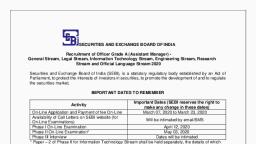
SECURITIES AND EXCHANGE BOARD OF INDIA, Recruitment of Officer Grade A (Assistant Manager) General Stream, Legal Stream, Information Technology Stream, Engineering Stream, Research, Stream and Official Language Stream 2020, Securities and Exchange Board of India (SEBI), is a statutory regulatory body established by an Act of, Parliament, to protect the interests of investors in securities, to promote the development of and to regulate, the securities market., IMPORTANT DATES TO REMEMBER, Important Dates (SEBI reserves the right to, make any change in these dates), March 07, 2020 to March 23, 2020, , Activity, , On-Line Application and Payment of fee On-Line, Availability of Call Letters on SEBI website (for, Will be intimated by email/SMS, On-Line Examinations), Phase I On-Line Examination, April 12, 2020, Phase II On-Line Examination*, May 03, 2020, Phase III Interview, Dates will be intimated, * Paper – 2 of Phase II for Information Technology Stream shall be held separately, the details of which, shall be available on SEBI website (www.sebi.gov.in) in due course., Applicants desirous of securing job at SEBI are hereby cautioned not to fall prey to any unscrupulous, elements who may try to deceive candidates/public by false promises of securing jobs in SEBI. In case, any candidate comes across such offer/ practice, the same may be immediately brought to the notice, of SEBI at
[email protected], with full details, such as name and contact details, of the elements, indulging in such practice., I. SEBI invites applications from Indian citizens for the post of Officer Grade A (Assistant Manager) for, the General Stream, Legal Stream, Information Technology Stream, Engineering Stream, Research, Stream and Official Language Stream. SEBI reserves the right to fill up the posts or not to fill up the, posts at all., , Stream, , UR, , Number of posts, OBC, EWS, SC, ST, @, $, , Out of which, PwBD**, , Educational Qualification, , 1 (Autism/, intellectual, disability/, specific learning, disability/mental, illness) *, , Master’s Degree in any, discipline, Bachelors’ Degree, in Law, Bachelors’ Degree in, Engineering, from, a, recognized university, CA /, CFA / CS / Cost Accountant., , Total, , 1 (D & HH), General, , 32, , 22, , 12, , 6, , 8, , 80, 1 (B & LV), 2 (Autism/, intellectual, disability/, specific learning, disability/mental, illness), Page 1 of 26
Page 2 :
Stream, , UR, , Number of posts, OBC, EWS, SC, ST, @, $, 4*, , Legal, , 12, , 3*, , Engineering, (Civil), , 4, , 1*, , 0, , 5, , 2, , 1, , 1, , 17, , 0, , 1*, , 0, , NA, , 1*, , NA, , 1*, , 2, , 0, , 3, , NA, , 1*, , 1, , 3, , 1, , 1, , 0, , 1 (D & HH)*, , 1 (D & HH)*, , 0, , 1*, , Official, Language, , 5*, 1 (D & HH)*, 1 (LV)*, , 0, , Research, , NA, , 28, , 8, , 1*, Engineering, (Electrical), , 1 (B & LV)*, 1 (B & LV), 2, , 1*, , 1 (D & HH), , 0, , 0, , Educational Qualification, Bachelor’s Degree in Law, from a recognized University, / Institute., , 6*, , 2, 8, , Information, Technology, , NA, , 2*, , Total, , Out of which, PwBD**, , 0, , 0, , 4, , 0, , 0, , 1, , 1 (HH)*, , Bachelor’s, Degree, in, Engineering (Electrical /, Electronics / Electronics And, Communication / Information, Technology, /, Computer, Science) OR Masters in, Computers Application OR, Bachelor’s Degree in any, discipline, with, a, post, graduate, qualification, (minimum 2 years duration), in Computers / Information, Technology., Bachelor’s Degree in Civil, Engineering, from, a, recognized, University, /, Institute., Bachelor’s, Degree, in, Electrical Engineering from a, recognized, University, /, Institute., , Master’s Degree in Statistics, / Economics / Commerce /, Business, Administration, (Finance) / Econometrics, from a recognized University, / Institute., Master’s Degree in Hindi with, English as one of the, subjects, at, Bachelor’s, Degree level or Master’s, Degree in Sanskrit / English /, Economics / Commerce with, Hindi as a subject at, Bachelor’s Degree level from, a recognized University /, Institute., , * Indicates backlog vacancies., @ Candidates belonging to OBC category but coming in the 'Creamy Layer' are not entitled to OBC reservation., $ Reservations for Economically Weaker Sections (EWSs) in recruitment is governed by Office Memorandum, No.36039/1/2019-Estt(Res) dated 31.01.2019 of Department of Personnel & Training, Ministry of Personnel, Public, Grievances & Pensions, Government of India., Disclaimer: “EWSs vacancies are tentative and subject to further directives of Government of India and outcome of any litigation. The, appointment is provisional and is subject to the Income & Asset certificate being verified through proper channels”. Benefit of, , Page 2 of 26
Page 3 :
reservation under EWSs category can be availed upon production of an ‘Income and Asset Certificate’ for Financial Year 2018-19, issued by a Competent Authority on the format prescribed by Government of India., , Note 1: A Post Graduate Diploma in any discipline will be acceptable as educational requirement for General, stream and a Post Graduate Diploma in Statistics / Economics / Commerce / Business Administration (Finance), / Econometrics will be acceptable as educational requirement for Research Stream, provided the same is, recognized as equivalent to a Master’ Degree in that discipline by Govt. of India. The onus to provide necessary, document in this regard shall be on the candidates., Note 2: Candidates are permitted to apply for maximum of 2 streams only for which he/she is eligible to apply,, as per their educational qualifications. Separate on-line application for each stream will have to be submitted, and requisite fees is to be paid for each application. In case a candidate applies more than once in a Single, Stream and/ or applies for more than 2 Streams, only the latest applications shall be considered valid and the, other applications shall be rejected. The officers recruited in any stream may be posted to any department of, SEBI, irrespective of their streams., Candidates who have appeared for the final examinations and waiting for the results are eligible to appear for, the Phase I, Phase II and Phase III of selection process. However, the offer to join SEBI to the selected, candidates shall be subject to production of necessary documents evidencing successfully obtaining the, requisite qualification., The date of passing eligibility examination will be the date appearing on the mark sheet or provisional certificate, issued by the University/ Institute. In case the result of a particular examination is posted on the website of the, University/ Institute, a certificate issued by the appropriate authority of the University/ Institute indicating the, date on which the result was posted on the website will be taken as the date of passing., ** Persons with Benchmark Disabilities (PwBD):, a. The specified disabilities are:, i. Blindness and Low Vision,, ii. Deaf and Hard of Hearing,, iii. Locomotor Disability including cerebral palsy, leprosy cured, dwarfism, acid attack victims and, muscular dystrophy,, iv. Autism, intellectual disability, specific learning disability and mental illness,, v. Multiple disabilities and, vi. Other disabilities (as per Rights of Persons With Disabilities Act, 2016), b. The PwBD candidates may belong to any category (i.e. GEN/ SC/ ST/ OBC/ EWSs) and they will be, eligible for age relaxations. Reservation for PwBD is horizontal and within the overall vacancies for the, posts., c. PwBD means a person with not less than forty per cent of a specified benchmark disability where, specified disability has not been defined in measurable terms and are eligible to apply in the GEN/ SC/, ST/ OBC/ EWSs category. They will be eligible for concession in application fee., Age Limit (as on 29/02/2020):, a. A candidate must not have exceeded the age of 30 years as on February 29, 2020 i.e., candidate must, have been born on or after March 01, 1990., b. The upper age-limit prescribed above will be relaxable:, i. up to a maximum of five years for candidates belonging to a Scheduled Caste or a Scheduled Tribe, if the posts are reserved for them;, ii. up to a maximum of three years in the case of candidates belonging to Other Backward Classes, who are eligible to avail of reservation applicable to such candidates if the posts are reserved for, them;, c. Only those candidates belonging to 'Non Creamy Layer' are eligible to apply under OBC Category. The, OBC candidates who belong to 'Creamy Layer' are not entitled to apply under OBC Category., Candidates belonging to OBC category but coming in the 'Creamy Layer' are not entitled to OBC, reservation. They should indicate their category as ‘Unreserved’. Candidates belonging to the OBC, Page 3 of 26
Page 4 :
(NCL) category should have OBC (NCL) certificate issued on or after March 01, 2019 but earlier than, the due date (closing date) of the application., d. Relaxation of 10 (ten) years for PwBD candidates shall be applicable whether the post is reserved or, not. Relaxation of 13 (thirteen) years for PwBD (OBC) candidates where vacancies are reserved for, OBC candidates. Relaxation of 15 (fifteen) years for PwBD (SC/ST) candidates where vacancies are, reserved for SC/ST candidates., e. Relaxation of 5 (five) years for Ex-servicemen. Ex-servicemen include Emergency Commissioned, Officers/Short Service Commissioned Officers, who have rendered at least five years continuous, Military Service and have been released a) on completion of assignment (including those whose, assignment is due to be completed within one year from February 29, 2020) otherwise than by way of, dismissal or discharge on account of misconduct or inefficiency or b) on account of physical disability, physical disability attributable to Military Service or c) on invalidment. Emergency Commissioned, Officers/Short Service Commissioned Officers who have completed their initial period of assignment of, five years of Military Service but whose assignment has been extended beyond five years and in whose, case the Ministry of Defence issues certificates that they would be released on selection within three, months from the date of receipt of offer of appointment., f. Candidates belonging to the Scheduled Castes and the Scheduled Tribes and the Other Backward, Classes who are also covered under the category of Persons with Benchmark Disabilities and Exservicemen will be eligible for grant of cumulative age-relaxation., Where there is no vacancy reserved for OBC/SC/ST category candidates, such candidates can still apply., However, they will not be eligible for any relaxations. SC/ ST candidates are exempt from payment of application, fee even in such case but will have to pay specified intimation charges. OBC/ PwBD candidates should possess, a latest certificate to this effect issued by the Competent Authority in the prescribed Format (formats are, available on the SEBI website)., II., , a., , MODE OF SELECTION: Mode of selection shall be a three stage process i.e. Phase I (on-line screening, examination consisting of two papers of 100 marks each), Phase II (on-line examination consisting of two, papers of 100 marks each) and Phase III (Interview)., Phase I On-Line Examination:, An online screening examination consisting of two papers (Multiple Choice questions of 100 marks each), will be held on April 12, 2020. The exam will consist of:, Paper, , Streams/ Subjects, , Paper 1, , All Streams: Multiple choice questions on the, subjects viz. General Awareness (including some, questions related to Financial Sector of easy to, moderate difficulty level), English Language,, Quantitative Aptitude and Test of Reasoning., General Stream: Multiple choice questions on, subjects Commerce, Accountancy, Management,, Finance, Costing, Companies Act and Economics., Legal, Information Technology, Engineering, Stream (Civil & Electrical), Official Language, Paper 2, stream: Multiple choice questions on Specialized, subject related to stream., Research Stream:- Multiple choice questions on, subjects Economics, Econometrics, Statistics,, Finance and Commerce., Aggregate Cut off, , Maximum, Marks, 100, , Duration, , Cut off, , 60 minutes, , 30%, , 100, , 40 minutes, , 40%, , 100, , 40 minutes, , 40%, , 40%, , i. There shall be negative marking (1/4th of marks assigned to the question) for the Paper 1 and Paper 2, in Phase I., ii. There shall be a cut-off of minimum 30% for Paper 1 (no sectional cut-off shall be there) and a cut-off, of minimum 40% for Paper 2 in Phase I., Page 4 of 26
Page 5 :
iii. Candidates would need to secure separate cut-off in each paper as mentioned at (ii) above as well as, aggregate cut-off marks of 40% in Phase I exam to be shortlisted for Phase II. Marks obtained in Phase, I shall be used only for shortlisting the candidates for Phase II examination process and will not be, counted for final selection of the candidates., iv. Subject to the criteria mentioned at (iii) above, all the candidates who clear Phase I shall be shortlisted, for Phase II. List of candidates shortlisted for Phase II will be made available on SEBI website., Syllabus for the papers in Phase I is available in the Annexure to this advertisement., b., , Phase II On-Line Examination:, An on-line examination consisting of two papers of 100 marks each will be held on May 03, 2020. The, papers shall be as follows:, Paper, , Maximum, Marks, 100, , Paper 1, , Duration, , Cut off, , Weigh, tage, 1/3rd, , All streams: English (Descriptive Test) to, 60, 30%, test the drafting skills, minutes, General Stream: Multiple choice questions on, subjects, Commerce,, Accountancy,, 100, 40, 40%, 2/3rd, Management, Finance, Costing, Companies, minutes, Act and Economics., Legal, Engineering Stream (Civil &, Paper 2, Electrical) and Official Language stream:, Multiple choice questions on Specialized, 100, 40, 40%, 2/3rd, subject related to stream., minutes, Research Stream:- Multiple choice questions, on subjects Economics, Econometrics,, Statistics, Finance and Commerce., Aggregate Cut off, 40%, Note:- The details with respect to Paper – 2 of Phase II for Information Technology Stream shall be made, available on SEBI website (www.sebi.gov.in) in due course., i. Candidates shortlisted for Phase II will be issued new Hall Tickets., ii. For candidates who have applied in multiple streams, Paper II will be conducted in various shifts, the, timings of which will be intimated in the Hall Ticket., iii. There shall be negative marking (1/4th of marks assigned to the question) for Paper 2 in Phase II, (except IT stream for which details shall be informed in due course)., iv. There shall be a cut-off of minimum 30% for Paper 1 and a cut-off of minimum 40% for Paper 2 in, Phase II., v. Candidates would need to secure separate cut-off in each paper as mentioned at (iv) above as well as, aggregate cut-off marks of 40% in Phase II exam (weightage of 1/3rd for Paper 1 and 2/3rd for Paper 2), to be shortlisted for Phase III., vi. Subject to the criteria mentioned at (v) above, candidates equaling 3 times the number of vacancies, shall be shortlisted, in order of merit, for Phase III i.e. the Interview. List of candidates shortlisted for, Interview will be made available on SEBI website., Note: All question papers (in both the Phases, except the test of English) will be set bilingually in Hindi and, English., Syllabus for the papers in Phase II is available in the Annexure to this advertisement., c., , Interview: Only the shortlisted candidates will be called for interview. Application fee shall not be refunded, to the candidates not shortlisted for Phase II and Interview. Candidate may opt for interview either in Hindi, or English. Weightage of marks obtained in Phase II will be 85%, while marks obtained in interview shall, be given a weightage of 15%., SEBI reserves the right to modify the selection procedure, if deemed fit., Page 5 of 26
Page 7 :
State/UT, , Centre, , State/UT, , Bangalore, Belgavi, Mysore,, Hubli - Dharwad, Gulbarga, Thiruvananthapuram,, Cochin, Kozhikode, Leh, , Karnataka, Kerala, Ladakh, , Uttar Pradesh, , Centre, Agra,, Prayagraj,, Ghaziabad,, Kanpur, Lucknow, Meerut, Varanasi,, Gorkhapur, Moradabad, , West Bengal, , Kolkata, Asansol, Siliguri, Hooghly, , b. The Phase II on-Line examination will be held at the following centres:, Ahmedabad/ Gandhinagar, Agartala, Aurangabad (MH), Bengaluru, Bhubaneswar, Chandigarh/ Mohali, Chennai, Coimbatore, Dehradun, Guwahati, Haldwani, Hubli - Dharwad, , Hyderabad/ Rangareddy, Indore, Jaipur, Kanpur, Kochi/ Ernakulam, Kolkata/ Greater Kolkata, Lucknow, Madurai, Meerut, Mumbai/Greater Mumbai/Navi, Mumbai/Thane, Muzzafarpur, Nagpur, , Nasik, New Delhi-NCR, Panaji, Patna, Prayagraj, Pune, Raipur, Ranchi, Siliguri, Surat, Vijayawada, Vishakhapatnam, , Candidates can provide their preference of upto three centers for Phase I and one center for Phase II in the, online application. Choice of Centre by candidates for Phase I and Phase II Examinations can be different and, must be indicated in the online application. Candidates will appear for the examination at an Examination Centre, at their own risks and expenses. SEBI does not make any arrangements for boarding/lodging of candidates., SEBI will not be responsible for any injury or losses etc. of any nature during the course of Examination., NB: Notwithstanding the aforesaid provision, SEBI reserves the right to change the Centres at its discretion. All, the Examination Centres will cater to examination for Low Vision Candidates in their respective centres., Candidates admitted to the examination will be informed of the time table and place or places of examination., The candidates should note that no request for change of centre will be entertained., c. The venue for the Interview will be intimated to the shortlisted candidates in their interview call letters., V., , APPLICATION FEE (NON-REFUNDABLE), Category of Applicant, , Amount of Fee, (Non-refundable), , Unreserved/OBC/EWSs, , Rs. 1000/- as application fee cum intimation charges, , SC/ ST/ PwBD, , Rs. 100/- as intimation charges, , Separate on-line application for each stream will have to be made with requisite fee for each application to, be paid as well., VI., , NOTE FOR PERSONS WITH BENCHMARK DISABILITIES:, , Definition of Person with Benchmark Disabilities, Reservation has been provided to Persons with Benchmark Disabilities as per Section 34 of “Rights of Persons, With Disabilities Act, 2016”. The disabilities specified in the Schedule of Rights of Persons With Disabilities Act,, 2016 are as below:, , Page 7 of 26
Page 8 :
1. Physical Disability:, A. Locomotor disability (a person's inability to execute distinctive activities associated with movement of self, and objects resulting from affliction of musculoskeletal or nervous system or both), including:, (a) "leprosy cured person" means a person who has been cured of leprosy but is suffering from:, (i) loss of sensation in hands or feet as well as loss of sensation and paresis in the eye and eye-lid but, with no manifest deformity;, (ii) manifest deformity and paresis but having sufficient mobility in their hands and feet to enable them to, engage in normal economic activity;, (iii) extreme physical deformity as well as advanced age which prevents him/her from undertaking any, gainful occupation, and the expression "leprosy cured" shall construed accordingly;, (b) "cerebral palsy" means a Group of non-progressive neurological condition affecting body movements, and muscle coordination, caused by damage to one or more specific areas of the brain, usually, occurring before, during or shortly after birth;, (c) "dwarfism" means a medical or genetic condition resulting in an adult height of 4 feet 10 inches (147, centimeters) or less;, (d) "muscular dystrophy" means a group of hereditary genetic muscle disease that weakens the muscles, that move the human body and persons with multiple dystrophy have incorrect and missing information, in their genes, which prevents them from making the proteins they need for healthy muscles. It is, characterised by progressive skeletal muscle weakness, defects in muscle proteins, and the death of, muscle cells and tissue;, (e) "acid attack victims" means a person disfigured due to violent assaults by throwing of acid or similar, corrosive substance., B. Visual impairment:, (a) "blindness" means a condition where a person has any of the following conditions, after best correction:, (i) total absence of sight; or, (ii) visual acuity less than 3/60 or less than 10/200 (Snellen) in the better eye with best possible correction;, or, (iii) limitation of the field of vision subtending an angle of less than 10 degree., (b) "low-vision" means a condition where a person has any of the following conditons, namely:, (i) visual acuity not exceeding 6/18 or less than 20/60 upto 3/60 or upto 10/200 (Snellen) in the better eye, with best possible corrections; or, (ii) limitation of the field of vision subtending an angle of less than 40 degree up to 10 degree., C. Hearing impairment:, (a) "deaf" means persons having 70 DB hearing loss in speech frequencies in both ears;, (b) "hard of hearing" means person having 60 DB to 70 DB hearing loss in speech frequencies in both, ears;, D. "speech and language disability" means a permanent disability arising out of conditions such as, laryngectomy or aphasia affecting one or more components of speech and language due to organic or, neurological causes., 2. Intellectual disability, a condition characterised by significant limitation both in intellectual functioning, (rasoning, learning, problem solving) and in adaptive behavior which covers a range of every day, social, and practical skills, including:, (a) "specific learning disabilities" means a heterogeneous group of conditions wherein there is a deficit in, processing language, spoken or written, that may manifest itself as a difficulty to comprehend, speak,, Page 8 of 26
Page 9 :
read, write, spell, or to do mathematical calculations and includes such conditions as perceptual, disabilities, dyslexia, dysgraphia, dyscalculia, dyspraxia and developmental aphasia;, (b) "autism spectrum disorder" means a neuro-developmental condition typically appearing in the first three, years of life that significantly affects a person's ability to communicate, understand relationships and, relate to others, and is frequently associated with unusal or stereotypical rituals or behaviours., 3. Mental behavior:, "mental illness" means a substantial disorder of thinking, mood, perception, orientation or memory that grossly, impairs judgment, behaviour, capacity to recognize reality or ability to meet the ordinary demands of life, but, does not include retardation which is a conditon of arrested or incomplete development of mind of a person,, specially characterised by subnormality of intelligence., 4. Disability caused due to:, (a) chronic neurological conditions, such as:, (i) "multiple sclerosis" means an inflammatory, nervous system disease in which the myelin sheaths, around the axons of nerve cells of the brain and spinal cord are damaged, leading to demyelination, and affecting the ability of nerve cells in the brain and spinal cord to communicate with each other;, (ii) "parkinson's disease" means a progressive disease of the nervous system marked by tremor, muscular, rigidity, and slow, imprecise movement, chiefly affecting middle-aged and elderly people associated, with degeneration of the basal ganglia of the brain and a deficiency of the neurotransmitter dopamine., (b) Blood disorder:, (i) "haemophilia" means an inheritable disease, usually affecting only male but transmitted by women to, their male children, characterised by loss or impairment of the normal clotting ability of blood so that a, minor would may result in fatal bleeding;, (ii) "thalassemia" means a group of inherited disorders characterised by reduced or absent amounts of, haemoglobin., (iii) "sickle cell disease" means a hemolytic disorder characterised by chronic anemia, painful events, and, various complications due to associated tissue and organ damage; "hemolytic" refers to the destruction, of the cell membrane of red blood cells resulting in the release of hemoglobin., 5. Multiple Disabilities (more than one of the above specified disabilities) including deaf blindness which, means a condition in which a person may have combination of hearing and visual impairments causing, severe communication, developmental, and educational problems., GUIDELINES FOR PERSONS WITH DISABILITIES USING A SCRIBE, The visually impaired candidates and candidates whose writing speed is adversely affected permanently for, any reason can use their own scribe at their cost during the online examination. In all such cases where a scribe, is used, the following rules will apply:, , , , , , Candidate should ensure that he/ she is eligible to use a scribe as per the Government of India rules, governing the recruitment of Persons with Benchmark Disabilities., The candidate will have to arrange his / her own scribe at his/her own cost., The scribe should be from an academic stream different from that stipulated for the post., Both the candidate as well as scribe will have to give a suitable undertaking in the prescribed format, with passport size photograph of the scribe along with call letter at the time of examination confirming, that the scribe fulfils all the stipulated eligibility criteria for a scribe mentioned above. Further in case it, later transpires that he/she did not fulfill any laid down eligibility criteria or suppressed material facts, the candidature of the applicant will stand cancelled, irrespective of the result of the online, Page 9 of 26
Page 10 :
, , , , , examination. Proforma of undertaking will be made available on SEBI website on or before the Call, Letters for the online examination are made available on the SEBI website., Those candidates who use a scribe shall be eligible for compensatory time of 20 minutes for every hour, of the examination or as otherwise advised., A person acting as scribe for one candidate cannot be a scribe for another candidate. In addition the, scribe arranged by the candidate should not be a candidate for the same examination. If violation of, the above is detected at any stage of the process, candidature of both the candidate and the scribe will, be cancelled. Candidates eligible for and who wish to use the services of a scribe in the examination, should invariably carefully indicate the same in the online application form. Any subsequent request, may not be favorably entertained., Only candidates registered for compensatory time will be allowed such concessions since, compensatory time given to candidates shall be system based, it shall not be possible for the test, conducting agency to allow such time if he / she is not registered for the same. Candidates not, registered for compensatory time shall not be allowed such concessions., (i) Guidelines for Candidates with locomotor disability and cerebral palsy, A compensatory time of twenty minutes per hour or otherwise advised shall be permitted for the, candidates with locomotor disability and cerebral palsy where dominant (writing) extremity is affected, to the extent of slowing the performance of function (minimum of 40%impairment)., (ii) Guidelines for Visually Impaired candidates, Visually Impaired candidates (who suffer from not less than 40% of disability) may opt to view the, contents of the test in magnified font and all such candidates will be eligible for compensatory time of, 20 minutes for every hour or otherwise advised of examination., Visually Impaired candidates under Low Vision, who use scribe, may skip the non-verbal questions, if, any, in Test of Reasoning and questions on Table/Graph, if any, in Test of Quantitative Aptitude. The, candidates will be awarded marks for such Section based on the overall average obtained in other, Sections of the respective test., These guidelines are subject to change in terms of Government of India guidelines/ clarifications, if any,, from time to time., , GUIDELINES FOR PERSONS WITH DISABILITIES, i., , ii., , A compensatory time of twenty minutes per hour shall be permitted for the candidates with locomotor, disability and cerebral palsy where dominant (writing) extremity is affected to the extent of slowing the, performance of function (minimum of 40% impairment) and for Visually Impaired candidates under Low, Vision (who suffer from not less than 40% of disability)., Visually Impaired candidates (who suffer from not less than 40% of disability) may opt to view the, contents of the test in magnified font and all such candidates will be eligible for compensatory time of, 20 minutes for every hour of examination. The facility of viewing the contents of the test in magnifying, font will not be available to Visually Impaired candidates who use the services of a Scribe for the, examination., , The scribe will be allowed to be used as per the guidelines issued vide Office Memorandum F.No.16-110/2003DDIII dated February 26, 2013 of Government of India, Ministry of Social Justice and Empowerment,, Department of Disability Affairs, New Delhi., The above guidelines are subject to change in terms of GOI guidelines/ clarifications, if any, from time to time., VII., , Pre-examination training for SC/ST/PwBD candidates:, , SEBI will arrange pre-examination training for SC/ST/PwBD candidates, free of cost at Mumbai, Kolkata,, Chennai and New Delhi centres. Candidates belonging to SC/ST/PwBD candidates, who desire to avail of the, pre-examination training, should invariably fill in the details in the relevant column while filling the ON-LINE, Page 10 of 26
Page 11 :
application. Any subsequent request shall not be entertained. Further, no other mode of request shall be, entertained., SEBI reserves the right to allocate any of the above centres for pre-examination training, irrespective of the, choice given in the online application., While training will be imparted free of cost, all other expenses regarding travelling, boarding, lodging etc., will, have to be borne by the candidate for attending the pre-examination training programme at the designated, centres. Candidates will be required to make their own arrangements for travel, boarding, lodging etc., for the, duration of the training., Candidates will also have to bring an attested copy of their caste certificate and a copy of the registration receipt, on the first day of the training., The details of the Pre-examination training will be communicated to the candidates only via email., Depending on the response and the administrative feasibility, the right to cancel any of the pre-examination, training centres and/or add some other centres is reserved by SEBI., By merely attending the pre-examination training, no candidate acquires any right to be selected in SEBI., VIII. GENERAL INSTRUCTIONS:, a. Candidate who is eligible and desires to apply for the above post should submit an ON-LINE application, with requisite fee/ intimation charges (wherever applicable). No other means/mode of application will be, accepted., b. Fees sent in any other manner not prescribed in this advertisement and / or the application submitted without, depositing the fee/ intimation charges would be rejected and no correspondence shall be entertained in this, regard., c. Candidates should satisfy themselves about their eligibility for the post applied for. Candidates seeking, reservation/ relaxation benefits available for SC/ST/OBC/PwBD/Ex-servicemen must ensure that they are, entitled to such reservation/ relaxation as per eligibility prescribed. At the time of the interview, they should, also be in possession of all the requisite certificates in the prescribed format in support of their claim as, stipulated for such benefits and these certificates should be dated earlier than the due date (closing date) of, the application., d. If the candidates are not eligible or have knowingly or willfully furnished incorrect or false particulars or, suppressed material information, their candidature will be liable to be cancelled at any stage of the selection., If the candidate qualifies in the selection process and subsequently it is found that he/she does not fulfill the, eligibility criteria, his/her candidature will be cancelled and if appointed, the appointment would be terminated, without any notice or compensation., e. Candidates who are already in service of Govt./ Quasi-Govt. Organizations and Public Sector Banks/, Undertakings will have to produce a "No Objection Certificate' from their employer, at the time of Interview., Before appointment in SEBI, a proper discharge certificate from the employer will have to be produced., f., , Outstation candidates called for Interview will be reimbursed single AC Three Tier return railway fare for, journey by the shortest route, subject to submission of necessary documentary evidence., , g. SEBI does not assume any responsibility for the candidates not being able to submit their applications within, the last date., h. In all matters regarding eligibility, conduct of examinations, interviews, assessment, prescribing minimum, qualifying standards in both the Examination and Interview, in relation to number of vacancies and, communication of result, SEBI's decision shall be final and binding on the candidates and no correspondence, shall be entertained in this regard. Further, SEBI reserves the right to relax any of the requirements for the, Page 11 of 26
Page 12 :
candidates in deserving cases. SEBI also reserves the right to cancel the advertisement, fully or partly on, any grounds., i., , Canvassing in any form will disqualify the candidate., , j., , Please note that Corrigendum, if any, issued on the above advertisement, will be published only on SEBI’s, website www.sebi.gov.in., , k. Any resultant dispute arising out of this advertisement shall be subject to the jurisdiction of the Courts, situated at Mumbai only., IX. HOW TO APPLY:, Candidates are required to apply On-Line through the website www.sebi.gov.in from March 07, 2020 to, March 23, 2020 and no other mode of application will be accepted. Candidates need not submit the system, generated print out of the ON-LINE application to SEBI's office., Detailed Guidelines/Procedures for:, A., B., C., D., , Application Registration, Payment of Fees, Uploading of Photograph, Uploading of Signature, Left Thumb impression and Handwriting declaration, , A. APPLICATION REGISTRATION, I. IMPORTANT POINTS TO BE NOTED BEFORE REGISTRATION, Before applying online, candidates should, i. Scan their photograph and signature ensuring that both the photograph and signature adhere to, the required specifications as given under Guidelines for uploading of photograph & signature, scan., ii. The left thumb impression should be properly scanned and not smudged. (If a candidate is not, having left thumb, he/she may use his/ her right thumb for applying.), iii. Scan the handwriting declaration ensuring that the document adheres to the required, specifications as given under Guidelines for uploading of handwriting declaration. The text for the, hand written declaration is as follows:, “I, _______ (Name of the candidate), hereby declare that all the information submitted by me in, the application form is correct, true and valid. I will present the supporting documents as and when, required.”, iv. The above mentioned hand written declaration has to be in the candidate’s hand writing and in, English only. If it is written and uploaded by anybody else or in any other language, the application, will be considered as invalid. (In the case of Visually Impaired candidates who cannot write, may get the text of declaration typed and put their left hand thumb impression below the, typed declaration and upload the document as per specifications.), v. Have a valid personal email ID and mobile number, which should be kept active till the completion, of this Recruitment Process. SEBI may send call letters for the Interview etc., through the, registered e-mail ID. In case a candidate does not have a valid personal e-mail ID, he/she should, create his/her new e-mail ID and mobile number before applying on-line and must maintain that, email account and mobile number. Under no circumstances, a candidate should, share/mention e-mail ID to/ of any other person., II. APPLICATION PROCEDURE, 1. Applicants are required to go to SEBI’s website ‘www.sebi.gov.in’ and open the link “Careers”., Thereafter, open the Recruitment Notification entitled “SEBI RECRUITMENT EXERCISE RECRUITMENT OF OFFICER GRADE A (ASSISTANT MANAGER) - 2020” and click on the, option "APPLY ONLINE" which will open a new screen., Page 12 of 26
Page 13 :
2. To register application, choose the tab "CLICK HERE FOR NEW REGISTRATION" and enter, Name, Contact details and Email-ID. A Provisional Registration Number and Password will be, generated by the system and displayed on the screen. Candidate should note down the, Provisional Registration Number and Password. An Email & SMS indicating the Provisional, Registration number and Password will also be sent., 3. In case the candidate is unable to complete the application form in one go, he/ she can save the, data already entered by choosing "SAVE AND NEXT" tab. Prior to submission of the online, application, candidates are advised to use the "SAVE AND NEXT" facility to verify the details in, the online application form and modify the same if required., 4. Candidates are advised to carefully fill and verify the details filled in the online application, themselves as no change will be possible/ entertained after clicking the “FINAL SUBMIT”, BUTTON., 5. The Name of the candidate and his/her Father/ Husband etc. should be spelt correctly in the, application as it appears in the Certificates/ Mark sheets. Any change/alteration found may, disqualify the candidature., 6. Validate your details and Save your application by clicking the "VALIDATE YOUR DETAILS" and, "SAVE & NEXT" button., 7. Candidates can proceed to upload Photo, Signature, Left Thumb impression and hand writing, declaration as per the specifications given in the Guidelines detailed under point "C" given below., 8. Candidates can proceed to fill other details of the Application Form., 9. Click on the Preview Tab to preview and verify the entire application form before “FINAL SUBMIT”., 10. Modify details, if required, and click on "FINAL SUBMIT" only after verifying and ensuring that, the photograph, signature uploaded and other details filled by you are correct., 11. Click on "PAYMENT" Tab and proceed for payment., 12. Click on "SUBMIT" button., 13. Candidates shall be solely responsible for filling up the online applications correctly. In case of, invalid applications due to errors committed by the applicant no claims for refund of application, fees/intimation charges so collected shall be entertained by the Board., 14. To avoid last minute rush, candidates are advised to pay the application fees/ intimation charges, and register online at the earliest., 15. Board does not assume any responsibility for the candidates not being able to submit their, applications within the last day on account of aforesaid reasons or any other reason., B. PAYMENT OF FEES ONLINE MODE, 1. Payment of application fee/ intimation charges has to be done after successful registration of the, application else application will be treated as cancelled., 2. Candidates have to pay the requisite fees/intimation charges only through ON-LINE mode., 3. The application form is integrated with the payment gateway and the payment process can be, completed by following the instructions., 4. The payment can be made by using only Debit Cards (Rupay/ Visa/ Master Card/Maestro), Credit, cards, Internet Banking, IMPS, Cash Cards/ Mobile Wallets., 5. After submitting your payment information in the online application form, PLEASE WAIT FOR THE, INTIMATION FROM THE SERVER. DO NOT PRESS BACK OR REFRESH BUTTON IN ORDER, TO AVOID DOUBLE CHARGE., Page 13 of 26
Page 14 :
6. On successful completion of the transaction, an e-Receipt will be generated. Candidates are, required to take a printout of the e-receipt., 7. Non-generation of 'E-Receipt' indicates PAYMENT FAILURE. On failure of payment, Candidates are, advised to login again using their Provisional Registration Number and Password and repeat the, process of payment., 8. Candidates are required to take a print of online Application Form containing fee details. Please note, that if the same cannot be generated, online transaction may not have been successful., 9. For Credit Card users: All charges are listed in Indian Rupee. If you use a non-Indian credit card,, your bank will convert it to your local currency based on prevailing exchange rates., 10. To ensure the security of your data, please close the browser window once your transaction is, completed., 11. There is facility to print application form containing fee details after payment of fees., C. GUIDELINES FOR UPLOAD OF PHOTOGRAPH, SIGNATURE, LEFT THUMB IMPRESSION &, HANDWRITING DECLARATION, In case the face in the photograph or signature is unclear, the application may be rejected. Candidate, may edit the application and re-upload the photograph/ signature in such case., Candidate should also ensure that photo is uploaded at the place of photo and signature at the place of, signature. If photo in place of photo and signature in place of signature is not uploaded properly,, candidate will not be allowed to appear for the exam., PHOTOGRAPH IMAGE, Photograph must be a recent passport size colour picture (4.5cm × 3.5cm), The picture should be in colour, against a light-coloured, preferably white background. Look straight, at the camera with a relaxed face., If the picture is taken on a sunny day, have the sun behind you, or place yourself in the shade, so, that you are not squinting and there are no harsh shadows., If you have to use flash, ensure there's no "red-eye"., If you wear glasses make sure that there are no reflections and your eyes can be clearly seen., Caps, hats and dark glasses are not acceptable. Religious headwear is allowed but it must not cover, your face., Dimensions 200 x 230 pixels (preferred)., Size of file should be between 20kb-50kb. Ensure that the size of the scanned image is not more, than 50kb. If the size of the file is more than 50KB,then adjust the settings of the scanner such as the, DPI resolution, number of colours etc., during the process of scanning., SIGNATURE, LEFT THUMB IMPRESSION AND HANDWRITING DECLARATION IMAGE:, , , , , , , , , , , , The applicant has to sign on white paper with Black Ink pen., The applicant has to put his left thumb impression on a white paper with black or blue ink., The applicant has to write the declaration in English clearly on a white paper with black ink, The signature, left thumb impression and the hand written declaration should be of the applicant and, not by any other person., The signature will be used to put on the Call Letter and wherever necessary., If the Applicant’s signature on the attendance sheet or Call letter, signed at the time of the, examination, does not match the signature uploaded, the applicant will be disqualified., Dimensions 140 x 60 pixels (preferred), Size of file should be between 10kb – 20kb for signature and left thumb impression., For handwriting declaration size of file should be 20kb – 50 kb. Ensure that the size of the scanned, image is not more than 20kb or 50 kb (for hand written declaration), Signature / Handwriting declaration in CAPITAL LETTERS shall NOT be accepted., , Page 14 of 26
Page 15 :
SCANNING THE DOCUMENTS:, , , , , , , , , , , Set the scanner resolution to a minimum of 200 dpi (dots per inch), Set Color to True Color, File Size as specified above, Crop the image in the scanner to the edge of the photograph/signature/ left thumb impression / hand, written declaration, then use the upload editor to crop the image to the final size (as specified above)., The image file should be JPG or JPEG format. An example file name is: image01.jpg or image01.jpeg, Image dimensions can be checked by listing the folder files or moving the mouse over the file image, icon., Candidates using MS Windows/MSOffice can easily obtain documents in .jpeg format not exceeding, 50kb (photograph and handwriting declaration) & 20kb (signature and left thumb impression) by using, MS Paint or MS Office Picture Manager. Scanned documents in any format can be saved in .jpg, format by using ‘Save As’ option in the File menu and size can be reduced below 50 kb (photograph, and handwriting declaration) & 20 kb (signature and left thumb impression) by using crop and then, resize option (Please see point (i) & (ii) above for the pixel size) in the ‘Image’ menu. Similar options, are available in other photo editor also., If the file size and format are not as prescribed, an error message will be displayed., While filling in the Online Application Form the candidate will be provided with a link to upload his/her, photograph, signature, left thumb impression and handwriting declaration., , If the file size and format are not as prescribed, an error message will be displayed., While filling in the Online Application Form the candidate will be provided with a link to upload his photograph, and signature., Procedure for Uploading the Photograph and Signature, There will be separate links for uploading Photograph, signature, left thumb impression and hand, writing declaration, Click on the respective link “Upload Photograph / signature / left thumb impression / hand writing, declaration”, Browse and Select the location where the Scanned Photograph / signature / left thumb impression /, hand writing declaration file has been saved., Select the file by clicking on it, Click the ‘Open/Upload’ button, Your Online Application will not be registered unless you upload your Photograph, signature, left thumb, impression and handwriting declaration as specified., Note:, (1) In case the face in the photograph or signature or left thumb impression or the handwriting declaration is, unclear / smudged the candidate’s application may be rejected., (2) After uploading the Photograph / signature / left thumb impression / handwriting declaration in the online, application form candidates should check that the images are clear and have been uploaded correctly. In, case the photograph or signature or left thumb impression or the handwriting declaration is not prominently, visible, the candidate may edit his/ her application and re-upload his/ her photograph or signature, prior to, submitting the form., (3) After registering online candidates are advised to take a printout of their system generated online, application forms., D. DOWNLOAD OF CALL LETTERS, Candidates will have to visit the website www.sebi.gov.in for downloading call letters for online examination., Intimation for downloading call letter will also be sent through email/SMS. Once the candidate clicks the relevant, link, he/she can access the window for call letter download. The candidate is required to use (i) Registration, Number/Roll Number, (ii) Password/Date of Birth for downloading the call letter. Candidate needs to affix recent, Page 15 of 26
Page 16 :
recognizable photograph on the call letter which should be the same as provided during registration and appear, at the examination centre with (i) Call Letter (ii) Photo Identity Proof as stipulated in this advertisement and also, specified in the call letter and (iii) Photocopy of the same Photo Identity Proof as brought in original., E. CENTRE INSTRUCTIONS, Note:, 1. The examination will be conducted online in venues given in the respective call letters. The addresses of the, venue will be advised in the call letter. Candidates are required to indicate the preferred test centre in the, application form. SEBI however, reserves the right to cancel any of the Examination Centres and/ or add, some other Centres, depending upon the response, administrative feasibility, etc., 2. As far as possible candidates will be allotted to a centre of his/her choice. However, SEBI, reserves the right, to allot the candidate to any centre (either within the state or outside the state) other than the one he/she, has opted for., 3. No request for change of centre/venue/date/ session for Examination shall be entertained., 4. Choice of centre once exercised by the candidate will be final. If sufficient number of candidates do not opt, for a particular centre for "Online" examination, SEBI reserves the right to allot any other adjacent centre to, those candidates OR if the number of candidates is more than the capacity available for online exam for a, centre, SEBI reserves the right to allot any other centre (either within the state or outside the state) to the, candidate., 5. Candidate will appear for the examination at an Examination Centre at his/her own risk and expenses and, SEBI will not be responsible for any injury or losses etc., of any nature., F. IDENTITY VERIFICATION, In the examination hall as well as at the time of interview, the call letter along with original and a photocopy of, the candidate’s currently valid photo identity (bearing exactly the same name as it appears on the call letter), such as PAN Card/ Passport/ Driving License/ Voter’s Card with photograph/ Bank Passbook with photograph/, Photo identity proof issued by a Gazetted Officer on official letterhead along with photograph/ Photo identity, proof issued by a People’s Representative on official letterhead along with photograph/ valid recent Identity Card, issued by a recognized College/ University/ Aadhaar card with a photograph/ E-Aadhaar card with a photograph/, Employee ID in original/ Bar Council Identity Card with photograph should be submitted to the invigilator for, verification. The candidate’s identity will be verified with respect to his/her details on the call letter, in the, Attendance List and requisite documents submitted. If identity of the candidate is in doubt the candidate may not, be allowed to appear for the Examination., Ration Card is not a valid ID proof., Note: Candidates have to produce in original the photo identity proof and submit photocopy of the photo identity, proof along with Examination Call Letter as well as the Interview Call Letter while attending the examination/, interview respectively, without which they will not be allowed to take up the examination/ interview. Candidates, must note that the name as appearing on the call letter (provided during the process of registration) should, exactly match the name as appearing on the photo identity proof. Female candidates who have changed, first/last/middle name post marriage must take special note of this. If there is any mismatch between the name, indicated in the Call Letter and Photo Identity Proof, the candidate will not be allowed to appear for the, examination. In case of candidates who have changed their name, will be allowed only if they produce original, Gazette notification / their original marriage certificate / affidavit in original. Photo ID should be valid as on the, day of the examination., Candidates reporting late i.e., after the reporting time specified on the call letter for examination will not be, permitted to take the examination. The reporting time mentioned on the call letter will be prior to the start time of, the test. Candidates may be required to be present at the venue for about 4-5 hours prior to the start of the, examination for completion of various formalities such as verification and collection of various requisite, documents, logging in, giving of instructions, etc., Page 16 of 26
Page 17 :
BIOMETRIC DATA – Capturing and Verification, It has been decided to capture the biometric data (thumb impression) and the photograph of the candidates on, the day of the Online Examination (Phase II) for the candidates who appear for the examination., The biometric data and photograph will be verified subsequently. Decision of the Biometric data verification, authority with regard to its status (matched or mismatched) shall be final and binding upon the candidates., Candidates are requested to take care of the following points in order to ensure a smooth process, , , , , , If fingers are coated (stamped ink/ mehndi/ coloured, etc.), ensure to thoroughly wash them so that, coating is completely removed before the exam / interview / joining day., If fingers are dirty or dusty, ensure to wash them and dry them before the finger print (biometric) is, captured., Ensure fingers of both hands are dry. If fingers are moist, wipe each finger to dry them., If the primary finger (thumb) to be captured is injured/damaged, immediately notify the concerned, authority in the test centre., , G. ACTION AGAINST CANDIDATES FOUND GUILTY OF MISCONDUCT., Candidates are advised in their own interest that they should not furnish any particulars that are false, tampered, with or fabricated and should not suppress any material information while submitting online application., At the time of examination, interview or in a subsequent selection procedure, if a candidate is (or has been), found guilty of, i., , Using unfair means or, , ii., , Impersonating or procuring impersonation by any person or, , iii. Misbehaving in the examination/interview hall or disclosing , publishing , reproducing, transmitting, storing, or facilitating transmission and storage of contents of the test(s) or any information therein in whole or part, thereof in any form or by any means, verbal or written, electronically or mechanically for any purpose or, iv. Resorting to any irregular or improper means in connection with his/her candidature or, v., , Obtaining support for his/her candidature by any unfair means or, , vi. The use of any mobile phone (even in switched off mode), pager or any electronic equipment or, programmable device or storage media like pen drive, smart watches etc. or camera or blue tooth devices, or any other equipment or related accessories either in working or switched off mode capable of being used, as a communication device during the examination is strictly prohibited. Such a candidate may in addition, to rendering himself/herself liable to criminal prosecution, be liable:, a. To be disqualified from the examination for which he/she is a candidate., b. To be debarred, either permanently or for a specified period, from any examination conducted by SEBI., c. For termination of service, if he/she has already joined SEBI., H. GENERAL INFORMATION:, The possibility for occurrences of some problem in administration of the examination cannot be ruled out, completely which may impact test delivery and/or result from being generated. In that event, every effort will be, made to rectify the problem, which may include shifting the candidates to the other centers or to conduct of, another examination if considered necessary. Decision of the SEBI in this regard shall be final. Candidates not, willing to accept such change shall loose his/her candidature for this exam., If the examination is held in more than one session, the scores across various sessions will be equated to adjust, for slight differences in difficulty level of different test batteries used across sessions. More than one session are, required if the nodes capacity is less or some technical disruption takes place at any centre or for any candidate., SEBI would be analyzing the responses (answers) of individual candidates with those of other candidates to, detect patterns of similarity of right and wrong answers. If from the analytical procedure adopted by SEBI in this, regard, it is inferred/ concluded that the responses have been shared and scores obtained are not genuine/ valid,, SEBI reserves the right to cancel the candidature of the concerned candidates and the result of such candidates, (disqualified) will be withheld., Page 17 of 26
Page 18 :
Instances for providing incorrect information and/or process violation by a candidate detected at any stage of, the selection process will lead to disqualification of the candidate from the selection process and he/she may not, be allowed to appear in any SEBI recruitment process in the future. If such instances go undetected during the, current selection process but are detected subsequently, such disqualification will take place with retrospective, effect., Not more than one application should be submitted by any candidate. In case of multiple applications, only the, latest valid (completed) application will be retained and the application fee/ intimation charges paid for the other, multiple registration(s) will stand forfeited., Notes:, After completing the procedure of applying on-line including payment of fees, the candidate should take a, printout of the system generated on-line application form, ensure that the particulars filled in are accurate and, retain it along with Registration Number and Password for future reference. They should not send this printout, to the SEBI. If the online transaction has been successfully completed a Registration Number and Password, will be generated. Candidates should note their Registration Number and Password for future reference., Please note that all the particulars mentioned in the online application including Name of the Candidate,, Category, Date of Birth, Address, Mobile Number, Email ID, Centre of Examination, etc., will be considered, as final and no change/modifications will be allowed after submission of the online application form., Candidates are hence requested to fill in the online application form with the utmost care as no, correspondence regarding change of details will be entertained. The SEBI will not be responsible for any, consequences arising out of furnishing of incorrect and incomplete details in the application or omission to, provide the required details in the application form., An email/ SMS intimation with the Registration Number and Password generated on successful registration, of the application will be sent to the candidate’s email ID/ Mobile Number specified in the online application, form as a system generated acknowledgement. If candidates do not receive the email and SMS, intimations at the email ID/ Mobile number specified by them, they may consider that their online, application has not been successfully registered., An online application which is incomplete in any respect such as without photograph and signature, uploaded in the online application form/ unsuccessful fee payment will not be considered as valid., Candidates are advised in their own interest to apply on-line much before the closing date and not to wait till, the last date for depositing the fee to avoid the possibility of disconnection/ inability/ failure to log on to the, website on account of heavy load on internet/website jam., SEBI does not assume any responsibility for the candidates not being able to submit their applications within, the last date on account of the aforesaid reasons or for any other reason beyond the control of the SEBI., Please note that the above procedure is the only valid procedure for applying. No other mode of application, or incomplete steps would be accepted and such applications would be rejected., Any information submitted by an applicant in his/ her application shall be binding on the candidate personally, and he/she shall be liable for prosecution/ civil consequences in case the information/details furnished by, him/ her are found to be false at a later stage., Helpline: In case of any problem experienced in filling up the form, payment of fees/intimation, charges, queries may be made at http://cgrs.ibps.in/. Do not forget to mention 'SEBI - Officer Grade A, 2020' in the subject of the email., , Page 18 of 26
Page 19 :
Annexure, Syllabus for Paper 2 of Phase I & Phase II in General Stream, (Common Syllabus for both phases), A. Commerce & Accountancy, a) Accounting as a financial information system;, b) Accounting Standards with specific reference to Accounting for Depreciation, Inventories, Revenue, Recognition, Fixed Assets, Foreign Exchange Transactions, Investments., c) Cash Flow Statement, Fund flow statement, Financial statement analysis; Ratio analysis;, d) Accounting for Share Capital Transactions including Bonus Shares, Right Shares., e) Employees Stock Option and Buy-Back of Securities., f) Preparation and Presentation of Company Final Accounts., B. Management, a) Management: its nature and scope; The Management Processes; Planning, Organization, Staffing,, Directing and Controlling;, b) The Role of a Manager in an Organization. Leadership: The Tasks of a Leader;, c) Leadership Styles; Leadership Theories; A successful Leader versus an effective Leader., d) Human Resource Development: Concept of HRD; Goals of HRD;, e) Motivation, Morale and Incentives: Theories of Motivation; How Managers Motivate; Concept of Morale;, Factors determining morale; Role of Incentives in Building up Morale., f) Communication: Steps in the Communication Process; Communication Channels; Oral versus Written, Communication; Verbal versus non-verbal Communication; upward, downward and lateral communication;, Barriers to Communication, Role of Information Technology., C. Finance, 1) Financial System, a) Role and Functions of Regulatory bodies in Financial Sector., 2) Financial Markets, a) Primary and Secondary Markets (Forex, Money, Bond, Equity, etc.), functions, instruments, recent, developments., 3) General Topics, a) Basics of Derivatives: Forward, Futures and Swap, b) Recent Developments in the Financial Sector, c) Financial Inclusion- use of technology, d) Alternate source of finance, private and social cost-benefit, Public-Private Partnership, e) Direct and Indirect taxes; Non-tax sources of Revenue, GST, Finance Commission, Fiscal Policy, Fiscal, Responsibility and Budget Management Act (FRBM),, f) Inflation: Definition, trends, estimates, consequences, and remedies (control): WPI, CPI - components and, trends., D. Costing, 1. Overview of Cost and Management Accounting - Introduction to Cost and Management Accounting,, Objectives and Scope of Cost and Management Accounting., 2. Methods of Costing - Single Output/ Unit Costing, Job Costing, Batch Costing, Contract Costing, Process/, Operation Costing, Costing of Service Sectors., 3. Basics of Cost Control and Analysis - (i) Standard Costing, (ii) Marginal Costing, (iii) Budget and Budgetary, Control., 4. Lean System and Innovation:a) Introduction to Lean System, b) Just-in-Time (JIT), Page 19 of 26
Page 20 :
c), d), e), f), g), h), , Kaizen Costing, 5 Ss, Total Productive Maintenance (TPM), Cellular Manufacturing/ One-Piece Flow Production Systems, Six Sigma (SS), Introduction to Process Innovation and Business Process Re-engineering (BPR)., , E. Companies Act, The Companies Act, 2013 – Specific reference to Chapter III, Chapter IV, Chapter VIII, Chapter X, Chapter XI,, Chapter XII and Chapter XXVII., F. Economics, a) Demand and Supply, Market Structures, National Income: Concepts and Measurement, Classical &, Keynesian Approach Determination of output and employment, Consumption Function, Investment, Function, Multiplier and Accelerator, Demand and Supply for Money , IS – LM, Inflation and Phillips Curve,, Business Cycles, b) Balance of Payments, Foreign Exchange Markets, Inflation, Monetary and Fiscal Policy, Non-banking, Financial Institutions., , Page 20 of 26
Page 21 :
Specialized Subject (Legal / Information Technology / Engineering/ Research Streams/Official, Language Stream):, Syllabus for Paper 2 of Phase I & Phase II in Legal Stream, Phase I, Sl., No., 1., , Subject, , Weightage*, , Constitution of India – Preamble, Part I, Part III, Part IV, Part IVA, Part V,, Part VI, Part VIII, Part IXA, Part IXB, Part XI., 2., Law of Contracts – Indian Contract Act, 1872 (Chapters I to VI), Specific, Relief Act, 1963., 3., Criminal Law – Indian Penal Code, 1860 (Chapters I, II, III, IV, V, VA, VI,, IX, XVII); Code of Criminal Procedure, 1973., 4., Law of Evidence – Indian Evidence Act, 1872., 5., Code of Civil Procedure, 1908 – Part I, Part II., 6., Administrative Law and Principles of Natural Justice, 7., Jurisprudence and Interpretation of Statutes, 8., Important Latin terms and maxims, 9., Law of Torts and Consumer Protection Act, 2019, 10., Arbitration and Conciliation Act, 1996 – Part I, 11., Transfer of Property Act, 1882 – Chapter III, Chapter IV, Chapter V., 12., Companies Act, 2013 – Chapter I, Chapter II, Chapter III, Chapter IV,, Chapter V, Chapter VII, Chapter VIII, Chapter IX, Chapter X, Chapter XI,, Chapter XII, Chapter XIII, Chapter XV, Chapter XVI., 13., Securities Laws – SEBI Act, 1992, SC(R) Act, 1956, Depositories Act, 1996, * Weightages are indicative only, , 10%, 10%, 15%, , 10%, 10%, 5%, 5%, 5%, 15%, , 15%, , Phase II, Sl., No., 1., , Subject, , Constitution of India – Preamble, Part I, Part III, Part IV, Part IVA, Part V,, Part VI, Part VIII, Part IXA, Part IXB, Part XI, Part XII, Part XIII, Part XIV,, Part XIVA, Part XX., 2., Law of Contracts – Indian Contract Act, 1872 (Chapters VIII to X), Indian, Partnership Act, 1932, Specific Relief Act, 1963, 3., Criminal Law – Indian Penal Code, 1860 (Chapters I, II, III, IV, V, VA, VI, IX,, XVII, XXI, XXII, XXIII); Code of Criminal Procedure, 1973., 4., Law of Evidence – Indian Evidence Act, 1872., 5., Code of Civil Procedure, 1908 – Part I, Part II, Part III, Part IV, Part V, Part, VII, Schedule I., 6., Administrative Law and Principles of Natural Justice, 7., Jurisprudence and Interpretation of Statutes, 8., Important Latin terms and maxims, 9., Law of Torts and Consumer Protection Act, 2019, 10., Arbitration and Conciliation Act, 1996 – Part I, Part III, Part IV., 11., Transfer of Property Act, 1882 – Chapter III, Chapter IV, Chapter V., 11., Law of Trusts – Parties to a Trust Deed and Duties of Trustees., 12., Corporate Law – Companies Act, 2013 (Chapter I, Chapter II, Chapter III,, Chapter IV, Chapter V, Chapter VII, Chapter VIII, Chapter IX, Chapter X,, Chapter XI, Chapter XII, Chapter XIII, Chapter XV, Chapter XVI, Chapter, XXVII, Chapter XXVIII, Chapter XXIX);, Limited Liability Partnership Act, 2008;, Insolvency and Bankruptcy Code, 2016 (Part I, Part II), 13., Taxation – General principles, Capital Gains Tax, Securities Transaction Tax, 14., Securities Laws – SEBI Act, 1992, SC(R) Act, 1956, Depositories Act, 1996, * Weightages are indicative only, Page 21 of 26, , Weightage*, 10%, , 10%, 10%, , 10%, , 15%, , 20%, , 5%, 20%
Page 22 :
Syllabus for Paper 2 of Phase I in Information Technology Stream, , Sr. No., 1. 1., , Topic, Database, Concepts, , 2. 2., , SQL Queries, , 3. 3., , Programming, Concepts (Java, /C C++ ), , 4. 4., , Data Analytics, Languages, (Python / R), , 5. 5., , Algorithms, problem, solving, , 6. 6., , Networking, Concepts, , 7. 7., , Information &, Cyber Security, Concepts, Data, warehousing, , 8. 8., , 9. 9., , for, , Shell, Programming, , Phase I, Details, ER‐model. Relational model: relational algebra, tuple, calculus, Integrity constraints, normal forms. File, organization, indexing (e.g., B and B+ trees),, Transactions and concurrency control., Select, view, truncate, delete, update, alter, Inner join,, different types of outer joins,, use of aggregate, functions, Union, intersection, except, in and exist, clauses, nested queries, Program control (iteration, recursion, Functions),, Scope of variables, Binding of variables & functions,, Parameter, passing,, Functional, and, Logic, Programming, OOPS Concepts, Inheritance, Class and, object, Constructors, Functions, Exception Handling, Regex, Slicing, Data reshaping, Dataframes,, Dictionaries and Sets, File Management, Classes and, Functions, Data Mining, Lists, Importing and exporting, data, charts and graphs, Tree and graph traversals, Connected components,, Spanning trees, Shortest paths; hashing, Sorting,, Searching; Design techniques (Greedy, Dynamic, Programming, Divide-and-conquer), ISO/OSI stack, LAN Technologies (Ethernet, Token, ring), TCP/UDP, IP, Basic concepts of switches,, gateways, and routers, Application layer protocols, (DNS, SMTP, POP, FTP, HTTP), Firewalls, Cyber Attacks, Software Development Security,, Network security, Authentication, CIA - Confidentiality,, Integrity and Availability, Network Audit, Systems Audit, Data Extraction, Data Cleaning, Data Transformation,, Data Loading, Metadata, Data Cube, Data Mart, Data, Models,, Shell Scripting Basics, Shell Variables, Shell Script, Arguments, If Statement, Loop, Return, Basic UNIX, commands, , Total, * Weightages are indicative only, , Weightage*, 10, , 10, , 30, , 10, , 10, , 10, , 10, , 5, , 5, , 100, , Please note that Syllabus for Paper 2 of Phase II of Information Technology Stream shall be made, available on SEBI website (www.sebi.gov.in ) in due course., , Syllabus for Paper 2 of Phase I & Phase II in Engineering Stream - Civil, (Common Syllabus for both phases), , 1. Building Materials: Stone, Lime, Glass, Plastics, Steel, FRP, Ceramics, Aluminium, Fly Ash, Basic, Admixtures, Timber, Bricks and Aggregates: Classification, properties and selection criteria; Cement: Types,, Composition, Properties, Uses, Specifications and various Tests; Lime & Cement Mortars and Concrete:, Properties and various Tests; Design of Concrete Mixes: Proportioning of aggregates and methods of mix, design., 2. Solid Mechanics: Elastic constants, Stress, plane stress, Strains, plane strain, Mohr’s circle of stress and, strain, Elastic theories of failure, Principal Stresses, Bending, Shear and Torsion., Page 22 of 26
Page 23 :
3. Structural Analysis: Basics of strength of materials, Types of stresses and strains, Bending moments and, shear force, concept of bending and shear stresses; Analysis of determinate and indeterminate structures;, Trusses, beams, plane frames; Rolling loads, Influence Lines, Unit load method & other methods; Free and, Forced vibrations of single degree and multi degree freedom system; Suspended Cables; Concepts and use of, Computer Aided Design., 4. Design of Steel Structures: Principles of Working Stress methods, Design of tension and compression, members, Design of beams and beam column connections, built-up sections, Girders, Industrial roofs,, Principles of Ultimate load design., 5. Design of Concrete and Masonry structures: Limit state design for bending, shear, axial compression and, combined forces; Design of beams, Slabs, Lintels, Foundations, Retaining walls, Tanks, Staircases; Principles, of pre-stressed concrete design including materials and methods; Earthquake resistant design of structures;, Design of Masonry Structure., 6. Construction Practice, Planning and Management: Construction - Planning, Equipment, Site investigation, and Management including Estimation with latest project management tools and network analysis for different, Types of works; Analysis of Rates of various types of works; Tendering Process and Contract Management,, Quality Control, Productivity, Operation Cost; Land acquisition; Labour safety and welfare., 7. Flow of Fluids, Hydraulic Machines and Hydro Power:, (a) Fluid Mechanics, Open Channel Flow, Pipe Flow: Fluid properties; Dimensional Analysis and Modelling;, Fluid dynamics including flow kinematics and measurements; Flow net; Viscosity, Boundary layer and control,, Drag, Lift, Principles in open channel flow, Flow controls. Hydraulic jump; Surges; Pipe networks., (b) Hydraulic Machines and Hydro power: Various pumps, Air vessels, Hydraulic turbines – types, classifications, & performance parameters; Power house – classification and layout, storage, pondage, control of supply., 8. Hydrology and Water Resources Engineering: Hydrological cycle, Ground water hydrology, Well hydrology, and related data analysis; Streams and their gauging; River morphology; Flood, drought and their management;, Capacity of Reservoirs., Water Resources Engineering : Multipurpose uses of Water, River basins and their potential; Irrigation systems,, water demand assessment; Resources - storages and their yields; Water logging, canal and drainage design,, Gravity dams, falls, weirs, Energy dissipaters, barrage Distribution works, Cross drainage works and headworks and their design; Concepts in canal design, construction & maintenance; River training, measurement, and analysis of rainfall., 9. Environmental Engineering:, (a) Water Supply Engineering:, Sources, Estimation, quality standards and testing of water and their treatment; Rural, Institutional and industrial, water supply; Physical, chemical and biological characteristics and sources of water, Pollutants in water and its, effects, Estimation of water demand; Drinking water Standards, Water Treatment Plants, Water distribution, networks., (b) Waste Water Engineering:, Planning & design of domestic waste water, sewage collection and disposal; Plumbing Systems. Components, and layout of sewerage system; Planning & design of Domestic Waste-water disposal system; Sludge, management including treatment, disposal and re-use of treated effluents; Industrial waste waters and Effluent, Treatment Plants including institutional and industrial sewage management., (c) Solid Waste Management:, Sources & classification of solid wastes along with planning & design of its management system; Disposal, system, Beneficial aspects of wastes and Utilization by Civil Engineers., (d) Air, Noise pollution and Ecology:, Concepts & general methodology., , Page 23 of 26
Page 24 :
10. Geo-technical Engineering and Foundation Engineering:, (a) Geo-technical Engineering: Soil exploration - planning & methods, Properties of soil, classification, various, tests and inter-relationships; Permeability & Seepage, Compressibility, consolidation and Shearing resistance,, Earth pressure theories and stress distribution in soil; Properties and uses of geo-synthetics., (b) Foundation Engineering: Types of foundations & selection criteria, bearing capacity, settlement analysis,, design and testing of shallow & deep foundations; Slope stability analysis, Earthen embankments, Dams and, Earth retaining structures: types, analysis and design, Principles of ground modifications., 11. Surveying and Geology:, (a) Surveying: Classification of surveys, various methodologies, instruments & analysis of measurement of, distances, elevation and directions; Field astronomy, Global Positioning System; Map preparation;, Photogrammetry; Remote sensing concepts; Survey Layout for culverts, canals, bridges, road/railway, alignment and buildings, Setting out of Curves., (b) Geology: Basic knowledge of Engineering geology & its application in projects., 12. Transportation Engineering:, Highways - Planning & construction methodology, Alignment and geometric design; Traffic Surveys and, Controls; Principles of Flexible and Rigid pavements design, Tunneling - Alignment, methods of construction, disposal of muck, drainage, lighting and ventilation., Railways Systems – Terminology, Planning, designs and maintenance practices; track modernization.., Harbours – Terminology, layouts and planning. Airports – Layout, planning & design., Syllabus for Paper 2 of Phase I & Phase II in Engineering Stream - Electrical, (Common Syllabus for both phases), 1. Electrical Materials: Electrical Engineering Materials, crystal structures and defects, ceramic materials,, insulating materials, magnetic materials – basics, properties and applications; ferrities, ferro-magnetic materials, and components; basics of solid state physics, conductors; Photo-conductivity; Basics of Nano materials and, Superconductors., 2. Electric Circuits and Fields: Circuit elements, network graph, KCL, KVL, Node and Mesh analysis, ideal, current and voltage sources, Thevenin’s, Norton’s, Superposition and Maximum Power Transfer theorems,, transient response of DC and AC networks, Sinusoidal steady state analysis, basic filter concepts, two-port, networks, three phase circuits, Magnetically coupled circuits, Gauss Theorem, electric field and potential due, to point, line, plane and spherical charge distributions, Ampere’s and Biot-Savart’s laws; inductance, dielectrics,, capacitance; Maxwell’s equations., 3. Electrical and Electronic Measurements: Principles of measurement, accuracy, precision and standards;, Bridges and potentiometers; moving coil, moving iron, dynamometer and induction type instruments,, measurement of voltage, current, power, energy and power factor, instrument transformers, digital voltmeters, and multi-meters, phase, time and frequency measurement, Q-meters, oscilloscopes, potentiometric recorders,, error analysis, Basics of sensors, Transducers, basics of data acquisition systems., 4. Computer Fundamentals: Number systems, Boolean algebra, arithmetic functions, Basic Architecture, Central, Processing Unit, I/O and Memory Organisation; peripheral devices, data representation and programming,, basics of Operating system and networking, virtual memory, file systems; Elements of programming languages,, typical examples., 5. Basic Electronics Engineering: Basics of Semiconductor diodes and transistors and characteristics, Junction, and field effect transistors (BJT, FET and MOSFETS), different types of transistor amplifiers, equivalent circuits, and frequency response; oscillators and other circuits, feedback amplifiers., 6. Analog and Digital Electronics: Operational amplifiers – characteristics and applications, combinational and, sequential logic circuits, multiplexers, multi-vibrators, sample and hold circuits, A/D and D/A converters, basics, of filter circuits and applications, simple active filters; Microprocessor basics- interfaces and applications, basics, of linear integrated circuits; Analog communication basics, Modulation and de-modulation, noise and, Page 24 of 26
Page 25 :
bandwidth, transmitters and receivers, signal to noise ratio, digital communication basics, sampling, quantizing,, coding, frequency and time domain multiplexing, power line carrier communication systems., 7. Systems and Signal Processing: Representation of continuous and discrete-time signals, shifting and scaling, operations, linear, time-invariant and causal systems, Fourier series representation of continuous periodic, signals, sampling theorem, Fourier and Laplace transforms, Z transforms, Discrete Fourier transform, FFT,, linear convolution, discrete cosine transform, FIR filter, IIR filter, bilinear transformation., 8. Control Systems: Principles of feedback, transfer function, block diagrams and signal flow graphs, steadystate errors, transforms and their applications; Routh-hurwitz criterion, Nyquist techniques, Bode plots, root loci,, lag, lead and lead-lag compensation, stability analysis, transient and frequency response analysis, state space, model, state transition matrix, controllability and observability, linear state variable feedback, PID and industrial, controllers., 9. Electrical Machines: Single phase transformers, three phase transformers - connections, parallel operation,, auto-transformer, energy conversion principles, DC machines - types, windings, generator characteristics,, armature reaction and commutation, starting and speed control of motors, Induction motors - principles, types,, performance characteristics, starting and speed control, Synchronous machines - performance, regulation,, parallel operation of generators, motor starting, characteristics and applications, servo and stepper motors., 10. Power Systems: Basic power generation concepts, steam, gas and water turbines, transmission line models, and performance, cable performance, insulation, corona and radio interference, power factor correction,, symmetrical components, fault analysis, principles of protection systems, basics of solid state relays and digital, protection; Circuit breakers, Radial and ring-main distribution systems, Matrix representation of power systems,, load flow analysis, voltage control and economic operation, System stability concepts, Swing curves and equal, area criterion. HVDC transmission and FACTS concepts, Concepts of power system dynamics, distributed, generation, solar and wind power, smart grid concepts, environmental implications, fundamentals of power, economics., 11. Power Electronics and Drives: Semiconductor power diodes, transistors, thyristors, triacs, GTOs, MOSFETs, and IGBTs - static characteristics and principles of operation, triggering circuits, phase control rectifiers, bridge, converters - fully controlled and half controlled, principles of choppers and inverters, basis concepts of, adjustable speed dc and ac drives, DC-DC switched mode converters, DC-AC switched mode converters,, resonant converters, high frequency inductors and transformers, power supplies., Syllabus for Paper 2 of Phase I & Phase II in Research Stream, (Common Syllabus for both phases), 1. Economics: Demand and Supply, Market Structures, National Income, Determination of output and, employment, Investment Function, Multiplier and Accelerator, Demand and Supply for Money , IS – LM,, Inflation and Phillips Curve, Business Cycles, Inflation, Monetary and Fiscal Policy, Non-banking Financial, Institutions., 2. Public Economics: Public Goods, Tax & Non-Tax Revenue, Direct & Indirect Taxes, Progressive and nonProgressive Taxation, Incidence and Effects of Taxation, Public expenditure , Public Debt, Public Budget and, Budget Multiplier., 3. Statistics and Econometrics: Measures of Central tendency & dispersions, Correlation, Sampling methods,, Sampling Distribution, Statistical Inferences, Hypothesis testing, Regression Analysis., 4. International Economics: Balance of Payments, Foreign Exchange Markets, Role of International Financial, Institutions: BIS, IOSCO, IMF & World Bank., 5. Financial Markets: Asymmetric Information, Market Model, Market Efficiency, Primary Market, Secondary, Market, Commodity Markets, Mutual Funds, Stock Exchanges, Depositories, Clearing Corporations, Credit, Rating Agencies, Corporate Debt Market. Forwards, Futures, Options, Hedging, Speculation and Arbitrage., , Page 25 of 26



 Learn better on this topic