Notes of PHYSIOLOGY/ ENDOCRINOLOGY, ZOOLOGY PHYSIOLOGY OF MUSCLE CONTRACTION.pptx - Study Material
Page 1 :
PHYSIOLOGY OF MUSCLE CONTRACTION, (Molecular & Chemical basis), , BY, , PROF. KHURSHEED AHMAD, DEPT. ZOOLOGY, GCW MA ROAD SRINAGAR
Page 2 :
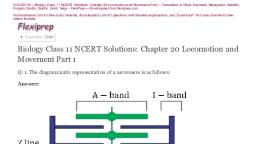
Mechanism of muscle contraction., [Molecular & chemical basis]., , INTRODUCTION:, The mechanism of muscle contraction is best understood, by taking skeletal muscles into consideration., The skeletal muscles possess alternate dark (Anisotropic), & light bands (Isotropic) bands., The functional unit of myofibril of skeletal muscles is the, sarcomere which is bordered by Z-Lines.
Page 3 :
From each Z-line arise actin filaments which extend , through half of the I-band & interdigitate with the ends of, myosin filaments in A-bands., , So far as the contraction of muscle is concerned , a , well known concept of sliding filament was proposed by , HUXLEY , so referred as Huxley's sliding filament theory., It is also called as Cross-bridge theory as it involves the, formation of cross-linkages., Also known as Ratchet theory as filaments slide like, rackets.
Page 4 :
When the motor nerve is stimulated & commands reach to , the muscle fibers , the ATP is broken down in myosin, filaments & energy is released which causes a , rearrangement of cross linkages b/w the filaments., As a result the actin filaments slide deeper into A-bands, between thick myosin filaments., The Z-lines are brought together & the sarcomere shortens., As all the sarcomeres shorten simultaneously , the whole, muscle fiber contracts.
Page 5 :
Since in muscle contraction , the actin filaments slide deeper , over the myosin filaments , the I-bands are reduced where as , A-bands remain unchanged. , in other wards shortening of sarcomere occurs due to the, shortening of I-bands., , During relaxation , the cross-linkages b/w the filaments are , rearranged again & actin filaments slide out from the A-band., this results in elongation of I-bands , thereby pushing the, Z-lines away from each other & thus lengthening the muscle, fiber.
Page 7 :
The main energy source necessary for muscle contraction is, ATP during which it is hydrolyzed to yield ADP & ip by ATPase, of myosin., ATP ADP + ip , There is another high energy rich compound---------- , Creatinine phosphate (CP) which is used to restore ATP , from ADP as per the equation below,, ADP + CP ATP + C , By this muscle contraction continues but CP decreases which , is regained during recovery immediately after , muscle contraction by a reverse reaction using ATP., C + ATP CP + ADP
Page 8 :
The ATP necessary for this purpose is obtained by , anaerobic metabolism (Glycolysis) resulting in the , formation of , lactic acid., During recovery after contraction , lactic acid is oxidized to , CO2 & H2O aerobically to produce more ATP., , C6H12O6 2(C3H6O3) + ENERGY (ATP), , 2C3H6O3 + 6O2 6CO2 +6 H2O +ATP
Page 9 :
The molecular & chemical basis of muscle contraction can, be studied under the following heads,, , 1. ENERGISED STATE (Resting Condition), Normally in resting condition , one ATP molecule , attaches itself to the myosin head & gets hydrolyzed, into ADP & iP with the release of energy., The released energy makes the oblique myosin heads , to rotate / twist & attains perpendicular position to the, rest of the myosin fiber.
Page 10 :
At this time the myosin head is said to be in, cocked position & increases the affinity of binding with , actin fibrils., However no binding occurs because of the two regulatory, proteins-----Tropomyosin & Troponin (three unit structure), which cover the active site (for binding with myosin head), on actin molecule as shown in the figure.
Page 12 :
2. FORMATION OF CROSSBRIDGES / ACTIn-MYOSIN COMPLEX, , As soon as CNS receives the sensory stimulus from the , receptor , It sends commands for contraction through, motor neurons., The message travels in the form of Action potential (AP) , As soon as the motor neuron comes in contact with the, muscle fiber , it transmits its AP to , neuromuscular junction (NM junction) by releasing, acetyl choline (Ach).
Page 14 :
The Ach in turn stimulates sarcolemma & spreads the AP, there on the surface of fiber., The AP soon is transferred to the deeper sites of muscle , fiber through t-tubules which are the invaginations from , the sarcolemma into sarcoplasm b/w terminal cisternae of, sarcoplasmic reticulum., The cisternae possess Rhinodine receptor (RN receptor), which makes sarcoplasmic reticulum to release Ca ions, into sarcoplasm. , Ca ions now bind to the C-unit of troponin which result in , the configurational changes in both the regulatory proteins
Page 15 :
due to which tropomyosin is forced into a groove b/w two, actin filaments thereby exposing the active site for myosin, head which now binds with actin to form actin-myosin , complex leading to cross linkage formation.
Page 17 :
3. POWER STROKE / SLIDING OF ACTIN OVER MYOSIN, , In the mean time , the ADP & iP formed by hydrolysis of, ATP leave the complex resulting in the forceful twisting / , rotating of myosin heads which now get inclined at an , angle of 45 degree instead of 90 degree., This makes the actin filaments to slide over the myosin , filaments., Since one myosin filament contains 500—600 myosin, heads , so by one power stroke the actin filaments slide, by 11nm & in case of forceful contraction it becomes, 5 times
Page 19 :
4. DETACHMENT, , After the power stroke , another ATP molecule binds to, myosin head & gets hydrolyzed into ADP & iP with the , release of energy. , As a result of it myosin head detaches from the actin , filament ( Breakage of cross linkages occur), ADP & iP present in myosin head re unite by ATPase activity, of myosin head. , As a result of it myosin head regains its 90 degree inclination, to repeat the process.
Page 21 :
Thus actin filaments continue to move inwards by , repeated attachments & detachments depending upon , the nature of stimulus., Further in a muscle fiber , some cross bridges are in , power stroke & some are in the energized state., Further it has been found that in resting phase , some , cross bridges remain formed even in the absence of , stimuli , so that the muscle remain in the , partial contraction state. It is called as Tone of the fiber &, accounts for the normal texture of muscles in the body.
Page 23 :
The flow chart of the above events is as follows,, AP travels in motor neuron, , AP passes into N-M junction, , Release of Acetylcholine, , N-M receptor on muscle end plate, , Spread of AP in sarcolemma, , AP spreads to deeper muscle fiber by t-tubule….. contd.
Page 25 :
THANKS , , FOR, , STAYING WITH ME, , DATED--- 29 / 11 / 2021



 Learn better on this topic