Notes of Physics Crash Course, Physics Vectors.pdf - Study Material
Page 1 :
1 . Scalar and vector quantities, Scalar quantities : Physical quantities that have only magnitude and no direction are called scalar quantities, or simply scalars., Example : man, time, speed, temperature, potential etc., Vector quantities : Physical quantities that have both magnitude and direction are called vector quantities, or vectors., Example : Displacement, velocity, force etc., Geometrical representation of a vector, Generally, a vector is represented by a straight line with an arrow head. The length of line is equal to, or proportional to the magnitude and arrow head shows the direction, , In figure. 1 OA is a vector and are represented by the line OA. Arrow mark shows the direction., A, , O, , fig.1, , 2 . Some definitions regarding vector, (i), , Equal vectors - Two vectors are said to be equal if they have the same magnitude and same direction., , , In figure. 2 A and B are two equal vectors, A, B, , (ii), , fig. 2, Note : If a vector is displaced parallel to itself, it remains equal to itself., Negative of a vector - The negative of a vector is defined as another vector having the same magnitude, , , but having an opposite direction. In fig. 3 vector A is the negative of vector B or vice-versa., A, B =– A, , (iii), , (iv), , fig. 3, Modulus of a vector - The modulus of a vector means the length or the magnitude of that vector. It, , , is a scalar quantity. Modulus of vector A | A | A, Unit vector - A unit vector is a vector of unit magnitude drawn in the direction of a given vector., A unit vector in the direction of a given vector is found by dividing the given vector by its modulus. Thus, , a unit vector in the direction of vector A is given by, , , , A, A,  , |A| A, , , A unit vector in the direction of a given vector A is written as  and is pronounced as ‘A carat’ a, ‘A hat’ or ‘A cap’, Note : - The magnitude of a unit vector is unity. It just gives the direction of a vector. A unit vector has
Page 2 :
(v), , no units or dimensions., Collinear vectors - Collinear vector are vectors acting along the same line. They act in the same direction, or opposite direction., Parallel vector - Two collinear vectors acting along the same direction are called parallel vectors. The, angle between the two vector must be zero. The magnitudes of two vectors need not be equal. They, are also called like vectors., , , In figure 4, a, b and c are parallel vectors., a, b, c, , fig. 4, Antiparallel vectors - Two collinear vectors acting in the opposite directions are called antiparallel the, , , angle between them is 180º. They are also called unlike vector. In figure 5. a and b are antiparallel, vectors, a, b, , fig. 5, , 3 . Addition of vectors, Triangle law of vector addition :, If two vectors are represented in magnitude and direction by the two sides of a triangle taken in the, same order, then the resultant is given both in magnitude and direction by the sides of the triangle taken, , , , , in opposite order. Consider two vectors OA = a are OB = b (see in figure 6), B, , B, b, , O, , a, , A, , a+, , O, , O, , A, , b, , A, , fig.6, , , , , , To add a to b , first draw vector a , Next draw vector b with its tail at the head of a and draw a line, , , , , , , from the tail of a to the head of b . Then c = a b . a and b are in the same order,, but c is in, opposite order. We can add any number of vectors by this method., Parallelogram law of vector addition :, If two vectors acting at a point be represented in magnitude and direction by two adjacent sides of a, parallelogram drawn from a point, their resultant is represented in magnitude and direction by the diagonal, of the parallelogram drawn from that point., , , , , Let a and b are represented by adjacent sides AB and AE of a parallelogram ABCE as shown in, figure. 7 given below., E, , C, , b, , b, , , A, , , a, , fig. 7, , B, , D
Page 3 :
, , The resultant c a b will be represented by diagonal AC . Let EAB = . Draw perpendicular CD, , on the extended portion of AB ., , from figure CD = | b | sin, , , BD = | b | cos , , | c | AC =, , AD2 CD2, , =, , (a b cos )2 (b sin )2, , =, , a2 b2 cos 2ab cos b2 sin2 , , =, , a2 b2 (sin cos2 ) 2ab cos , , , | c | a2 b2 2abcos , , ...(i), , , , Let AC makes an angle with a, tan , , , , CD, b sin , , AD a b cos , , ....(ii), , Special cases, (1) If = 0º, , from (i) | c | a b, , from (ii) = 0, (2) If = 180º, , from (i) | c | a b, from (ii) = 0, (3) If = 90º, , , from (i) | c | a2 b2, 1 a , from (ii) tan , b, , Illustration : 1, Two forces of equal magnitude 5 units have an angle 60° between them. Find the magnitude and direction, of resultant force., Solution, R2 = P2 + Q2 + 2PQcos = 52 + 52 +2[5][5] cos60°, = 25 + 25 + 25 = 75, tan =, , R=, , 5 3 unit, , Q sin , 1, 5 3/2, 5 sin 60, 5 3, =, =, =, =, P Q cos 5 5 cos 60 5 5(1 / 2), 3, 15, , = 30°, Illustration : 2, The resultant of two forces 3p and 2p is R. If the first force is doubled keeping the same direction, then the, resultant is also doubled. Find the angle between two forces.
Page 6 :
6 . M ultiplication of a vector by a real number, , Suppose a vector a is multipled by a real number, the vector increases in magnitude, the direction remains, , , constant. For example, let a be multiplied by 2 then the vector 2a has the same direction but magnitude, , , becomes twice. When the vector a is multiplied by -2, the direction is opposite to that of a, , When the vector a is multiplied by the scalar m the new vector has the same direction and same unit but, , the magnitude becomes m times the magnitude of a, , a, , 2a, , -2a 2a, , fig. 11, , 7 . D ot product of two vectors, , , , , The scalar product of two vectors A and B is a scalar quantitiy given by the product of magnitude of A, , and B and the cosin of the smaller angle between then, , A .B AB cos , where, is the angle between the two vectors, Geometrical meaning of scalar product, , , , , As shown in fig 12. suppose two vectors A and B are represented by OP and OQ and POQ = , Q, , Q, , B, B, , O, , , , , , R, B cos, (a), , A, , A, , P, , O, , s, co, , , A, (b), , P, , fig.12, From figure 12 (a), , A . B = AB cos = A (B cos) = A (OR), , , = A (magnitude of component of B in the direction of A ), From figure 12 (b), , A . B = AB cos = B (A cos) = B (OS), , , = B (magnitude of component of A in the direction of B ), Thus the scalar product of two vectors is equal to the product of magnitude of one vector and the magnitude, of component of other vector in the direction of the first vector, PROPERTIES OF DOT PRODUCT, , 1., A . B = AB cos = AB, where = 0 , 2, 2., , when the two vectors are parallel, , , A . B = AB cos, B . A = BA cos, , , A . B B . A i.e. dot product is commutative
Page 7 :
Magnitude of ˆi, ˆj and kˆ is one. The angle between any two of them is 90º, So,, , ˆi . ˆi 1 1 cos 1, cos 1 as 0, , y, >, , ˆj . ˆj 1, , j, , kˆ . kˆ = 1, >, , ˆi . ˆj 1 1 cos 90º 0, , O, , i, , fig. 13, , >, , >, , z, , kˆ . ˆj 0, , >, , k, , kˆ . ˆi 0, , Illustration : 6, , >, , 3., , i, j, k are unit vectors, along x, y, z directions, , , , Given two vectors A 2i 2j , B 3iˆ, , (a) Find A . B, (b) Find angle between the two vectors, , , (c) Find projection of A on B, , , (d) Find projection of B on A, , Solution :, (a), , , ˆ, A . B ( 2iˆ 2ˆj). (3i), , = 6(iˆ . ˆi) 6( ˆj . ˆi), = –6, (b), , 2î 2 ĵ.(3î ) | 2î 2 ĵ || 3î | cos , , , , ˆ ( ( 2)2 (2)2 ) 3 cos , 6 ˆi.iˆ 6( ˆj.i), , , , cos 1 / 2, , (c), , Projection of vector a on vector b = a cos, , , Projection here A on B = A cos , , A.B, = , |B|, , , , , , = 120°, , 6, 6, 2, =, =, | 3iˆ |, 3, , (d), , , , Projection of B on A = B cos, , B. A, = , |A|, 6, , =, , =, , =, , 2, , 2, , ( 2) (2), , 6, 8, , 3, 2, , , , 6, 2 2, , 1.5 2, , , , 6, 44, , a, , , , x, , b
Page 8 :
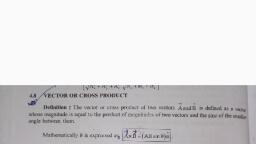
8 . Cross Product of two vectors, Before defining cross product we want to find the area of the parallelogram formed by two vectors, , , , a and b ., , Draw DN perpendicular to OB., sin DN / OD, , , , DN = (OD)sin = bsin, Area of the parallelogram = (base) (height), = (OB) (DN) = absin, , , , , Cross product of two vectors a and b is denoted by a b ., , We define a b | a || b | sin n̂ ab sin n̂, , , where n̂ is a unit vector perpendicular to a and b both, , , and is angle (0 ) between two vectors a and b, as shown in the figure., Remark, , fig. 14, , fig. 15, , , , , (i) The direction of a b (or n̂ ) is the direction of rotation when a is rotated towards b through the angle ., , , (ii) a b b a, , (iii) | a b || ab sin n̂ || ab sin | | n̂ | ab sin , , , = area of the parallelogram formed by the vectors a and b ., The direction of the resultant vector can be represented by the following three rules., Flemming left hand rule, C =A× B, C, , 90º, , B, , B, , , , A, , A, , fig. 16, , , , If the middle finger and the fore finger point in the direction of vector A & B respectively, the thumb pointss, , in the direction of the vector A B, C, Screw rule, , , , If a screw rotates in the direction of corresponding to vector B from vector A the, , , direction in which it moves (upwards or downwards) gives the direction of the vector A B, fig. 17, Right hand thumb rule, , , , If the fingers of the right hand curl in the direction from A to B , the thumb, , points in the direction of vector A B, , B, A, , C, , B, , Cross Product of Two unit Vectors, In the diagram, , OA î , OB ĵ, , î ĵ | î || ˆj | sin 90 n̂, where direction of, , n̂ is along Z-axis but a unit vector along Z-axis, , is denoted by k̂ so n̂ k̂, , A, , fig. 18
Page 10 :
1, INTRODUCTION, 1., , 2., , A vector may change if :, (A) frame of reference is translated, , (B) frame of reference is rotated, , (C) vector is translated parallel to itself, , (D) vector is rotated, , One of the following is not a vector :, (A) displacement, , 3., , (B) work, , (D) gravitational field., , (B) Length, , (C) mass, , (D) weight., , (B) towards origin, , (C) indeterminate, , (D) away the origin., , Which one of the following is not a scalar :, (A) time, , 4., , (C) force, , Direction of zero vector, (A) does not exist, , ADDITION, 5., , The magnitudes of four pairs of displacement vectors are given. Which pairs of displacement vectors, cannot be added to give a resultant vector of magnitude 4 cm ?, (A) 2 cm, 3 cm, , 6., , (B) 1 cm, 3 cm, , (C) 1 cm, 5 cm, , For the fig., , , ABC, , (C) C A B, , , , When two vectors, always :, , (D), , 11., , (B), , , , (C), , /2, , (D), , /4, , , , , , A B C and the magnitudes of A, B and C are 5, 4 and 3 units respectively, the angle between A, , and C is :, , If, , (B) cos–1 (4/5), , (C), , /2, , (D) sin–1(3/4), , Two forces of 4 dynes and 3 dynes act upon a body. The resultant force on the body can only be, (A) More than 3 dynes, , (B) More than 4 dynes, , (C) Between 3 and 4 dynes, , (D)Between 1 and 7 dynes, , In case of three vector quantities of same type, in which case the resultant cannot be zero?, (A) 10,10,10, , 12., , (C) greater than (a + b) (D) not greater than (a + b), , , , , A, B and C are 12, 5 and 13 units respectively and A B C , the angle, , , between vectors A and B is :, , (A) cos–1(3/5), 10., , , A BC 0, , If the magnitudes of vectors, , (A) 0, 9., , , , , , A and B of magnitude a and b are added, the magnitude of the resultant vector is, , (A) equal to (a + b) (B) less than (a + b), 8., , , , (B) B C A, , (A), , 7., , (D) 1 cm, 7 cm, , (B) 10,10,20, , (C) 10, 20,20, , (D) 10,20,40, , Three forces of magnitudes 30,60 and P Newton acting at a point are in equilibrium. If the angle, between the first two is 60º, the value of P is :, (A), , 25 2, , (B), , 30 3, , (C), , 30 6, , (D), , 30 7
Page 11 :
13., , Two forces each numerically equal to 10 dynes are acting as shown in, the following figure, then their resultant is :, , (A) 10 dynes, , (B) 20 dynes, , (C), , 10 3 dynes, , (D) 5 dynes, , SUBTRACTION, 14., , , , , , , , A and B are such that | A B| = | A B| . The angle between the vectors A and B is, , Two vectors, , (B) /3, , (A) 0, 15., , (C), , /2, , (D), , , , A particle moves through angular displacement on a circular path of radius r. The linear displacement will, be, (A) 2r sin (/2), , (B) 2r cos (/2), , (C) 2r tan (/2), , (D) 2r cot (/2), , RESOLUTION, 16., , The vector, , , , P makes 120º with the x-axis and the vector Q makes 30º with the y-axis. What is their, , resultant ?, (A) P + Q, 17., , (B) P – Q, , (B) 5 miles, , (C) 4 miles, , (D) between 5 and 9 miles, , , , The angle that the vector A 2 i 3j makes with y-axis is :, (A) tan–1(3/2), , 19., , P2 Q2, , A man travels 1 mile due east, then 5 miles due south, then 2 miles due east and finally 9 miles due north,, how far is he from the starting point :, (A) 3 miles, , 18., , P 2 Q 2 (D), , (C), , (B) tan–1 (2/3), , (C) sin–1(2/3), , (D) cos–1(3/2), , A man moves towards 3 m north then 4m towards east and finally 5 m towards 37° south of west. His, displacement from origin is:, (A) 5 2 m, , (B) 0 m, , (C) 12 m, , (D) 5 m, , DOT PRODUCT, 20., , If 3î 2 ĵ 8k̂ and 2 î xˆj k̂ are at right angles then x =, (A) 7, , 21., , (B) – 7, , (D) – 4., , a 1î a 2 ĵ is a unit vector perpendicular to 4î 3 ĵ if, (A) a1 = .6, a2 = .8, , 22., , (C) 5, , (B) a1 = 3, a2 = 4, , (C) a1 = .8, a2 = .6, , (D) a1 = 4, a2 = 3., , , , If a is a vector and x is a non-zero scalar, then, , , , , , (A) x a is a vector in the direction of a, , , , , , (C) x a and a have independent directions, , , , , , (B) x a is a vector collinear to a, (D) none of these., , CROSS PRODUCT, 23., , , , , , , , If a is perpendicular to b and c , then, , , , , , (A) a ( b c ) 1, , , , , , (B) a ( b c) 0, , , , , , (C) a ( b c) 1, , (D) None of these.
Page 12 :
2, INTRODUCTION, 1., , Pick out the two scalar quantities in the following list:, Force, angular momentum, work, current, linear momentum, electric field, average velocity, magnetic, moment, reaction as per Newton’s third law, relative velocity., , 2., , Pick out the only vector quantity in the following list:, Temperature, pressure, impulse, time, power, total path length, energy, gravitational potential, coefficient of, friction, charge., , ADDITION, 3., , The sum of the magnitudes of two forces acting at a point is 18 and the magnitude of their resultant is 12., If the resultant is at 90º with the force of smaller magnitude, what are the magnitudes of forces ?, , 4., , The sum of two forces acting at a point is 16 N. If the resultant force is 8 N and its direction is perpendicular, to minimum force, then the forces are :, , 5., , When two forces of magnitude P and Q are perpendicular to each other, their resultant is of magnitude, R. When they are at an angle of 180° to each other, their resultant is of magnitude, , R, . Find the ratio, 2, , of P and Q., 6., , , , , , , , , , The resultant of two velocity vectors A and B is perpendicular to A .Magnitude of Resultant R is, , , , , , , , equal to half magnitude of B . Find the angle between A and B ?, 7., , Two vectors have magnitudes 3 units and 4 units respectively. What should be the angle between, them if the magnitude of the resultant is, (a) 1 unit,, , (b) 5 units and, , (c) 7 units., , SUBTRACTION, 8., , , , , , A vector A of length 10 units makes an angle of 60° with a vector B of length 6 units. Find the, , , , , , , , magnitude of the vector difference A B & the angle it makes with vector A ., 9., , A body is moving with uniform speed v in a horizontal circle in anticlockwise direction.What is the change, in velocity in (a) half revolution (b) first quarter revolution., , 10., , If the sum of two unit vectors is also a unit vector. Find the magnitude of their difference ?, , RESOLUTION, 11., , , , A are 4 and 6 m respectively. The x and y components of vector A B, , are 10 and 9 m respectively. Calculate for the vector B the following :, , The x and y components of vector, (a) its x and y components, , 12., , (b) its length, and, , (c) the angle it makes with x-axis., , , , If the four forces as shown are in equilibrium, Express F1 & F2 in unit vector form., F2, , ĵ, , 15 N, , 30°, 37°, , 10 N, , 30°, , F1, , î
Page 13 :
13., , A plane body has perpendicular axes OX and OY marked on it and is acted on by following forces:, 5 P in the direction OY, 4 P in the direction OX, 10 P in the direction OA where A is the point (3a, 4a), 15 P in the direction AB where B is the point (–a, a), Express each force in the unit vector form & calculate the magnitude & direction of sum of the, vectors of these forces., , 14., , A body acted upon by three given forces is under equilibrium., (a), , , , If F1 = 10 Nt, F2 = 6 Nt , find the values of, , F2, , F1, , 37°, , , F3 & angle ., (b), , 15., , 16., , 17., , 18., 19., , x, , , , Express F2 in unit vector form., , F, , , , A particle is acted upon by the forces F1 2î aĵ 3k̂ , F2 5î cĵ bk̂ , F3 bî 5 ĵ 7k̂ ,, , F4 c î 6 ĵ ak̂ . Find the values of the constants a, b, c in order that the particle will be in equilibrium., A vector makes an angle of 30° with the horizontal. If horizontal component of the vector is 250, find, the magnitude of vector and its vertical component?, , , , , A î 2 ĵ 3k̂ , when a vector B is added to A , we get a unit vector along x-axis. Find the value of, , B ? Also find its magnitude., , In the above question, find a unit vector along B ?, , , , , Vector A , B and C have magnitude 5, 5 2 and 5 respectively, directions of A , B and C are, towards east, North-East and North respectively. If î and ˆj are unit vectors along East and North, , respectively, express the sum A B C in terms of î , ˆj . Also find magnitude and direction of the, resultant., , 20., , You walk 3 Km west and then 4 Km headed 60° north of east. Find your resultant displacement:, (a), , graphically, and, , (b), , using vector components., , 21., , A car travels due east on a level road for 30 km. It then turns due north at an intersection and travels4 0, km before stopping. Find the resultant displacement of the car., , 22., , A particle is given a displacement of 5.0 cm in the east direction and then a displacement of 4.0 cm, 60º north of east. Find the magnitude and the direction of the resultant displacement., , 23., , A particle is given a displacement of 4.0 m in x-y plane. If the x-component of the displacement vector is 2.0, m, find the y-component. Also find the angle subtended by the displacement vector with the x-axis., , 24., , An aeroplane takes off at an angle of 30º to the horizontal runway. The component of its velocity along the, runway is 200 km h–1. What is the actual velocity of the plane ? What is the vertical component of its, velocity ?, , 25., , A 50 kg block is placed on an inclined plane with an angle of 30º. Then find the components of the weight, (i) perpendicular (ii) parallel to the inclined plane., , 26., , Find the magnitude of resultant of following three forces acting on a particle., , , F1 20 N in eastward direction,, , F2 20 N due north east and, , F3 20 N in southward direction
Page 15 :
3, INTRODUCTION, 1., , The resultant of two forces F 1 and F 2 is P. If F 2 is reversed, then resultant is Q. Then the value of, (P2 + Q2) in terms of F 1 is:, (A), , 2., , , , 2 F12 F22, , , , (B) F12, , F22, , (C), , F1 F2 2, , (D) None of these, , Which of the following is a vector quantity?, (A) Temperature, , (B) Surface tension, , (C) Heat, , (D) Force, , ADDITION, 3., , The resultant of two forces acting at an angle of 150º is 10 kg wt, and is perpendicular to one of the forces., The smaller force is :, (A), , 4., , 10 3 kg wt(B) 20 3 kg wt, , 3 ) kg wt, , The resultant of two forces, one double the other in magnitude is perpendicular to the smaller of the, two forces. The angle between the two forces is:, (A) 150°, , 5., , (D) (20 /, , (C) 20 kg wt, , The two vectors, , (B) 90°, , (C) 60°, , (D) 120°, , A and B are drawn from a common point and C = A B, then angle between A and, , B is, (A) 900 if C2 A2 + B2, (C) greater than 900 if C2 > A2 + B2, 6., , (B) greater than 900 if C2 < A2 + B2, (D) None of these, , , , , If e1 & e2 are two unit vectors and is the angle between them , then sin is :, 2, , 1 , e1 e2, (A), 2, , 1 , e1 e2, (B), 2, , , e1 . e2, (C), 2, , SUBTRACTION, , , 7., If | A B || A B | , which of the following options in not true, , , , , (A) A is a null vector, (B) B is a null vector, (C) A is to B, , 8., If C A B , then which of the following relations is necessarily valid., (A) A < B, , (B) A > B, , (C) A = B, , , e1 x e2, (D) , 2 e1 e2, , , , (D) A is || to B, (D) none of these, , RESOLUTION, 9., , If, , , , , A B is a unit vector along x-axis and A i j k , then what is B ?, , (A) j k, 10., , (B) j k, , (C) i j k, , (D) i j k, , , , With respect to a rectangular cartesian co-ordinate system three vectors are expressed as a 4 i j ,, , , , , b 3i 2 j and c k where i , j and k are unit vectors along the x,y,z axes respectively. The unit, vector along the direction of sum of these vectors is :
Page 16 :
11., , 1 , ( i j k), 3, , (A), , r , , (C), , 1, r ( i j k ), 3, , r , , 1 , ( i j k), 2, , (D), , r , , 1 , ( i j k), 3, , Three forces P, Q & R are acting at a point in the plane. The angle between P & Q and Q & R are 150°, & 120° respectively. Then for equilibrium, forces P, Q & R are in the ratio :, (A) 1 : 2 : 3, , 12., , (B), , (B) 1 : 2 :, , (C) 3 : 2 : 1, , 3, , (D), , 3 :2:1, , A bird moves from point (1, –2, 3) to (4, 2, 3). If the speed of the bird is 10 m/sec, then the velocity, vector of the bird is:, , , , (A) 5 î 2 ĵ 3k̂, , , , , , (B) 5 4î 2 ĵ 3k̂, , , , (C) 0.6 î 0.8 ˆj, , (D) 6 î 8 ĵ, , DOT PRODUCT, 13., , , , , , (A) 0, 14., , , , , , , , , , If a = 2î 3 ĵ , b = 2ˆj 3k̂ , then ( a + b ).( a – b ) =, (B) -8, , (C) 9, , (D) -10., , A unit vector in xy-plane that makes an angle of 450 with the vector î ĵ and an angle of 600 with the vector, , 3î 4 ĵ is, (A) î, 15., , (B), , î ĵ, , (C), , 2, , î ĵ, 2, , (D) None of these., , , , The force determined by the vector r = (1, 8, 7) is resolved along three mutually perpendicular, , , directions , one of which is the direction of the vector a 2 i 2 j k . Then the vector component, , , , , of the force r in the direction of the vector a is :, (A) 14 i 14 j 7 k, , (B) , , 14 14 7 , i j k, 3, 3, 3, , (C) , , 2 2 1, i j k, 3, 3, 3, , (D) none of these, , CROSS PRODUCT, 16., , If, , | A B | 3 A . B then the value of | A B | is :, , (A) ( A 2 B 2 , , 3AB)1 / 2, , (B), , (A 2 B2 AB)1/ 2, , 1/ 2, , 17., , AB , 2, 2, , (C) A B , (D) A + B, 3, , , , , , , Let a 2 i j 2 k and b i j . If c is a vector such that a. c | c|, | c a| 2 2, , , , and the angle between ( a b) and c is 300, then |( a b) c| , (A) 2/3, , 18., , 19., , (B) 3/2, , (C) 2, , (D) 3, , , If the vectors a , b , c form the sides BC, CA and AB respectively of a triangle ABC, then, , , (A) a. b b. c c. a 0, (B) a b b c c a, , , (C) a. b b. c c. a, (D) a b b c c a 0, , , , , , , , , , , , , , , The value of i x r x i + j x r x j + k x r x k, , , (A) r, , , , (B) 2 r, , , , is :, , , , (C) 3 r, , , , (D) 4 r
Page 17 :
PHYSICS, , 4, INTRODUCTION, 1., , What is the maximum number of rectangular components into which a vector can be split in space ?, , 2., , What is the maximum number of rectangular components into which a vector can be split in its own plane, , ADDITION, 3., , , , , Two vectors A and B are such that A B C and A2 + B2 = C2. Find the angle between the two vectors., , SUBTRACTION, , , , 4., If A B is a unit vector along x-axis and A ˆi ˆj kˆ , then what is B ., , 5., , , , , The direction of a vector A is reversed. Find the values of A and | A | ?, , RESOLUTION, 6., , A body is moving uniformly on a circle with speed v. Find the magnitude of change in its velocity when it has, turned an angle ., , DOT PRODUCT, 7., , î and ĵ are unit vectors along x-axis and y- axis respectively. What is the magnitude and direction of the, , vectors î ĵ , and î ˆj ? What are the components of a vector A 2î 3 ĵ along the directions of î ĵ and, , î ˆj ?, 8., , , , Given that A = B. Find the angle between A B and A B ., , CROSS PRODUCT, 9., , , , , Angle between P and Q is . Find the value of P.Q P ?, , 10., , Find the value of p for which the vectors a 3î 2 ĵ 9k̂ and b î pˆj 3k̂ are (i) perpendicular (ii), , , , parallel., ,
Page 18 :
ANSWER SHEET, EXERCISE # 1, 1., , (D), , 2., , (B), , 3., , (D), , 4., , 5., , (D), , 6., , (C), , 7., , (D), , 8. (C), , 9., , (A), , 10., , (D), , 11., , (D), , 12. (D), , 13., , (A), , 14., , (C), , 15. (A), , 16. (A), , 17., , (B), , 18., , (B), , 19. (B), , 20. (B), , 21., , (A), (B), , 22., , (B), , 23. (B), , EXERCISE # 2, 1., , work & current, , 2. Impulse, , 3., , 5 & 13, , 4., , 6 N & 10 N, , 5. 2 ± 3, , 6., , 150º, , 7., , (a) 180º (b) 90º (c) 0º, , 9., , (a) 2 v directed south (b), , 11., , (a) Bx = 6m ; By = 3m, , 12., , F2 (12 5 3 ) ˆi (12 3 15)jˆ , F1 (12 3 6) ˆj, , 13., , ˆ 12P ˆi 9Pj,, ˆ 20, tan1 [ 2] with the +ve x-axis., 5P ˆj, 4P ˆi, 6P ˆi 8Pj,, , 14., , (a) 90º , F 3 = 8 (b) – 6i, , 15., , a = –7, b = – 3, c = –4, , 16., , 500 250, ,, 3, 3, , 18., , 20., 22., , 24., , 2ˆj 3kˆ, , 8. Ans., , 2 v south-west, (b) 3, , 76 Units, tan–1, , 10. Unity, , 5 m (c) tan–1(1/2) = 26.6º, , 17., , 2ˆj 3kˆ ,, , 13, , 19. 10 2, 45º N of E, , 13, 1iˆ 2 3 ˆj, , 61 26º 3 N of E, 400, , 200, , 3, , 3, , 21. 50 km, 53º N of E, 23., , 2 3, 60º, , 25. (i) 250 3 (ii) 250, , 3 3, 7, , (C)
Page 19 :
26., , 20 3, , 28. 3, –1, , 29., , 7 2, , 30., , 31., , 5/ 2, , 32. (i) 1 (ii) 2iˆ 2ˆj, , 33., , 4 6, , 35. North, , 36., , /4, , 37., , 38., , Nort, , 56 , cos , , 65 , , 6 ˆj 3kˆ, , EXERCISE # 3, 1., , (A), , 2., , (D), , 3., , (A), , 4., , (C), , 5., , (B), , 6., , (B), , 7., , (B), , 8., , (D), , 9., , (B), , 10., , (A), , 11. (D), , 12. (D), , 13., , (A), , 14., , (D), , 15. (B), , 16. (B), , 17., , (B), , 18., , (B), , 19. (B), , EXERCISE # 4, /2, , 1., , 3, , 2., , 2, , 3., , 5., , , 2A,0, , 6., , 2V sin (/2), , 7., , 8., , 90º, , 9., , zero, , 10. (i) –15 (ii), , 4., , 2, 45º N of E,, , 2, 3, , ˆj kˆ, , 2, 135º N of W,, , 5, 2, , ,, , 1, 2



 Learn better on this topic