Notes of New Class, Bio & Chemistry & Physics chemistry : basic science notes - Study Material
Page 1 :
polymer, polymer, any of a class of natural or synthetic substances, composed of very large molecules, called macromolecules, that, are multiples of simpler chemical units called monomers., Polymers make up many of the materials in living organisms,, including, for example, proteins, cellulose, and nucleic acids., Moreover, they constitute the basis of such minerals, as diamond, quartz, and feldspar and such man-made materials, as concrete, glass, paper, plastics, and rubbers., The word polymer designates an unspecified number, of monomer units. When the number of monomers is very, large, the compound is sometimes called a high polymer., Polymers are not restricted to monomers of the same, chemical composition or molecular weight and structure., Some natural polymers are composed of one kind of monomer., Most natural and synthetic polymers, however, are made up of, two or more different types of monomers; such polymers are, known as copolymers., Natural polymers: organic and inorganic, Organic polymers play a crucial role in living things, providing, basic structural materials and participating in vital life, processes. For example, the solid parts of all plants are made, up of polymers. These include cellulose, lignin, and, various resins. Cellulose is a polysaccharide, a polymer that is, composed of sugar molecules. Lignin consists of a complicated, three-dimensional network of polymers. Wood resins are, polymers of a simple hydrocarbon, isoprene. Another familiar, isoprene polymer is rubber., Other important natural polymers include the proteins, which, are polymers of amino acids, and the nucleic acids, which are, polymers of nucleotides—complex molecules composed of
Page 2 :
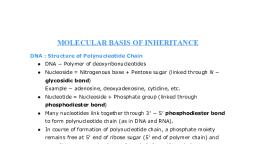
nitrogen-containing bases, sugars, and phosphoric acid. The, nucleic acids carry genetic information in the cell. Starches,, important sources of food energy derived from plants, are, natural polymers composed of glucose., polynucleotide chain of deoxyribonucleic acid (DNA), Portion of polynucleotide chain of deoxyribonucleic acid, (DNA). The inset shows the corresponding pentose sugar and, pyrimidine base in ribonucleic acid (RNA)., Many inorganic polymers also are found in nature, including, diamond and graphite. Both are composed of carbon. In, diamond, carbon atoms are linked in a three-dimensional, network that gives the material its hardness. In graphite, used, as a lubricant and in pencil “leads,” the carbon atoms link in, planes that can slide across one another., Synthetic polymers, Synthetic polymers are produced in different types of reactions., Many simple hydrocarbons, such as ethylene and propylene,, can be transformed into polymers by adding, one monomer after another to the growing chain. Polyethylene,, composed of repeating ethylene monomers, is an addition, polymer. It may have as many as 10,000 monomers joined in, long coiled chains. Polyethylene is crystalline, translucent, and, thermoplastic—i.e., it softens when heated. It is used for, coatings, packaging, molded parts, and the manufacture of, bottles and containers. Polypropylene is also crystalline and, thermoplastic but is harder than polyethylene. Its molecules, may consist of from 50,000 to 200,000 monomers., This compound is used in the textile industry and to make, molded objects., Other addition polymers include polybutadiene, polyisoprene,, and polychloroprene, which are all important in the
Page 3 :
manufacture of synthetic rubbers. Some polymers, such, as polystyrene, are glassy and transparent at room temperature,, as well as being thermoplastic. Polystyrene can be coloured any, shade and is used in the manufacture of toys and, other plastic objects., If one hydrogen atom in ethylene is replaced by, a chlorine atom, vinyl chloride is produced. This polymerizes, to polyvinyl chloride (PVC), a colourless, hard, tough,, thermoplastic material that can be manufactured in a number of, forms, including foams, films, and fibres. Vinyl acetate,, produced by the reaction of ethylene and acetic acid,, polymerizes to amorphous, soft resins used as coatings and, adhesives. It copolymerizes with vinyl chloride to produce a, large family of thermoplastic materials., Many important polymers have oxygen or nitrogen atoms,, along with those of carbon, in the backbone chain. Among such, macromolecular materials with oxygen atoms are polyacetals., The simplest polyacetal is polyformaldehyde. It has a, high melting point and is crystalline and resistant to abrasion, and the action of solvents. Acetal resins are more like metal, than are any other plastics and are used in the manufacture of, machine parts such as gears and bearings., A linear polymer characterized by a repetition of ester groups, along the backbone chain is called a polyester. Open-chain, polyesters are colourless, crystalline, thermoplastic materials., Those with high molecular weights (10,000 to 15,000, molecules) are employed in the manufacture of films, molded, objects, and fibres such as Dacron., The polyamides include, the, naturally, occurring, proteins casein, found in milk, and zein, found in corn (maize),
Page 4 :
from which plastics, fibres, adhesives, and coatings are made., Among the synthetic polyamides are the urea-formaldehyde, resins, which are thermosetting. They are used to produce, molded objects and as adhesives and coatings for textiles and, paper. Also important are the polyamide resins known, as nylons. They are strong, resistant to heat and abrasion, noncombustible, and nontoxic, and they can be coloured. Their, best-known use is as textile fibres, but they have many other, applications., A different class of polymers are the mixed organicinorganic compounds. The most important representatives of, this polymer family are the silicones. Their backbone consists, of alternating silicon and oxygen atoms with organic groups, attached to each of the silicon atoms. Silicones with, low molecular weight are oils and greases. Higher-molecularweight species are versatile elastic materials that remain soft, and rubbery at very low temperatures. They are also relatively, stable at high temperatures., Fluorocarbon-containing polymers, known as fluoropolymers,, are made up of carbon–fluorine bonds, which are highly stable, and render the compound resistant to solvents. The nature of, carbon–fluorine bonding further imparts a non-stick quality to, fluoropolymers; this is most widely evident in, the polytetrafluoroethylene (PFTE) Teflon., Polymer chemistry, The study of such materials lies within the domain of, polymer chemistry. The investigation of natural polymers, overlaps considerably with biochemistry, but the synthesis of, new polymers, the investigation of polymerization processes,, and the characterization of the structure and properties of
Page 5 :
polymeric materials all pose unique problems for polymer, chemists., Polymer chemists have designed and synthesized polymers that, vary, in, hardness,, flexibility,, softening, temperature, solubility in water, and biodegradability. They, have produced polymeric materials that are as strong as steel, yet lighter and more resistant to corrosion. Oil, natural gas, and, water pipelines are now routinely constructed of plastic pipe., In recent years, automakers have increased their use of plastic, components to build lighter vehicles that consume less fuel., Other industries such as those involved in the manufacture of, textiles, rubber, paper, and packaging materials are built upon, polymer chemistry., Besides producing new kinds of polymeric materials,, researchers, are, concerned, with, developing, special catalysts that are required by the large-scale industrial, synthesis of commercial polymers. Without such catalysts, the, polymerization process would be very slow in certain cases.



 Learn better on this topic