Notes of Mrityunjay Classes, Civil Engineering IMG_20211115_103651~2.jpg - Study Material
Page 1 :
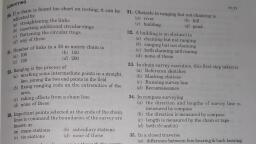
Tha, , 77. The last reading of leavelling is always a, (a) back sight (6) fore sight, (c) intermediate sight (¢) any of these, , 78. In levelling, a station is a point where, (a) staffis placed, , (6) instrument is set up, , (c) bench mark is marked, , (d) none of these, , 79. Tilting levels are used for, (a) fly levelling (6) precise levelling, , (c) profilelevelling (d) none of these, , In levelling across a hill, the level should be, set up on, , (a) side of the hill, (c) both (a) and (6, , 80., , (6) its top, (d), none of these, , An imaginary line connecting the points of equal, elevation on the ground surface is known as, , (a) contour line, , (6) contour interval, , (c) horizontal equivalent, , (d) contour gradient., , 81., , The vertical distance between any two consecutive, contours is known as, (a) conmtour line, , (c) contour gradient, , 82., , (6) controur interval, (d) horizontal equivalent, , The contour interval depends upon, (a) Nature of the ground, , (6) Seale of the map, , (c) Purpose and extent of survey, (d) All of these, , Contour interval is proportional, , (a) directly to the scale of map, , (6) inversely to the scale of map, , (c) directly to the flatness of the ground, (d) none of these, , 83., , 85., , horizontal is called, , (a) contour line, , (6) contour gradient, , (c) contour interval, , (d) horizontal equivalent., , Contour lines are perpendicular to the, (a) ridge line (6) valley line, (ec) both(a)and(6) (d) none of these, , 86., , 87., , for preparing the contour map ofa, (a) valley (6) hill, (c) ridge (d) plain surface,, , , , An imaginary line lying throughout the surface, of gound having a constant inclination to the, , The tacheometric method is more suitable method, , 89., , oT,, , 92., , 93., , 94., , 95., , Plane table surveying is a graphical method of, surveying 10 which, (a) field work, simultaneously, (6) plotting is done, in field book, (c) only field work is done, , (d) none of these, , and plotting proceeds, , later while records are taken, , Setting up the plane table consists of operations, etti, , (a) levelling, , (6) centring ;, , (c) levelling and centring, , (d) orienting, , Placing the table over the station such that the, station plotted on sheet is exactly, above the, corresponding station on the ground is, , (6) levelling, , (a) centring ;, (d) resection, , (c) orienting, , Orientation is the operation of keeping the table, , at successive stations such that, , (a) position of the table at the station is parallel, to the position it occupied at the previous, station, , (6) position of station plotted on sheet is exactly, above the corresponding station on ground, , (c) table is brought in a horizontal plane, , (d) none of these, , The two-point problem is, , (a) a case of resection method where no vay is, required to be drawn from the proceeding, station to the instrument station, , (6) locating of position of plane table by means of, two visible well defined points, , (c) both (a) and (6), , (d) none of these, , Three-point problem can be solved by, @) tracing paper method, , (6) graphical method, , (c) trial and error method, , (d) all of these, , Strength of fix of a plane table is, , (a) accuracy in centring, , (6) accuracy in locating the position ofimeeeamnenn, , 6 eo re observations to three stations, y ol table while solyi -pol, , (d) none of these ee, , A poor ‘fix’ of the table is, (a) when station is within great triangle, (6) when station is near the great circle, , (c) the angle subtend di, (d) none of these oe