Notes of I PUC, Chemistry Periodic table.pdf - Study Material
Page 1 :
1., , , , PERIODIC TABLE
Page 2 :
, , 2.
Page 3 :
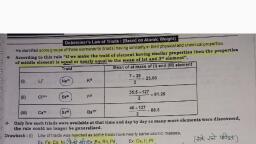
1, , Chapter 1, , Periodic Table, , Introduction, Development of Periodic Table, 1. Dobereiner’s Law of Triads:, When elements having similar properties are, placed in increasing order of atomic weight in, group of three, then atomic weight of middle, element, , is, , arithmetic, , mean, , of other two, , elements., Triad, , Concept Ladder, Doberenier's law of trids was, rejected because in some, triads all the three elements, possessed nearly the same, atomic masses., , Atomic, Masses, , Lithium, , 6.94, , Sodium, , 22.99, , Potassium, , 39.1, , The arithmetic mean of the masses of potassium, and lithium corresponds to 23.02, which is, almost equal to the atomic mass of sodium, Ex:, Ca, Sr, Ba, , Previous Year’s Question, Who is called the father of, chemistry, [AIPMT], (1) Faraday, (2) Priestley, (3) Rutherford, (4) Lavoiser, , P, As, Sb, Cl, Br, I, S, Se, Te, , �, When elements arranged in order of their, increasing atomic weights, the properties of every, eighth element were similar to those of the first, one., , Rack your Brain, Why was the law of octaves, discarded?, , 3., , Periodic Table, , 2. Newland’s Law of Octaves :
Page 4 :
sa, , re, , ga, , ma, , pa, , dha, , ni, , sa, , Li, , Be, , B, , C, , N, , O, , F, , Na, , Na, , Mg, , Al, , Si, , P, , S, , Cl, , K, , 3. Lother Meyer Curve, He plotted a graph between the atomic volume, and atomic weights of the elements and observed, that, , the, , elements, , with, , similar, , properties, , occupied similar position on the curve., , Concept Ladder, Lother Meyer proposed, that, the, physical, properties of the elements, are a periodic function of, the atomic weights., , (1) The most strongly electropositive alkali metal, occupy the peaks on the curve., (2) The less strongly electropositive alkaline earth, metals occupy the descending position on the, , Periodic Table, , curve., , Rack your Brain, Why Lothar Meyer's periodic, classification was not that much, appreciated., , (3) The most electronegative elements i.e. halogens, occupy the accupy the ascending position on the, curve., 4.
Page 5 :
4. Mendeleev’s Periodic Table :, The physical and chemical properties of elements, are the periodic function of their atomic weights,, i.e., when the elements are arranged in order of, their increasing atomic weights, elements with, similar properties are repeated after certain, regular intervals. It consists of seven horizontal, rows called periods., Mendeleev's original talb econsists of 8 vertical, columns called groups. Thesea re numbered as, I, II, III....VIII. However, 9th vertical column called, zero group was added with the discovery of inert, gases. Except for 8 and 0, each group is further, , Definition, A tabular arrangement of, elements in rows and columns,, highlighting, the, regular, repetition of properties of, elements is called a periodic, table., , Concept Ladder, Modern Periodic Table, Mosley's Low, , � � a �Z � b�, � �Z, , divided into two sub-group designated as A and, B. Group 8 consists of 9 elements arranged in, Defects :, Position of hydrogen, position of isotopes, position, of lanthanides and actinides, anomalous pairs of, elements. Some dissimilar elements are grouped, together while some similar elements are placed, in different groups., Modern Periodic Law :, y, , Physical and chemical properties of the elements, are a periodic function of their atomic numbers,, i.e. elements are arranged in order of their, increasing atomic numbers, the elements with, similar properties are repeated after certain, regular intervals., Cause of Periodicity :, It is due to repetition of similar outer electronic, configurations after certain regular intervals., , Rack your Brain, Iodine having lower atomic mass, than tellurium was placed ahead, of tellurium. Why?, , Previous Year’s Question, The long form of periodic table has, �, [AIPMT], (1) 8 horizontal rows & 7 vertical, columns, (2) 7 horizontal rows & 18 vertical, columns, (3) 7 horizontal rows & 7 vertical, columns, (4) 8 horizontal rows and 8 vertical, columns, , 5., , Periodic Table, , three sets each containing three elements.
Page 6 :
Electronic configuration of elements :, , Periodic Table, , Nomenclature of element with Atomic number (Z) > 100, Digit, , Root, , Abbreviation, , Digit, , Root, , Abbreviation, , 0, , nil, , n, , 5, , pent, , p, , 1, , un, , u, , 6, , hex, , h, , 2, , bi, , b, , 7, , sept, , s, , 3, , tri, , t, , 8, , oct, , o, , 4, , quad, , q, , 9, , enn, , e, , 6.
Page 7 :
Q.1., , What is the name of element with atomic number (Z) = 103?, , A1., , Unniltrium, , Electronic Configuration of Elements and The Periodic Table, Periodic table is divided into the four blocks viz., (1) s-Block (2) p-Block (3) d-Block (4) f-Block, s-Block Elements, , Rack your Brain, , Q.2, , Why Be is not a true alkaline earth metal?, , A2, , Be is not a true alkaline earth metal since its oxide is amphoteric, , 7., , Periodic Table, , Which elements of s-Block are, largely found in biological fluids?
Page 9 :
d-Block Elements (Transition Elements), , (1) These are present in the middle part of, the periodic table (between s and p block, elements), (2) These constitute IIIB to VIIB, VII, IB and IIB i.e.,, 3 to 12 groups of the periodic table., (3) Filling of electrons takes places in penultimate, shell. i.e., (n – 1) shell., y, , 3d Series : Also known as first transition series, having 10 elements starting from “Scandium” (Z, = 21) to “Zinc” (Z = 30)., Ex :- Fe : [Ar] 3d64s2, , y, , 4d Series : Also known as second transition, series having 10 elements starting from “Yttrium”, , Concept Ladder, d-block, elements, form, coloured, compounds, and, coloured complexes. They, have vacant orbitals. Electrons, take up energy and move to, higher energy levels and thus, appear coloured., , (Z = 39) to “Cadmium” (Z = 48)., Ex :- Pd : [Kr] 4d105s0, 5d Series : Also known as third transition series, having 10 elements starting from “Lanthanum” (Z, = 57) to “Mercury” (Z = 80)., Ex :- Au : [Xe] 5d106s1, y, , 6d Series : Also known as fourth transition series, having 10 elements starting from “Actinium” (Z =, 89) to “Copernicium” (Z = 112)., Ex :- Rf : [Rn] 6d27s2, , Previous Year’s Question, An atom has electronic configuraiotn, 1s22s22p63s23p63d34s2, you will place, it in, �, [AIPMT], th, (1) 5 gruop, (2) 15th gruop, (3) 2nd group, (4) 3rd group, , 9., , Periodic Table, , y
Page 10 :
f-Block Elements (Inner Transition Elements), , (1) All are metals., (2) They are paramagnetic in nature., (3) They form coloured compounds., (4) They have tendency to form complexes., (5) Filling of electrons takes place in anti-, , Concept Ladder, , penultimate shell. i.e. (n – 2) shell., (6) Chemically, lanthanides are very similar. It is, difficult to separate them form a mixture by, applicaiton of a chemical property. Similary,, actinides have similar chemical proper;ties., The, , members, , of, , actinides, , show, , f-Block show variable valency., The +3 is the most important, oxidation state. Few elements, show +2 and +4 oxidation, states., , the, , phenomenon of radioactivity., y, , Lanthanoids : (Atomic number 58–71), Lanthanoids belongs to 3rd group (III B group), and VI period having (n–2)f1–14 (n–1)d0-1 ns2, electronic configuration., , y, , Actinoids : (Atomic number 90–103), Actinoids belongs to 3rd group (III B group), and VII period (n–2)f0–14 (n–1)d0-1 ns2 electronic, , Periodic Table, , configuration., y, , Hydrogen, Helium, Thorium are exception to, , Previous Year’s Question, Gadolinium belongs to 4f series. Its, atomic number is 64. Which of the, following is the correct electronic, configuration of gadolinium?, �, [AIPMT-2015], (1) [Xe]4f05s1, (2) [Xe]4f75d16s2, (3) [Xe]4f65d26s2 (4) [Xe]4f86d2, , block classification., , 10.
Page 11 :
y, , Every period starts with the filling of s-orbital &, ends with p-orbital., , y, , Mainly d and f-block elements have exceptions, in electronic configuration which is due to orbital, contraction., , Rack your Brain, What are transactinides or Super, heavy elements?, , Magic number :, y, , They are the set of number after which properties, of elements (mainly chemical property) are, repeated at regular intervals., General electronic configuration for various, blocks :, (i) s-block : ns, , 1,2, , where n ≥ 1, , (ii) p-block : ns np, 2, , 1–6, , (iii) d-block : (n–1)d, , where n ≥ 2, , ns, , 1–10, , 1, 2, , where n ≥ 4, , (iv) f-block : (n–2)f1–14(n–1)d0,ns2 where n ≥ 6, , Concept Ladder, Values of magic numbers are in, gruop., 1st : I(A)– 2, 8, 8, 18, 18, 32, 2nd : II(A)– 8, 8, 18, 18, 32, 3rd : III(B)– 18, 18, 32, 4th to 12th : 18, 18, 32, , y, , Maximum number of electrons in outermost orbit, , 13th to 17th : 8, 18, 18, 32, 32, , of :, , 18th : 8, 8, 18, 18, 32, , (i) s-block elements = 2, (ii) p-block elements = 8, (iii) d-block elements = 10, y, , Total number of electrons in outermost orbit of, Pd will be 18., i.e. Pd – [Kr] 4s2 4p6 4d10, , y, , Maximum number of electrons in penultimate, shell i.e. (n–1) shell., (i) d-block elements = 18, (ii) f-block elements = 9, , y, , Maximum number of electrons is antipenultimate, shell i.e. (n–2) shell of f-block elements 32 range, (19 to 32)., , Previous Year’s Question, The elements Z = 114 has been, discovered recently. It will belong to, which of the following family/group, and electronic configuration?, [NEET], 14, 10, (1) Carbon family, [Rn] f 6d 7s2 7p2, (2) Oxygen family, [Rn] f14 6d10 7s2 7p4, (3) Nitrogen family, [Rn] f14 6d10 7s2, 7p6, (4) Halogen family, [Rn] f14 6d10 7s2, 7p5, , 11., , Periodic Table, , (iv) f-block elements = 14
Page 12 :
Atomic numbers of various inert gases :, 2, First period ���, � He � 2 �, , Previous Year’s Question, , 8, Second period ���, � Ne � 10 �, , The electronic configuration of an, element is 1s22s2sp63s23p3. What is, the atomic number of the element,, which is just below the above, element in the periodic table?, [NEET], (1) 36 , (2) 49, (3) 33 , (4) 34, , 8, � Ar � 18�, Third period ���, , 18, Fourth period ���, � Kr � 36 �, 18, Fifth period ���, � Xe � 54 �, , 32, Sixth period ���, � Rn � 86 �, , 32, Seventh period ���, � Og � 118�, , Group Identification, , �, , Group No. � 18 � Zinert gas � Zgiven, , �, Rack your Brain, , Total number of elements in a period :, (i) Total number of elements in a period, When n = 1, 3, 5, ……, (ii) Total number of elements in a period, , �n � 1�, �, 2, , 2, , �n � 2�, �, , 2, , 2, , When n = 2, 4, 6, ……, Q.3, , Calculate the total number of elements and total subshell in 7th period., , A.3, , For 7th period n = 7 , , , 7�1, , �, , �, , 2, , 2, , �, , ∴ n = 7 is odd number, , 64, � 32 elements, 2, , � Total elements �, Total subshell in period � �, �, 2, �, �, 32, � 4 � s, p, d, f �, 2, Identification of group, block, period in periodic, table :, (A) When atomic number is given :, Periodic Table, , Minimum atomic no. which can, change the present modal of, periodic table?, , Concept Ladder, Total subshells in a period, , =, , Total elements, 2, , (i) Lanthanoid (Atomic number 58 to 71), → 3rd group (III-B), , 12.
Page 13 :
→ 6th period, , Concept Ladder, , → f-block, (ii) Actinoid (Atomic number 90 to 103), → 3rd group (III-B), → 7th period, → f-block, ⇒ Atomic number 104 to 118– Last two digit, , Metalloids, Si, Ge, As, Sb, Te, At (universal, metalloid), B or Se is non metal/metalloid, Po is metal/metalloid, , gives group number in periodic table., Ex : Atomic number 115 – group 15. (Last two digit, gives group number), Que. Complete the following table :, S.No., , Atomic no., , 1, , 87, , 2, , 115, , 3, , 52, , 4, , 26, , Group, , Block, , Period, , Rack your Brain, Noble gases don’t have covalent, radii. Why ?, , Concept Ladder, , S.No., , Atomic, No., , Group, , Block, , Period, , 1, , 87, , 1st, , s, , VIIth, , 2, , 115, , 15th, , p, , VIIth, , 3, , 52, , 16th, , p, , Vth, , 4, , 26, , 8th, , d, , IVth, , Total s-block elements, = 14 (12 + H, He), H and He are exception of, block classification on the, basis of position in periodic, table., , Rack your Brain, What is the total number of liquid, metal and non metal elements?, , 13., , Periodic Table, , Sol.
Page 14 :
(A) When configuration is given :, ns → (n–2)f → (n–1)d → np, , Previous Year’s Question, , y, , The subshell that receives last electron is block., , y, , Period number is highest number of orbit., , y, , Group number can be calculated as follows., , (i) �s-block : Group number = Number of outermost, s electron., (ii) �, p-block :, , The total number of rare-earth, elements are, [AIPMT], (1) 8, (2) 12, (3) 14, (4) 10, , Group number = 12 + Number of, , outermost p electron., (iii) �d-block : Group number = Number of outermost s, electron + Number of Penultimate d electron., (iv) �f-block : Group number for f-block is 3rd group., Q.4, , Find out group, block & Period., (a) [He] 2s2 2p3, , A.4., , (b) [Rn] 7s2 5f14 6d10 7p5, , (a) 15th group,, , p-block,, , IInd period, , (b) 17th group,, , p-block,, , VIIth period, , Bohr’s classification :, (I) Inert gases :, → Outermost orbit complete., → Total 7 inert gases are discovered., , Rack your Brain, What is first man made radioactive, lanthanoid?, , → General configuration is ns2np0/6., (II) Normal/Representative elements :, → Last orbit incomplete., →s, � and p-block elements except inert gases are, called representative/normal element., → General configuration is ns1,2np0–5, (III)Transition elements :, y, , In this case last two orbit are incompleted in its, , Periodic Table, , atomic or ionic form., y, , d-block elements except 12th group (Zn, Cd, Hg,, Uub) are called as transition elements., , Previous Year’s Question, The element having the electronic, configuraiotn 1s22s22p63s23p1, [AIPMT], (1) A transition element, (2) A representative element, (3) An inert gas, (4) An inner-transition element, , 14.
Page 15 :
(IV)Inner transition elements :, y, , In this case last 3 orbits are incompleted in its, , Concept Ladder, , atomic or ionic form., y, , Elements of 12th group are not, , f-block elements are called inner transition, , transition elements but they, , elements., , are considered in transition, series., , Q.5, , Select the set of representative elements., , , , (1) Atomic number 11, 26, 35, 88, , (2) Atomic number 66, 101, 17, 37, , , , (3) Atomic number 19, 38, 15, 7, , (4) Atomic number 30, 80, 105, 92, , A.5, , (3), , Q.6 ., , �If an orbital contains 3 electrons or if there are 3 values of spin quantum number, then, select the incorrect option., , (1) Na belongs to p-block, (2) (Zinc = 30) changes its block (1s3 2s3 2p9 3s3 3p9 4s3), , , (3) Total number of elements in 6th period will be 27, , , , (4) Total number of elements in 3rd period will be 12, , , , (5) �Total number of periods in periodic table will be less than total number of periods in, modern periodic table., , A.6, , (3) Total number of elements in 6th period will be 48., , Typical elements :, Those elements which explain the properties of, there respective group., y, , Third period elements except inert gases are, called typical elements., , y, , Elements of 2nd period are not typical elements, since they have :, (i) Small size, (ii) High Zeff, (iii) Absence of vacant d-orbitals, , Previous Year’s Question, The element, with atomic number, 118, will be, [AIIMS], (1) a transition element, (2) an alkali metal, (3) an alkaline earth metal, (4) a noble gas, , 15., , Periodic Table, , y
Page 16 :
Bridge elements :, y, , According to modern periodic table, the elements, of 2nd period (Li, Be, B) are called as bridge, , Rack your Brain, What is first man made element?, , elements., y, , According to Mendeleev periodic table, the, elements of 3rd period (Na, Mg, Al), , are called, , as bridge elements., Diagonal Relationship :, y, , Concept Ladder, Diagonal Properties, , Elements of second period are showing properties, similar to elements of third period which are, diagonally related to them, this is called as, diagonal relationship., , y, , The cause of diagonal relationship is similar value, , Almost, , have, , similarity, , in, , properties., , of ionic potential (φ)., Transuranic Elements :, y, , Those elements which are coming after Uranium, in periodic table., , y, , All trans Uranic elements are radioactive and, artificial (Man made)., , y, , Total transuranic elements in periodic table are, 26., , y, , First man made element is Technetium(Tc)., , y, , First man made Lanthanoid is Promethium (Pm)., , y, , Total natural elements are 90 (1 to 90)., , y, , Traces of Np, Pu are found in naturally occurring, ore of Uranium that is Pitch Blend. (U3O8)., , Liquid elements :, , Periodic Table, , (i) Liquid at room temperature- Hg, Br, (ii) Liquid around room temperature- Cs, Fr, Ga, Uub, , Previous Year’s Question, The element, with atomic number, 118, will be, [AIIMS], (1) a transition element, (2) an alkali metal, (3) an alkaline earth metal, (4) a noble gas, , Concept Ladder, All actinoids are radioactive, but all actinoids are not man, made., , 16.
Page 17 :
Periodicity :, y, , The causes of periodicity is repetition of general, electronic configuration., , y, , Zeff,, , ionisation, , energy,, , electronegativity,, , electroaffinity, metallic character etc are periodic, properties., , Definition, Regular repetition of properties, at fixed intervals is called as, periodicity., , Zeff (Effective nuclear charge), , Where,, , , Z is number of protons, , s is shielding/screening constant, , Definition, The net positive charge attracting, an electron in an atom is known, as effective nuclear charge., , Concept Ladder, , Shielding effect : s > p > d > f, , Shielding effect :, (1) �, It is the phenomenon is which nuclear charge, present on outermost electron is decreased by, presence of inner or outer electron., , most effective, p-orbital is effective, d-orbital is, poor and f-orbital is negligible., , Rack your Brain, Which element has the highest, effective nuclear charge?, , s > p > d > f (shielding effect)., 17., , Periodic Table, , (2) �The shielding of electron present in s-orbital is
Page 18 :
Slater’s Rule :, (Calculation of σ and zeff), (1) For ns/np electron., nth ⇒ σ = 0.35, (n–1) ⇒ σ = 0.85, (n–2) or lower ⇒ σ = 1.0, (2) For nd/nf electron., nd/nf ⇒ σ = 0.35, (3) For 2 electron species (Ex : He, Li+, Be++ etc.), σ = 0.3, , Concept Ladder, On moving from left to right, �, in s and p-block elements σ, is increased by 0.35 and zeff is, increased by 0.65., On moving from left to right, in d-block σ is increased by, 0.85 and zeff is increased by, 0.15., , Examples :, (1) Calculate the σ and zeff for Na., Sol Na = 1s2 2s2 2p6 3s1, σ = 8 × 0.85 + 2 × 1.0 = 8.85, Zeff = Z – σ = 11 – 8.85 = 2.15, (2) Calculate the σ and zeff for 3s electron of Mg., , Rack your Brain, If Zeff of carbon is x than find out, the value of Zeff of oxygen?, , Sol. Mg = 1s2 2s2 2p6 3s2, s = 1 × 0.35 + 8 × 0.85 + 2 × 1.0 = 9.15, Zeff = Z – σ = 12 – 9.15 = 2.85, y, , From top to bottom Zeff value is, Li = 1.30, Na = 2.20, K = 2.20, , Concept Ladder, �On moving from top to bottom, zeff is increased by 0.9 in IInd, & IIIrd period. Thereafter it, remains constant., , Rb = 2.20, Note :, Slater’s rule is never used for comparing various, , Periodic Table, , periodic properties., , Rack your Brain, Total number of liquid elements, are?, , 18.
Page 19 :
Atomic Radius:, , (a) Covalent radius :, , Concept Ladder, For non-metal, , rcov alent =, , d, 2, , �It is defined as one-half the distance between, the nuclei of two covalently bonded atoms of the, same element in a molecule. This is generally, used for non-metals., , rcov alent radius �, , 1, �Bond length�, 2, , For Homoatomic molecule : dA–B = rA + rB, For Heteroatomic : dA–B = rA + rB – 0.09 |∆EN|, , Rack your Brain, How covalent bonds are broken?, , (Stevenson and Schoemaker formula), (b) Metallic radius : (Crystal radius), y, , It is half of internuclear distance present between, the two adjacent metal ions in the metallic lattice., Covalent radius is always lower than metallic, radius since in case of metallic radius no, overlapping takes place., , y, , Kernel is the part left after separation of, outermost orbit., , y, , Concept Ladder, For metal, , rmetallic =, , d, 2, , Generally metallic radius is present between two, metal atoms., 19., , Periodic Table, , y
Page 20 :
Rack your Brain, Which metal would form a stron, metallic bond?, , Previous Year’s Question, Largest difference in radii is found, in case of the pair, [AIIMS], (1) Li, Na, (2) Na, K, (3) K, Rb, (4) Rb, Cs, (c) Van der Walls radius :, y, , It is half of internuclear distance between nuclei of, two non-bonded isolated atoms or adjacent atoms, belonging to neighbouring molecules., , y, , It is also defined with respect to inert gases, it is, half of the internuclear distance present between, , Concept Ladder, For metal, , rvwf =, , d, 2, , atoms of inert gas in solid state., , , Rack your Brain, Why is van der Walls radius greater, than covalent radius?, , Q.7, , Inert gases have maximum size. Why ?, , Periodic Table, , A.7 �In case of inert gases, we consider Vanderwaal radius and Vanderwaal radius is greater than, that of metallic and covalent radius., , 20.
Page 21 :
Rack your Brain, What is antipenultimate shell?, , Block-wise comparison of elements:, (I) �s-block :, , The atomic or ionic size of s-block, , elements is given as follows :, In the above figure Be and Cs has minimum and, maximum atomic radius respectively., Note : (i) �Ionic radius Li+(76 pm) ≥ Mg2+(72 pm) and Na+ (102, pm) ≥ Ca2+ (100 pm)., (ii) �Metallic bond strength of Ba is higher than K due, to metallic radius of Ba is lower than K., (II) �p-block : Generally on moving along period from, left to right size of elements decreases and on, moving from top to bottom size of elements, y, , In boron family the trend in atomic size is given as :, , B � Al, � Ga, � Tl, �, ��, �, � � In, ���, Transition, contraction, , Lanthanoid, contraction, , Previous Year’s Question, Which of the following atoms will, have the smallest size?, [AIIMS], (1) Mg, (2) Na, (3) Be, (4) Li, , 21., , Periodic Table, , increases.
Page 22 :
y, , In carbon family the trend in atomic size is given, , Previous Year’s Question, , as :, , C � Si, ��, Tl, ��, �� Ge, �, � � Sn, �, ��, �, Weak, Transition, contraction, , y, , Weak, Lanthanoid, contraction, , In nitrogen and oxygen families there is general, trend for atomic size that is from top to bottom, , Which is correct regarding size of, atom?, [AIIMS], (1) N < O, (2) B < Ne, (3) V > Ti, (4) Na > K, , it increases., (III)d-block : Generally on moving top to bottom size, increases., , Concept Ladder, , Note : (From left to right), , Transition, similarity, , metal, in, , show, , properties, , in, , both horizontal and vertical, direction due to comparable, size., , Rack your Brain, Why d-block elements are highly, reactive?, , Previous Year’s Question, , Order of size of 3d series :, (i) Covalent radius :, , Periodic Table, , Sc, � Ti � V � Cs � Mn, � Co, � Ni, � Zn, �����������������, � � Fe, ������, ����, � � Cu, ������, �, Zeff � �, , Zeff � �, , Zeff � �, , Among the elements Ca, Mg, P and, Cl, the order of increasing atomic, radii is, [AIPMT-2010], (1) Mg < Ca < Cl < P, (2) Cl < P < Mg < Ca, (3) P < Cl < Ca < Mg, (4) Ca < Mg < P < Cl, , 22.
Page 23 :
(ii) Metallic radius:, , Sc � Ti � V � Cr � Mn � Fe � Co � Ni � Cu � Zn, The variation in covalent and metallic radius of Cr, and Mn is due to the fact that in case of Mn two, electrons participate in metallic bond formation, whereas in case of Cr three electrons participate, in formation of metallic bond, that is why metallic, bond strength of Cr is high and its metallic radius, is low., (IV) f-block :The order of ionic size of lanthanoid, series elements is shown as follows :, y, , The metallic radius/atomic radius of Eu is, maximum in lanthanoids series since, in case, of Eu two electrons are participating in metallic, bond but in case of other metals of lanthanoid, series three electrons are participating in metallic, bond due to which their metallic bond strength is, high and their metallic radius is low., , Concept Ladder, and, , minimum, , Atomic Size (Period Trends) :, , atomic radius along the period, , , , are inert gases and halogens., , 23., , Periodic Table, , Maximum
Page 24 :
y, , Electrons are in the same energy level but there, is more nuclear charge., , y, , Outermost electrons are pulled closer., , Ex : (i) Li > Be > B > C > N > O > F << Ne, (ii) Na > Mg > Al > Si > P > S > Cl << Ar, Atomic Size (Group Trends) :, , Concept Ladder, Size of an atom depends upon, , , , effective nuclear charge and, screening, , effect., , Therefore,, , when we move from left to, y, , As we increase the atomic number (or go down, , right of periodic table atomic, size decreases, , a gorup)., y, , Each atom has another energy level, so the atoms, get bigger., , Ex : (i) F < Cl < Br < I, (ii) Be < Mg < Ca < Sr < Ba, (iii) N < P < As < Sb < Bi, (iv) Li � Na � K � Rb � Cs � Fr, ������, , Lanthanoid, contraction, , Periodic Table, , (v) V � Nb � Ta, , Previous Year’s Question, Arrange the following in increasing, order of their atomic radius : Na, K,, Mg, Rb, [AIPMT], (1) Mg < K < Na < Rb, (2) Mg < Na < K < Rb, (3) Mg < Na < Rb < K, (4) Na < K < Rb < Mg, , 24.
Page 25 :
Size order of Isoeletronic species Ions of element, , Ionic Radius �, , 1, , Zeff, , �, , � ve charge, � ve charge, , Ionic Size (Group Trends) :, y, , Each step down a group is adding an energy level., , y, , Ions therefore get bigger as you go down, because, of the additional energy level., , Ex: (i) F– < Cl– < Br– < H–, (ii) I– > I > I+, (iv) NaH > H2 > HCl (H-radius), , 25., , Periodic Table, , (iii) S–2 > Cl– > Ar > K+ > Ca+2 (isoelectronic)
Page 26 :
Ionic Size (Period Trends) :, y, , Across the period from left to right, the nuclear, charge increases so they get smaller., , y, , Notice the energy level charges between anions, and cations., , Rack your Brain, Does the radius of an atom or, ion depend upon electron-proton, ratio?, , Previous Year’s Question, The radii of F, F–, O and O–2 are in the, order of, [AIPMT], 2–, –, (1) O > F > O > F, (2) O2– > F– > F > O, (3) F– > O2– > F > O, (4) O2– > O > F– > F, , Periodic Table, , Previous Year’s Question, Which of the following order of ionic, radii is corrctly represented, [AIPMT-2014], –, 2–, +, (1) F > O > Na, (2) Al3+ > Mg2+ > N3–, (3) H– > H > H+, (4) Na+ > F– > O2–, , 26.
Page 27 :
Ionisation energy (IP or IE) :, , Definition, , Ex Which of the following represents IP1., , ( 1), , The amount of energy required, , Na � s � ���, � Na � � g �, , to remove an electron from an, , �Sublimation Energy + IP �, � K �g �, � 2� K � g � ���, � Cl � g �, � 3� Cl � g � ���, � Mg � g � �IP � IP �, �4 � Mg � g � ���, 1, , isolated gaseous atom., , �, , �, , 2, , 2�, , 1, , 2, , Concept Ladder, , Sol.(2), Note :, , When an electron is being, , Successive IP :, , removed, , from, , an, , atom, , �, , �, , �, , having half-filled or full-filled, , 1, , 1, �IP2, , 1, �IP2, �IP3, , orbitals, the amount of energy, , �1e, �1e, �1e, Al � g � ���, � Ag � � g � ���, � Ag 2� ���, � Ag 3�, �IP, �IP, �IP, , y, , IP2 = IP1 (Neutral atom), , (Ag+(g)), , y, , IP3 = IP1 + IP2 (Neutral atom) (Ag2+(g))(Ag+(g)), , required is maximized., , 27., , Periodic Table, , y
Page 28 :
Important points :, y, , The concept of Zeff is used when we compare IP, of same elements/isoelectronic species., , Ex :Order of IP :, (1) Cl(g) > Cl– (g), (2) Al3+ > Mg2+ > Na+ > F– > O2– > N3–, (3) Ne+(g) > Ne(g), (4) Mg (g) > Mg (g) > Mg(g), 2+, , +, , (5) Al3+(g) > Al2+(g) > Al+(g) > Al(g), y, , The concept of half filled/full filled configuration, is applicable in the following 2 cases., , (a) Case-I :, , On moving left to right in a periodic, , Previous Year’s Question, Which of the order for ionisation, energy is correct., [AIPMT], (1) Be > B > C > N > O, (2) B < Be < C < O < N, (3) B < Be < C < N < O, (4) B < Be < N < C < O, , table., It is applicable when difference in atomic number, is one and in all the other cases Zeff is use., Ex :, , � � � � ��, �, (ii) O � 2p � � N � 2p � � �Z � 1 �Half filled and full filled electronic configuration�, �, (iii) F � 2p � � Ne � 2p � �, �, (i) C 2p2 � N 2p3, 4, , 5, , 3, , 6, , (b) Case-II : On moving top to bottom in a periodic, , Rack your Brain, , Periodic Table, , table., �, The concept of half-filled is applicable till 4th, period after that Zeff is used., , Successive electron gain enthalpies, are always positive. Why?, , 28.
Page 30 :
Rack your Brain, Why ionisation enthalpy is always, calculated in gaseous state?, , Periodicity :, , Previous Year’s Question, For the second period elements, the correct increasing order of first, ionization enthalpy is, [NEET-2019], (1) Li < Be < B < C < O < N < F < Ne, (2) Li < Be < B < C < N < O < F < Ne, (3) Li < B < Be < C < O < N < F < Ne, (4) Li < B < Be < C < N < O < F < Ne, , Block -wise comparison :, (I) s-block element :, , Concept Ladder, If, , difference, , between, , two, , successive I.P. values is less, than 11 eV then higher oxidation, On moving down a group, if size is same or, , Periodic Table, , almost same due to lanthanoid or transition, contraction then I.P. increases because zeff, increases., , state is more stable., If, , difference, , successive, , between, I.P., , values, , two, is, , greater then 16 eV then lower, oxidation state is more stable., , 30.
Page 31 :
(II) p-block element :, , (III) d-block element :, The order of IP moving from left to right in d-block, is shown as follows :, 3d series, , Sc, , Ti, , V, , Cr, , Mn, , Fe, , Co, , Ni, , Cu, , Zn, , 4d series, , Y, , Zr, , Nb, , Mo, , Tc, , Ru, , Rh, , Pd, , Ag, , Cd, , 5d series, , La, , Hf, , Ta, , W, , Re, , Os, , Ir, , Pt, , Au, , Hg, , Note :, �There are various exceptions in the IP of d-block, elements which is due to the following reasons., (1) Exceptional electronic configuration., (3) �When e— is removed from ns orbital then, remaining e- is shifted to (n-1) orbital due to, which the no. of exchanges are changed and, IP also changes., y, , On moving from top to bottom in d-block Zeff is, dominating factor., , Previous Year’s Question, Which of the following has the, highest first ionisation energy, [AIPMT], (1) Li, (2) Be, (3) B, (4) C, , 31., , Periodic Table, , (2) Irregular variation in size and Zeff.
Page 32 :
y, , Order of IP of 3d series will be:Sc < Ti > V < Cr < Mn < Fe > Co > Ni < Cu < Zn, , Note, , •, , 2nd, 6th & 7th group IP decreases & in rest of all, groups IP increases., , y, , From top to bottom., , Previous Year’s Question, Which of the following element has, maximum first ionisation potential?, [AIIMS], (1) V, (2) Ti, (3) Cr, (4) Mn, , For the group no. 4, 5, 6, 10, 3d < 4d < 5d, , Rack your Brain, , For all groups, 4d < 3d < 5d, y, , The above 2 orders are not valid for 3rd group., , Why hydrogen has high ionisation, energy compare to ionic metals?, , (IV) f-block, In case of Lanthanoids i.e. 4f-series, , Periodic Table, , 4f ; σ ↓, Zeff, ↑, IP ↑, , Ex. (1) Na+ is more stable than Na2+ since �IP is � 16 eV, (2) Mg2+ is more stable than Mg+ since �IP � 11 eV, 32.
Page 33 :
Previous Year’s Question, , (iv) To decide valence electron, Ex: , , IP1 = 12, , IP2 = 27, IP3 = 39, IP4 = 169, y, , The above element may be Al., , y, , Oxide of above element may be amphoteric., , y, , The above element is a metal., , y, , Outermost electron (valency) = 3, , Q.8, , In which of the following options, the order of arrangement does not, agree with the variation of property, indicated against it?, [NEET-2016], (1) I < Be < Cl < F (increasing electron, gain enthalpy), (2) Li < Na < K < Rb (increasing, metallic radius), (3) Al3+ < Mg2+ < Na+ < F– (increasing), (4) B < C < N < O (increasing first, ionization enthalpy), , Given following values of IP in [eV], IP1, 12, , IP2, , IP3, , 127, , 139, , IP4….., 167……… , , Select the correct option :, (1) Element may be Na. , , (2) Element may be Li., , (3) Element is a metal. , , (4) Both (1) & (3), , A.8 �, (4) Element may be Li is incorrect because 3 electrons are present in Li, Note- Isotopes have similar values of size & IP., Ex. Correct order of IPs are, (1) N3- < O2- < F- < Na+ < Mg2+ < Al3+, (3) Be2+ > La+ > He, (4) Sc > Y > La < Ac, (5) Ni < Pd < Pt (10th group) , (6) Rn > W > Hg > La, , Rack your Brain, Why IP values of lanthanoids, generally increases from Ce to Lu?, , 33., , Periodic Table, , (2) I+ (g) > I (g) > I- (g)
Page 34 :
(7) Zn > Fe > Sc, (8) Order of IP1 of 2nd period elements, , , Ne > F > N O > C > Be > B > Li, , (9) Order of IP2 of 2nd period elements, , , Li > Ne > O > F > N > B > C > Be, , , , Periodic Table, , , , 34.
Page 35 :
y, , Electron gain enthalpy is the enthalpy change in, the above process., , X � g � � e� ���, � X� � g �, , �H � EGE, , Definition, Electron Affinity is amount of, energy released when electron is, added to isolated gaseous atom, in its ground state., , 35., , Periodic Table, , Electron Affinity/ Electron gain enthalpy :
Page 36 :
y, , For exothermic ∆H is negative and for endothermic ∆H is positive., , Relation between IP & EA, EA, EA, �, �, �, ����, �, ����, �, X � g � � e� �, ���, � X �g � M �g � �, ���, � M �g � � e, IP, IP, , IP x� � EA � x �, , � �, , IP�M� � EA M�, , � �, , (i) �Ionisation Potential of monoanion is always equal to EA of neutral atom., (ii) �Similarly, Ionisation Potential of neutral atom is always equal to EA of monocation., Important Points, y, , The formation of poly -ve anion is always endothermic process., , O� g � � e� � O��g �, O��g � � e� � O2� g��, , Periodic Table, , O� g � � 2e� � O2� g��, , � �H � �141 kJ / mol �, � �H � �744 kJ / mol �, � �H � �603 kJ / mol �, , �Exothermic �, �Endothermic �, �Endothermic �, , 36.
Page 37 :
y, , Concept of repulsion factors is applicable when, we compare EA of 2nd & 3rd period elements., , F � 1 e� ���, � F�, y, , and, , Cl � 1 e� ���, � Cl �, , Electron affinity of Cl is more than F (2nd period, element < 3rd period element), , y, , Order of EA, F < Cl > Br > I, N < P > As > Sb > Bi, O < S > Se > Te, , Previous Year’s Question, Which one of the following, arrangements represents the correct, order of electron gain enthalpy (with, negative sign) of the given atomic, species, [AIPMT-2010], (1) Cl < F < S < O (2) O < S < F < Cl, (3) S < O < Cl < F (4) F < Cl < O < S, , EA of oxygen is minimum in chalcogens, Ex: IP (Cs) > EA (Cl), Order of EA, , Family Halogen > Chalogen > Pnicogen�, � Always valid, p4, p3, Config., p5, ��, Q.9 , , EA of Cl is maximum in Periodic Table., , A.9 , , If we consider Cl, , � �, , � �, , �, �, Cl g � e � Cl g � 350 KJ / mol, , , , EA = +350 KJ/mol, , , , EGE = -350 KJ/mol , , EA >> EGE, , Rack your Brain, Which group has, electronaffinity?, , the, , highest, , Order of EA, (I) 2nd period elements, , A.10 �Assertion and Reason both are true and Reason is the correct explanation of the, Assertion., 37., , Periodic Table, , Q.10 �Assertion : Addition of one electron in nitrogen is endothermic where as in phosphorus, is exothermic., �, Reason : Nitrogen doesn’t contain vacant d-orbital but phosphorus contains d-orbital.
Page 38 :
(II) 3rd period element, , •, , Exothermic/ Endothermic, , ( 1), , �, , �e, Stable configuraiton of atom ���, � endothermic, , (1s2 /np6 /2s2 /3s2 /2p3 ) � EA � 0, �, , (2), , �e, Unstable configuration of atom ���, � exothermic, , (3), , Poly negative anion formation ���, � endothermic, , (4), , �e, Neutral atom ���, � endothermic (IP), , �, , Examples for endothermic/ exothermic :, , ( 1) Cl � g � ���, � Cl ��g �, (2) K� g � ���, � K��g �, , (exothermic), , � Na, (3) Na � g � ���, � Cl ��g �, (4) Cl 2 � g � ���, , (endothermic), , �, �g �, , y, , (endothermic)), (endothermic), , Order of electron affinity of various species :, , Periodic Table, , (1) I+ > I > I– (2) Cl > F > S > O, (3) F > O > N > Be > Ne, , (4) Cl > P > Na > Al > Ar, , (5) Cl > F > P > N , , (6) Cl > F > Br > I, , Previous Year’s Question, Fluorine has low electron affinity, than chlorine because of, [AIPMT], (1) Smaller radius of fluorine, high, density, (2) Smaller radius of chlorine, high, density, (3) Bigger radius of fluorine, less, density, (4) Smaller radius of chlorine, less, density, , 38.
Page 39 :
y, , The concept of EN is independent of configuration, factor and it is a relative concept., , y, , Partial charges are developed by EN & it has no unit., � �, , ��, , H� Cl, , Definition, It is the tendency of atom in a, molecule by which it attracts, shared pair of electrons towards, itself, , 39., , Periodic Table, , Electronegativity
Page 40 :
S.No., , Character, , CH≡CH, , CH2 = CH2, , CH3 – CH3, , (1), , Hybridisation, , sp, , sp2, , sp3, , (2), , % s-character, , 50 %, , 33.33 %, , 25 %, , (3), , % p-character, , 50 %, , 66.7 %, , 75 %, , (4), , EN value, , 3.25, , 2.75, , 2.5, , Ex: (1) C < N < O < F, (2) F > Cl > Br > I, , Previous Year’s Question, , (3) SbF5 > SbF3, Scale of EN, (I) Pauling’s scale, , XA � XB � 0.208 � A �B, , Periodic Table, , Or � A �B � 23.06 � XA � XB �, XA � EN of A, XB � EN of B, , 2, , � AB � Reso, onance energy in Kcal/mol �1, Resonance Energy � Ehybrid � EMost stable resonating structure, , The, chemical, elements, are, arranged int he order of increasing, electronegativites in the sequence, [AIPMT-2010], (1) P, Si, Se, Br, N, (2) Si, Se, P, Br, N, (3) Si, P, Se, Br, N, (4) Se, P, Si, Br, N, , 40.
Page 41 :
(II) Mullikan scale, , EN �, , IP � EA, ev / atom, 2, , Previous Year’s Question, , Relationship between XP and XM, , XP �, , XM, 2.8, , or, , XP �, , IP � EA, ev/atom, 5.6, , IP � EA, KJ/mol, 540, 1 Kcal � 4.2 KJ, , Which element has the, electronegativity, (1) Li, (3) Fe, , (2) F, (4) Cl, , lowest, [AIPMT], , Or XP �, , Rack your Brain, , Applications, (1) Bond polarity - � �EN, , Ex : H – F > H – H, , (2) % ionic character � �EN, , The bond length decreases with, multiplicity of bnod. Why?, , Accrording to Henry-Smith equation, % ionic character � 16 | EN | � 3.5 | EN |2, Ex: CsF is having highest ∆EN = 3.3, % ionic character = 16 (3.3) + 3.5 (3.3)2 = 91 %, Ionic character can never be 100 % since, polarisation exists, �, Covalent character can never be 100 % since, Vander Wall forces exists., (3) Bond length (Inter nuclear distance), , dA � dB � rA � rB � 0.09 | �EN |, , Concept Ladder, If the EN difference of a, covalently bonded atom (Dc), increases, the bond energy, of the covalent bond also, increases., , (Schoemaker & Stevenson formula), , (2) H2O > H2S > H2Se > H2Te (Bond polarity), (3) HF > HCl > HBr > HI (Ionic character), (4) NaCl < MgS < AlP (Covalent character), (5) B < P < S < N < O < F (Non metallic character), , Previous Year’s Question, Which of the following order is, wrong?, [AIPMT], (1) NH3 < PH3 < AsH3 – acidic, (2) Li < Be < B < C –1st IP, (3) Al2O3 < MgO < Na2O < K2O – basic, (4) Li+ < Na+ < K+ < Cs+ – ionic radius, , 41., , Periodic Table, , Ex: (1) NH3 > SbH3 > AsH3 > PH3 (Bond polarity)
Page 42 :
Acidic/Basic Nature :, (1) Lewis concept :, AA : Acid–acceptor of electron pair.sss, BD : Base–donor of electron pair., , , Lewis Base :, , y, , Anionic species. , Ex : NH2Θ , OHΘ , FΘ ., , y, , Lone pair containing species., :, , PH, , H O, Ex : NH, 3, , 3, , Previous Year’s Question, Acidity of pentoxides in VA group, [AIPMT], (1) Decreases, (2) Increases, (3) Remains same, (4) None, , 2, , Lewis Acid : Vacant orbital containing species :, Ex : FeCl3, MnCl2, MnCl2, AlCl3, SiF4, etc., y, , Contraction, , of, , octat/hypovalent/electron, , deficient species., , Rack your Brain, Ex : BCl3, AlCl3, BeCl2 etc., y, , Central atom bonded by multiple bond., , Ex : CO2, SO2, SO3 etc., , , Cationic Species :, , For monatomic anions of similar, charge, base strength decreases, with increasing size. Why?, , Ex : Li+, Be++, H+, etc., , Lewis Basic Strength (LBS) :, , Concept Ladder, , , , Periodic Table, , , , 42.
Page 45 :
Q.11, , Elements A, B, C, D and E have the following electronic configurations :, , , , A : 1s2 2s2 2p1 B : 1s2 2s2 2p6 3s1, , , , C : 1s2 2s2 2p6 3s2 3p3 , , , , E : 1s2 2s2 2p6 3s2 3p6 4s2, , , , Which among these will belong to the same group in the periodic table ?, , A.11, , Out of these, elements A and B will belong to the same group of the periodic table, , D : 1s2 2s2 2p6 3s2 3p5, , because they have same outer electronic configuration, ns2 np1., , Q.12, , An element X with Z = 112 has been recently discovered. what is the electronic, configuration of the element? To which group and period will it belong?, , A.12, , (a), , The electronic configuration of element X is [Rn]86 5f14 6d10 7s2, , , , (b), , It belongs to d-block as last electron enters in d subshell., , , , (c), , As number of electrons in (n – 1)d subshell and valence shell is equal to , twelve i.e. 10 + 2. So it belongs to group 12., , , , (d), , It belongs to period 7 of the periodic table as principal quantum number of , valence shell is 7 (i.e., 7s2)., , Q.13, , Tell the relation between effective nuclear charge (Zeff), atomic number (Z) and, shielding constant (s)., , Q.14, A.14, , Zeff = Z – s, , Pb4+ compounds are very good oxidising agents. Explain., Pb4+ is less stable than Pb2+ due to inert pair effect. so, Pb4+ compounds are very good, oxidising agent., , 45., , Periodic Table, , A.13
Page 46 :
Q.15, , Arrange the following in correct order of stability :, , , , Ga+, In+, Ti+, , A.15, , Ga+ < In+ < Ti+, , Q.16, A.16, , The atomic radii of palladium and platinum are nearly same. Why?, Due to lanthanide contraction (poor shielding of nuclear charge by 4f-electrons),, atomic radii of 4d and 5d elements are nearly same., , Q.17, , In the ionic compounds KF, the K+ and F– ions are found to have practically identical, radii, about 1.34 Å each. What can you predict about the relative atomic radii of K & F?, , A.17, , Atomic radius of K is larger than F because the size of cation is smaller than its parent, atom while size of anion is bigger than its parent atom. Thus, atomic radii of K will be, greater than 1.34 Å while atomic radii of F will be less than 1.34 Å., , Q.18, , The first ionization enthalpy of carbon is greater than that of boron, whereas the, reverse is true for second ionization enthalpy. Explain., , A.18., , Carbon has higher IE1 because of smaller atomic size and greater Zeff. Removal of, second electron from stable 1s2 2s2 configuration in case of B+ requires greater energy., , Periodic Table, , So, B has greater IE2., , Q.19, , Among the elements B, Al, C and Si,, , , , (i), , Which element has the highest first ionization enthalpy?, , , , (ii), , Which element has the most metallic character?, , , , Justify your answer in each case., , A.19, , (i) C , , (ii) Al, , 46.
Page 47 :
Q.20, A.20, , Cesium (Cs)., , Q.21, , Which important property did Mendeleev use to classify the elements in his periodic, , Among alkali metals, which element do you expect to be least electronegative?, , table?, , A.21, , Mendeleev used the atomic masses of the element in classifying the elements in his, periodic table. According to Mendeleev’s law, the properties of elements are a periodic, function of their atomic masses., , Q.22, A.22, , What is the basis of classification of elements in the long form of the periodic table?, Physical and chemical properties of the elements are a periodic function of their, atomic numbers., , Q.24, A.24., Q.25., A.25., , Which two elements of the following belong to the same period. Al, Si, Ba and O., Al and Si., , What are horizontal rows and vertical columns of the periodic table called?, Horizontal rows are called periods while vertical columns are called groups., , Give four examples of species which are isoelectronic with Ca2+., Ar, K+, Cl–, S2– or P3– are isoelectronic with Ca2+ since all have 18 electrons., , Q.26, , Which among the following are transition and which are inner transition elements?, , , , Sg, Bk, Er, Fm, Fe, Pb, Cr, Ca, Ar, Zr, Ce, 47., , Periodic Table, , Q.23, A.23
Page 48 :
A.26., , Transition elements : Sg, Fe, Cr, Ze, , , , Inner transition elements : Bk, Er, Fm, Ce, , Q.27., A.27, , Why are electron gain enthalpies of Be and Mg positive?, They have fully filled s-orbitals and hence have no tendency to accept an additional, electron. consequently, energy has to be supplied if an extra electron has to be added, to the much higher energy p-orbitals of the valence shell. That is why electron gain, enthalpies of Be and Mg are positive., , Q.28, , What are the atomic numbers of elements which constitute f-block (lanthanoids and, actinoids)?, , A.28, , Lanthanoids = 58 to 71, Actinoids = 90 to 103., , Q.29, , Lanthanoids and actinoids are placed in separate rows at the bottom of the periodic, table. Explain the reason for this arrangement., , A.29, , These have been placed separately at the bottom of the periodic table for convenience., If they are placed within the body of the periodic table in series order of increasing, atomic numbers, the periodic table will become extremely long and cumbersome., , Q.30, , Explain why chlorine can be converted into chloride ion more easily as compared to, fluoride ion from fluorine., , Periodic Table, , A.30, , since electron gain enthalpy of Cl is more negative than that of F, therefore, more, energy is released when Cl ���, � Cl �, , than when F ���, � F�, , 48.
Page 49 :
Chapter Summary, Modern periodic table (long form of the periodic table), •, Elements are arranged in order of their increasing atomic number., •, It consists of 18 group and 7 period., •, First period contain only two element. It is the shortest period of Periodic , table., •, 6th and 7th period contains 32 elements. It is the longest period of the , periodic table., 2., Modern periodic table is divided into four blocks viz. s, p, d and f., (i) s-Block elements :, •, These elements contain 1 or 2 electrons in the s-orbital of their respective, outermost shells., •, Outer shell electronic configuration being ns1-2. Where n = 1 to 7., •, It include elements of group 1 and group 2., •, Group 1 is known as alkali metals included hydrogen and group 2 is known, as alkali earth metals., •, There are 14 elements s-block elements., (ii) p-Block elements :, •, These elements contain 1-6 electrons in the p-orbitals of their respective , outermost shells., •, Outer shell electronic configuration being ns2 np1-6 where n = 2 to 7., •, It include elements of groups 13, 14, 15, 16, 17 & 18 excluding helium., •, There are 36 elements in p-block., (iii) d-Block elements :, •, d-block elements are also called transition elements., •, It contains 1 to 10 electrons in their d-orbitals of their respective , penultimate shells., •, Outer shell electronic configuration (n-1)d1-10 ns0-2 where n = 4 to 7., •, It include elements of groups 3, 4, 5, 6, 7, 8, 9, 10, 11 & 12., •, It is further divided into four series :, , 3d-series (first transition series), , 4d-series (second transition series), , 5d-series (third transition series), , 6d-series (fourth transition series), •, There are 40 elements in d-block., , 49., , Periodic Table, , 1.
Page 50 :
Periodic Table, , (iv) f-block elements, •, f-block elements are also called innertransition elements, •, It contains 1-14 electrons in the f-orbitals of their anti-penultimate shells., •, Outer shell electronic configuration being : (n-2)f1-14 (n-1)d0-1 ns2, where n, = 6 to 7., •, It is divided into two series of f-block elements each containing 14 elements., , 4f-series (Lanthanoids), , 5f-series (Actinoids), •, There are 28 elements in f-block., 3., Size of atoms, It is expressed in terms of following parameters., (i) Atomic radius is the distance between the centre of the nucleus to the, outermost shell containing electrons., (ii) Covalent radius is one-half the distance between the nuclei of two covalently, bonded atoms of the same element in a molecule., (iii) van der Waals radius is one-half the distance between the nuclei of two, adjacent identical atoms belonging to two neighbouring molecules of an, element. The atomic radii of noble gases or inert gases are van der waals radii., (iv) Metallic radius is one-half the internuclear distance between the two adjacent, metal ions in the metallic lattice., , Van der Walls radius > metallic radius > covalent radius., 4. Atomic and ionic size., (i) In a group, atomic and ionic radii increase from top to bottom due to increase, in the number of shells and the corresponding increase in the screening effect, of the inner electrons., (ii) The radius of a cation is always smaller than its parent atom while the radius, of an anion is always larger than its parent atom., (iii) The radius of a cation is always smaller than its parent atom while the radius, of an anion is always larger than its parent atom., (iv) Isoelectronic species are neutral or ionic species which have the same number, of electrons but different nuclear charges. The ionic radii of isoelectronic ions, increase with the decrease in the magnitude of the nuclear charge,, e.g., Al3+ < Mg2+ < Na+ < Ne < F- < O2- < N35., Electron gain enthalpy, (i) Electron gain enthalpy of an element is the energy released when a neutral, isolated gaseous atom accepts an extra electron to form the gaseous anion., It is denoted by DegH., , 50.
Page 51 :
7., , 8., , 51., , Periodic Table, , 6., , (ii) The DegH1 for most of the elements is negative while their DegH2 is always, positive., (iii) DegH1 becomes more negative from left to right in a period and less negative, from top to bottom in a group., (iv) The overall negative DegH for halogens; Cl > F > Br > I, for chalogens; S > Se > Te > Po > O., Ionization enthalpy., The minimum amount of energy required to remove the most loosely bound, electron, from an isolated gaseous atom to convert into gaseous cation is called ionization, enthalpy. It is represented by DiH and units are electron volts (eV) per atom, or kcal mol-1., (i) The successive ionization enthalpies follow the sequence : DiH3 > DiH2 > DiH1., (ii) The DiH decreases from top to bottom in a group due to increase in atomic size, and screening effect., (ii) DiH increases from left to right in a period due to a corresponding increase in, the nuclear charge., Electronegativity (EN), Electronegativity of an element is the tendency of its atom to attract the shared, pair of electrons towards itself in a covalent bond., (i) The electronegativity of an atom decreases regularly down a group from top to, bottom but increases along a period from left to right., (ii) On the Pauling scale electronegativity of F is the maximum (4) Cs or Fr is the, lowest (0.7)., (iii) Pauling and Mulliken scales are related by the expression, Pauling scale =, Mulliken scale/2.8., Some elements of the second period show diagonal relationship with elements of, third, Period and hence exhibit some similar properties. For example, in some properties,, Li, resembles Mg, Be resembles Al and B resembles Si., These difference arise due to :, (i) small size, (ii) large charge/ radius ratio, high electronegativity and, (iii) absence of d-orbitals among the elements of second period.
Page 52 :
Periodic Table, , 52.
Page 53 :
Periodic Table, , 53.



 Learn better on this topic