Notes of History, History Chapter No 5 Mass Media - Study Material
Page 1 :
Mass Media And History, Exercise, Q. 1. A. Complete the sentences by choosing the correct option., (1) The first English newspaper in India was started by ………, (a) James Augustus Hickey, (b) John Marshall, (c) Allen Hume, (2) Television is an …………… medium., (a) visual, (b) audio, (c) audio-visual, Answer : (1) The first English newspaper in India was started by James Augustus, Hickey., Explanation:, James Augustus Hickey was an Irish man. The first English Newspaper was ‘The, Bengal Gazette’ or ‘Calcutta General Advertiser.’ It was first printed on 29thJanuary, 1780., (2) Television is an audio-visual medium., Explanation:, Any media which uses both sound and a visual component are called audio-visual, medium. Television is used as a powerful media to show the events as it actually, happened. While radio can only broadcast and newspaper can only publish news,, television can telecast the news live., Q. 1. B. Identify the wrong pair in the following, correct it and rewrite., (1) ‘Prabhakar’ - Acharya P.K. Atre, (2) ‘Darpan’ - Balshastri Jambhekar, (3) ‘Deenbandhu’ - Krishnarao Bhalekar, (4) ‘Kesari’ - Bal Gangadhar Tilak, Answer : (1) ‘Prabhakar’ – Bhau Mahajan, (2) ‘Darpan’ - Balshastri Jambhekar, (3) ‘Deenbandhu’ - Krishnarao Bhalekar
Page 2 :
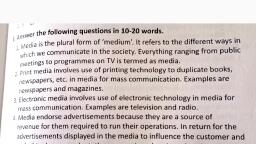
(4) ‘Kesari’ - Bal Gangadhar Tilak, The wrong pair was (1) ‘Prabhakar’ – Acharya P.K. Atre, Explanation:, The newspaper ‘Prabhakar’ aimed at creating social awareness. The French, Revolution, the letters by Gopal Hari Deshmukh were published in this newspaper., Q. 2. A. Write brief notes:, The role of the newspaper in the Indian struggle for independence, Answer : 1. Newspapers played a vital role in creating social awareness and insisted, on the need for achieving independence from the clutches of the British., 2. The newspapers advocated social reforms among the masses to make them stand, united in the freedom struggle., 3. The newspaper ‘Kesari’ started by Balgangadhar Tilak raised slogans like ’Swaraj is, my birth right, and I shall have it.’ These revolutionized the minds of many Indians., 4. The newspapers strongly criticized the British Government for its brutality., 5. Many other newspapers like ‘Darpan’ started by Balshastri Jambhekar, ‘Prabhakar’, by Bhau Mahajan all aimed at promoting fire against the British., 6. Newspapers like ‘Induprakash’ supported social reforms like widow remarriage., 7. The newspapers at the time of freedom struggle invited political participation from the, remote masses also., Q. 2. B. Write brief notes:, Why do we need mass media?, Answer : Media through which messages are delivered or communicated to a large, group of people or mass is called Mass media. Television, radio, newspapers,, magazines, internet are some of the forms of mass media. We need mass media for the, following reasons:, 1. Mass media facilitates easy flow of communication from one corner of the world to, the another., 2. It educates people about the day to day happenings of the world.
Page 3 :
3. It plays a vital role in developing a common understanding between people and, brings them closer., 4. It helps in promoting the right things oat the right time., 5. It acts as a bridge between the Government and the people., 6. It helps in spreading awareness among people politically, socially and economically., Q. 2. C. Write brief notes:, Mass Media and professional opportunities., Answer : Newspapers and magazines, television, radio, etc. are important sources of, mass media. These mass media are entrusted with the responsibility of not only, providing news but also with the social responsibility of promoting truth and justice., Mass media requires commitment, dedication, sacrifice to pursue a career. Mass media, offers a lot of professional opportunities. Journalism, a career in films, publishing,, editing, direction, scriptwriting, production, etc. are some of the opportunities. The, modern world offers prospects for Radio Jockey or Video Jockey also., Q. 3. A. Explain the following sentences with its reason., Any information received through mass media needs to be reviewed critically., Answer : Analysis and critical review of the information are necessary to ascertain its, authenticity. Sometimes the news is exaggerated or not presented exactly. There are, higher chances of misrepresentation of facts. These kinds of news may cause, psychological, personal, moral and cultural damages to society. Hence, a thorough, understanding of the information is needed., Q. 3. B. Explain the following sentences with its reason., Knowledge of history is essential for newspaper articles., Answer : Newspapers provide us with a wide variety of news. When a news is, published, it is mandatory to provide all the information pertaining to that news. To, enable better understanding and clarity of the news provided, the study of the similar or, parallel event is necessary. Hence, the history of the news needs to be published., Newspapers publish separate columns about the historical information to commemorate, a special occasion such as the Independence Day, World Environment Day, etc. The, knowledge of history thus becomes essential for newspaper articles., Q. 3. C. Explain the following sentences with its reason., Television is the most popular medium.
Page 4 :
Answer : 1. Television is the most popular audio-visual medium of communication., 2. The programmes and news that are telecasted in a television channel cause a huge, impact on the minds of the people., 3. It attracts a large number of viewers of all age groups., 4. It is also used for educative and information purposes., 5. It acts as a source of entertainment and relaxation., Q. 4. A. Answer the following questions in 25-30 words., Explain the objectives of newspapers., Answer : Newspapers are the print media of communication. The news is printed and, distributed regularly at a definite time. They serve as historical documents. These, newspapers provide us with local, national and international news., The following are the objectives of newspapers:, 1. The primary objective is to provide information to the citizens related to the, happenings. They provide a lot of facts to keep the citizens aware., 2. The newspapers are also vested with the task of interpreting or explaining the news., Editorials, opinion columns, news analysis, etc., are some examples., 3. The newspapers also create awareness among the public., 4. Another objective is to provide service to readers. They provide information to aid, them in their day to day needs, example, advertisement., 5. Newspapers come up with puzzles, stories, comics, etc., to provide entertainment., Q. 4. B. Answer the following questions in 25-30 words., How is history helpful in the planning of Akashavani programmes., Answer : Akashvani broadcasts various kinds of programmes right from entertainment, to education. History plays a vital role in planning the broadcast of the programmes. A, programme on national leaders needs to be supported by sufficient historical, information. The programmes on the birth or anniversary of leaders are supported by, the lectures given by historians. Maintaining accuracy is needed while broadcasting, episodes of historical serials are very important. This is possible if one has a deep, understanding of the history of the concerned period.
Page 5 :
Q. 5. Read the following extract and answer the questions., Radio: ‘Indian Broadcasting Company’ (IBC), a private radio company was the, first one to broadcast daily programmes. Later the same company was taken over, by the British Government and named as ‘Indian State Broadcasting Service, (ISBS). On 8th June 1936, it was renamed, as ‘All India Radio (AIR).’, After Independence, AIR became an integral part of the Ministry of Information, and Broadcasting (India). Initially, it broadcasted Governmental programmes and, schemes. It was named as ‘Akashvani’ on the suggestion of the famous poet, Pandit Narendra Sharma. Akashvani broadcasts various entertainment,, awareness creating and literary programmes., It also broadcasts special programmes for farmers, workers, the youth and, women. The ‘Vividh Bharati’ programmes are broadcasted in 24 regional, languages as well as 146 dialects of Indian languages. Lately, various new, channels like ‘Radio Mirchi’ are providing radio services., (1) Akashavani (AIR) is an integral part of which ministry?, (2) What was the new name of IBC?, (3) In how many regional languages and local dialects are ‘Vividh Bharati’, programmes broadcasted?, (3) How AIR was named ‘Akashvani’?, Answer : (1) Akashavani (AIR) is an integral part of the Ministry of Information and, Broadcasting (India)., (2) The new name of IBC is All India Radio(AIR)., (3) The ‘Vividh Bharati’ programmes are broadcasted in 24 regional languages and 146, dialects of the Indian languages., (4) The All India Radio was named as ‘Akashvani’ on the basis of the suggestion given, by the famous poet Pandit Narendra Sharma. It was renamed as Akashvani in 1957., Q. 6. Complete the following concept chart.
Page 6 :
Answer :



 Learn better on this topic