Notes of First semester B Pharm, HAP 1 Unit III / Body fluids and Blood C - Study Material
Page 1 :
Unit II – Body fluids and BLOOD, , COMPOSITION, AND, , FUNCTIONS OF BLOOD, , 1
Page 2 :
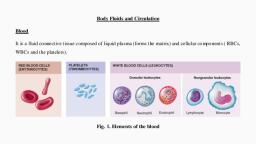
BLOOD – Introduction, • BLOOD meets Multi cellular organism’s need of oxygen and nutrients + also, elimination of CO2 and other metabolic wastes from the system ., • In other words blood transports oxygen from the lungs and nutrients from the, GIT to various body parts to meet their metabolic needs., , • Blood is a specialized fluid connective tissue ( of the transport system), • Composed of Liquid matrix –that dissolves and suspends various cells and cell, fragments., , • Blood = Watery matrix + various types of cells, • Plasma= Blood - various types of cells, • Serum = Blood – Fibrinogen, , 2
Page 3 :
Physical characteristics of BLOOD, 1. Dense and viscous than water ., 2. Slightly sticky, 3. Red to reddish brown ( Venous blood), , 4. Warm 38 Degree Centigrade ( Slightly warmer than body temperature), 5. Slightly alkaline ( PH7.35-7.45), 6. 8% of total body mass- 20% ECF), 7. 5-6 lts in healthy adult MALE , 4-5 lts in adult FEMALE. Constant Volume of, blood is maintained by hormonal / other feed mechanisms( ADH,, Aldosterone), 8. Specific Gravity : Male : 1.507, Female : 1.503., , 3
Page 4 :
Functions of BLOOD, , 1. Transportation : of oxygen from the lungs to various body parts and, carbon Dioxide from body to lungs . Carries Nutrients from GIT,, Hormones from End Glands, heat and waste metabolites to the lungs,, kidney and skin for elimination., 2. Regulation : Role in Homeostasis of body fluids by buffering effect, ( maintaining healthy PH), Regulating Body Temperature by heat, absorbing /cooling, water content of cells ( By osmatic pressure), , 3. Protection : By clotting – Preventing further Loss of blood, maintain, optimum volume, phagocytosis, interferons et al protect against disease., , 4
Page 5 :
Blood is made up, of TWO, Components, , BLOOD, PLASMA A, Watery liquid, matrix containing, Dissolved, substances. 55%, of blood, , FORMED, ELEMENTS: cells, and cell, fragments . 45%, of blood volume, , 5
Page 6 :
6
Page 7 :
SUMMARY, , Plasma Proteins : Functions, • Consists of Water : largely – Acting as Solvent and suspending media, for components of Blood . Acts as an absorbent / absorbs,, transportation and release of heat ( homeostasis), • Proteins called PLASMA PROTEINS : Albumin, Globulin,, Fibrinogen,, • PP exerts Osmatic pressure thus helps maintain water balance b/w, blood and tissue- in other words : Helps regulate blood volume., • Essential for blood clotting, • Influence ESR : Diagnostic significance., • Protein Reserve, • Helps maintain viscosity – therefore Blood Pressure., , 7
Page 8 :
• FORMED ELEMENTS OF BLOOD, • Are Heavier than plasma ., • Percentage of total blood volume occupied, by RBC is called HAEMATOCRIT. ( 40%, means 40% of blood is composed of RBC), • Normal values, • Adult Male : 40-54%, • Adult Female : 38-56%, • Significantly HIGH: Polycythemia, • Significantly LOW: Anemia, , 8
Page 9 :
9
Page 10 :
HAEMOGLOBIN, •, , Red pigment of Blood, , • Consists of GLOBIN ( 96%) and HAEM( 4%), • GLOBIN ( Protein) consisting of 4 polypeptide chains and 4 non peptide, , pigments – called HAEMES., • One ring like Haem bind to each peptide chain – at the center is IRON, ION ( Fe 2+)that can reversibly bind to one oxygen molecule. ( Iron, around 0.34%), • Irin remains in FERROUS ( fe3+) state., , • Oxygen picked up in the lungs is transported to iron of the haem group, • As and how the blood flows iron – oxygen disassociates – Release, oxygen, • Picks up CO2 combining with amino acids in the globin of haeme., Resulting in CARBAMINO compound., • Normal hemoglobin counts are 14 to 17 gm/dL (grams per deciliter) for, men and 12 to 15 gm/dL for women., , •, , 10
Page 11 :
HAEMOGLOBIN, , Varieties of Hb: Foetal Hb and Adult Hb ( HbF, HbA) – Difference is in iron, content., Physiological Variations in Hb count :, 1. Age: with advancing age, Increasing., 2. Sex: Women slightly less than men, 3. Diurnal variation : Morning lowest, evening Highest., 4. Altitude: Higher Altittude , Higher concentarion., 5. Exercise and emotion : Increases amount, , 11
Page 12 :
12



 Learn better on this topic