Notes of FE, BEEE IMG-20220114-WA0001.jpg - Study Material
Page 1 :
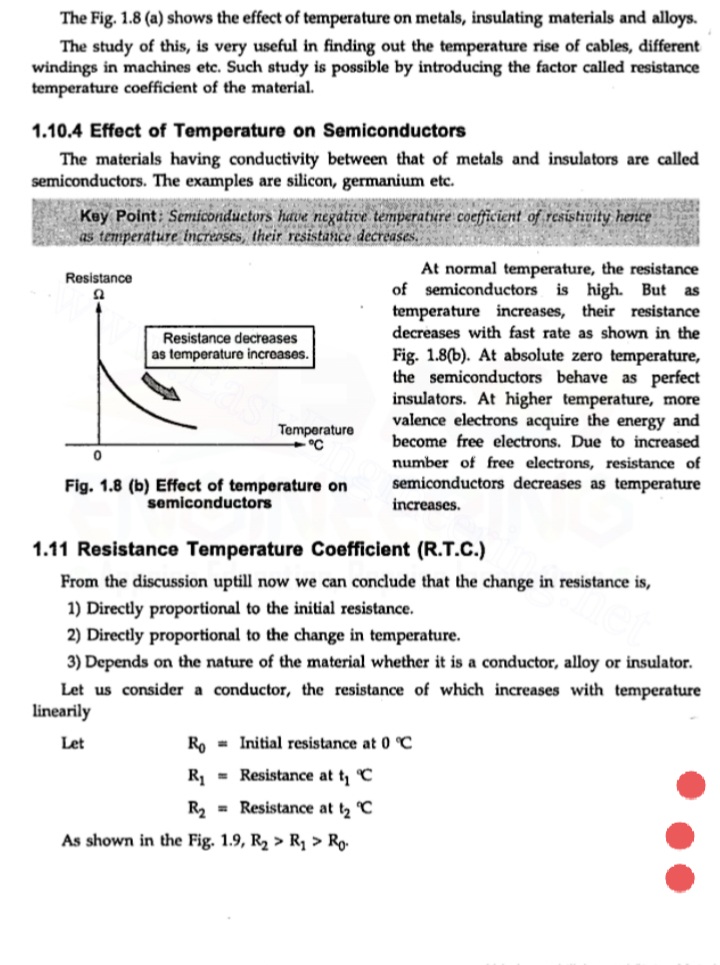
‘The Fig. 1.8 (a) shows the effect of temperature on metals, insulating materials and alloys., The study of this, is very useful in finding out the temperature rise of cables, different, , windings in machines etc. Such study is possible by introducing the factor called resistance, temperature coefficient of the material., , 1.10.4 Effect of Temperature on Semiconductors, , The materials having conductivity between that of metals and insulators are called, semiconductors. The examples are silicon, germanium etc., , pa ae 3h, , At normal tem ture, the resistance, , renee of semiconductors, la high. But as, , temperature increases, their resistance, , Readuca Gaiuooe decreases with fast rate as shown in the, , Pe 180) A sb pete, , q the semiconductors behave as perfect, , insulators. At higher temperature, more, , valence electrons acquire the energy and, , become free electrons. Due to increased, , number of free electrons, resistance of, , Fig. 1.8 (b) Effect of temperature on semiconductors decreases as temperature, semiconductors increases., , , , , , , , , 1.11 Resistance Temperature Coefficient (R.T.C.), From the discussion uptill now we can conclude that the change in resistance is,, 1) Directly proportional to the initial resistance., 2) Directly proportional to the change in temperature., 3) Depends on the nature of the material whether it is a conductor, alloy or insulator., , Let us consider a conductor, the resistance of which increases with temperature, linearily, , Let Ro = Initial resistance at 0 °C, Ry = Resistance at t, °C @, R, = Resistance at ty °C, As shown in the Fig. 1.9, Ry > Ry > Ro. e, e