Notes of Class 9 ( Hindi +English), Science ch15_improvement_in_food_ - Study Material
Page 1 :
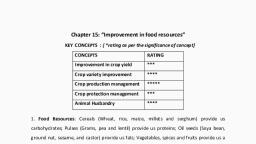
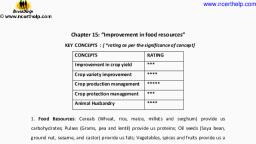
Chapter 15: “Improvement in food resources”, KEY CONCEPTS : [ *rating as per the significance of concept], CONCEPTS, , RATING, , Improvement in crop yield, , ***, , Crop variety improvement, , ****, , Crop production management, , *****, , Crop protection management, , ***, , Animal Husbandry, , ****, , 1. Food Resources: Cereals (Wheat, rice, maize, millets and sorghum) provide us, carbohydrates; Pulses (Grams, pea and lentil) provide us proteins; Oil seeds (Soya bean,, ground nut, sesame, and castor) provide us fats; Vegetables, spices and fruits provide us a, range of minerals, nucleic acids and vitamins. In addition to these food crops, fodder crops, like berseem, oats or sudan grass are raised as food for the livestock are called as fodder, crops., 2. The Kharif crops: The crops grown in rainy season are called as Kharif crops (Paddy, Soya, bean, pigeon pea and maize). They are grown from June to October., 3. The Rabi crops: The crops grown in winter season are called Rabi crops (Wheat, gram,, peas, and mustard). They are grown November to April., Compare Kharif crops and Rabi crops:, SN, , Crop, , Season, , Example, , 1, , Kharif crops, , June to October ( Rainy Season), , Paddy, Soya bean, and maize, , 2, , Rabi crops, , November to April ( winter, season), , Wheat, gram, peas, and, mustard, , 4. The Green Revolution: Food supplies are generally as proteins, carbohydrates, fats,, minerals, nucleic acids and vitamins in all living organisms. Indian population is growing, enormously. Green Revolution is the need of the hour to increase food-grain production., , 88
Page 2 :
5. Sustainable Practices: For sustained livelihood, one should undertake mixed farming,, intercropping, and integrated farming practices, for example, combining agriculture with, livestock/ poultry/ fisheries/bee-keeping. The major group of activities for improving crop, yield can be classified as: Crop varietal improvement, Crop production improvement, Crop, protection improvement, 6. The Crop varietal improvement:, a) Hybridization: It refers to crossing between genetically dissimilar plants;It is all to get, higher yield, improved quality, biotic and abiotic resistance, change in maturity duration,, wider adaptability and desirable agronomic characteristics., SN, , Type, , Context, , 1, , Intervarietal Hybridization, , between different varieties, , 2, , Interspecific Hybridization, , between different species, , 3, , Intergeneric Hybridization, , between different genera, , 4, , Genetically Modified Crops (GMC)., , Another way of improving the crop is by, introducing a gene that would provide the, desired characteristic., , 7. The Crop production improvement: They include” no cost production”,” low cost, production” or “high cost production” practices., a) Nutrients( Sixteen elements are required for growth are called as essential elements, Carbon, oxygen, hydrogen+ Macronutrients & Micronutrients. They increase the yield):, SN, , Macronutrient, , Micronutrient, , 1, , Six elements are required in larger, quantity, , Other seven elements are required, in small quantity, , 2, , Ex.Nitrogen, phosphorus,, calsium,Postasium, magnisium, sulphur, , Ex. Iron, manganese, boron, zink,, copper, molybdinum, chlorine, , 89
Page 3 :
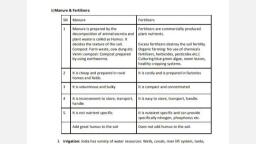
b)Manure & Fertilizers:, SN, , Manure, , Fertilizers, , 1, , Manure is prepared by the, decomposition of animal excreta and, plant waste is called as Humus. It, decides the texture of the soil., Compost: Farm waste, cow dung etc., Vermi compost: Compost prepared, by using earthworms., , Fertilizers are commercially produced, plant nutrients., , 2, , It is cheap and prepared in rural, homes and fields, , It is costly and is prepared in factories, , 3, , It is voluminous and bulky, , It is compact and concentrated, , 4, , It is inconvenient to store, transport,, handle., , It is easy to store, transport, handle., , 5., , It is not nutrient specific., , It is nuteient specific and can provide, specifically nitrogen, phosphorus etc., , Add great humus to the soil, , Does not add humus to the soil., , Excess fertilizers destroy the soil fertility., Organic farming: No use of chemicals, fertilizers, herbicides, pesticides etc.(, Culturing blue green algae, neem leaves,, healthy cropping systems., , 3. Irrigation: India has variety of water resources: Wells, canals, river lift system, tanks,, rainwater harvesting, water shedding management to increase in ground water, levels and to check the water flowing away to the sea. Planning to reduce soil, erosion., 4. Cropping patterns:, SN, , Mixed cropping, , Inter-cropping, , Crop rotation, , 1, , Two or more crops, grown simultaneously, on the same piece of, land, , Two or more crops grown, simultaneously on the same piece, of land in a definite pattern, , Growing different, crops on a piece of, land in a preplanned succession, , 2, , Ex. Wheat+ Gram;, Wheat+ Mustard;, Wheat+ gram;, Groundnut+, sunflower., , Soyabean + maize/bajra+Cowpea, ((Please refer Fig. 15.2, NCERT Text, Book Page- 208)., , Two or three crops, can be grown in a, year depending, upon the duration., , 90
Page 4 :
3, , A type of insurance, against failure of one, of the crops., , A few rows of one crop alternate, with a few rows of a second crop., Crops are selected such that their, nutrient requirements are, different. This ensures the, maximum utilization of the, nutrients supplied and prevents, pests and diseases spreading in the, crop field., , The availability of, moisture and, irrigation facilities, decides the choice, of the crop to be, cultivated., , 8. Crop protection improvement/ management: Field crops are infested by large number, of weeds, insects pests, diseases & storage of grains, SN, , Weeds, , Insect pests, , Diseases, , Storage of grains, , 1, , Weeds are, unwanted plants in, the crop field, , Insect pest is, nuisance in the crop, field, , Disease is caused, by pathogens in, the field, , Different factors are, responsible., , 2, , Weeds take up, nutrients and, reduce the growth, , Insect pest affect, the health of crop, and reduce the, yield., , Diseases alter the, physiology of, crops and reduce, the yield, , Different factors, reduce the quality of, stored grains, , 3, , Ex. Xanthium,, Parthenium, , Ex. Caterpillars,, dragonfly, , Ex. Bacteria, Virus, , Biotic factors:, insects, rodents,, fungi, Abiotic factors:, moisture &, temperature, , 4, , Removal of weeds, at an early stage is, recommended., Spray weedicides, , Spread of chemicals, such as pesticides, , Spread of, chemicals to kill, pathogens, , Systematic, management of, ware house., , 9. Animal Husbandry: It is a scientific management of animal livestock, includes feeding,, breeding and diseases control. Animal-based farming includes cattle farming, Poultry, farming, fish farming, and bee Keeping., SN, , Content, , Cattle, farming, , Poultry, farming, , Fish farming, , Bee Keeping., , 1, , Purpose, , Milk (milch, animals) and, , Meat,, chicken, egg, , Cheep source of, animal protein., , Honey, wax,, medicinal, , 91
Page 5 :
draught labor, (draught, animals) in, agriculture., , production, , Fish production is, aquaculture., Growing of, marine fishes is, called, mariculture., , preparations., Additional, income to the, farmer., , 2, , Cross, breeding: To, get desired, qualities, , Exoticquality of, lactation, Indigenous, breedsquality of, disease, resistance, , Exotic &, Indigenous, breeds, , Both Exotic &, Indigenous fishes, are used, , Exotic- high, honey collection, capacity, &stingless., Indigenous beesare used, , 3, , Desirable, maintenance, , Good, ventilation in, sheds, Roughage/, concentrates, Protection, from, parasites &, skin diseases, Vaccination, , Good, ventilation in, sheds, Roughage/, concentrates, Protection, from, parasites &, skin diseases, Vaccination, , Fish farming/, locating large, schools of fish/, use of satellites, and echo-sounds, In Composite fish, culture seed is, wild, mixed with, other species., Hormonal, stimulation to, bring desired, quality in fish, production., , Value or quality, depends upon, the pasturage or, the flowers, available for the, taste of honey., , 4, , Example, , Exotic or, foreign, breeds (, Jercy, brown, Swiss), Local breeds, (Red sindhi,, Sahiwal), , ExoticLeghorn, Indigenous, breeds- Aseel, , Fresh water (, Macrobrachium), & Marine(, Peneaus) prawns, Fresh water, fishes, Marine fishes(, Bombay duck,, sardines), Common, , Apisceranaindica, dorsata, A.florae, , 92
Page 6 :
QUESTION BANK, 1. Give two examples of Cereals (Wheat, rice), 2. Define the Kharif crop and give two examples (The crops grown in rainy season are, called as Kharif crops Ex. Paddy, Soya bean)., 3. Write about the importance of Green Revolution (Indian population is growing, enormously. Green Revolution is the need of the hour to increase food-grain, production., 4. Define the term Hybridization(Crossing between genetically dissimilar plants), 5. What is the importance of Genetically Modified Crops? (It is another way of, improving the crop is by introducing a gene that would provide the desired, characteristic.), 6. Define the term mixed cropping and give two examples. (Two or more crops grown, simultaneously on the same piece of landEx. Wheat+ Gram; Wheat+ Mustard), 7. Distinguish between weeds, insects pests(Weeds are unwanted plants in the crop, field Insect pest is nuisance in the crop field), 8. What is Animal Husbandry? It is a scientific management of animal livestock,, includes feeding, breeding and diseases control. Animal-based farming includes, cattle farming, Poultry farming, fish farming, and bee keeping., 9. Distinguish between aquaculture and mariculture. (Fish production is aquaculture., Growing of marine fishes is called mariculture.), 10. What is the importance of Bee Culture? (It is useful for honey, wax, medicinal, preparations. And also for additional income to the farmer.), QUESTION PAPER:FORMATIVE ASSESSMENT – I (For Practice), Marks- 40, , Time: 90 minutes, , * General Instructions, 1. Questions 1-5 (1 Mark each), , 2. Questions 6-10 (2 Mark each), , 3. Questions 11-15 (3Mark each), , 4. . Questions 16-17 (5Mark each), , 93
Page 7 :
Q.1 Maize and Millets are Pulses. Mention True/False……………………………………, Q.2 What is the Scientific name of Honey Bee…………………………………………………., Q.2 What led us to improve food grain production?, Q.3 Which revolution led to the availability of milk for efficient use?, Q.4 What is the process of injecting semen of desired bull into the vagina of cows is called?, Q.5 Name any one exotic breed usually used for variety of improvement programmes., Q.6 What is the significance of GMC, Q.7 Mention the significance of Irrigation in developing agriculture., Q.8. What is Pest and give one example., Q.9 What is Weed and give one example., Q.10 Give two examples for Inter-cropping., Q.11 Distinguish between Kharif and Rabi Crops, Q.12 What is called Sustainable Practice in improvement in food resources., Q.13. Mention three techniques of Hybridization used to achieve desirable agronomic, characteristics., Q.14.Distinguish between Macro Nutrients and Micro Nutrients, Q.15 Distinguish between Compost and Vermi Compost., Q.16 Distinguish between Cattle farming and Poultry farming., Q.17 Distinguish between Fish farming and Bee keeping., -------X------94



 Learn better on this topic