Page 1 :
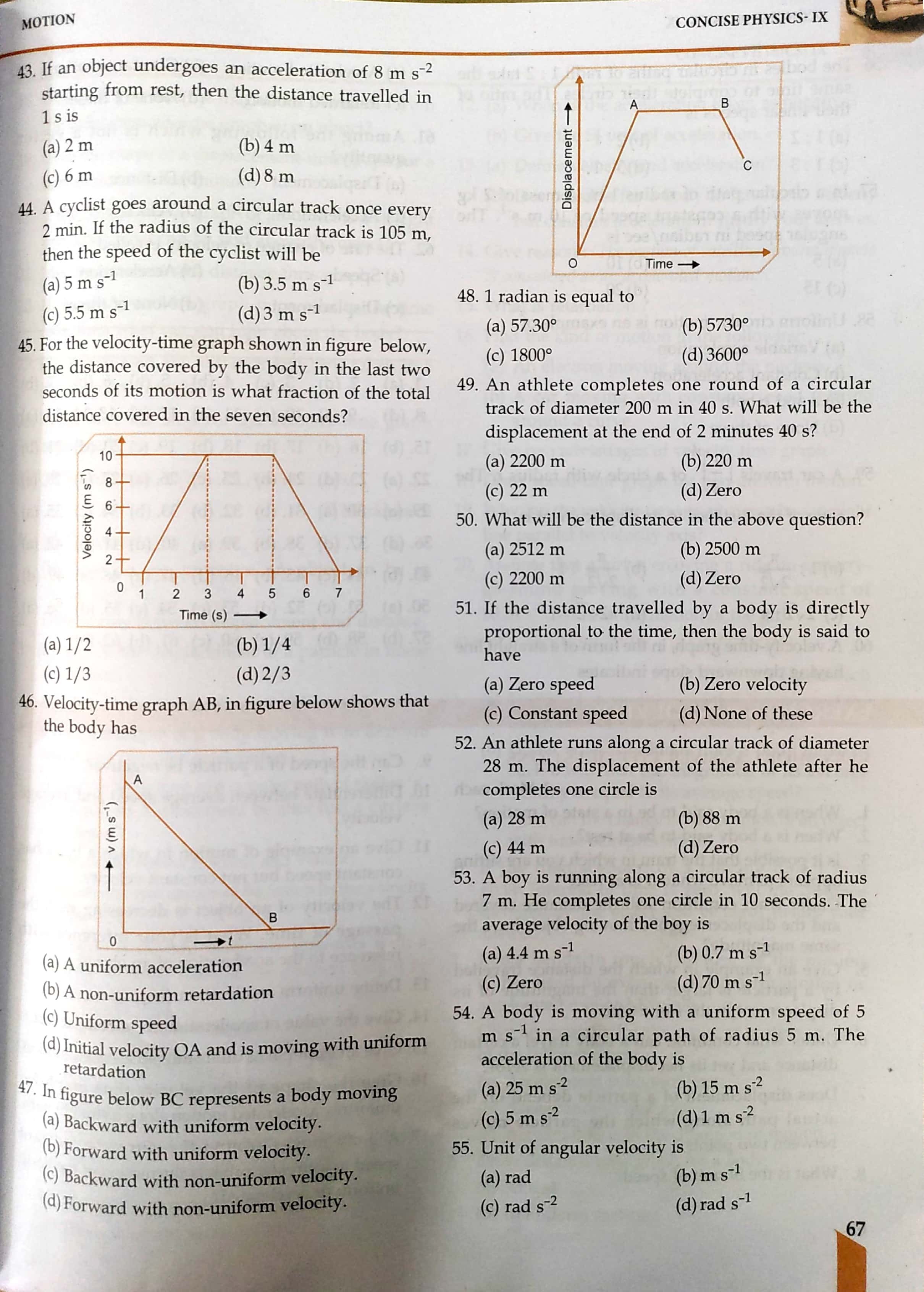
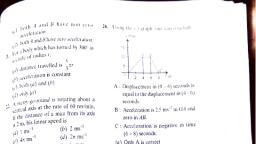
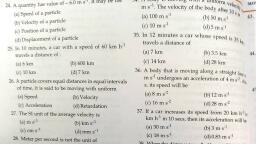
_ If an object undergoes an acceleration of 8 m s-2, starting from rest, then the distance travelled in, 1s is, , (a)2m (b)4m, , (c)6m (d)8m, , _A cyclist goes around a circular track once every, 2 min. If the radius of the circular track is 105 m,, then the speed of the cyclist will be, , (a) 5m St (b) 3.5 ms"!, , ()55ms” (d)3 mst, , For the velocity-time graph shown in figure below,, the distance covered by the body in the last two, , seconds of its motion is what fraction of the total, distance covered i in thes seven seconds?, , 10, % 8 |, g |, 27 |, 0 4 2 34 SS momn |, ' _Time (s) —> Ss) a oe ees, (a) 1/2 (b)1/4, () 1/3 (d)2/3, , . Velocity-time graph AB, in figure below shows that, the body has, , le, , , , , , , , , , , , , , (a) A uniform acceleration + tae, (b) A non-uniform retardation =, (°) Uniform speed ie, (d) Initial velocity OA angie moving, retardation, - In figure below BC re, (a) Backward ie, (b) Forward with w a, , 2 a oe, 54. A bo, , ~ CONCISE PHYSICS- IX, , , , , Displacement —>, , , , , , Oo, , 48. 1 radian is equal to, (a) 57.30° (b) 5730°, (c) 1800° (d) 3600°, 49. An athlete completes one round of a circular, , track of diameter 200 m in 40 s. What will be the, displacement at the end of 2 minutes 40 s?, , (a) 2200 m (b) 220 m, (c) 22m (d) Zero, 50. What will be the distance in the above question? —, (a) 2512 m (b) 2500 m, (c) 2200 m (d) Zero, , 51. If the distance travelled by a body is directly, proportional to the fime, then the body is said to, have |, (a) Zero speed (b) Zero mareorla Re, (c) Constant speed (d) None of these, , 52. An athlete runs along a circular track of diameter, 28 m. The displacement of the athlete after he, completes one circle is, (a) 28 m (b) 88 m, (44m ie v | (d) Zero, , 53. A boy i is running along a circular track of radius, , __ 7m. He completes one circle in 10 seconds. The ©, , vat ARE Re ae OHS boy is, (a)4.4ms7 Mer,, , as B ot if, , body mete ¢ with a “uniform ee of 5