Notes of Class 9, Maths & Biology IMG-20220107-070447.jpeg - Study Material
Page 1 :
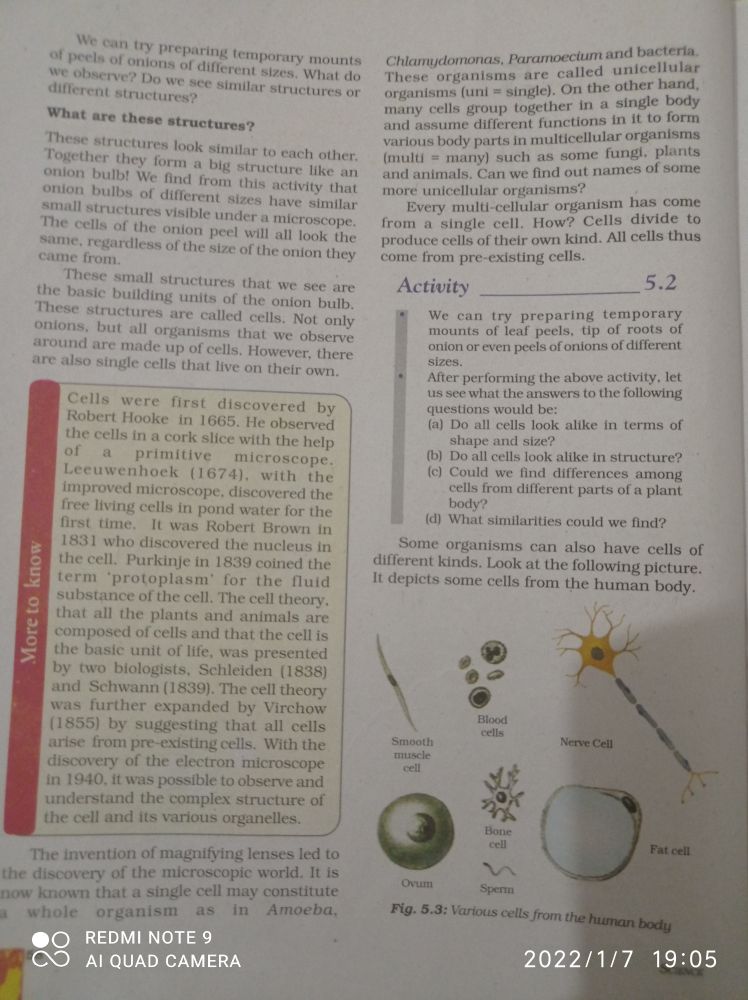
ny Preparing temporary mounts, , ons of different sizes, Wh,, Do we see, t structures?, , , , do, Similar structures or, , , , We observe’, differe, , What are these structures?, , cow OF thes Hook stimtlar to each other,, ier they form a big structure tike a, , onion bulb! We find from thi stivty that, simak bulbs of different sizes. have similar, , I structures visible under a microscope., The cells of the onion pect will all look the, cane: egardless of the size of the onion they, came from., , These small structures that we se, the basic t, These struct, onions,, , , , , , , , , , , , , , , , , are, liding units of the onfon bulb., res are called cells. Not only, but all organisms that we observe, around are made up of cells, However, there, are also single cells th; live on their own,, , , , , , , , Cells were first discovered by, Robert Hooke in 1665. He observed, the cells in a cork slice with the help, of a primitive microscope., Leeuwenhoek (1674), with the, improved microscope, discovered the, free living cells in pond water for the, first time. It was Robert Brown in, 1831 who discovered the nucleus in, the cell. Purkinje in 1839 coined the, term ‘protoplasm’ for the fluid, substance of the cell. The cell theory,, that all the plants and animals are, ‘composed of cells and that the cell is, the basic unit of life, was presented, by two biologists, Schleiden (1838), and Schwann (1839). The cell theory, was further expanded by Virchow, (1855) by suggesting that all cells, arise from pre-existing cells. With the., discovery of the electron microscope:, in 1940, itwas possible to observe and, understand the complex structure of, the cell and its various organelles., , ‘The invention of magnifying lenses led to, the discovery of the microscopic world. It is, now known that a single cell may constitute, s whole organism as in Amoeba,, , , , , , , , , , , , , , , , , , , , , , , , , , , , , Paramoectum and bacteria, 1, , These organisms are called uniceliiter, organisms (uni = single). On the omer, , many cells group together in a sindle boa, and assume different functions 1m it 10 Term, various body parts in multicellular orgartorts, {multi = many) such as some fung!. plants, and animals, Can we find out names, , 2, , more unicellular organisms? ;, Every multicellular organism has come, from a single cell, How? Cells div ;, , produce cells of their own kind. All cells thus, come from pre-existing cells., Activit 5.2, can try preparing temporary, B] mrounte of leat pects, Up of roots of, onion or even peels of onions of different, ane he above activity, let, . + performing the above activity,, cae nt ie tree a following, questions would be:, (a) Do all cells look alike in terms of, shape and size?, (b) Do all cells look alike in structure?, (6) Could we find differences among, cells from different parts of a plant, body?, (@) What similarities could we find?, , , , lamydomonas,, , , , , , , , , , , , , , Some organisms can also have cells of, different kinds. Look at the following picture., It depicts some cells from the human body., , 2/1/7 19:05



 Learn better on this topic