Notes of Class9, English The Snake Trying.docx - Study Material
Page 1 :
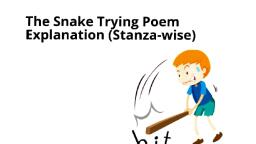
The Snake Trying Introduction, In the poem, the poet says that the snake tries to escape from being hit by the stick held by a person who is trying to kill it. The poet wants to say that all snakes are not harmful., Humans have a notion that snakes are dangerous and try to kill them as soon as they spot one but this is not true. He tells us how a harmless green – colored snake tries to hide behind the green bushes in order to save itself., RHYME SCHEME, As the poem is written in free verse with lines unequal in length and no metre, there is no rhyme scheme in the poem., Poetic Devices, Imagery, The poet uses a certain description that is appealing to the senses., The Snake Trying Poem Explanation (Stanza-wise), The snake trying, To escape the pursuing stick,, With sudden curvings of thin, Long body. How beautiful, And graceful are his shapes!, Word meanings, Pursuing: Chasing, following, Curvings: Twisting, Explanation - The snake tries to escape from being hit by the stick that is following it. As the snake crawls, its body twists and turns forming fascinating shapes., He glides through the water away, From the stroke. O let him go, Over the water, Into the reeds to hide, Without hurt. Small and green, He is harmless even to children., Word meanings, Glides: Moves, Stroke: Hitting of the stick, Reeds: Water or marsh plants with thick stems, Explanation - The snakes moves through the water in order to save themselves. The poet pleads to let it escape and hide behind the thick marshy plants as it is harmless. The small green-colored snake is harmless even to children., Along the sand, He lay until observed, And chased away, and now, He vanishes in the ripples, Among the green slim reeds., Word meaning, Vanishes: Disappears, Explanation - Till it was spotted and chased away by the person holding a stick, it lay quietly in the sand. In order to save itself, the snake disappears in the ripples of the water and hides in the camouflaging green bushes of the marshy plants., Literary devices, 1. Rhyme scheme is absent. The poem is written in free verse., 2. Transferred epithet: the adjective used with a noun refers to a noun other than the one with which it is used., Pursuing stick – pursuing refers to the person who is holding the stick and not the stick itself., 3. Alliteration: the repetition of a consonant sound in 2 or more consecutive words., He is harmless – ‘h’, The Snake Trying Summary, In this poem, a harmless green-colored snake tries to save itself from being hit by a person who is chasing it with a stick to kill it. The poet says that the snake is harmless even to children. People fear snakes and when they see one, they try to kill it with a stick. The snake tries to save itself and hides behind the green – coloured bushes of marshy plants growing in the water. It hides in the ripples of the water body in order to save itself. The snake disappears behind the marshy plants., Question Answers, Q1.What is the snake trying to escape from?, AnsThe snake is trying to escape the person who is chasing it with a stick and is trying to hit it., Q2.Is it a harmful snake? What is its color?, Ans. The snake is harmless. It is green in colour., Q3.The poet finds the snake beautiful. Find the words he uses to convey its beauty., Ans.The words used to describe the snake are beautiful and graceful., Q4.What does the poet wish for the snake?, Ans. The poet wishes that the snake saves itself., Q5.Where was the snake before anyone saw it and chased it away? Where does the snake disappear?, Ans. Before it was seen, it was lying in the sand. It disappears behind the marshy plants., Extra Questions and Answers, Short Answer Type, Question 1., What is the snake trying to escape from?, Answer:, The snake is trying to escape from a being hit by a stick, or even worse, being killed. It is being chased by someone with a stick. The person is afraid of the snake and perceives it as a potential threat., Question 2., Is the snake harmful?, Answer:, No, it is not a harmful snake as it is not poisonous. The poet says the snake is a green one. Green snakes are generally garden snakes and are considered harmless as they are not venomous., Question 3., Why did the person with a stick attack the snake?, Answer:, The person attacked the snake when he saw it lying on the sand. He was driven by his own fear of snakes and their being venomous that led him to attack the snake to either kill it or drive it away., Question 4., What do you learn about the person attacking the snake?, Answer:, The person attacking the snake is governed by his fear of snakes. He wishes to kill or hurt the snake and rushes in to attack the snake, without pausing to consider that the snake is a green garden snake which is not venomous. Moreover, the snake is lying on the sand and is not about to attack anyone. The man is also pitiless as he goes to hurt or kill the snake., Question 5., What does the poet wish for the snake?, Answer:, The poet sees the snake as a beautiful creation of Nature. Moreover, it is a green garden snake and not a harmful one. He wishes that it should not be assaulted with the stick. It should be allowed to go under the water into the reeds to hide without being hurt., Question 6., Where was the snake before someone saw it and chased it away? Where does the snake disappear?, Answer:, The snake was lying unobserved on the sand till someone saw it and, fearing it, rushed to attack it with a stick. The pursuer chased it away. The snake disappeared in the ripples of the water among the green reeds., Question 7., What does the poet mean when he says ‘O Let him go’?, Answer:, The poet tells the man chasing the snake with a stick to let the snake go. The poet wishes that the snake should not be hurt and should be allowed to make its escape and reach its destination safely., Question 8., ‘He is harmless even to children.’ What does the poet think about the snake?, Answer:, The poet is of the opinion that the snake which is being chased is a green snake of the garden variety and is not venomous. It is not harmful, not even to children who are more vulnerable. He feels the snake should not be hurt and should be allowed to reach its place safely., Question 9., What impression do you form of the poet in this poem?, Answer:, The poet loves Nature and all its creations. He finds the snake and its graceful movements beautiful. He is compassionate and does not want the snake harmed. He tries to stop the person with the stick from attacking the snake and is happy to see the snake glide away into the reeds., Question 10., What is the central idea of the poem “The Snake Trying”?, Answer:, The poet says that all snakes are not venomous or harmful. Nor do they attack without provocation. Even if a snake is poisonous, it will do us no harm if it doesn’t see any danger from us. It is wrong to attack or kill a snake as soon as we see it. But sadly, human beings always try to kill a snake as soon as they see it.All creatures have a right to their life. Like the snake in this poem all try to save themselves in case of danger., Question 11., How does the snake look when it tries to escape?, Answer:, The snake was lying on the sand when someone saw it and chased it with a stick. The snake glided away through the water and disappeared among the reeds. It looked beautiful and graceful and its body curved and glided across the water., Question 12., Where did the snake finally go? How did the poet view its escape?, Answer:, The snake glided away through the water into the reeds and finally disappeared among the ripples in the green reeds. The poet heaved a sigh of relief when the snake reached there safely, Question 13., What is the message of the poem ‘The Snake Trying’?, Answer:, The poet conveys the message that we should not attack or kill animals, even animals that may be venomous like snakes. He points out that not all snakes are poisonous; in fact, some of them are quite harmless. Human beings are cruel and attack snakes without provocation, based on their own fears. Even if a snake is poisonous, it will not harm anyone until it perceives some danger because a snake only bites in self¬protection., Question 14., Is the snake in the poem ‘The Snake Trying’ a victim or a threat?, Answer:, The snake in the poem ‘The Snake Trying’ is a victim and not a threat. It is a harmless snake, who is lying on the sand till he is chased by a human being with a stick. Yet, despite being attacked, the snake makes good its escape, rather than retaliate., Long Answer Type, Question 1., Why does the man want to kill the snake? How does the snake protect itself?, Answer:, Seeing the snake lying on the sand, the man sees it as a potential threat and reacts to it in that manner. He takes a stick and rushes to attack the snake. He tries to kill it, or at least hurt it. The snake, which is a garden snake, and not dangerous even to children, makes good its escape. He does not react even to provocation. He only tries to escape before the man can reach it and kill it. The movement of the snake is very graceful and elegant. The snake does not stick to one straight path but wends its way in and out of the path. At last, the snake floats over the water and hides itself among the green reeds., Q2.The poem “The Snake Trying” by W.W.E. Ross presents two divergent attitudes towards the snake. Discuss both attitudes. Or, How does the attitude of the poet towards the snake differ absolutely from that of the man with the stick?, Ans:- The poem The Snake Trying“ by W.W.E. Ross presents two divergent attitudes towards the snake. The man with the stick shows a cruel and unsympathetic attitude, He believes that all snakes are poisonous and a threat to human beings. Therefore, although this particular snake is lying comfortably on the sandy bank of the pond with no intention of harming anyone, the man gets ready to kill him the moment he sees him., The poet, on the contrary, has a loving and kind attitude towards the snake. He does not find it to be ugly or terrifying. Instead, he finds beauty and elegance in his body and displays appreciation for the appealing looks of this creature., Moreover, the poet seems to have a thorough knowledge of the behaviour of the different varieties of snakes. He informs the man with the stick that the snakes with thin, green bodies are absolutely harmless and cannot harm even children. He does not want such a harmless snake to be killed. Instead, he should be permitted to escape to safety by hiding himself among the reeds., Q3. Which values can be noticed about the poet from his attitude towards snakes?, Ans:- The poet’s concern and caring attitude towards the snakes emphasizes his values of gentleness, kindness, and sympathy. His thoughtfulness towards all living beings can also be noticed after reading this poem. We know that his thoughts are based on sound scientific reasons when he tells that all snakes are not poisonous. The small and green ones, in particular, are absolutely safe and cannot harm even children., We learn that the poet is an environmentalist and believes in the preservation of animals when he dissuades the man with the stick from killing the snake., His profound sense of love for the innocent snake is also revealed when he requests the man to let the snake go and hide amidst the slim, green reeds. The poet’s deep understanding of the behaviour of snakes can be seen when he remarks that the snake can camouflage and deceive the hostile person by merging itself into the green reeds., Q4. The poem “The Snake Trying” has a deep moral lesson. Which moral values come out of it? Or How is the poem “The Snake Trying” an inspirational poem?, Ans:- The poem has a deep moral lesson as it inspires the readers to cultivate a sympathetic and loving attitude towards all living creatures. The poet shows how there is beauty in all creations of God, even in the curling and curving body of the snake. He wants this beauty to be preserved. The poet’s plea to the man chasing the snake is, in fact, his request to all to preserve the diversity of nature. The poem inspires in the readers a sense of justice by stressing that killing an innocent snake without any provocation is unfair. Animals may be killed only for self-defence, else they must be saved. The poem further motivates the readers to attain deep knowledge about the phenomenon of nature. By gaining a thorough knowledge, one may be able to distinguish between the harmful and the harmless animals., Thus, the poem motivates people to adopt humanistic and friendly feelings towards all living creatures., Extracts, Read the extracts given below and answer the questions that follow., Question 1., The snake trying, To escape the pursuing stick,, With sudden curvings of thin, Long body., Where is the snake?, Answer:, The snake is lying on the sandy bank of a pond or stream., What is the snake trying to escape from?, Answer:, The snake is trying to escape from being hit with a stick., © How does the snake move?, Answer:, The snake glides gracefully with curving movements., Is it a harmful snake?, Answer:, No, the snake is not harmful., Question 2., How beautiful, And graceful are his shapes!, He glides through the water away, From the stroke., Whose shapes are beautiful?, Answer:, The snake’s shapes as it moves away., How is it trying to escape?, Answer:, It is trying to escape with sudden curving of its long thin body., © Who is the assailant?, Answer:, Man is the assailant as he attacks the snake with a stick., Why does the poet want the pursuer to let the snake go?, Answer:, The poet wants the pursuer to let the snake go as it is harmless., Question 3., O let him go, Over the water, Into the reeds to hide, Without hurt., Who is the speaker? Who is he speaking to?, Answer:, The poet is speaking to the man speaking to the man pursuing the snake., Who is ‘him’?, Answer:, ‘Him’ refers to the snake., © Why is the speaker telling the listener to let him go?, Answer:, The speaker is telling the listener to let the snake go because it is harmless., Where does the snake go and why?, Answer:, The snake goes through the water to save itself from the man pursuing it with a stick., Question 4., O let him go, Over the water, Into the reeds to hide, Without hurt. Small and green, He is harmless even to children., What is the snake trying to escape from?, Answer:, The snake trying to escape from the man about to attack it with a stick., Is it a harmful snake?, Answer:, The snake is harmless even for children., © What does the snake look like?, Answer:, It is small and green in colour and looks very graceful., What does the poet wish for the snake?, Answer:, The poet wished the snake to be saved., Question 5., Along the sand, He lay until observed, And chased away, and now, He vanishes in the ripples, Among the green slim reeds., Where was the snake before someone saw it and chased it away?, Answer:, The snake was lying on the sand till someone saw it and again chased it away., Where does the snake disappear?, Answer:, The snake disappears in the ripples of water among the green reeds., © What impression do you form of the poet?, Answer:, The poet is compassionate and loves nature., D)What impression do you form of the pursuer?, Answer:, He is pitiless and governed by his fears.



 Learn better on this topic