Notes of X Standard 22 - 23, ENGLISH FIRST LANGUAGE An Astrologer's day , Ethics notes.pdf - Study Material
Page 1 :
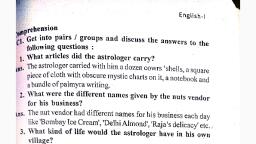
IX - English 9. An Astrologer's Day, , cl., , 5., , C2., , - By R.K. Narayan, , Answers to the following questions., , What articles did the astrologer carry?, , Astrologer carried a dozen cowries, shells, a square piece of cloth with, obscure mystic charts on it, a notebook and a bundle of palmyra writing., , What were the different names given by the nuts vendor for his, business?, , The nuts vendor gave fancy names each day by calling it "Bombay, Icecream" one day and on the next day "Delhi Almond" and on the third, , "Raja's Delicacy" and so on., , What kind of life would the astrologer have in his own village?, , If the astrologer was living in his village itself he would have carried on, the work of his forefathers namely, tilling the land, living, marrying and, ripening in his cornfield and ancestral home., , How much did the astrologer charge for his new clients?, Astrologer charged his clients three paise per question being asked., , Why did the astrologer remain silent for at least ten minutes, initially?, The astrologer would remain silent for at least ten minutes, that would, provide him enough information for a dozen answers and advices to be, , given to his clients., , What was the signal for the astrologer to bundle up?, , The nuts vendor would blow out his flare and rise to go home which happens, to be the signal for the astrologer to bundle up., , How much did the astrologer demand from his new client to answer, his question?, , The astrologer demanded rupees five from his new client to answer his, question., , What did the astrologer ask Guru Nayak to do?, , The astrologer asks Guru Nayak to take the next train but never travel, southward again since he would be in danger if he does so in his near, future journeys., , Working in pairs, discuss the answers to the following questions and, write them in your notebook., Why did the astrologer have no light of his own for his business?
Page 2 :
ee, , The astrologer transacted his business by the light of a flare which crackled, and smoked up above the groundnut heap nearby. The place was lit up b, , shop lights. It was a bewildering criss cross of light rays and moving, shadows. This kind of li ght suited the astrologer very well, for the ample, reason that he had not in the least intended to be an astrologer when he, began life and he knew what was going to happen to himself next minute., , 2. Why did the astrologer close his business when the nuts vendor blew, out his flare?, The astrologer closed his business when the nuts vendor blew out his flare, , since it left him in darkness except for a little shaft of green light which, strayed in from somewhere and touched the ground before him., , 3. How eficient was the astrologer in his business?, The astrologer's business was as much as an honest man's labour as any, other that was a deserving wages for him., , 4, "When shall I get him?", a) Who was this question asked to?, The astrologer., , b) Whom does "I" refer to?, The client of the astrologer, Guru Nayak., , c) Why does the speaker want to get him?, Guru Nayak wanted to get him to take revenge upon him., 5. "You look worried. What is wrong?", , a) Who is the speaker?, The astrologer's wife., , b) Whom does "you" refer to?, The astrologer., , c) Why was he worried?, The astrologer was worried because the client had promissed him to pay, one rupee but had paid only twelve and a half annas., , C3.1 Why did the astrologer run away from his village?, The astrologer, when young, one day had drunk, gambled and quarrelled, badly which had resulted in stabbing a person and then pushed him into a, nearby well. Hence he had to run away from his village., , 2. In the story, do you think the astrologer should be punished for his, crime?
Page 3 :
Describe how the astrologer felt at the end of the story?, At the end of the story, the astrologer felt relieved because the client whom he, , had met that day was none other than the peson whom he tried to kill and had, pushed into the well. He had carried the guilt of being a murderer till then. So, he was relaxed to find that the person was alive., , Describe the role of fate and chance in the story., , The fate of the astrologer seems to be good. After committing a crime he runs, away from his village without getting caught and leads a safe life. He takes up, an occupation which is not known to him but he does it well and earns his, livelihood out of it. He chanced to meet Mr. Guru Nayak, whom he had tried to, kill but he was saved by somebody. The astrologer saves himself from Guru, Nayak and sends him away by using his astrological tricks by saying that the, person who tried to kill him had already been dead. So at the end he gets, another chance to lead a lie without the guilt of being murderer and also a safe, , life without the fear of Guru Nayak's attack on him., Does this story make you think that all astrologers are false? Write, , about it?, This story is about a person who has taken astrology as a mask to protect, , himself and earn a living. After running away from home he had taken it as a, , disguise. He doesn’t have any basic knowledge of astrology. He is only skilled, in reading people’s problems and giving some advice to console them. But that, doesn’t mean that all astrologers are false. There are many astrologers who, , have taken it as profession after a deep study for many years., How has R.K Narayan portrayed the attractive appearance of the, , astrologer?, The astrologer had a very imposing appearance. His forehead was resplendent, with sacred ash and vermilion and his eyes sparked with a sharp, abnormal, , glean which was really an outcome of. continued searching look for customers.
Page 4 :
IX - English, , C3., , C4., , Poem 8: Ethics - Linda Pastan, , What question did the teacher use to ask every time?, The teacher used to ask the class an ethical question. "If there was a fire in a t, museum, which would you save? - A Rembrandt painting or an old woman, , who hadn't many years left.", Were the children able to answer the question correctly?, The children chose a different answer every time the question was posed., , Sometimes they chose to save the painting and sometimes the old woman., Where is the speaker working when the speaker narrates this incident?, The speaker is working in the museum probably as the curator., , What had the speaker realized after many years., The speaker realized that both the painting and herself, an old woman now,, were valuable in their own way. She realizes that the painting is like her-she is, old and in the "autumn" or "winter" of her life. So, she connects to the dark, , colors of the painting because they feel similar to the closing of her own life., You cannot separate them when trying to decide which to save; it's all part of, life and its cycles, and no one-children included-can alter the circle of life., There could never be a proper ethical choice between the two., , Discuss with your friends if the poem is only about a lesson of ethics, , learnt in school or if it offers something higher than this :, The poem begins with the memory of an ethics class the poet herself attended., , The question in case of a fire which is worth saving a famous painting or an, old woman is beyond the comprehension of children who answered differently, in each time. A mature person who understands the ethical values only will be, able to answer such question. But the poem carries a higher message. It is not, just a lesson to be learnt in school. It is a question of human values. As the time, passes the old piece of art and the veterans in the society do not draw much of, the attention of the children. They understand the value of both only in the, , later half of their life., , List a few ‘ethics’ you have to follow in the situations given below :, Place of work : We should be sincere and kind towards others and co-workers., , Never speak ill about the company., Place of learning (a school/class) : We should be obedient, disciplined and, , attentive in the class. We should be hard working, punctual and no teasing or, , hurting the classmates., Place of worship : We should maintain silence and peace, cleanliness and, , sanctity., Place of living : We should respect the elder, parents and maintain cordial, , relationship with everyone, who are living with us.



 Learn better on this topic