Notes of Class 8 A, B, C, D, S. St. Ch 12 history class 8 - Study Material
Page 1 :
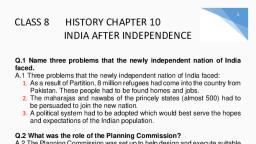
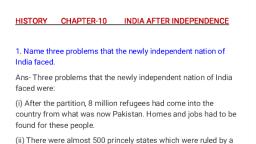
(History) (Chapter - a (India After Independence), , Class ~ 8), Exercises, ’, Let's recall, Question 1:, Name three problems that the newly independent nation of India faced., € Answer 1:, , The three problems that the newly independent nation of India faced are as follows:, » Rehabilitation of a large number of refugees., » Assimilation of princely states., >» Ensuring the unity of a country which is full of diversity., , Question 2:, , What was the role of the Planning Commission?, , € Answer 2:, , The Planning Commission was to formulate policies which would guide the economic development., Productivity and employment opportunities were to be increased through proper implementation of, those policies., , 3s Fill in the blanks: ae a, , (a) Subjects that were placed on the Union L, (b) Subjects on the Concurrent List were, (c) Economic planning by which both the state and ‘the privat private sector played a role in development, was called a model., , (d) The death of sparked off such violent protests that the government was forced to give in, to the demand for the linguistic state of Andhra. ‘, , € Answer 3:, , (a) Subjects that were placed on the Union List were taxes, defence and foreign affairs., , (b) Subjects on the Concurrent List were forests and agriculture., , (c) Economic planning by which both the state and the private sector played a role in development, was called a Mixed economy model., , (d) The death of Potti Sriramulu sparked off such violent protests that the government was forced to, give in to the demand for the linguistic state of Andhra., , Question 4:, , State whether true or false:, , (a) At independence, the majority of Indians lived in villages., , (b) The Constituent Assembly was made up of members of the Congress party., , (c) In the first national election, only men were allowed to vote,, , (d) The Second Five Year Plan focused on the development of heavy industry., , € Answer 4:, , (a) At independence, the majority of Indians lived in villages. True, , (b) The Constituent Assembly was made up of members of the Congress party. False, (c) In the first national election, only men were allowed to vote. False, , (d) The Second Five Year Plan focused on the development of heavy industry. True, , , , and
Page 2 :
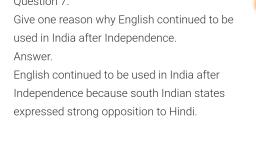
(History)(Chapter - e oe After Independence), ,, Let's discuss, Question 5:, What did Dr Ambedkar mean when he said that “In politics we will have equality, and in social and, economic life we will have inequality"?, © Answer 5:, , By political equality, Dr. Ambedkar meant the universal adult franchise which gave equal rights to all, citizens. By socioeconomic inequality, he meant the income disparities among people., , 6:, After Independence, why was there a reluctance to divide the country on linguistic lines?, € Answer 6:, The partition of the country along communal lines changed the mindset of the nationalist leaders., They wanted to prevent further divisions in the country on sectarian lines., , Question 7:, , Give one reason why English continued to be pend tia after Independence., € Answer 7: ;, Some leaders believed that English should be away with and Hindi should be promoted as the, , national language. But this idea was opposed by leaders from non-Hindi areas. They did not want, an imposition on Hindi on the people of those areas. Finally, it was decided that while Hindi would, be the ‘official language’; English would be used for communication among various states., , , , Question 8: oss, , How was the economic development of India vinvalised in the early decades after Independence?, © Answer 8:, , Removing poverty and building a modern technical and industrial base were important objectives, for the new nation. The Planning Commission was set up in 1950 to plan and execute policies for, economic development., , The policy makers followed the model of the mixed economy. As per this model, both the State and, the private sector had to play important and complementary role in economic development.