Notes of EIGHTH - A SOCIAL STUDIES, SOCIAL STUDIES civis exercise.pdf - Study Material
Page 1 :
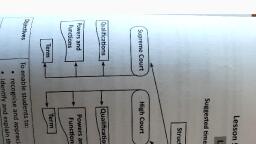
Lesson 5: THE JUDICIARY, Lesson Plan, Suggested time: 6-7 periods (40 mins each), Structure of the Judiciary, Supreme Court, High Court, Subordinate Courts, Lok Adalat, Qualifications, Qualifications, Civil, Criminal, Powers and, Powers and, Functions, Functions, Term, Term, Objectives, To enable students to:, • recognise and appreciate the role of the judiciary in a democracy, • identify and explain the structure of the judiciary, board, chalk, picture of the Supreme Court of India,
Page 2 :
Exercises, III. Short Answers, Fill in the blanks., 1., 1. The chief justice of India is appointed by the, 1. What is the meaning of the term appellate, power?, President., • If a person is unhappy with a judgment, given by a High Court, he or she can, appeal to the Supreme Court, which will, then hear the case and give the final, judgment., 2. Disputes between the two state governments, are dealt by the Supreme Court., 3. The High Court is the highest court at the, state level., 4. Disobeying a court is known as contempt of, 2. What is the advisory jurisdiction of the, Supreme Court?, court., 5. A High Court judge can be removed through, a resolution in Parliament., • The Supreme Court advises the President, and the Council of Ministers, on matters, of constitutional issues or issues of public, importance., II. True or False?, 1. The Indian judiciary has a single unified, structure. (T), • The President can seek the advice of the, Supreme Court but this is not binding on, the President., 2. High Courts deal only with criminal cases. (F), 3. A person dissatisfied with the order of the, district court can appeal to the Supreme, Court. (F), 3. Explain the term judicial review., • Any law, government that is not in accordance, with the text or intention of the, or policy made by the, 4. Lok Adalats and Mobile Courts deliver, speedy justice. (T), 5. A High Court cannot issue directives to the, prime minister of India. (F), Constitution can be declared illegal by, the Supreme Court., -217
Page 3 :
• Courts of the chief judicial magistrate, the, first class magistrate and The second class, magistrate: subordinate courts, 4. What is a public interest litigation?, • Any citizen of India can go to the court if, the interest of the public has been affected, by the deeds of the government., 2. What are the differences between civil and, criminal cases?, • The courts then check the malpractices of, the public officials and prevent the misuse, of power by the government., Civil cases, • Deal with individual wrongs. For example,, cases dealing with issues related to money., marriage, etc., Is brought by an individual or a private party, • You cannot be imprisoned or arrested., 5. Give two examples of subordinate courts., • Court of the civil judge, • The court of the munsif, 6. A person is not satisfied with the judgment, of the Court of Session's judge. To which, court should she appeal?, • The guilty has to compensate the victim, for damages caused, which is usually, monetary., • The High Court., Criminal cases, IV. Answer in detail., • Deal with wrongs against society or the, State. Offences such as theft cheating,, murder, arson, loot rape, dacoity or robbery, • Is brought by the government., • The guilty can be fined, arrested or, imprisoned., 3. What are the advantages of having a single, unified judicial system in the country?, 1. Draw and explain the hierarchal structure, of the various courts of the Indian judiciary., Supreme court, Highest court with the Chief Justice of India, at its head, situated in New Delhi, defender, of our Fundamental Rights, Independent of, the Legislature and Executive, High court, • Ifa citizen is dissatisfied with the judgment, given in any lower court he or she can, appeal to a higher court., • If a fundamental right is violated, the, citizen can appeal either to the High Court, or to the Supreme Court and the courts, can issue writs to safeguard and enforce, the fundamental rights., • Apex court of the state, headed by a chief, justice, has original jurisdiction over cases,, deals with all cases of the state - both civil, and criminal., District court, • Located in each district of the state,, separate courts for civil and criminal cases, Subordinate courts, Multiple Choice Questions, • Civil courts: Court of the civil judge,, highest court of civil justice, 1. b, 3. а & d, 9. d, 2. с, 4. с, 5.с, 6. a, 7. c, 8. d, • Court of civil judge and Court of munsif:, subordinate courts under it, Values that enrich, • Criminal courts: Court of the Sessions, judge, highest court in the district dealing, with criminal cases, Respect for individual rights, Justice and fairness, Willingness to settle cases speedily
Page 4 :
Lesson 6: THE ROLE OF THE POLICE AND THAT OF THE COURTS, Lesson Plan, Suggested time: 5-6 periods (40 mins each)
Page 5 :
Answer key for the exercises in the lesson, Exercises, Fill in the blanks., 3. On the basis of what factors does the judge, decide a case?, I., 1. The head of the police administration of a, district is called Superintendent of Police., • The judge hears both sides of the case., • Based on the evidence or proof presented, by the police, witnesses, defendant, public, prosecutor, and the defense lawyer the, judge gives his or her verdict., 2. A complaint petition to the police is known, by the abbreviation FIR., 3. A death sentence will be carried out only if it, is confirmed by High/Supreme Court., 4. If a person is found guilty by the High Court,, he or she can appeal to the Supreme Court., IV. Answer in detail., 1. Describe the procedure to file an FIR., 5. A person who watched a crime being, committed is known as a witness., • The police station is required to register, an FIR whenever information is given that, II. True or False?, a crime has been committed., 1. An FIR can be filed only in the police station, that belongs to the area where the crime, took place. (F), • Even if the crime is committed beyond the, purview of the police station, in order to, avoid delay, the police must file a FIR and, then transfer the case to the police station, 2. The police have the authority to punish the, offenders. (F), concerned., 3. The police cannot torture the persons they, detain for questioning. (T), • The FIR must be hand-written, signed and, prepared in duplicate., • The police officer assigns a registration, number, and signs and gives the informant, his or her copy, while retaining one copy, for the police., 4. A person accused of a crime is considered, innocent until proven guilty in a court. (T), 5. Every accused person has a right to have a, lawyer to represent him in court. (T), 6. An accused person will be set free by the, court if there is not enough evidence to, punish him or her. (T), • The FIR should specify the place, date and, time of the incident, and describe the, incident in detail., III. Answer in brief., 1. What is a first information report (FIR)?, 2. Why should every accused be held innocent, until proven otherwise? What will happen, if this is not so?, • When a person becomes the victim or, witness of a crime, he or she should file a, First Information Report (FIR) in the police, Only a thorough investigation and a free and, fair trial in a court of law can prove whether, a person is guilty of a crime or not. To ensure, that the investigation is carried out in an, unbiased manner and also to ensure that, station., • The police will begin their investigation, into an offence only after an FIR has been, lodged., the accused gets a free and fair trial, it is, necessary that she/he is considered to be, innocent until proven guilty., 2. Who is a public prosecutor?, • Any criminal offence is deemed to be an, offence against society and therefore, against the State., If this were not so, innocent people could, get punished for crimes they have not, committed., • A public prosecutor is a lawyer who argues, the case for the government or defends, the State., 3. Explain the process of investigating crimes., • It is one of the most important duties of, the police., • He or she is appointed by the State., -223



 Learn better on this topic