Notes of Class 8thA and C, Science Chapter 17,Solar system. - Study Material
Page 1 :
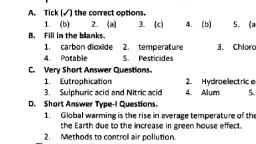
Chapter 17: Stars and the Solar System, A., , Tick ( ) the correct options., 1., , B., , C., , (a), , 2., , (b), , 3., , (b), , 4., , (b), , 5., , (a), , 6., , (a), , Fill in the blanks., , 3. Halley's, , 1., , Sirius, , 2., , Hunter, , 4., , meteorite, , 5., , great bear constellation 6. the southern hemisphere, , Very Short Answer Questions., 1., , (a) 123°C, , (b) -233C, , 2., , It is the distance travelled by the light ina year., 1 light year = 9.46 x 10² kilometres, , 3., , Jupiter, , 4., , We can never see the backside of the moon from Earth because the moon, rotates about its axis in about the same time that it takes to orbit the Earth., , 5., , A comet is a small body of ice and dust that moves around the Sun in, , highly elliptical orbit., D., , Short Answer Type-1, 1., , Questions, , The Sun appears to be larger and brighter because it is much nearer to, , the Earth than any other star, 2., , Mars is called red planet because its red colour comes from iron oxide, (rust) in its soil., , 3., , The pole star appears stationary as seen from the Earth because it lies, close to the axis of rotation of the Earth., , 4., , Western Sky., Venus and Uranus, , 5., , Asteroids are small irregular heavenly bodies of rock and metals which, revolves around the Sun in the gap between the orbits of mars and jupiter., Short Answer Type-ll Questions., 1. (i) It is clearly seen in the northern part of the sky in July., (i) There are seven prominent stars in this constellation which form, the shape of a dipper., (ii) At the end of the tail of Ursa minor is the Pole star., 6., , E., , 2., , The Earth is the only planet in the solar system on which life is known to, , exist. Conditions for existence of life are:
Page 2 :
(), (i), (ii), (iv), , Earth is at the right distance from the Sun., It has right temperature range., Presence of water., A suitable atmosphere., , (v) A blanket of ozone., , S. No Parameters, , Meteorites, , Meteors, , (Points of, , difference), 1., , Burning, , Meteors burn, , Meteorites does not, , completely before burn completely on, , 2., , Size, , they reach the, , entering the Earth's, , surface of the, , atmosphere and, , Earth., , lands on Earth's, surface., , The size of this The size of this, , heavenly, , body heavenly body is, , is very small, , asvery big., , compared to the, , size of meteorites., 3., , Damage, , It does not cause, , any damage., , It can create a large, crater and cause a, , lot of damage on the, Earth's surface., 4., , Scientific, studies, , Not yet possible., , It helps the scientists, to know about the, , nature of the matter, , in outerspace., 4., , (a) (i), , Planets are solid heavenly bodies which revolve around the, , Sun in closed elliptical orbits., (i) A planet has no light of its own. It shines because it reflects the, light of the Sun., (b) We learn to be disciplined, punctual and focussed in life like these, heavenly bodies., F, , Long Answer Questions., , 1., , (a) New moon: When the moon is in between the Earth and the Sun, then the side of the moon, lit by the Sun is away from the Earth, and the side of the moon which is towards the Earth is dark. This is, called a new moon. New moon night is called 'Amavasya' in India., (b) Crescent moon: The phase of moon when a small portion of moon, is lit by Sun is called a crescent moon.
Page 3 :
(c), , First quarter: After 7 days of new moon, the Sun lit half, portion of, moon. S0, we are able to see half moon. It is called, First, , quarter, , moon., , (d) Gibbous, , moon:, , called the, , 2., , When, , gibbous, , we see more, , (at, , than half of the moon, it is, , 10th, , day of new moon)., (e) Full moon: After 14 days of new moon day. We are able to see full part, of moon facing towards Earth. It is also called as 'Purnima in India., (a) An Artificial satellite is a human-made object that has been placed, moon, , into the orbit around the Earth, , or some, , specific functions., , (6)Parameters, Type of body, , Revolution, Size the body, , Planets, Planets are natural, , other, , planets, , to, , perform, , Satellites, Satellites, , heavenly bodies, , both, natural and, artificial, human made objects., , Planets revolve, , Satellites revolve, , are, , around the Sun., around the planets., Sizeofthe planets are Size of the satellites are, , large as compared to very small as compared, size of satellites., to planets., , (c) Three uses of artificial satellites are:, , () Artificial satelites are used for weatherforecasting, , (ii) Artificial satellites are used for transmitting radio and television, , signals., , (ii) Artificial satellites are used for collecting information about, other planets and about the outer space.