Notes of RAKVB - STD :- 8 -RAVISIR, Science CHAPTER - 16.pdf - Study Material
Page 1 :
LIGHT, , T, , he world is largely known through, the senses. The sense of sight, is one of the most important, senses. Through it we see mountains,, rivers, trees, plants, chairs, people and, so many other things around us. We also, see clouds, rainbows and birds flying, in the sky. At night we see the moon, and the stars. You are able to see the, words and sentences printed on this, page. How is seeing made possible?, , comb and close all its openings, except one in the middle. You can, use a strip of black paper for, this purpose. Hold the comb, perpendicular to the sheet of paper., Throw light from a torch through, the opening of the comb from one, side (Fig. 16.1). With slight, adjustment of the torch and the, comb you will see a ray of light along, the paper on the other side of the, comb. Keep the comb and the torch, steady. Place a strip of plane mirror, in the path of the light ray (Fig., 16.1). What do you observe?, , 16.1 What makes Things, Visible, Have you ever thought how we see, various objects? You may say that eyes, see the objects. But, can you see an, object in the dark? It means that eyes, alone cannot see any object. It is only, when light from an object enters our, eyes that we see the object. The light, may have been emitted by the object, or, may have been reflected by it., You learnt in Class VII that a polished, or a shiny surface can act as a mirror. A, mirror changes the direction of light, that falls on it. Can you tell in which, direction the light falling on a surface, will be reflected? Let us find out., , 16.2 Laws of Reflection, Activity 16.1, Fix a white sheet of paper on a, drawing board or a table. Take a, , Fig. 16.1 : Arrangement for showing reflection, , After striking the mirror, the ray of, light is reflected in another direction., The light ray, which strikes any surface,, is called the incident ray. The ray that, comes back from the surface after, reflection is known as the reflected ray., , 2021–22
Page 2 :
Table 16.1 : Angles of Incidence, and Reflection, , A ray of light is an idealisation. In, reality, we have a narrow beam of, light which is made up of several, rays. For simplicity, we use the term, ray for a narrow beam of light., , S., No., , Angle of, ∠i), Incidence (∠, , Angle of, ∠r), Reflection (∠, , 1., , Draw lines showing the position of, the plane mirror, the incident ray and, the reflected ray on the paper with the, help of your friends. Remove the mirror, and the comb. Draw a line making an, angle of 90º to the line representing the, mirror at the point where the incident, ray strikes the mirror. This line is known, as the normal to the reflecting surface, at that point (Fig. 16.2). The angle, , 2., 3., 4., 5., , Do you see any relation between the, angle of incidence and the angle of, reflection. Are they approximately equal?, If the experiment is carried out carefully,, it is seen that the angle of incidence is, always equal to the angle of reflection., This is one of the laws of reflection., Let us perform another activity on, reflection., , Fig. 16.2 : Drawing the normal, , between the normal and incident ray is, called the angle of incidence (∠i). The, angle between the normal and the, reflected ray is known as the angle of, reflection (∠r) (Fig. 16.3). Measure the, angle of incidence and the angle of, reflection. Repeat the activity several, times by changing the angle of, incidence. Enter the data in Table 16.1., , Reflected, ray, , What would happen if I, threw the light on the, mirror along the normal., , Activity 16.2, , Incident, ray, Normal, , Fig. 16.3 : Angle of incidence and angle of, reflection, 200, , Perform Activity 16.1 again. This, time use a sheet of stiff paper or a, chart paper. Let the sheet project a, little beyond the edge of the Table, (Fig. 16.4). Cut the projecting, portion of the sheet in the middle., Look at the reflected ray. Make sure, that the reflected ray extends to the, projected portion of the paper. Bend, that part of the projected portion on, which the reflected ray falls. Can, you still see the reflected ray? Bring, the paper back to the original, SCIENCE, , 2021–22
Page 3 :
with the Sun as the source of light, instead of a torch. You, too, can use the, Sun as the source of light., , position. Can you see the reflected, ray again? What do you infer?, , These activities can also be performed, by making use of the Ray Streak, Apparatus (available in the kit, prepared by NCERT)., , Boojho remembered that in Class VII,, he had studied some features of the, image of an object formed by a plane, mirror. Paheli asked him to recall those, features:, (i) Was the image erect or upside, down?, (ii) Was it of the same size as the, object?, (iii) Did the image appear at the same, distance behind the mirror as the, object was in front of it?, (iv) Could it be obtained on a screen?, Let us understand a little more about, the formation of an image by a plane, mirror in the following way:, , (a), , (b), Fig. 16.4 (a), (b) : Incident ray, reflected ray, and the normal at the point, of incidence lie in the same, plane, , Activity 16.3, , When the whole sheet of paper is, spread on the table, it represents one, plane. The incident ray, the normal at, the point of incidence and the reflected, ray are all in this plane. When you bend, the paper you create a plane different, from the plane in which the incident, ray and the normal lie. Then you do not, see the reflected ray. What does it, indicate? It indicates that the incident, ray, the normal at the point of, incidence and the reflected ray all lie, in the same plane. This is another law, of reflection., Paheli and Boojho performed the, above activities outside the classroom, , A source of light O is placed in front, of a plane mirror PQ. Two rays OA, and OC are incident on it (Fig. 16.5)., Can you find out the direction of, the reflected rays?, Draw normals to the surface of the, mirror PQ, at the points A and C., Then draw the reflected rays at the, points A and C. How would you, draw these rays? Call the reflected, rays AB and CD, respectively., Extend them further. Do they meet?, Extend them backwards. Do they, meet now? If they meet, mark this, point as I. For a viewer’s eye at E, (Fig. 16.5), do the reflected rays, 201, , LIGHT, , 2021–22
Page 4 :
Fig. 16.6 : Parallel rays incident on, an irregular surface, , Fig. 16.5 : Image formation in a plane mirror, , appear to come from the point I., Since the reflected rays do not, actually meet at I, but only appear, to do so, we say that a virtual image, of the point O is formed at I. As you, have learnt already in Class VII,, such an image cannot be obtained, on a screen., , Fig. 16.7 : Rays reflected from irregular, surface, , You may recall that in an image, formed by a mirror the left of the object, appears on the right and the right, appears on the left. This is known as, lateral inversion., , 16.3 Regular and Diffused, Reflection, Activity 16.4, Imagine that parallel rays are, incident on an irregular surface as, shown in Fig. 16.6. Remember that, the laws of reflection are valid at, each point of the surface. Use these, laws to construct reflected rays at, various points. Are they parallel to, one another? You will find that, these rays are reflected in different, directions. (Fig. 16.7), , When all the parallel rays reflected, from a rough or irregular surface are, not parallel, the reflection is known as, diffused or irregular reflection., Remember that the diffused reflection, is not due to the failure of the laws of, reflection. It is caused by the, irregularities in the reflecting surface,, like that of a cardboard., On the other hand, reflection from, a smooth surface like that of a mirror, is called regular reflection (Fig. 16.8)., Images are formed by regular, reflection., , Fig. 16.8 : Regular reflection, , 202, , SCIENCE, , 2021–22
Page 5 :
Do We See all Objects due to Reflected Light?, Nearly everything you see around is seen due to reflected light. Moon, for example,, receives light from the Sun and reflects it. That’s how we see the moon. The objects, which shine in the light of other objects are called illuminated objects. Can you, name some other such objects?, There are other objects, which give their own light, such as the Sun, fire, flame, of a candle and an electric lamp. Their light falls on our eyes. That is how we see, them. The objects which emit their own light are known as luminous objects., , I have a question. Can the, reflected rays be further reflected, if incident on another mirror?, , Let us find out., , 16.4 Reflected Light Can be, Reflected Again, Recall the last time you visited a hair, dresser. She/he makes you sit in front of, a mirror. After your hair cut is complete,, she/he holds a mirror behind you to show, you how the hair has been cut, (Fig. 16.9). Do you know how you could, see the hair at the back of your head?, , Paheli recalls having constructed a, periscope as an Extended Activity in, Class VI. The periscope makes use of, two plane mirrors. Can you explain, how reflection from the two mirrors, enables you to see objects which are, not visible directly? Periscopes are, used in submarines, tanks and also, by soldiers in bunkers to see things, outside., , 16.5 Multiple Images, You are aware that a plane mirror forms, only a single image of an object. What, happens if two plane mirrors are used, in combination? Let us see., , Fig. 16.9 : Mirror at the hair dresser shop, 203, , LIGHT, , 2021–22
Page 6 :
Activity 16.5, , Can you now explain how you can, see the back of your head at the hair, dresser’s shop?, This idea of number of images formed, by mirrors placed at an angle to one, another is used in a kaleidoscope to, make numerous beautiful patterns. You, can also make a kaleidoscope yourself., , Take two plane mirrors. Set them, at right angles to each other with, their edges touching (Fig. 16.10). To, hinge them you can use adhesive, tape. Place a coin in between the, mirrors. How many images of the, coin do you see (Fig. 16.10)?, , Kaleidoscope, , Activity 16.6, To make a kaleidoscope, get three, rectangular mirror strips each about, 15 cm long and 4 cm wide. Join, them together to form a prism as, shown in Fig. 16.12(a). Fix this, arrangement of mirrors in a circular, cardboard tube or tube of a thick, chart paper. Make sure that the tube, is slightly longer than the mirror, strips. Close one end of the tube by, a cardboard disc having a hole in, the centre, through which you can, see [Fig. 16.12(b)]. To make the disc, durable, paste a piece of transparent, plastic sheet under the cardboard, , Fig. 16.10 : Images in plane mirror at right, angle to each other, , Now hinge the mirrors using the, adhesive tape at different angles, say, 45°, 60°, 120°, 180° etc. Place some, object (say a candle) in between, them. Note down the number of, images of the object in each case., Finally, set the two mirrors, parallel to each other. Find out how, many images of a candle placed, between them are formed (Fig., 16.11)., , (a), , mirrors, , (b), Fig. 16.11 : Image in plane mirror parallel, to each other, , (c), , Fig. 16.12 : Making a kaleidoscope, , 204, , SCIENCE, , 2021–22
Page 7 :
16.6 Sunlight — White or, Coloured, , disc. At the other end, touching the, mirrors, fix a circular plane glass, plate [Fig. 16.12(c)]. Place on this, glass plate several small pieces of, coloured glass (broken pieces of, coloured bangles). Close this end of, the tube by a ground glass plate., Allow enough space for the colour, pieces to move around., , In Class VII, you learnt that the sunlight, is referred to as white light. You also, learnt that it consists of seven colours., Here is another activity (Activity 16.7), showing that sunlight consists of several, colours., , Your kaleidoscope is ready. When, you peep through the hole, you will be, able to see a variety of patterns in the, tube. An interesting feature of a, kaleidoscope is that you will never see, the same pattern again. Designers of, wallpapers and fabrics and artists often, use kaleidoscopes to get ideas for new, patterns. To make your toy attractive,, you can wrap the kaleidoscope in a, coloured paper., , 16.7 What is inside Our Eyes?, We see things only when light coming, from them enters our eyes. Eye is one, of our most important sense organs. It, is, therefore, important to understand, its structure and working., The eye has a roughly spherical, shape. The outer coat of the eye is, white. It is tough so that it can protect, the interior of the eye from accidents., Its transparent front part is called, , Activity 16.7, Get a plane mirror of a suitable size., Place it in a bowl (katori) as shown, in Fig. 16.13. Fill the bowl with water., Put this arrangement near a window, in such a way that direct sunlight, falls on the mirror. Adjust the, position of the bowl, so that the reflected, light from the, mirror falls on a, wall. If the wall is, not white, fix a sheet, of white paper on it., Reflected light will, be seen to have, many colours. How, can you explain, this? The mirror, and water form a, , prism. As you learnt in Class VII,, this breaks up the light into its, colours, Splitting of light into its, colours is known as dispersion of, light. Rainbow is a natural, phenomenon showing dispersion., , Fig. 16.13 : Dispersion of light, 205, , LIGHT, , 2021–22
Page 8 :
cornea (Fig. 16.14). Behind the cornea,, we find a dark muscular structure, called iris. In the iris, there is a small, opening called the pupil. The size of, the pupil is controlled by the iris. The, iris is that part of eye which gives it its, distinctive colour. When we say that a, person has green eyes, we refer actually, to the colour of the iris. The iris controls, the amount of light entering into the, eye. Let us see how., Ciliary, muscle, Iris, , Optic, Nerve, , Lens, , Class VII. The lens focuses light on the, back of the eye, on a layer called retina, (Fig. 16.14). The retina contains several, nerve cells. Sensations felt by the nerve, cells are then transmitted to the brain, through the optic nerve. There are two, kinds of cells–, (i) cones, which are sensitive to bright, light and, (ii) rods, which are sensitive to dim light., Cones sense colour. At the junction, of the optic nerve and the retina, there, are no sensory cells, so no vision is, possible at that spot. This is called the, blind spot. Its existence can be, demonstrated as follows:, , Activity 16.9, , Cornea, , Make a round mark and a cross on, a sheet of paper with the spot to the, right of the cross (Fig. 16.15). The, distance between two marks may be, 6-8 cm. Hold the sheet of paper at, an arm’s length from the eye. Close, your left eye. Look continuously at, the cross. Move the sheet slowly, towards you, keeping your eye on, the cross. What do you find? Does, the round mark disappear at some, point? Now close your right eye., Look at the round mark now and, repeat the activity. Does the cross, disappear? The disappearance of the, cross or the round mark shows that, there is a point on the retina which, cannot send messages to the brain, when light falls on it., , Retina, Fig. 16.14 : Human eye, , Caution : For this activity, never use, a laser torch., , Activity 16.8, Look into your friend’s eye. Observe, the size of the pupil. Throw light on, her eye with a torch. Observe the, pupil now. Switch off the torch, and, observe her pupil once again. Do, you notice any change in the size, of the pupil? In which case was the, pupil larger? Why do you think it, was so?, In which case do you need to, allow more light in the eye, when, the light is dim or bright?, Behind the pupil of the eye is a lens, which is thicker in the centre. What, kind of lens is thicker at the centre?, Recall what you learnt about lenses in, 206, , Fig. 16.15 : Demonstration of blind spot, SCIENCE, , 2021–22
Page 9 :
The impression of an image does not, vanish immediately from the retina. It, persists there for about 1/16th of a, second. So, if still images of a moving, object are flashed on the eye at a rate, faster than 16 per second, then the eye, perceives this object as moving., , Activity 16.10, Get a square piece of cardboard of, size 6-8 cm. Make two holes as, shown in Fig. 16.16. Thread a, string through the two holes. Draw/, paste a cage on one side of the, cardboard and a bird on the other, side. Twist the string and make the, card twirl rapidly. Do you see the, bird in the cage?, , Reverse side, of cardboard, , Front side of, cardboard, , Nature has provided eyes with, eyelids to prevent any object from, entering the eye. Eyelids also shut out, light when not required., Eye is such a wonderful instrument, that it (normal) can clearly see distant, objects as well as objects nearby. The, minimum distance at which the eye can, see objects distinctly varies with age. The, most comfortable distance at which one, can read with a normal eye is about, 25 cm., Some persons can see objects close, to them clearly but cannot see distant, objects so clearly. On the other hand,, some persons cannot see objects nearby, clearly but they can see distant objects, quite well. With suitable corrective, lenses, these defects of the eye can be, corrected., Sometimes, particularly in old age,, eyesight becomes foggy. It is due to the, eye lens becoming cloudy. When it, happens, persons are said to have, cataract. There is a loss of vision,, sometimes extremely severe. It is, possible to treat this defect. The opaque, lens is removed and a new artificial, lens is inserted. Modern technology, has made this procedure simpler, and safer., , 16.8 Care of the Eyes, Fig. 16.16 : Bird in cage, , The movies that we see are actually, a number of separate pictures in, proper sequence. They are made to, move across the eye usually at the rate, of 24 pictures per second (faster than, 16 per second). So, we see a moving, picture., , It is necessary that you take proper care, of your eyes. If there is any problem, you should go to an eye specialist. Have, a regular checkup—, l If advised, use suitable spectacles., l Too little or too much light is bad, for eyes. Insufficient light causes, eyestrain and headaches. Too much, light, like that of the Sun, a powerful, 207, , LIGHT, , 2021–22
Page 10 :
Did you know?, Animals have eyes shaped in different ways. Eyes of a crab are quite small but, they enable the crab to look all around. So, the crab can sense even if the enemy, approaches from behind. Butterflies have large eyes that seem to be made up of, thousands of little eyes (Fig., 16.17). They can see not only in, Eyes, the front and the sides but the, back as well., A night bird (owl) can see very, well in the night but not during, the day. On the other hand, day, light birds (kite, eagle) can see, well during the day but not in the, night. The owl has a large cornea, and a large pupil to allow more, light in its eye. Also, it has on its, retina a large number of rods and, only a few cones. The day birds, Fig. 16.17 : Eyes of a butterfly, on the other hand, have more, cones and fewer rods., , lamp or a laser torch can injure the, retina., l Do not look at the Sun or a powerful, light directly., l Never rub your eyes. If particles of, dust go into your eyes, wash your, eyes with clean water. If there is no, improvement go to a doctor., l Always read at the normal distance, for vision. Do not read by bringing, the book too close to your eyes or, keeping it too far., You learnt about balanced diet in, Class VI. If food is deficient in some, components, eyes may also suffer. Lack, of vitamin A in foodstuff is responsible, for many eye troubles. Most common, amongst them is night blindness., One should, therefore, include in the, diet components which have vitamin A., Raw carrots, broccoli and green, , vegetables (such as spinach) and cod, liver oil are rich in vitamin A. Eggs,, milk, curd, cheese, butter and fruits, such as papaya and mango are also rich, in vitamin A., , 16.9 Visually Impaired, Persons Can Read and, Write, Some persons, including children, can, be visually impaired. They have very, limited vision to see things. Some, persons cannot see at all since birth., Some persons may lose their eyesight, because of a disease or an injury. Such, persons try to identify things by, touching and listening to voices more, carefully. They develop their other, senses more sharply. However,, additional resources can enable them, to develop their capabilities further., , 208, , SCIENCE, , 2021–22
Page 11 :
Non-optical and optical aids for visually impaired, Non-optical aids include visual aids, tactual aids (using the sense of touch),, auditory aids (using the sense of hearing) and electronic aids. Visual aids, can, magnify words, can provide suitable intensity of light and material at proper distances., Tactual aids, including Braille writer slate and stylus, help the visually challenged, persons in taking notes, reading and writing. Auditory aids include cassettes, tape, recorders, talking books and other such devices. Electronic aids, such as talking, calculators and computers, are also available for performing many computational, tasks. Closed circuit television, also an electronic aid, enlarges printed material, with suitable contrast and illumination. Nowadays, use of audio CDs and voice boxes, with computers are also very helpful for listening to and writing the desired text., Optical aids include bifocal lenses, contact lenses, tinted lenses, magnifiers, and telescopic aids. While the lens combinations are used to rectify visual, limitations, telescopic aids are available to view chalkboard and class, demonstrations., , 16.10 What is the Braille, System?, The most popular resource for visually, challenged persons is Braille., Louis Braille, himself a visually, challenged person, developed a, system for visually challenged persons, and published it in 1821., , Braille system has 63 dot patterns or, characters., Each, character, represents a letter, a combination of, letters, a common word or a, grammatical sign. Dots are arranged, in cells of two vertical rows of three, dots each., Patterns of dots to represent some, English letters and some common, words are shown below., , Louis Braille, , Fig. 16.18 : Example of dot patterns used, in Braille System, , The present system was adopted in, 1932. There is Braille code for common, languages, mathematics and scientific, notation. Many Indian languages can, be read using the Braille system., , These patterns when embossed on, Braille, sheets, help, visually, challenged persons to recognise words, by touching. To make them easier to, touch, the dots are raised slightly., 209, , LIGHT, , 2021–22
Page 12 :
Visually impaired people learn the, Braille system by beginning with, letters, then special characters and, letter combinations. Methods depend, upon recognition by touching. Each, , character has to be memorised. Braille, texts can be produced by hand or by, machine. Typewriter-like devices and, printing machines have now been, developed., , Some visually impaired Indians have great achievements to their, credit. Diwakar, a child prodigy has given amazing performances, as a singer., Ravindra Jain, born completely visually impaired, obtained, his Sangeet Prabhakar degree from Allahabad. He had shown his, excellence as a lyricist, singer and music composer., Lal Advani, himself visually impaired, established an, Helen A. Keller Association for special education and rehabilitation of disabled, in India. Besides this, he represented India on Braille problems, in UNESCO., Helen A. Keller, an American author and lecturer, is perhaps the most wellknown and inspiring visually challenged person. She lost her sight when she was, only 18 months old. But because of her resolve and courage she could complete, her graduation from a university. She wrote a number of books including The, Story of my Life (1903)., , 210, , SCIENCE, , 2021–22
Page 13 :
KEYWORDS, , WHA, T Y, OU HA, VE LEARNT, WHAT, YOU, HAVE, , ANGLE OF, , Ü, , Light is reflected from all surfaces., , INCIDENCE, , Ü, , Regular reflection takes place when light is, , ANGLE OF, , incident on smooth, polished and regular, , REFLECTION, , surfaces., , BLIND SPOT, BRAILLE, , Ü, , rough surfaces., Ü, , CONES, , of reflection., (ii) Incident ray, reflected ray and the normal, , DIFFUSED OR, , drawn at the point of incidence to the, , IRREGULAR, , reflecting surface, lie in the same plane., , REFLECTION, , IRIS, , Ü, , Image formed in a plane mirror undergoes, lateral inversion., , Ü, , Two mirrors inclined to each other give multiple, images., , KALEIDOSCOPE, LATERAL INVERSION, , Two laws of reflection are, (i) The angle of incidence is equal to the angle, , CORNEA, , INCIDENT RAYS, , Diffused or irregular reflection takes place from, , Ü, , Beautiful patterns are formed in a, kaleidoscope because of multiple reflections., , LAWS OF, REFLECTION, PUPIL, , Ü, , colours., Ü, , REGULAR, REFLECTION, RETINA, , Splitting of light into its constituent colours is, known as dispersion., , REFLECTED RAYS, REFLECTION, , Sunlight, called white light, consists of seven, , Ü, , Parts of the eye are cornea, iris, pupil, lens,, retina and optic nerve., , Ü, , A normal eye can see nearby and distant, objects clearly., , Ü, , Visually impaired persons can read and write, using the Braille system., , RODS, Ü, , Visually impaired persons develop their other, senses more sharply to improve their interaction with their environment., , 211, , LIGHT, , 2021–22
Page 14 :
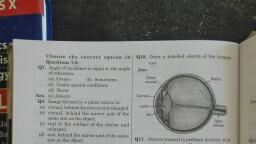
Exercises, 1., , Suppose you are in a dark room. Can you see objects in the room? Can, you see objects outside the room. Explain., , 2., , Differentiate between regular and diffused reflection. Does diffused, reflection mean the failure of the laws of reflection?, , 3., , Mention against each of the following whether regular or diffused reflection, will take place when a beam of light strikes. Justify your answer in each, case., (a), (c), , Polished wooden table, Cardboard surface, , (e), , Mirror, , (b) Chalk powder, (d) Marble floor with water, spread over it, (f) Piece of paper, , 4., , State the laws of reflection., , 5., , Describe an activity to show that the incident ray, the reflected ray and, the normal at the point of incidence lie in the same plane., , 6., , Fill in the blanks in the following., (a), , A person 1 m in front of a plane mirror seems to be _______________ m, away from his image., , (b), , If you touch your ____________ ear with right hand in front of a plane, mirror it will be seen in the mirror that your right ear is touched with, ____________., , (c), , The size of the pupil becomes ____________ when you see in dim light., , (d), , Night birds have ____________ cones than rods in their eyes., , Choose the correct option in Questions 7 – 8, 7., , Angle of incidence is equal to the angle of reflection., (a) Always, (c) Under special conditions, , 8., , (b) Sometimes, (d) Never, , Image formed by a plane mirror is, (a) virtual, behind the mirror and enlarged., (b) virtual, behind the mirror and of the same size as the object., (c) real at the surface of the mirror and enlarged., (d) real, behind the mirror and of the same size as the object., , 9., 10., , Describe the construction of a kaleidoscope., Draw a labelled sketch of the human eye., , 212, , SCIENCE, , 2021–22
Page 15 :
EXERCISES, , 11. Gurmit wanted to perform Activity 16.8 using a laser torch. Her teacher, advised her not to do so. Can you explain the basis of the teacher’s advise?, 12. Explain how you can take care of your eyes., 13. What is the angle of incidence of a ray if the reflected ray is at an angle of, 90° to the incident ray?, 14. How many images of a candle will be formed if it is placed between two, parallel plane mirrors separated by 40 cm?, 15. Two mirrors meet at right angles. A ray of light is incident on one at an, angle of 30° as shown in Fig. 16.19. Draw the reflected ray from the second, mirror., , Fig. 16.19, 16. Boojho stands at A just on the side of a plane mirror as shown in Fig., 16.20. Can he see himself in the mirror? Also can he see the image of, objects situated at P, Q and R?, , Fig. 16.20, 17. (a), , Find out the position of the image of an object situated at A in the, plane mirror (Fig. 16.21)., , (b), , Can Paheli at B see this image?, , (c), , Can Boojho at C see this image?, , (d), , When Paheli moves from B to C, where does the image of A move?, , Fig. 16.21, 213, , LIGHT, , 2021–22
Page 16 :
Extended Learning — Activities and Project, 1., , Make your own mirror. Take a glass strip or glass slab. Clean it and, put it on a white sheet of paper. See yourself in the glass. Next put, the glass slab on a black sheet of paper. Again look into the glass., In which case do you see yourself better and why?, , 2., , Make friends with some visually impaired students. Enquire from, them how they read and write. Also find out how they are able to, recognise objects, hurdles and currency notes., , 3., , Meet an eye specialist. Get your eye sight checked and discuss how, to take care of your eyes., , 4., , Survey your neighbourhood. Find out how many children below, the age of 12 years use spectacles. Find out from their parents, what, in their view, could be the reason for the weak eyesight of, their children., , Did You Know?, Eyes can be donated by any person as an invaluable gift to visually, impaired persons suffering from corneal blindness, The person may be, (a) a male or female., (b) of any age., (c) of any social status., (d) using spectacles., (e) suffering from any normal disease but not AIDS, Hepatitis B or C,, rabies, leukemia, lymphoma, tetanus, cholera, encephalitis., The eyes have to be donated within 4-6 hours after death at any, place, home or hospital., A person who wants to donate the eyes may pledge eyes during his/her, lifetime to any registered eye bank. He/she should also inform his/her, relatives about this pledge so that they can take necessary action after, his/her death., You can also donate a Braille kit., , 214, , SCIENCE, , 2021–22



 Learn better on this topic