Notes of Class 7, Social Science role of state government in distribution of resources23.pdf - Study Material
Page 1 :
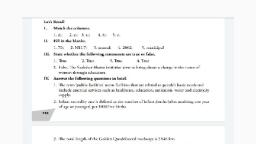
—_—_—_—_—$—$K$K<¥$¥$\¥X\¥\!*[!=_——>_—_SESEaE EEE”, Let’s Recall, , 1, , . a. use resources for the welfare of its citizens, , v, , . b. suit the needs of the people, . c. NITI Aayog, , &, , 4, a. 2005, 5. ¢. NITI Aayog, I. 1, Tre, 2. False. The NITI Aayog is headed by the Prime Minister,who is also the head of the, Council of Ministers., 3. Falsc.A minister introduces a bill in the assembly to cater to the requirements of the, people in a better way., , 4, False, Janani Suraksha Yojana has been implemented with the objective of reducing, maternal and infant mortality by promoting an option for deliveries in public or, accredited private health institutions., , 5. True, , . The recommendations made by the NITI Aayog for the utilisation of the available, , resources are taken into account by the Council of Ministers before deciding upon the, manner of resource allocation., , . ‘The three dimensions of health are physical, mental and social., , . Private and public are the two types of healthcare facilities available to the people of, India., 4, The Government of India had launched the National Rural Health Mission (NRHM), in 2005., 5. ‘The Kerala state is initiating a Health Management Information System for online, reporting and analysis of a variety of medical data which are necessary for healthcare., , TL., , yn, , , , IV. 1, ‘The collective wealth of a country is termed as its resources. Resources can be natural,, material and human., It is important to allocate resources to ensure a balanced plan for their use, and to, censure equal development of all regions of the state. This includes the promotion of, social and economic justice by creating employment opportunities and focusing on, backward regions by the government., , 2. According to World Health Organization (WHO), ‘Health is a state of complete, , physical, mental, and social well-being of an individual and society at large and not, merely the absence of disease or infirmity.’, , », , |. Public healthcare services in India: The Government of India runs a number of hospitals, and health centres across the country. Spread across both urban and rural areas, these, are established with the help of moncy from taxes that the citizens of the country pay., “The public healthcare facilities include quality healthcare services at cither free or at a, very low cost. ‘This is done so that even poor people can have access to quality medical, treatment., , 4, The Government of India had launched the National Rural Health Mission (NRHM), in 2005. In 2013, the government launched the National Urban Health Mission, (NUHM) and both came to be represented under the National Health Mission 2013., ‘The National Health Mission finances healthcare programmes in the states and Union, ‘Territories., , 5. ‘The activities of Directorate of Health Services, administered by the government, of Kerala, include the establishment and maintenance of medical institutions with, necessary infrastructure, control of communicable diseases, rendering of family welfare
Page 2 :
‘The National Health Mission finances healthcare programmes in the states and Union, ‘Territorics., , 5. ‘The activities of Directorate of Health Services, administered by the government, of Kerala, include the establishment and maintenance of medical institutions with, necessary infrastructure, control of communicable discases, rendering of family welfare, services including maternal and child health services, and implementation of national, programmes for the control and eradication of diseases. Some of the community, healthcare programmes already in place in Kerala arc National Programme for Control, of Blindness, National Tuberculosis (TB) Control Programme, National Leprosy, Eradication Programme and Mental Health Programme., , « It is the responsibility of the state government to improve primary healthcare, infrastructure. The NITI Aayog, in collaboration with the World Bank and the Ministry, of Health and Family Welfare has released a Health Index in 2018. ‘The index will, help the central government to measure improvement of a state in terms of its health, infrastructure and would be linked to incentives under the National Health Mission., , As per a report, Kerala held the first rank in terms of overall performance. Let us look at, the healthcare processes adopted by the government of Kerala:, , + The Directorate of Health Services, administered by the government of Kerala, oversces the establishment and maintenance of medical institutions with necessary, infrastructure, control of communicable diseases, rendering of family welfare services, including maternal and child health services, and implementation of national, programmes for the control and eradication of discases., , + Some of the community healthcare programmes already in place in Kerala are, National Programme for Control of Blindness, National Tuberculosis (TB), , Control Programme, National Leprosy Eradication Programme and Mental Health, Programme., , ‘+ The state has been able to initiate many programmes that match the key performance, areas financed by the National Rural Health Mission (NRHM) and National Urban, Health Mission (NUHM)—two branches of the National Health Mission., , 2. Difference between public and private healthcare services:, , Public Healthcare Services Private Healthcare Services, , A large number of hospitals and nursing,, homes are privately-owned. A large, number of doctors also have private, practices., , , , , , ‘The Government of India runs a number, of hospitals and health centres across the, country., , , , , , , , , , , , Spread across both urban and rural areas,, these are established with the help of money, from taxes that the citizens of the country, pay., , “These services are available in both urban, and rural areas, and are established by, individuals and companies using their, own moncy., , , , ‘The public healthcare facilities include quality, healthcare services at either free or at a very, low cost., , , , , , Since these facilities are not owned by the, government, some of these services are, expensive and at times beyond the scope, of the common man., , , , , , », , ‘The Directorate of Health Services, administered by the government of Kerala,, , provides preventive and promotive healthcare in addition to the routine curative, services and rehabilitation aspects of healthcare, Its activities include the establishment, and maintenance of medical institutions with necessary infrastructure, control of, , communicable discases, rendering of family welfare services including maternal and, child health services, and implementation of national programmes for the control and, , eradication of discases., , 4, ‘The reasons for the success of the Kerala healthcare programmes are as follows:, , * Priority is given to the upgradation of health infrastructures in rural and urban areas., * In Kerala, NRHM funding has made it possible to upgrade Community Health, Centres (CHC) and other medical institutions., , * Upgradation of general hospitals, district hospitals, taluk hospitals and other
Page 3 :
Health Mission (NUHM)—two branches of the National Health Mission:, , 2. Difference between public and private healthcare services:, , , , Public Healthcare Services, , Private Healthcare Services, , , , ‘The Government of India runs a number, of hospitals and health centres across the, country., , , , , , A large number of hospitals and nursing, homes are privately-owned. A large, number of doctors also have private, practices., , , , , , Spread across both urban and rural areas,, these are established with the help of money, from taxes that the citizens of the country, , pay., , ‘These services are available in both urban, and rural areas, and are established by, individuals and companies using their, own money., , , , ‘The public healthcare facilities include quality, healthcare services at either free or at a very, low cost., , , , , , Since these facilities are not owned by the, government, some of these services are, expensive and at times beyond the scope, of the common man., , , , 3. ‘The Directorate of Health Services, administered by the government of Kerala,, provides preventive and promotive healthcare in addition to the routine curative, services and rehabilitation aspects of healthcare. Its activities include the establishment, , and maintenance of medical institutions with necessary infrastructure, control of, , communicable discases, rendering of family welfare services including maternal and, child health services, and implementation of national programmes for the control and, , eradication of diseases., , 4, ‘The reasons for the success of the Kerala healthcare programmes arc as follows:, * Priority is given to the upgradation of health infrastructures in rural and urban areas., , + In Kerala, NRHM funding has made it possible to upgrade Community Health, Centres (CHO) and other medical institutions., , * Upgradation of general hospitals, district hospitals, taluk hospitals and other, , institutions have also taken place., , * To provide primary healthcare services to tribals, several mobile medical units, are functioning in the state. These vehicles conduct medical camps in remote, tribal settlements where treatment for basic illnesses, antenatal and postnatal care,, , immunisation services, prevention and control of communicable diseases, etc. are, , provided., , * Accredited social health activists are voluntary workers who ensure that the primary, healthcare services are accessed by the rural poor for prevention and control of, communicable diseases and community-based mental health programme., , 5. Programmes in Kerala for women and children:, , A special school health programme has been launched, which will eventually cover all, , government and government, , , , ided schools. The programme aims to develop healthy, , and informed adult human beings by promoting physical and mental health through, , childhood and adolescence., , Janani Suraksha Yojana has been implemented with the objective of reducing maternal, , , , an, private health institutions., , , , infant mortality by promoting an option for deliveries in public or accredited, , ‘To improve the immunisation status of the state, outreach camps have been identified, , to organise immunisation sessions in remote areas with special attention given to tribal,, , coastal and urban slums. Immunisation is necessary to save the lives of a large number, , of children.



 Learn better on this topic