Page 1 :
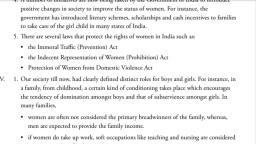
Let's Recall, , ih, , iL, , Il., , yw, , Seow, , .¢.940 2. a. 62 per cent 3. b. home 4.c. 2015, c. 18th century, True, . False. Gender refers to the social distinction between men and women., True, . False. Those economic activities which are in the organised sector comprise the formal, sector., , . False. A woman's ability to multi task is considered natural., . A:stereotype is a very firm and simple idea about what a particular type of person or, , thing is like, or how a person should or should not behave., , . Sex ratio is the ratio of males to females in a population, expressed as the number of, , females per thousand males., , . Women, today, are contributing to the formal sector (also called the organised sector) of, , the economy, though their compensation is less than their male counterparts., , . In most societies, a woman's role as a homemaker is not valued monetarily or otherwise., , . Empowerment of women to fight against inequalities is possible through expansion of, , education facilities, creation of more job opportunities and institutional representation, in legislatures., , . Gender refers to the social classification into men and women whereas sex refers to the, , biological distinction between male and female. In other words, gender pertains to the, differences between men and women as determined by society in terms of their social, domains, roles and responsibilities., , . Since women, from ancient times, were considered more emotional and intellectually, , inferior to men, it was believed that their emotions influenced their decisions and, behaviour. This prejudiced attitude made people feel that women lacked the political, acumen to participate in the political process. People also felt that if women were, , accorded the right to vote, it would en-danger their feminine characteristics. Their status, in seciety, therefore, was one of second-class citizens who played a key role in home, , affaics but were devoid of all other powers and privileges., , . The tendency has been to perceive women only as housewives, daughters, or mothers—, , always dependent on the male members of the household. Society, often, does not, view women as free thinking individuals. Cases of eve-teasing, molestation and sexual, harassment are not uncommon., , . A number of initiatives are now being taken by the Government of India to introduce, , positive changes in society to improve the status of women. For instance, the, government has introduced literary schemes, scholarships and cash incentives to families, to take care of the girl child in many states of India., , . Thete are several laws that protect the rights of women in India such as:, , * the Immoral Traffic (Prevention) Act, * the Indecent Representation of Women (Prohibition) Act, , * Protection of Women from Domestic Violence Act, , . Our society till now, had clearly defined distinct roles for boys and girls. For instance, in, , a family, from childhood, a certain kind of conditioning takes place which encourages, , the tendency of domination amongst boys and that of subservience amongst girls. In, , many families,, , * women are often not considered the primary breadwinners of the family, whereas,, men are expected to provide the family income., , , , ae, , , , oR aaa.
Page 2 :
In the informal sector:, , . ‘The Beti Bachao, Beri Padhao Scheme,, , - Gender inequality can be reduced w', , accorded the right to yote, it would en-danger their feminine characteristics. Their status, in society, therefore, was onc of second-class citizens who played a key role in home, affairs but were devoid of alf orher powers and privileges., , ‘The tendency has been to perceive women only as housewives, daughters, or mothers—, always dependent on the male members of the household. Society, often, does not, , view women as free thinking individuals. Cases of eve-teasing, molestation and sexual, , harassment are not uncommon., , . A number of initiatives are now being taken by the Government of India to introduce, , positive changes in society to improve the status of women. For instance, the, , government has introduced literary schemes, scholarships and cash incentives to families, , to take care of the girl child in many states of India., , ‘There are several laws that protect the righes of women in India such as:, , the Immoral Traffic (Prevention) Act, , * the Indecent Representation of Women (Prohibition) Act, , * Protection of Women from Domestic Violence Act, , Our society till now, had clearly defined distinct roles for boys and girls, For instance, in, , a family, from childhood, a certain kind of conditioning takes place which encourages, , the tendency of domination amongst boys and that of subservience amongst girls. In, , many farnilies,, , women are often not considered the printary breadwinners of che family, whereas,, men are expected to provide the family income., , + if women do take up work, soft occupations like teaching and rarsing are considered, , more appropriate for them., , the responsibility of houschold chores Jies wich the women and pot men., , Reasons why women were denied the yore:, , from ancient times, were considered more emotional and intellectually, , it was believed rhat their emotions influenced their decisions and, political, , + Since women,, inferior to men,, behaviour. This prejudiced attitude made people feel that women lacked the, acumen to participate in the p tical process., , * People felt that if women were accorded the right to vote, it would en-danger their, feminine characteristics., , * Probably, the men who held the power over vote felt that their infli, negated if women were allowed to join the public space as voters., , juence would be, , svomen are mostly employed as agriculcural labourers engaged in weeding, milling, , and hocing., are also involved in processing and marketing of, dicrafts such as weaving, basket, + women home-grown, making, knitting, selling, , products,beekeeping, han, , poultry products and fish., launched in 2015 has the following objectives:, , «prevention of gender-biased sex selective climination, © ensuring survival and procection of the girl child 6/7, , * ensuring education and participation of the girl child, , ichin a family by:, , ctunities of education for both girls and boys., , = equal divisio: kc in a family irrespective of gender., , eae unbiased support women whe choose to work outside the home., = ie ae, , «providing equal oppo!, a of household worl, , , , a>