Notes of VII B, Science Chapter 12 Biology_Reproduction-in-plants - Study Material
Page 1 :
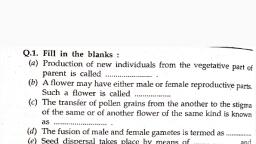
Class- VII-CBSE-Science, , Reproduction in Plants, , CBSE NCERT Solutions for Class 7 Science Chapter 12, Back of Chapter Questions, 1., , Fill in the blanks:, (a), , Production of new individuals from the vegetative part of parent is called, ________., , (b), , A flower may have either male or female reproductive parts. Such a flower is, called _________., , (c), , The transfer of pollen grains from the anther to the stigma of the same or of, another flower of the same kind is known as _________., , (d), , The fusion of male and female gametes is termed as __________., , (e), , Seed dispersal takes place by means of _________, _________ and _________., , Solution:, , 2., , (a), , Vegetative propagation, , (b), , Unisexual, , (c), , Pollination, , (d), , Fertilization, , (e), , Wind, water and animals, , Describe the different methods of asexual reproduction. Give examples., Solution:, The various modes of asexual reproduction in plants are as follows:, (i), , Vegetative propagation: The plants can produce new plants from vegetative parts, of plants such as roots, stems, leaves and buds., Vegetative propagation is divided into two types:, , a., , Natural vegetative propagation: This type of vegetative propagation occurs easily, in nature and involves simple vegetative parts., , Example:, Potato plant sprouting from its eye., b., , Artificial vegetative propagation: This type of vegetative propagation is, performed manually and generally occurs in laboratory conditions., , Example:, The stem cutting of a rose plant develops into a complete plant., Practice more on Reproduction in Plants, , Page - 1, , www.embibe.com
Page 2 :
Class- VII-CBSE-Science, , (ii), , Reproduction in Plants, , Budding: Budding is a process by which a new individual form from a bulb-like, projection called bud. It grows and gets detached from the parent to form a new, individual., , Example:, Yeast, (iii), , Fragmentation: It is a form of asexual reproduction where a new organism is, formed from the fragments of the parent body., , Example:, Spirogyra, (iv), , Spore formation: Spore formation is the mode of reproduction in many nonflowering plants. Spores are tiny cells protected by a thick wall., , Example:, Fungi, 3., , Explain what you understand by sexual reproduction., Solution:, In plants, Sexual reproduction involves the production of seeds. It requires two parents., Most plants reproduce sexually with the help of flowers. Through this process new, organisms are produced which are almost like their parents., , 4., , State the main difference between asexual and sexual reproduction., Solution:, Few differences between sexual and asexual reproduction include:, , 5., , Sexual reproduction, , Asexual reproduction, , i. Two parents are required, , i. Only one parent is required, , ii. Newly formed plants are similar to their, parents in sexual reproduction., , ii Newly formed plants are identical to their, parents and to each other,, , iii. Flower is the reproductive part of a plant, which contains the sexual organs of a plant., These are important for sexual reproduction., , iii. Special reproductive parts are not required, for asexual reproduction., , Examples: Hibiscus, corn, papaya, etc., , Examples: yeast, rose, jasmine, potato, etc., , Sketch the reproductive parts of a flower., Solution:, , Practice more on Reproduction in Plants, , Page - 2, , www.embibe.com
Page 3 :
Class- VII-CBSE-Science, , 6., , Reproduction in Plants, , Explain the difference between self-pollination and cross-pollination., Solution:, Differences between self-pollination and cross-pollination:, Cross-pollination, , Self-pollination, , It involves the transfer of pollen, i. Self-pollination is a type of pollination which, from the stamen to the pistil of the involves the transfer of pollen from stamen to the, same flower., pistil of the same flower., It takes place in both unisexual and, ii. It takes place only in bisexual flowers., bisexual flowers., , 7., , How does the process of fertilization take place in flower?, Solution:, , Practice more on Reproduction in Plants, , Page - 3, , www.embibe.com
Page 4 :
Class- VII-CBSE-Science, , Reproduction in Plants, , After pollination, a pollen tube develops from a pollen grain which passes though style, into the ovule. The male gametes are carried by pollen tube into the ovule and through, the micropyle it enters the ovule. One of the two gametes fuses with female gamete to, form zygote. The process of fusion of male and female gamete is called fertilization., , Longitudinal section of flower showing fusion of male and female gametes, 8., , Describe the various ways by which seeds are dispersed., Solution:, Seed dispersal takes place in the following ways:, Dispersal by animals – The seeds can be dispersed by animals or birds by many ways., The fruits can be eaten by birds and animals and excrete the seeds somewhere away from, parent plant or the seeds or fruits could be stuck to animal body due to their special, structure and hence get transferred to different sites. Example: Xanthium., (b), , Dispersal by wind – Wind carries away seeds that are usually small in size and, have wings or hair-like structures. Example: Winged seeds of drumsticks, hairy, fruit of sunflower, etc. are dispersed by wind., , (c), , Dispersal by water - Many aquatic plants or plants that live near water has seeds, that can float and are carried away by water. For example, coconuts can float and, are dispersed by water., , (d), , Dispersal by explosion - Sometimes the seeds are dispersed by the bursting of, fruits with sudden jerks. The seeds get scattered or distributed far from the parent, plant., , Examples:, Castor and balsam., 9., , Match the items of Column I with those in column II., , Practice more on Reproduction in Plants, , Page - 4, , www.embibe.com
Page 5 :
Class- VII-CBSE-Science, , Reproduction in Plants, , Column I, , Column II, , Bud, , Maple, , Eyes, , Spirogyra, , Fragmentation, , Yeast, , Wings, , Bread mould, , Spores, , Potato, Rose, , Solution:, Column I, , Column II, , Bud, , Yeast, , Eyes, , Potato, , Fragmentation, , Spirogyra, , Wings, , Maple, , Spores, , Bread mould, , Concept insight: List the modes of asexual reproduction in plants., 10., , Tick (, , ) the correct answer:, , (a), , The reproductive part of a plant is the, , (i), , leaf, , (ii), , stem, , (iii), , root, , (iv), , flower, , (b), , The process of fusion of the male and female gametes is called, , (i), , fertilisation, , Practice more on Reproduction in Plants, , Page - 5, , www.embibe.com
Page 6 :
Class- VII-CBSE-Science, , Reproduction in Plants, , (ii), , pollination, , (iii), , reproduction, , (iv), , seed formation, , (c), , Mature ovary forms the, , (i), , seed, , (ii), , stamen, , (iii), , pistil, , (iv), , fruit, , (d), , A spore producing organism is, , (i), , rose, , (ii), , bread mould, , (iii), , potato, , (iv), , ginger, , (e), , Bryophyllum can reproduce by its, , (i), , stem, , (ii), , leaves, , (iii), , roots, , (iv), , flower, , Solution:, (a), , The reproductive part of a plant is the, , (iv), , flower, , (b), , The process of fusion of the male and female gametes is called, , (i), , fertilization, , (c), , Mature ovary forms the, , (iv), , fruit, , (d), , A spore producing organism is, , (ii), , bread mould, , (e), , Bryophyllum can reproduce by its, , (ii), , leaves, , Practice more on Reproduction in Plants, , Page - 6, , www.embibe.com



 Learn better on this topic