Page 1 :
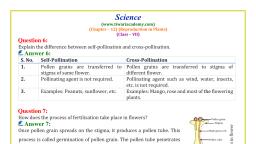
Science, , (www.tiwariacademy.com), (Chapter - 12) (Reproduction in Plants), (Class - VII), Fragmentation, When water and nutrients are available algae grow and multiply rapidly and breaks up into two or, more fragments. These fragments or pieces grow into new individuals., , Fragmentation in spirogyra (an alga), Spore formation, The spores are asexual reproductive bodies. Each spore is covered by a hard protective coat to, withstand unfavourable conditions such as high temperature and low humidity. So they can survive, for a long time. Under favourable conditions, a spore germinates and develops into a new individual., , Sporangium, , _Spores, , Hypha, , Reproduction through spore formation in fungus, , Question 3:, , Explain what you understand by sexual reproduction., , €. Answer 3:, , When two parents are involved in reproduction, the method is called sexual reproduction. The male, and female gametes fuse during fertilization to produce zygote. The zygote subsequently develops, into an embryo which further develops into a new individual., , Question 4:, , State the main difference between asexual and sexual reproduction., , €. Answer 4:, , S. No. Asexual Reproduction Sexual Reproduction, , Only one parent is needed. Two parent (Male and female gametes) are required., Offspring is normally similar to Offspring shows variation with respect to parent., parent., Yeast, hydra, spirogyra etc.show Animals, human, insects etc. show _ sexual, asexual reproduction. reproduction., , Question 5:, Sketch the reproductive parts of a flower., , €. Answer 5:, , ‘Anther, Stamen, Filament, , etal, (petals = corolla), , Sepal, (sepals = calyx) ', Reproductive Parts of a Flower, www.tiwariacademy.com, A Step towards free Education, , 2