Notes of Class 6, Social Science Life in twons and villages chapter- 8.pdf - Study Material
Page 1 :
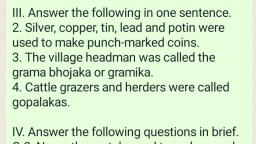
Let's, , Recall, , Based on your understanding, tick (v ) the correct option., 1. a. pramukha or shreshthin, 2. c. pepper, , 3. b. uzhavar, , 4. b. ampharae, , 5. a. Arikamedu, , State whether the following statements are true or false and rewrite the incorrect, statements to Correct them., , 1. TRUE, 2. FALSE. The headmen of the carly villages were called grama bhojaka., , 3. FALSE. People organised themselves into shrenis or guilds, and made rules and, regulations., 4. TRUE, , 5. FALSE. The Northern Black Polished Ware had a glossy surface., , Answer the following in one sentence., , 1. The first urbanisation had taken place during the Indus Valley Civilisation., 2. Silver, copper, tin, lead and potin were used to make punch-marked coins., 3. The village headman was called the grama bhojaka or gramika., , 4, Cattle grazers and herders were called gopalakas., 5., , ‘The main source of information about the people in South India is a body of texts,, collectively referred to as the Sangam Literature., Answer the following in brief., , 1. Guilds were formed to organise the large-scale trading activities during this period., Merchant guilds comprised of traders and merchants, while leather and ivory workers,, , , , goldsmiths, weavers and carpenters were part of the crafts guilds. These guilds provided, technical training, collected the raw materials and distributed che finished products., , 2. Silver, copper, tin, lead and potin were used co make punch-marked coins. They are, called punch-marked coins because the designs were punched on to the metal., , 3. The Sangam Literarure mention various kinds of people living in the villages of the, Tamil region. Some families owned iarge tracts of cultivable land and were known as, vellatars. Farmers who owned small pieces of land were known as uzhavar. If this land, was not sufficient for their subsistence, they worked on the land of big landowners., , Landless labourers and slaves were known as kadai siyar and adimai, respectively. They, worked on the land owned by others., , 4. The compositions of these ancient Tamil poets are collectively called Sangam Literature, and the period in which they were compiled is called the Sangam Age. A study of the, Sangam tects reveals that Tamil was a highly developed language. A significant section of, Sangam Literature are the poems on fove (Aham) and war (Puram) that are divided into, anthologies such as the Pattupattu, and the Ectutogai. ‘The Sangam Literature is mostly, about battles, heroic deeds of kings, and the sociai, political, economic, and religious life, of people in those times. It is from the Sangam Literature that we get to know about the, Cholas, the Cheras and the Pandyas., , 5. The fatakas are stories about che nrevinue hee af ob Bodo 1
Page 2 :
routes. Pliny also complained about the drain of wealth from Rome to India because of, costly Indian imports., , V. Answer the following in detail., , ey, 2, 3, 4., , w, , Major features of the Second Urbanisation include:, , * Iron tools and implements: The use of iron was extensive at this time. Ic became, possible to clear the deep forests with the help of iron implements., , * Guilds and trade: The emergence of business communities, such as the sethis,, gahapatis and sarthavahas, was also an important factor behind the growth of, townships, , * Coins: Coins came to be used as a medium of exchange. By the Mauryan period,, coins were widely in circulation. Kings received taxes from the merchants in the form, of coins., , * Urban centres: As the population increased, trade grew in volume. Consequently, the, number of towns and cities also increased. In fact, we can say thar there was an urban, boom., , * Northern Black Polished Ware Pottery: This was a special type of pottery that was, used by people during this period. As is obvious, it was black in colour and had a, glossy surface. It was made of clay. The remains of such pottery have been found in, the Gangetic Plains of Uttar Pradesh and Bihar, and in parts of central-castern and, southern India., , Ring wells: Archaeological excavations at Kumrahar, near Patna in Bihar, have, , revealed the remains of a Mauryan palace. Here, ceramic pots with rings placed one, , on top of the other have been found. These are called ring wells. They may have been, , used as drains or for storage of water., , * Northern Black Polished Ware Pottery was a special type of pottery that was used by, people during the Second Urbanisation., , * Asis obvious, it was black in colour and had a glossy surface., , = It was made of clay. The remains of such pottery have been found in the Gangetic, , Plains of Uttar Pradesh and Bihar, and in parts of central-castern and southern India., , * In the beginning of civilisations, the mode of trade was by barter, that is, exchange of, goods., , , , * Gradually, coins came to be used as a medium of exchange., * By the Mauryan period, coins were widely in circulation., © Kings received taxes from the merchants in the form of coins., , “The discovery of a number of Roman coins at various sites in the peninsula leaves no, doubt that India was a gainer in their trade with the Roman Empire. Pottery, terracotta, and bead ornaments, wires, and copper vessels have also been found in large number., ‘Trade with Rome was an important source of revenuc for the south Indian kingdoms., Moreover, the exports from India to the Roman Empire far exceeded its imports. That, was why the trade with Rome was in India’ favour. Similarly, Romans were able to get, some of the trade items that were in demand in their country. The Roman traders also, set up several settlements along the Indian coasts., , . The Cholas, the Pandyas and the Cheras ruled the present-day Tamil Nadu, with cheir, , capitals in Kaveripattinam or Puhar, Madurai and modern-day Cochin, respectively., Trade was an important source of revenue for these kingdoms. Kaveripattinam was, , a port city. The rulers encouraged both internal and overseas trade. There was a great, demand for Indian goods such as pepper. spices, dyes, pearls, precious stones, ivory, fine, doth and even exotic animals, particularly in Rome. Remains of the Roman settlements, can be scen in many trading centres, such as Arikamedu. Roman amphorac (jugs, , with two handles and a narrow neck), used for storing wine and oil, were excavated at, Arikamedu., , cor
Page 3 :
Ring wells: Archacological excavations at Kumrahar, near Patna in Bihar, have, revealed the remains of a Mauryan palace. Here, ceramic pots with rings placed one, ‘on top of the other have been found. These are called cing wells. They may have been, used as drains or for storage of water,, , Northern Black Polished Ware Pottery was a special type of pottery that was used by, people during the Second Urbanisation., , + Asis obvious, it was black in colour and had a glossy surface., , * Ie was made of clay. The remains of such pottery have been found in the Gangetic, Plains of Uttar Pradesh and Bihar, and in parts of central-castern and southern India., , In the beginning of civilisations, the mode of trade was by barter, that is, exchange of, goods., , * Gradually, coins came to be used as a medium of exchange., , + By the Mauryan period, coins were widely in circulation., + Kings recived taxes from the merchants in the form of coins., , |. The discovery of a number of Roman coins at various sites in the peninsula leaves no, , doube that India was a gainer in their trade with the Roman Empire. Pottery, terracotta, and bead ornaments, wires, and copper vessels hrave also been found in large number., ‘Trade with Rome was an important source of revenue for the south Indian kingdoms., Morcover, the exports from India to the Roman Empire far exceeded its imports. That, was why the trade with Rome was in India’s favour. Similarly, Romans were able to get, some of the trade items that were in demand in their country. The Roman traders also, sct up several settlements along the Indian coasts., , ‘The Cholas, the Pandyas and the Cheras ruled the present-day Tamil Nadu, with their, capitals in Kaveripattinam or Puhar, Madurai and modern-day Cochin, respectively., ‘Trade was an important source of revenuc for these kingdoms. Kaveripattinam was, , a port city. The rulers encouraged both internal and overseas trade. There was a great, demand for Indian goods such as pepper, spices, dyes, pearls, precious stones, ivory, fine, cloth and even exotic animals, particularly in Rome. Remains of the Roman settlements, can be scen in many trading centres, such as Arikamedu, Roman amphorac (jugs, , with two handles and a narrow neck), used for storing wine and oil, were excavated at, , Arikamedu., , , , , , VI. Solve the crossword., , — [3, Fp] E, al =., R| H, T| r, fmlelo[ays [tT] #2 [N/E ['s|, R| 1], , |Z/>|= >[x|-lo]>]elo]> |e



 Learn better on this topic