Notes of 5th Semester Core, Zoology Photic &nonphotic zeitgebars.pdf - Study Material
Page 1 :
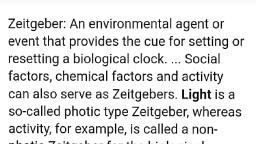
Zeitgeber: An environmental agent or, event that provides the cue for setting or, resetting a biological clock. ... Social, factors, chemical factors and activity, can also serve as Zeitgebers. Light is a, so-called photic type Zeitgeber, whereas, activity, for example, is called a non, photic Zeitgeber for the biological, clock. 29-Mar-2021
Page 2 :
Lemally, , _ behavioral rhythms of an individual deprived of, , * external cues, are gradually shifted from the phase, of environment. Exposure to an environment cue, can reset the clock and can keep the behavior, synchronized properly with environment. The, process is called entrainment and__ the, environmental cue responsible for entrainment is, called entrainer or zeitgebers (time-giver). As for, example, light is the most common entrainer in, circadian rhythms., , Male crickets start a bout of calling to attract, females daily at about same time of evening and, continue for more or less same hours -before, stopping. When they are held in constant condition, of laboratory, in constant temperature, and lights, are on continuously (for 24 hours), they continue to, sing regularly for a limited hours of time each day., This indicates that calling is a circadian rhythm and, independent of environmental, changes, that is, regulated by a free-running biological clock. But, under condition of constant light, calling started, about 25 to 26 hours later than it did in the, previous day, though the total length of time per, cycle of calling and non-calling never exceeds 24, hours. So, there was a deviation in the free-running, cycle of calling by 1 to 2 hours each day., , Now the crickets were placed in a regime of 12, hours of and 12 hours of darkness. In a few, , ays they started to call about 2 hours before lights, , off (i.e. nightfall) and continued until about 2.5, , , , , , hours before lights went on (i.e. morning). This, cycle of calling is exactly like that of natural one,, which synchronized with dusk and dawn. Unlike, free-running cycles, the calling under 12L: 12D, does not deviate. From this result, we can conclude, that switching from light to darkness offers an, external environmental cue that entrain the circadian, calling pattern in crickets. So changing from light to, dark is the entrainer or zeitgeber. In 12L: 12D, condition or natural condition, the calling time does, not deviate because it is reset by the entrainer each day., , We have already discussed that sleep-awake, cycle is a well-recognized daily rhythm in human, beings. People, who move from one time zone to, another quickly (by a Boeing jet), suffer from Jet, lag. It is due to the functioning of the free-running, sleep-awake cycle according to the time schedule of, the zone one has left. As for example, New Delhi, and New York are two different time zones having, almost 12 hours difference. When it is 12 AM in, New Delhi, it is 12 PM in New York (of previous, day). When a person undertakes a fast journey from, New Delhi to New York, his day and night are, simply reversed. In New York, he will feel sleepy at, 12 noon (because it is midnight in New Delhi) and, will remain awake at 12 PM (because it is midnoon, at New Delhi). But the effect will be temporary, after *, a few day of staying at New York, the sleep-awake, clock of the person will be reset or entrained by the, local time schedule., , Scanned with CamScanner