Notes of NEW CLASS 5 2022, Maths & Social Science & English Grammar plant.pdf - Study Material
Page 1 :
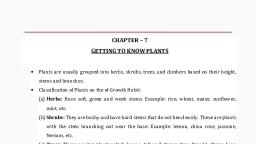
Getting to know plants, Plants are classified into five types on the basis structure and size:i. Herbs, ii. Shrubs, iii. Trees, iv. Climbers, v. Creepers, Herbs: - Those plants whose height is less than four feet, their, life span is about few months to a year and their stems are thin, and green are called herbs., Herbs have not many branches., Ex: - Coriander, Tomato, Sunflower, Mustard, Paddy, Wheat, etc., Shrubs: - Those plants whose height is greater than four feet, but less than eight feet and their stems are brown and hard and, have so many branches arise near the base of the plants are, called shrubs., Ex: - Rose, Jasmine, Lemon, China rose etc., Tree: - Those plants whose height is greater than eight feet or, three metre have hard and woody stems are called trees., Ex: - Mango, Neem, Peepal, Gulmohar etc., Trunk: - Stems of trees are very hard, thick and brown in colour, are called trunk., Climbers: - Some plants have weak stems so they need support, of the plant, sticks or walls to climb up such plants are called, climbers., Ex: - Pea, Money plant, Grapevine etc., Creepers: - Those plants which are spread on the ground and, cannot stand upright due to weak stem so these plants are, called creepers., Ex: - Mint, Water melon, Pumpkin, etc., There are two systems in plants: i. Root system, ii. Shoot system
Page 2 :
i., ii., , i., ii., iii., , i., , ii., , Root system grows below the ground and shoot systems, grow above the ground., There are two types of root present in plants., Tap root, Fibrous root, i. Tap root: - It is a single thick root coming out from the, germinating seed and grows vertically downward into the, soil., So many branching root which are smaller in size grow from, the tap root are called lateral roots., Ex of tap root: - Pea, Radish, Carrot, Tulsi, Mustard, Mango,, Balsam., ii. Fibrous root: - A cluster of thin fibre like roots at the base, of the stem are grown under the soil is called fibrous root., Ex: - Wheat, Maize, Grass, Millet, Paddy etc., Function of roots: Roots hold the plant firmly in the soil., Roots absorb water and minerals from the soil., Roots prevent soil erosion., Soil erosion: - Soil may be blown off by strong wind or, washed away by flowing water is called soil erosion., Root modification: Root of some plants like radish, Carrot, Sweet potato, Beet,, Turnip etc. are stored food produced by plants and becomes, swollen and fleshy., The roots of some plants like Dahlia, Sparagous, and Bamboo, can develop into new plants., Prope roots: - Rope like roots grow from the main branches, that grow downwards and anchor in the soil to provide, additional support to the plant, these roots are called prope, roots., Ex: - Banyan, Bamboo., Stilt roots: - Some plants like Maize, Sugarcane and screw, pine have long, thin stems need some additional, support to remain standing erect, this additional
Page 3 :
, , , , , , , , , , , support is provided by the roots growing from their, stems are called stilt roots., Stem: - It is the main axis of the shoot that bears branches,, leaves, flowers, buds, fruits etc and it is a link between root, and the other part of the plant., Node: - The point from where leaves and branches grow on, a stem., Inter node: - It is the portion of the stem between two nodes, is called inter node., Apical bud or Terminal bud: - It is a bud present on the tip of, the stem., It is responsible for lengthwise growth of the plant., Axillary bud: - The buds which give rise to branches are, called Axillary buds., Function of stem: i. Stem carries water and minerals from the roots to the, other parts of the plant., ii. It supports branches, leaves, flowers and fruits of the, tree., iii. It carries the food made by leaves to the other parts of, the plant., iv. It holds the plant upright due to which it is called the, backbone of the plant., Modification of the stems, i. Some stems like ginger, potato, onion etc are stored the, food made by leaves., ii. Some plants like cactus, opuntia, prickly pear etc are, prepared their own food because chlorophyll present in, stems of all these plants., iii. In some plants like rose and bougainvilla stems, modified into thorns and protected the plant from, being eaten by animals., iv. Stems of some plants like rose, hibiscus, potato,, drumstick etc help to produce new plants.
Page 4 :
v., , Stems of some plants are weak and they need support, for standing upright. So stem of some plants like grapes, and passion flower etc modified into special structure, called tendril to provide support to stand still., Leaf: - It is the flat, green part of the plant that arises from, the node of a stem or its branches., Petiole (Stalk): - It is the portion of the plant which connect, leaf to the stem or branches., Lamina (Blade):- The broad, flat, green portion of a leaf is, called lamina or leaf blade., Midrib: - The petiole continues in the centre of the leaf is, called midrib., Side Veins: - They are tiny veins that arise from both sides of, the midrib., The side veins transport food and water and provide support, to the leaf., There are two types of leaf venation., i. Reticulate Venation, ii. Parallel Venation, i. Reticulate Venation: - Side veins of the leaf from a net like, design on both sides of the midribs are called reticulate, venation., Ex: - Neem, Rose, Pea plant, Peepal etc., ii. Parallel Venation: - The side veins of the leaves are parallel to, each other the venation is called parallel venation., Ex: - Banana, Grass., Leaf Venation: - The arrangement of side veins in a leaf is, called venation., Those plants whose leaves have reticulate venation, their, roots are fibrous roots., Function of leaves, Leaves of most of the plant have chlorophyll and they, prepared food in the presence of sunlight and carbondioxide., Modification of leaves
Page 5 :
, , Leaves of some plants like cactus are converted into thorn to, prevent water loss., Leaves of some plants like pea and glory lily modified into leaf, tendril to support weak stem to stand still., Leaves of some plants like Bryophyllum and begonia are, reproduce through leaves., Leaves of some plants like spinach, Mustard, Onion etc stored, the food., Those leaves which are more broad and flat prepare most, food through photosynthesis., Flower: - Flowers of different plants has different size, shape,, colour and fragrance., It is the reproductive part of the plant., Pedicel: - Flowers are attached to the stem by a stalk is called, pedicel., There are four wholers are present in flower., i. Sepal (Calyx), ii. Petal (Corolla), iii. Stamen (Androecium), iv. Pistil or Carpel (Gynaecium), Sepal: - It is the outermost green leaf like structure at the, base of the flower is called Sepal., It protects the flower in the bud stage., It is the outermost part of the plant., Petal: - It is the leaf like coloured part of the flowers which, have sweet smelling and attract insects for pollination is called, petal., It is the second wholer of the flower., Stamen: - Many little stalk which swollen top around the, centre of the flower are called stamen., It is the male part of the flower., Stamen consists of a thin filament and anther., Filament: - It is a thin green stalk around the centre of the, flower is called filament.
Page 6 :
Anther: - It is a bay like top present on top of the filament is, called anther., Anther carries pollen grains., Pollen grain: - They are dust like particles present in anther, and contain male sex cells., It is the third wholer of the plant., Pistal or carpel: - A flask shaped structure in the centre of the, flower is called pistal or carpel., It is female reproductive part of the flower., It consist of three parts, i. Style, ii. Stigma, iii. Ovary, i., Stigma: - It is a knod like structure present at top of the, pistal is called stigma., ii. Style: - A thin, long tube like structure present in upper, portion of the pistal is called the style., iii. Ovary: - A swollen portion present in base of the pistal is, called ovary., Ovary contains female sex cells called ovules., After fertilization ovary develop into fruit and ovules into, seeds., Complete flower: -Those flowers have if all four whorls are, present in any flower then that flower is called complete, flowers., Ex: - Flowers of pea, Mustard, Hibiscus etc., Incomplete flowers: - If all four whorls are not present in a, flower then that flower is called incomplete flower., Ex: - Flowers of Date Palm, Mulberry etc., Bisexual Flowers: - Those flowers have both male and female, reproductive parts are present called bisexual flower., Ex: - Hibiscus, Pea, Mustard etc., All complete flowers are bisexual flowers.
Page 7 :
, , , , , , , , , , , , , , , , , , , Unisexual flowers: - Those flowers have only one, reproductive parts are present (Male or female) are called, unisexual flowers., Ex: - Cucumber, Papaya etc., Pollination: - Pollen grains get transferred from the anther to, stigma of same flower or another flower by insects wings etc, are called pollination., Fertilization: - After pollination pollen grains reached in, ovary through style and male gametes fuse with ovules this, process is called fertilization., Function of flowers: i. Flowers are the reproductive organs of the plant., ii. Ovary of the flowers developed into the fruit and ovules, converted into seeds., iii. Flowers are the source of perfumes, flowering fruits and, certain medicine., iv. Nectar from flowers is a source of food to insects., Reproduction in plant by two method, i. Asexual reproduction, ii. Sexual reproduction, Asexual reproduction: - A sexual reproduction is a mode of, reproduction by which offspring arise from a single parent, and inherit the character of that parent only., Vegetative propagation: - It is a kind of reproduction in which, a new plant grows from the body parts of a plant such as the, stem, roots and leaves is called vegetative propagation., Vegetative propagation by roots: - Sweet Potato, Carrot,, Radish, Turnip, Dahlia etc., Glatioli, Lilly, Tube rose grow from bulbs of the mother plants., Bulbs are underground buds whose shape like a bulb So it is, called bulb., Vegetative propagation by stem: - Rose, Hibiscus, Money, plant.
Page 8 :
Stem cutting: - A piece of stem taken from the mother plant, and planted in the soil, after some days new plants grow out, from the buds of the stem, this method is called stem cutting., Layering: - The side branches of a plant bent towards the, ground and covered with moist soil and its tip are free then, after sometimes new root developed. This method, reproduction is called layering., Ex: - Jasmine plant and lemon plant., Mango, Grapes, Rose are some types of plant are grown by, stem cutting and budding., Vegetative propagation by leaves: Bryophyllum, Certain plants like Mushrooms, ferns and mosses do not bear, flowers and seeds and have special structure called spores, which help in reproduction., Seeds: - A seed is a tiny supporting package which can give, rise to a tree., It has three parts, i., Seed Coat, ii. Seed leaves, iii. Embryo, Seed coat: - It is the outer covering of a seed which protects, the baby plant inside the seed., Seed coat has a tiny hole through which the seed gets, water., Seed leaves (Cotyledons): - Seed leaves also called, cotyledons., It contains the stored food which is used by the growing, seedlings., Some seeds have two cotyledons like gram, pea, bean etc, so it is called dicotyledons., Ex: - Maize, Wheat, Rice etc., Embryo: - It is a baby plant by which leaves between the, seed leaves (cotyledons)., Embryo contains two parts
Page 9 :
, , , , , , , , , , i. Radicle, ii. Plumule, Radicle develops into the roots of the plant., Plumule develops into stem of the plant., Dispersal of seeds: Dispersal of seeds by wind, water, animals and explosion of, fruits etc., Seedling: - A baby plant coming out of the seed is called, seedling., Insecticides: - The chemical used by the farmers for, destroying harmful insects are called insecticide., Pesticides: - The chemicals used by the farmers for, destroying harmful pests are called pesticides., Over use of insecticides and pesticides can be harmful to, the soil and our health., Fertilizers are two types: i., Organic fertilizers, ii. Inorganic fertilizers



 Learn better on this topic