Notes of Physics PUC 2, Physics Nuclei (Boscoss).pdf - Study Material
Page 1 :
AS NUCLEI, , jnTRODUCTION, , gutherford’s atom model proposes that at the centre of the atom there i, , which carries most of the mass and the entire Positive charge F the, 7 The size of the nucleus is of the order of 10-!5m which is very small oe a d, a size of the atom which is of the order of 10-!%m. Therefore, most th, e inside the atom is empty space. , oe, s, , Because of the very small size of the nucleus, making a study of its structure, and behaviour is extremely difficult. Efforts have been made to probe the nucleus, ysing high energy beam of particles from machines called “accelerators”. Our present, knowledge of the nucleus is very little and mostly it is based on experimental, , abservations. Some of the commonly known phenomenon associated with the nucleus, of atom are radioactivity, nuclear fission and nuclear fusion., , 132 COMPOSITION OF ATOMIC NUCLEUS, , qucleus, , After the discovery of neutron in 1932 by Chadwick, it was suggested that, every nucleus is composed of only protons and neutrons. Neutron is uncharged whereas, * proton has positive charge. The charge on proton is equal in magnitude to that, of the electron. The neutron and proton have masses very close to each other., The neutrons and protons are called nucleons since they are the constituents of, a nucleus. The total number of neutrons and protons in a nucleus is called the, mass number A of the nucleus. The total number of protons in a nucleus is called, the atomic number Z of the nucleus. The number of neutrons in the nucleus of, , an atom of atomic number Z and mass number A is N =A — Z. The nucleus, , of an atom is represented by the symbol 7X* or 4x where X is the chemical, symbol of the atom of the given element. The number of orbital electrons in a, , neutral atom is equal to the atomic number., , \sotopes: Nuclei having same atomic number but different mass number are called, ‘Sotopes. Hydrogen has three isotopes. They are iH, jH? and ,H®. Nucleus of, , HH! is a proton. .H2 is called deuterium and its nucleus is called deuteron. iH, , ; 1 ., 5 called tritium and its nucleus is called triton. In natural uranium, nearly 99.3%, , 'S the isotope 99U238 and nearly 0.7% is the isotope y,U??>. All isotopes of an, , el . F, teen have identical chemical properties. But their nuclear properties are generally, "ferent, , lsobars, 'Sobars, el, , : Nuclei having same mass number but different atomic number are called, em They contain different number of protons. Hence they are atoms of different, ent ; + i 40, (iy pase kamPles of isobar are (i) ,H? and yHe3 (ii) jgAr'? and Ca and, ere"’ and aqNi58,, , Scanned with CamScanner
Page 2 :
596]| UNIT- X @, , Isotones: Nuclei having equal number of neutrons but different atomic hump, , are called isotones. ,H? and jHe4 are isotones since they contain 2 Neutrons wi, : » (Cl, , and ,0!6 are isotones since they contain 8 neutrons. &, , , , Isomers: The nuclei having same atomic number and same mass number bu, from one another in their internal structure and their nuclear energy sta, called isomers. For example, the stable nucleus of 3g9'°7 has an isomer, emits gamma rays with a half life of 2.8 hour., , t diffe,, tes are, Which, , Mirror nuclei : Nuclei having the same mass number but with the proton number, and neutron number interchanged are called mirror nuclei. For example, 1B ang, He? are mirror nuclei., , 13.3 SIZE OF THE NUCLEUS, , From experiments it is found that volume of the nucleus is proportional to the, number of nucleons present in it (or mass number A). Generally, nuclei are found to, have spherical shape. If R is the radius of a nucleus with mass number A, then volume, , 4 400, of the nucleus is V = 5 aR>. Hence 3 ak? xc A ie. R « Al3, or R=R, AlB, , where R, is a constant of proportionality. R = R, when A =1. Thus R, represents, the radius of the nucleus of a hydrogen atom which is nothing but a proton. From, neutron scattering experiments it is found that R, * 1.3 x 10-!5m = 1.3 fermi., (1 fermi = 10-!>m). The smallest nucleus in nature (,H!) has radius of about 1.3, fermi whereas the biggest nucleus in nature (9,U738) has radius of about 8 fermi., 13.4 NUCLEAR MASS AND DENSITY, , Nuclear mass: Atomic mass and nuclear mass are measured in terms of atomic, , mass unit (u). One atomic mass unit (lu) is defined as ' the mass of an atom, of carbon-12. Thus, , mass of | atom of C!*, , , , lu =, 12, There are 6.02 x 10³ atoms in 12 gram of C!2., 12, *. Mass of one atom of C!2 = gz, 6.02x1073, , 1 12, ae Hae) & = 166x104 g = 1.66 x 10⁻²⁷ kg., , . The mass of the atom of C'? by definition is exactly 12-u. The masses of ne, atoms of three isotopes of hydrogen are 1.0078 u, 2.0141 u and 3.0160 u. The mass|, , Scanned with CamScanner
Page 3 :
—® NUCLEI |, s of two isotopes of chlorine are 34.98 u, and 36.98 u. The atomic weight, , ato! . ,, af clement is the weighted average of the masses of all its isotopes. The relative, at wgances of the two Isotopes of chlorine are 75.4% and 24.6% respectively. Therefore,, abun weight of chlorine is, mi, 5.4x3 24.6x 36.9:, - mheouse *36.98 35 4,, , The estimated mass of proton is m, = 1.0072768u = 1.672 x 10⁻⁷ kg. and the, , ass of neutron is m= 1.008665 u = 1474 x 10-27 kg. The mass of electron is, n = 0.00055 u = 9.1 x 10⁷! kg., , ¢, Since mass m, of a proton -.:d mass m, of a neutron are nearly equal, we have, , xm, = My Where My = 1.67 x 10⁻⁷ kg is mass of a nucleon. If A is the mass number, of the nucleus, mass of the nucleus M = Amy. Since the mass of electron (m, = 0.00055 u, =9,1 x 10⁻³! kg) is very small compared to the mass of a nucleon, the mass of nucleus is, slightly less than mass of the atom. Atomic masses are determined using mass spectrograph., , : Nuclear density : Since the size of the nucleus is very small and practically the entire, mass of the atom is contained in the nucleus, the density of the nucleus is very high., , _. Nuclear mass, mingle Henan = Nuclear volume, , For a nucleus of mass number A, nuclear mass = Am, where my is mass of each, , nucleon., , 4 4 Pa, _ _4 13)3 = —qR3, Nuclear volume = Bm =37 (RA) 3 mRyA, , —-27, Nuclear density = jay = Smy__ 3x 670 = 1.815 x 10!7 kgm., BTROA 4nRo 4nx(13x10-'*), , , , This calculation shows that the nucleus is in a highly compressed state. Its density is, of the order of 1017 kgm (about 10! times greater than the density of water). The nuclear ©, density does not depend on mass number A or the number of nucleons in the nucleus. Hence, , nuclei of all elements have nearly the same density., , 1, 3.5 MASS-ENERGY RELATION, , te From the special theory of relativity, Einstein established that mass and energy, Velog ti Valent. The energy equivalent of a mass m is E = mc? where c is the, city of light in vacuum. According to this relation, mass is another form of, , _ er, :, rs ne can convert this mass-energy into other forms of energy, such as kinetic, 8Y and vice versa., , Scanned with CamScanner
Page 4 :
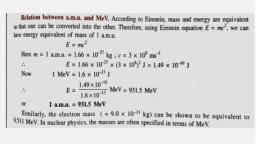
598 | UNIT- x @, , In nuclear and elementary particle interactions both conversion of mass ;, , i . . nt, energy and conversion of energy into mass take place. Therefore, while applying, the law of conservation of energy to nuclear reactions, the energy associ 8, , : ated With, mass is also included. Following are some of the experimental verifications of Einstejy?, , . s, mass-energy relation., , , , (i) A positron has the same mass as an electron but an opposite charge (tye, Positron is an antiparticle to electron. When an electron and a Positron co, close to each other they annihilate or destroy each other. Their Masses are, converted into energy according to Einstein’s relation and the energy is releaseq, in the form of gamma (y) rays. This process is called pair annihilation,, , (ii) When a gamma (y) ray photon of energy 1.02 MeV or more is approaching, a heavy nucleus, due to the action of the intense electric field, the gamma, ray photon is converted to a pair of particles - an electron and a positron,, This process is called pair production and it is the reverse of pair annihilation,, Thus, energy is converted into mass in the two particles., , )., , me, , (iii) During nuclear fission of a heavy nucleus into smaller nuclei, there is a decrease, in total mass. This, decrease in mass is converted into energy which is liberated, , ‘during the process. This is the principle behind explosion of nuclear bomb, and working of nuclear reactors., , 13.5.1 Energy equivalent of one atomic mass unit :, , The energy equivalent of a mass m is given by E = mc? where c is the velocity, , of light in vacuum. One atomic mass unit (u) = 1.66 x 10⁻²’kg and velocity of light in, vacuum is c = 2.9979 x 10⁸ ms"., , Therefore the energy equivalent of 1 atomic mass unit is given by, E = me? = (1.66 x 1077) (2.9979 x 10⁸)? = 14.919 x 10-!! joule, _ 14.919x10⁷!! on, 1602x109 eV = 9.313 x 10⁸ eV = 931.3 MeV, Thus one atomic mass unit is equivalent to 931.3 MeV of energy., That is, lu = 931.3 MeV, Note :, , ’ . ‘ +. mass, (i) During the fission of U5, there is a loss of mass of about 0.223 u. This ™, , 3 : g31MeV, is converted into energy. The energy liberated during a fission is = 0.223 *, = 208 MeV., , Scanned with CamScanner
Page 5 :
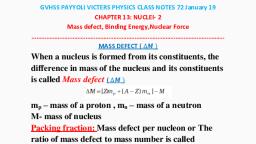
) —® NUCLEI iF, , constit!, , , , , , , , si of two deuterium nuclei into one helium nucleus, there is a decrease, , ‘i purind of 0.0252 U- This mass is converted into energy and the energy liberated is =, in mas 931 MeV. = 23.5 MeV, , x, 0.0252 ’ ,, stron is an antiparticle to electron and their mass is completely destroyed when they, Gi) posi pw each other. During the pair annihilation of an electron and a positron each, jntera!, , 0.00055 u, the energy liberated is = 2 x 0.00055 x 931MeV = 1.02MeV., , a ray photon of energy 1.02 MeV or more may convert into an electron and, , i) A gamm: : hen j Is j ‘, ! roduction) when it travels in the electric field around the nucleus., , a positron (pair P, , 5 NUCLEAR BINDING ENERGY, 7 defect: The mass of a nucleus depends on the masses of the nucleons. But it is, ws se the sum of the masses of the constituent nucleons is always more than the actual, ee the resulting nucleus. The difference between the sum of the masses of the, , uent nucleons and the actual mass of the nucleus is called mass defect., , Let M be the mass of a nucleus having mass number A and atomic number, , ' 2. 1f m, is the mass of the proton and m, is the.mass of the neutron, then mass, , defect of the nucleus is, AM = [Zm, + (A — Z) m,] — M, For example, for carbon-12, M =12 u, m, = 1.00728 u, m, = 1.00867 u., AM =[6 x 1.00728 + 6 x 1.00867] — 12 = 12.0957 — 12 = 0.0957 u, , That means, compared to total mass of 6 protons and 6 neutrons, the mass of carbon, I? nucleus is smaller by 0.0957 u., Binding energy :, Th ‘ mn, “~ me in a nucleus are held together by strong attractive forces called nuclear forces., |, "ore work must be done in seperating the nucleons from each other. In other words,, , ” ener ms t S, &Y must be Supplied to split the nucleus completely into its constituent nucleons. This, , e ., , tected binding energy. Thus, binding energy nie mineleny can be defined as, these teleost ne required to split the nucleus into its constituent nucleons. If, Thus tide S Join together to form the nucleus an equal amount of energy will be released., formed * & energy of a nucleus is also equal to the energy released when a nucleus is, but ™ its constituent nucleons. During the formation of the nucleus, energy is released, , ec) 7, Teases by an amount equal to the mass defect. On the other hand, during the, , Scanned with CamScanner



 Learn better on this topic