Notes of General Chemistry 2, Chemistry module 2A.pdf - Study Material
Page 1 :
SHS, , General Chemistry 2, Quarter 3: Week 2 - Module 2A, Properties of Liquids and, Intermolecular Forces
Page 2 :
STEM – General Chemistry 2, Grade 11 Quarter 3: Week 2 - Module 2A: Properties of Liquids and, Intermolecular Forces, First Edition, 2021, , Copyright © 2021, La Union Schools Division, Region I, , All rights reserved. No part of this module may be reproduced in any form, without written permission from the copyright owners., , Development Team of the Module, , Author: Cristita C. Ferrer, PhD, MT II, Editor: SDO La Union, Learning Resource Quality Assurance Team, Illustrator: Ernesto F. Ramos Jr., P II, Management Team:, Atty. Donato D. Balderas, Jr., Schools Division Superintendent, Vivian Luz S. Pagatpatan, PhD, Assistant Schools Division Superintendent, German E. Flora, Ph.D, CID Chief, Virgilio C. Boado, Ph.D, EPS in Charge of LRMS, Rominel S. Sobremonte, EdD, EPS in Charge of Science, Michael Jason D. Morales, PDO II, Claire P. Toluyen, Librarian II
Page 3 :
General, Chemistry 2, Quarter 3 - Module 2A, Properties of Liquids and, Intermolecular Forces
Page 4 :
Target, , Intermolecular forces are attractive forces that act between molecules or, particles in the solid or liquid states. These are forces that form between molecules,, atoms, or ions. Generally, these attractive forces are much weaker than bonding, forces or intramolecular forces., This module will provide you with information and activities that will help you, understand the different properties of liquids such as surface tension, viscosity,, vapor pressure, boiling point, and molar heat of vaporization; and the properties of, water with its molecular structure and intermolecular forces., After going through this module, you are expected to:, 1. describe the following properties of liquids, and explain the effect of, intermolecular forces on these properties: surface tension, viscosity, vapor, pressure,, boiling, point,, and, molar, heat, of, vaporization, (STEM_GC11IMFIIIa-c-102); and, 2. explain the properties of water with its molecular structure and, intermolecular forces (STEM_GC11IMFIIIa-c-103)., , Jumpstart, , Before going on, let’s check how accurate your observation and, thinking skills are as you do the first activity., Have fun and good luck! Are you ready? Let’s start!, Activity 1: “Describe My Pictures!”, Direction: Look at the given pictures below. Describe each in just a phrase or, a statement. Write your answers on a separate paper., , 1., , 2.
Page 5 :
3., , 4., , 5., , 6., , 7., , 8., , Credit: Dr. Keith Hayward, , 9., , 10., , Activity 2: “Complete Me!”, Direction: Complete the given paragraph about liquid below by decoding the, clues using the alphabet (e.g.: 1 – A; 2 – B; 5 – E; 10 – J; 19 – S; and the like). Write, your answers on a separate paper., Liquids have (1) 6 – 9 – 24 – 5 - 4 volume and assumes shape of occupied, part of container. They have high (2) 4 – 5 – 14 – 19 – 9 – 20 – 25. They cannot be, appreciably (3) 3 – 15 – 13 – 16 – 18 – 5 – 19 – 19 – 5 – 4. In terms of motion of, molecules, they have (4) 18 – 1 – 14 – 4 – 15 – 13, medium speed, and (5) 12 – 9 –, 13 – 9 – 20 – 5 – 4 distances., That’s indeed a good start! Congratulations!
Page 6 :
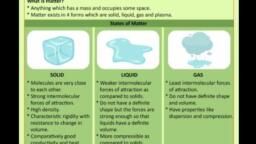
Discover, , Matter is anything that occupies space and has mass. Matter is divided into, different phases such as solid, liquid, gas, plasma, and Bose-Einstein Condensates., The first three phases of matter differ in various properties such as volume/shape,, density, compressibility, motion of their molecules, and their molecular behavior., Fluid is a gas or a liquid. Also, it is a substance that can flow., Liquids show the following properties such as surface tension, viscosity,, vapor pressure, boiling point, and molar heat of vaporization., I. Surface Tension, The cohesive forces between liquid molecules are responsible for the, phenomenon known as surface tension. The cohesive forces between molecules, down into a liquid are shared with all neighboring atoms. Those on the surface have, no neighboring atoms above, and exhibit stronger attractive forces upon their nearest, neighbors on the surface. This enhancement of the intermolecular attractive forces, at the surface is called surface tension., , Figure, 1:, Cohesion, and, surface, tension, http://hyperphysics.phy-astr.gsu.edu/hbase/surten.html), , (Image, , Source:, , Surface tension is the measure of the elastic force in the surface of a liquid., It is the amount of energy required to stretch or increase the surface of a liquid by a, unit area. It is the energy, or work, required to increase the surface area of a liquid, due to intermolecular forces. It is manifested as some sort of skin on the surface of, a liquid or in a drop of liquid., Molecules within a liquid are pulled in all directions by intermolecular forces., Molecules at the surface are pulled downward and sideways by other molecules, not, upward away from the surface (See next page).
Page 7 :
Figure 2: Molecules within a liquid (Image Source: wps.prenhall.com), , These intermolecular forces tend to pull the molecules into the liquid and cause, the surface to tighten like an elastic film or “skin”., Liquids that have strong intermolecular forces also have high, surface tension., FYI:, Surface tension is typically measured in dynes/cm, the force in dynes required, to break a film of length one cm. Equivalently, it can be stated as surface energy, in ergs per square centimeter. Water at 20°C has a surface tension of 72.8, dynes/cm compared to 22.3 for ethyl alcohol and 465 for mercury., Use the illustrations/pictures given below to show manifestations of surface, tension., , Figure 3. Floating paper clip on water, , Figure 4. Drop of liquid on a coin, , Figure 5. Water strider walking on the surface of a quiet pond. (Image Source:, http://hyperphysics.phy-astr.gsu.edu/hbase/surten.html)
Page 8 :
It’s Viewing Time!, To view how water droplets form on the surface of the water pool because of, surface, tension,, you, may, refer, to, this, link:, https://chem.libretexts.org/Bookshelves/Physical_and_Theoretical_Chemistry_Tex, tbook_Maps/Supplemental_Modules_(Physical_and_Theoretical_Chemistry)/Physic, al_Properties_of_Matter/States_of_Matter/Properties_of_Liquids/Surface_Tension., Capillary Action, Capillary action is the tendency of a liquid to rise in narrow tubes or be drawn, into small openings such as those between grains of a rock. Capillary action, also, known as capillarity, is a result of intermolecular attraction between the liquid and, solid materials., Examples of Capillary Action:, , Figure 6. Colored water seen rising up in glass tubes. Without capillary action,, the water level in all tubes would be the same. Smaller diameter tubes have more, relative surface area inside the tube, allowing capillary action to pull water up higher, than, in, the, larger, diameter, tubes, (Image, Source:, http://water.usgs.gov/edu/capillaryaction.html), Credit: Dr. Keith Hayward, , Figure 7. A doctor takes blood sample from a patient’s finger using a capillary, tube. (Image Source: https://www.colourbox.com/image/blood-testing-image6891015)
Page 9 :
Figure 8. Water mixed with food coloring rises up freshly-cut stalks of, celery (Image Source: http://water.usgs.gov/edu/capillaryaction.html), , REMEMBER:, Capillary action is a phenomenon wherein a liquid is able to rise up on a, narrow tube. Adhesive forces between the tube and the liquid allow the liquid to, exceed its weight. The narrower the tube, the higher the liquid will reach., Capillary action is the result of cohesive and adhesive forces. When liquid, flows through a narrow space, the cohesive and adhesive forces act together to lift, it against the natural force of gravity., , Two types of forces are involved in capillary action:, A. Cohesion is the intermolecular attraction between like molecules (the liquid, molecules)., B. Adhesion is an attraction between unlike molecules (such as those in water, and in the particles that make up the glass tube)., These forces also define the shape of the surface of a liquid in a cylindrical, container (the meniscus)., THINK ABOUT THIS!, When the cohesive forces between the liquid molecules are greater than, the adhesive forces between the liquid and the walls of the container, the surface, of the liquid is convex. Example: mercury in a container, When the cohesive forces between the liquid molecules are lesser than the, adhesive forces between the liquid and the walls of the container, the surface of, the liquid is concave. Example: water in a glass container, , Figure, 9., Concave, and, Convex, Meniscus., http://www.diffen.com/difference/Adhesion_vs_Cohesion), , (Image, , Source:
Page 10 :
II. Viscosity, It is a measure of a fluid’s resistance to flow. In layman’s term, it is defined as, the measure of the thickness of a liquid. The greater the viscosity, the slower the, liquid flows., , FYI:, Viscosity is expressed in units of centipoise (cP), also known as stoke. It, is a metric system unit. The SI unit is Pascal-second (Pa-s) or Newtonsecond/meter2 (N-s/m2)., 1 centipoise = 0.001 Pa-s, , Table 1 below shows the viscosities of liquids of some pure substances. Water, has viscosity of 1 centipoise or 0.001 Pa/s at 20 oC., Substances with lower viscosities include carbon tetrachloride and benzene., Glycerol has a resistance to flow of more than a thousand times greater than water., Liquids, Acetone (C3H6O), , Viscosity (in Ns/m2), at 20oC, 3.16 x 10⁻⁴, , Benzene (C6H6), , 6.25 x 10⁻⁴, , Carbon tetrachloride (CCl4), , 9.69 x 10⁻⁴, , Diethyl ether (C2H5OC2H5), Ethanol (C2H5OH), , 2.33 x 10⁻⁴, , Glycerol (C3H8O3), Mercury (Hg), , 1.49 x 100, , 1.20 x 10⁻³, 1.55 x 10⁻³, , Water (H2O), 1.01 x 10⁻³, Table 1. Viscosities of liquids of selected substances, , REMEMBER:, The more viscous a liquid is, the thicker is its consistency. The liquid with, the longest time to flow is, the most viscous while the one with the shortest time is, the least viscous., In general, stronger intermolecular forces leads to higher viscosity., Thus, the most viscous liquid has the strongest intermolecular force and, the least viscous liquid has the weakest intermolecular force.
Page 11 :
Examples:, 1. Given the molecular structures of water and glycerol, can you tell why, glycerol has a higher viscosity than water?, , That’s a great idea!, , REMEMBER:, , The larger number of –OH groups allow glycerol to form more H-bonds, with other glycerol molecules, making its intermolecular forces stronger than, those of water, and its resistance to flow greater., 2. Consider the table of viscosities below. Table 2 presents the viscosities of, a series of hydrocarbons at 20oC. All the substances in the list are, hydrocarbons and nonpolar. What causes the differences in viscosities of, the hydrocarbons in the list?, Substance, , Formula, , Viscosity (in kg/m s), , Hexane, , CH3CH2CH2CH2CH2CH3, , 3.26 x 10⁻⁴, , Heptane, , CH3CH2CH2CH2CH2CH2CH3, , 4.09 x 10⁻⁴, , Octane, , CH3CH2CH2CH2CH2CH2CH2CH3, , 5.42 x 10⁻⁴, , Nonane, , CH3CH2CH2CH2CH2CH2CH2CH2CH3, , 7.11 x 10⁻⁴, , Decane, , CH3CH2CH2CH2CH2CH2CH2CH2CH2CH3, 1.42 x 10⁻³, Table 2. Viscosities of some hydrocarbons. (Image Source: http://, wpscms.pearsoncmg.com/wps/media/objects/3662/3750037/Aus_content_10/Ta, ble10-04.jpg), You got it right!, , REMEMBER:, The size of the molecules affects the viscosities of the hydrocarbons. The, larger the molecule, even if it is nonpolar, the stronger the intermolecular, forces and the greater the viscosity compared to nonpolar substances made up, of small molecules.
Page 12 :
It’s Thinking Time!, How does temperature affect the viscosities of substances?, Viscosity (decreases or increases) as temperature increases. Example:, Hot molasses flows much (faster or slower) than cold molasses., , The Idea:, Viscosity and temperature are inversely proportional with each other., , III. Vapor Pressure of a Liquid, The equilibrium pressure of a vapor above its liquid; that is, the pressure, exerted by the vapor above the surface of the liquid in a closed container., , Figure 10. Evaporation of water in open and in closed containers (Image Source:, http:// boomeria.org/physicslectures/heat/equilibrium.jpg), (a) The water molecules in the liquid evaporate and go into the vapor phase. In the, open flask, some of the water molecules in the vapor phase find their way out of, the flask are lost to the atmosphere., (b) When a liquid evaporates to a gas in a closed container, the molecules cannot, escape., Molar Heat of Vaporization (ΔHvap), It is the energy (usually in kilojoules) required to vaporize 1 mole of a liquid at, a given temperature., Gas molecules move in random directions, collide with other gas particles and, the walls of the container., Some will strike the liquid surface and condense back into it. In the closed, flask, none of the gas particles are able to get out of the container, and eventually,, the number of molecules that go into the gaseous state would equal the number of, molecules that condense back., When the rate of condensation of the gas becomes equal to the rate of, evaporation of the liquid, the gas in the container is said to be in equilibrium with, the liquid.
Page 13 :
liquid ⇋ vapor (gas), In this condition, the amount of gas and liquid no longer changes., , Figure 11. Equilibrium between liquid and gas (Image Source: http://, wpscms.pearsoncmg.com/wps/media/objects/3662/3750037/Aus_content_10/Fi, g10-20.jpg), The equilibrium vapor pressure is the maximum vapor pressure of a liquid, at a given temperature and that it is constant at a constant temperature. It increases, with temperature., Vapor Pressure and Temperature, Look at the given Figure below. Study the following plot of vapor pressure of, water as it varies with temperature., , Figure 12. Vapor pressure of water vs. temperature, , What do you conclude from the previous Figure?, It can be gleaned from Figure 12 that as the temperature increases, the vapor, pressure of water also increases. When temperature is high, more molecules have, enough energy to escape from the liquid. At a lower temperature, fewer molecules, have sufficient energy to escape from the liquid.
Page 14 :
Study the graph in Figure 13 below. The graph shows the vapor pressures for, four common liquids: diethyl ether, ethyl alcohol, water and ethylene glycol, as a, function of temperature. For all four liquids, the vapor pressure increases as, temperature increases., , Figure 13. Vapor pressure of four common liquids, shown as a function of, temperature, (Image, Source:, http://wps.prenhall.com/wps/media/objects/, 3311/3391416/blb1105.html), Vapor Pressure and Strength of Intermolecular Forces, Consider the Table below on the vapor pressures of the following substances., How is vapor pressure related to strength of intermolecular forces?, Substance, , Vapor Pressure at 25oC, , Pentane, Acetone, Ethyl alcohol, Water, Table 3. Vapor pressure of selected, , 0.71 atm, 0.28 atm, 0.08 atm, 0.03 atm, substances, , Ethyl alcohol and water have very low vapor pressures. Both liquids have the, strong dipole-dipole interaction called hydrogen bonding. Acetone is polar but does, not have H-bonding. Its vapor pressure is of intermediate value. Pentane is a, nonpolar substance, and its vapor pressure is high compared to those of water and, ethyl alcohol., When liquids evaporate, the molecules have to have sufficient energy to break, the attractive forces that hold them in the liquid state. The stronger these, intermolecular forces are, the greater the amount of energy needed to break them., For some substances with weak intermolecular forces, the energy requirement, is easy obtained from collisions with other molecules and absorption of energy from, the surroundings. Many molecules can vaporize, resulting in a high vapor pressure.
Page 15 :
For molecules with strong intermolecular forces, gathering enough energy may not, be as easy, and register low vapor pressures., The Idea:, The stronger the intermolecular forces of attraction, the lower the vapor, pressure of a liquid., Molar Heat of Vaporization (ΔHvap) and Boiling Point, Remember:, The relationship between vapor pressure and strength of intermolecular, forces is consistent with the trends in two other properties of liquids, the enthalpy, or molar heat of vaporization, and the boiling point of the liquid., Study the given Table below. What do you notice?, , Pentane (C5H12), , 6.3, 26.5, , Boiling Point* (oC), -186, 36.1, , Acetone (CH3COCH3), , 30.3, , 56.5, , 39.3, , 78.3, , 40.79, , 100, , Substance, Argon (Ar), , Ethanol (C2H5OH), Water (H2O), *Measured at 1 atm, , ΔHvap (kJ/mol), , Table 4. Molar heats of vaporization and boiling points of selected substances, Molar Heat of Vaporization and Strength of Intermolecular Forces, The heat of vaporization may be considered a measure of the strength of, intermolecular forces in a liquid. If the intermolecular attraction is strong, it takes, a lot of energy to free the molecules from the liquid phase and the heat of, vaporization will be high., It is easier to vaporize acetone (lower Hvap) than water (higher Hvap) at a given, temperature, and more acetone escapes into the vapor phase at a given temperature., Acetone is a polar substance but has no H-bonding. It has weaker intermolecular, forces than water, and therefore acetone molecules are held less tightly to one, another in the liquid phase., Let’s Put It This Way!, Have you tried rubbing acetone on your hands? Compare what you felt when, water is used. Acetone has a lower ΔHvap than water so that heat from our hands is, enough to increase the kinetic energy of these molecules and provide additional heat, to vaporize them. As a result of the loss of heat from the skin, our hands feel cool., Boiling Point, The boiling point of a liquid is the temperature at which the liquid converts, into a gas. A liquid boils when its vapor pressure equals the pressure acting on the, surface of the liquid. The boiling point is the temperature at which the vapor pressure, of a liquid is equal to the external pressure. Also, it is the temperature at which liquid
Page 16 :
boils. The boiling point of a liquid when the external pressure is 1 atm is called the, normal boiling point., The normal boiling point is the temperature at which the liquid converts to, a gas when the external pressure is 1 atm. The normal boiling point of water is 100 oC., Remember:, The boiling point of a liquid depends on the external pressure. For, example, at 1 atm, water boils at 100oC, but if the pressure is reduced to 0.5 atm,, water boils at only 82oC., , Ext Pressure: 1 atm, VP of water: 1 atm, BP of water: 100oC, , Ext Pressure: 0.5 atm, VP of water: 0.5 atm, BP of water: 100oC, , Figure 14 Vapor pressure of four common liquids, shown as a function of temperature, (Image Source: http://wps.prenhall.com/wps/media/objects/3311/3391416/blb1105.html), Boiling Point and Molar Heat of Vaporization, Remember:, The boiling point is directly related to molar heat of vaporization: the higher, ΔHvap, the higher the boiling point., The boiling points of substances often reflect the strength of the intermolecular, forces operating among the molecules. At the boiling point, enough energy must, be supplied to overcome the attractive forces among molecules before they can, enter the vapor phase., , Water: A Very Unusual Liquid, Water (H2O) is an essential substance to life. It is the most abundant, compound on earth, and comprises about more than 60% of the human body. But it, is also one of the most unusual substances on earth.
Page 17 :
I Challenge You!, Can you identify substances other than water that can exist naturally in all, three states? Can you identify some unusual properties of water? Can you explain, why water is said to be one of the most unusual substances on earth?, The Unique Properties of Water, A. Water is a good solvent., A unique property of water is its ability to dissolve a large variety of, chemical substances. It dissolves salts and other ionic compounds, as well as, polar covalent compounds such as alcohols and organic substances that are, capable of forming hydrogen bonds with water. Gases like oxygen and carbon, dioxide will dissolve in water meaning that some animals do not need to, breathe air in order to respire but they must still be able to absorb oxygen and, excrete carbon dioxide. Water is sometimes called the universal solvent, because it can dissolve so many things., B. Water has a high specific heat., Specific heat is the amount of heat or energy needed to raise the, temperature of one gram of a substance by 1oC. The specific heat of water is, 1 calorie/g-oC (4.18 J/g-oC), one of the highest for many liquids. Water can, absorb a large amount of heat even if its temperature rises only slightly. To, raise the temperature of water, the intermolecular hydrogen bonds should, break. The converse is also true; water can give off much heat with only a, slight decrease in its temperature. This allows large bodies of water to help, moderate the temperature on earth., C. The boiling point of water unusually high., Many compounds similar in mass to water have much lower boiling, points. The strong intermolecular forces in water allow it to be a liquid at a, large range of temperatures., In the plot on the right, the, broken lines direct one to the, estimated boiling points of HF,, H2O and NH3 if H-bonding was, not present in these three, substances., (Image, Source:, http:// www.reasons.org/Media/, Default/Article/articles/waterdesigned-for-life-part-2-of-7/, part2-2.png), Figure 15. Boiling points of Group 14-17 hydrides. The dotted lines direct to the, boiling points of H2O, HF, and NH3 in the absence of H-bonding., D. Solid water is less dense, and in fact floats on liquid water., Unlike all other liquids, the molecules in solid water are actually farther, apart than they are in liquid water. When solid water forms, the hydrogen, bonds result in a very open structure with unoccupied spaces, causing the
Page 18 :
solid to occupy a larger volume than the liquid. This makes ice less dense than, liquid water, causing ice to float on water., , Figure 15. The structure of ice., (Image Source: http://media.wiley.com/Lux/35/168035.image2.jpg), , Explore, , To explore and master these concepts, here are some, science laboratory activities prepared for you! Keep going! You, can do it! Enjoy!, , Activity Number 1: “The Unique Liquid!”, Objectives:, A. To determine the properties of liquids;, B. To explain how intermolecular forces affect the properties of liquids; and, C. To explain the how the properties of water are related to its structure and, intermolecular forces., , Materials:, liquid samples: water, ethyl alcohol, kerosene, beakers or glass jars with wide mouth, small piece of wax paper or plastic sheet, old newspapers to catch drips and spills, plastic straw, salt, sugar, , three droppers, three pieces blade, glass jar, one-peso coins, plastic sheet, pepper, talcum powder
Page 19 :
Procedure:, Part A: “Liquid and Drops on A Wax Paper”, a. Lay a piece of wax paper flat on the surface of the table., b. Using a dropper, place a drop of a liquid sample on the wax paper., Do the same for the two other liquids. Make sure a different dropper, is used for each of the liquid samples to avoid contamination., c. Observe and record the appearance of the drops of the liquid samples, on wax paper., Part B: “Liquid and Blade on the Surface”, a. Place some of the liquid samples in a beaker or a wide mouth glass, jar., b. Carefully place a blade on the surface., c. Did the blade float on the surface of the liquids? Record observations., REMINDER:, To be safe throughout the conduct of the science activity, observe, strictly the following PRECAUTIONARY MEASURES:, 1. Use the different materials for their intended purposes only for this, activity., 2. Do not play with the materials especially the sharp ones., 3. Dispose the used materials and liquids properly., 4. Do NOT mix the liquids., 5. Never taste the liquids., , Part C: “Drop Me One At A Time!”, a. Fill a small glass jar all the way to the top with water., b. Add one-peso coin to it. What happened to the level of the water in the, glass jar?, c. Try adding one-peso coins one at a time. What happens to the water in the, jar?, d. Count how many coins can you add without causing the water to overflow., Part D: “What’s My Shape!”, a. Take some water with a straw and put a few drops on plastic sheet. What, is the shape of the drop?, b. Move a drop around with your straw. Does the drop change?, c. Move one of the drops close to another one with your straw. What happens, when two drops meet?, d. Put a small amount of one of the solids (salt, pepper, sugar, talcum powder), on one of the drops. Does the shape change?, e. Try this again with the other solids.
Page 20 :
Data Analysis:, Part A:, 1. How would you describe the appearance of the drops of the liquid samples, on wax paper?, ________________________________________________________________________, ________________________________________________________________________, ________________________________________________________________________, ________________________________________________________________________, ________________________________________________________________________, Part B:, 1. Did the blade float on the surface of the liquids? Why or why not?, ________________________________________________________________________, ________________________________________________________________________, ________________________________________________________________________, ________________________________________________________________________, ________________________________________________________________________, Part C:, 1. What happened to the level of the water in the glass jar?, ________________________________________________________________________, ________________________________________________________________________, 2. What happened to the water in the jar when you added more one-peso, coins?, ________________________________________________________________________, ________________________________________________________________________, 3. How many coins were added without causing the water to overflow?, ________________________________________________________________________, Part D:, 1. What is the shape of the drop of water on the plastic sheet?, ________________________________________________________________________, 2. What happens when two drops meet?, ________________________________________________________________________, ________________________________________________________________________, ________________________________________________________________________, 3. Complete the Table below:, Solids Added to the Drop, Salt, Pepper, Sugar, Talcum powder, , Changes the Drop’s Shape, (Yes / No)
Page 22 :
Deepen, To deeply and practically apply our lesson in your, real life situation, do the next task., , Performance Task:, Goal: To draw and explain the relationship of the properties of water to an, environmental phenomenon, Note: On a short bond paper, draw and explain how the property of water, is related to one of the following situations:, a. The role of water in plant nutrition;, b. Environmental pollution;, c. Changing climate and the capacity of bodies of water to act as, temperature buffer: “In summer months this means that water must, absorb a great deal of energy in the form of heat from the sun in order, for the temperature to increase. Since most bodies of water are large, enough not to be significantly affected by the heat from the sun, water, provides an almost constant temperature for the plants and animals, living there. It takes about 4.5 times greater amount of energy to heat, up water than an equal amount of land. Hence, large bodies of water, heat up and cool down more slowly than adjacent land masses.”;, d. Drying up of small water bodies; or, e. Survival of aquatic organisms in temperate countries., Role: You are a young environmentalist, Audience: Teachers and classmates, Situation: You are invited to give a talk about environmental awareness,, protection, and preservation to help lessen the impacts of, environmental malpractices of some people to humanity and the, world-at-large., As one of the international awarded environmentalists, you are, expected to show and explain how the properties of water are related, to environmental phenomena., Product/Performance: Drawing/illustration and an essay showing and, explaining how the different properties of water are connected to, some environmental phenomena which people experience nowadays., Standard: Criteria for your task is shown in the given rubric on the next page:
Page 23 :
Rubric for Essay: High School, , CRITERIA, , Focus/ Main, Point, , Support, , Organization, & Format, (Paragraphs,, Transitions), Language, Use, Style &, Conventions, (Sentence, structure,, word choice,, grammar,, spelling,, punctuation), , Originality, (Expression, of the theme, in a creative, way), , Highly, Proficient, (4), The essay is, focused,, purposeful, and, reflects, clear, insight, and, ideas., Persuasively, supports main, point with welldeveloped, reasons and/or, examples, Effectively, organizes ideas, to, build, a, logical, coherent, argument, Effective, and, creative use of, elements, of, style to enhance, meaning Uses, correct, grammar,, spelling,, punctuation, throughout with, very few errors, Distinctive, experimentation, with language, and usage to, enhance, concepts, Applies higher, order thinking, and, creative, skills to relay, complex ideas, , Proficient, (3), , Developing, (2), , Beginning, (1), , The essay is, focused on the, topic, and, includes, relevant ideas., , The essay is, focused on topic, and, includes, few, loosely, related ideas., , The, essay, poorly, addresses topic, and, includes, irrelevant ideas., , Supports main, point, with, developed, reasons and/or, examples, , Supports main, point with some, underdeveloped, reasons and/or, examples, , Provides little or, no support for, the main point, , Organizes ideas, to, build, an, argument, , Some, organization of, ideas to build, an argument, , Little, or, no, organization of, ideas to build, an argument, , Appropriate use, of elements of, style, Uses, correct, grammar,, spelling,, and, punctuation, with few errors, , Some use of, elements, of, style Contains, frequent errors, in, grammar,, spelling,, and, punctuation, , Little or no use, of elements of, style, Many, errors, in, grammar,, spelling,, and, punctuation,, makes reader’s, comprehension, difficult, , Sufficient, experimentation, with language, and usage to, enhance, concepts, Applies, basic, creative skills to, relay ideas, , Very, little, experimentation, to, enhance, concepts Does, not, exhibit, creativity, , No, experimentation, nor, enhancement of, concepts, No, adherence, to, the theme, , Adapted from https://www.kpu.ca/sites/default/files/NEVR/High%20School%20Rubrics.pdf, , SCORE
Page 24 :
Rubric for Artwork: High School, , CRITERIA, Craftsmanship/, Skill, (Neatness,, precision, care), , Understanding, (Demonstration, that, instructions, and concepts, are understood), Creativity/, Originality, (Inventiveness,, expression of, ideas and, imagination), , Highly Proficient, (4), The artwork shows, outstanding, craftsmanship,, with, clear, attention to detail., , Proficient, (3), The, artwork, shows average, craftmanship, and attention, to detail., , The artwork is, planned carefully;, understanding of, all concepts and, instructions, is, clearly shown., , The art work is, planned, adequately;, understanding, of, some, concepts and, instructions, shown., The, artwork, demonstrates, an, average, amount, of, personal, expression., , The, artwork, demonstrates, original personal, expression, and, outstanding, problem-solving, skills., , Developing, (2), The, artwork, shows below, average, craftmanship, and, little, attention, to, detail., The, artwork, shows, little, evidence, of, understanding, the concepts, and, instructions., , Beginning, (1), The, artwork, shows, poor, craftmanship, and, no, attention, to, detail., , The, artwork, demonstrates, little personal, expression, and problemsolving skills., , The, artwork, lacks evidence, of, personal, expression., , SCORE, , The, artwork, shows, no, understanding, of, the, concepts and, instructions., , Adapted from https://www.rcampus.com/rubricshowc.cfm?sp=yes&code=Q3X9A4&, , Gauge, , You are now on the last part of your module. To, assess how much you have understood the lesson, you are, asked to answer a 15-point Multiple Choices type of test., Keep going! Good luck!, Direction: Write the CAPITAL letter of the correct answer on a separate paper., (15 points), 1. What is called as the amount of energy required to stretch or increase the, surface of a liquid by a unit area?, A. adhesion, B. capillarity, C. cohesion D. surface tension, 2. What type of force is required to increase the surface area of a liquid?, A. intermolecular B. intramolecular C. normal, D. tension
Page 25 :
3. What is referred to as the energy (usually in kilojoules) required to vaporize 1, mole of a liquid at a given temperature?, A. molar heat of deposition, B. molar heat of vaporization, C. molar heat of condensation, D. molar heat of sublimation, 4. How is surface tension expressed?, A. dynes/cm, B. erg/cm-s, C. kilogram/cm-s, D. newton/cm, 5. Which of the following substances has the HIGHEST boiling point?, A. acetone, B. ethanol, C. ethyl alcohol, D. water, 6. Which of the following statements BEST describes capillary action?, A. It is the tendency of a fluid to rise in narrow tubes or be drawn into small, openings., B. It is the tendency of a fluid to rise in wide tubes or be drawn into large, openings., C. It is the tendency of a liquid to rise in narrow tubes or be drawn into, small openings., D. It is the tendency of a liquid to rise in wide tubes or be drawn into large, openings., 7. Which type of force between the tube and the liquid will allow the liquid to, exceed its weight?, A. adhesion, B. cohesion, C. gravity, D. weight, 8. When does a liquid have high surface tension? When it has _____., A. high intermolecular force, B. high intramolecular force, C. low intermolecular force, D. low intramolecular force, 9. How is temperature related to the viscosity of a liquid?, A. direct, B. equal, C. inverse, D. none, 10. How does temperature affect the vapor pressure of water?, A. directly, B. equally, D. inversely, D. none, 11. How can the vapor pressure of a liquid be INCREASED?, A. When the intermolecular forces of attraction are low., B. When the intermolecular forces of attraction are high., C. When the intramolecular forces of attraction are low., D. When the intermolecular forces of attraction are high., 12. How can a concave meniscus of a liquid be formed?, A. When the adhesive forces between the liquid molecules are lesser than the, cohesive forces between the liquid and the walls of the container., B. When the adhesive forces between the liquid molecules are greater than the, cohesive forces between the liquid and the walls of the container., C. When the cohesive forces between the liquid molecules are lesser than the, adhesive forces between the liquid and the walls of the container., D. When the cohesive forces between the liquid molecules are lesser than the, adhesive forces between the liquid and the walls of the container., 13. How can molecules with sufficient energy break the attractive forces that hold, them in the liquid state? When liquids _____., A. condense, B. evaporate, C. freeze, D. sublime
Page 26 :
14. Why do solid water float in liquid water? When solid water forms, the _____, bonds result in a very _____ structure with unoccupied spaces,, causing the solid to occupy a larger volume than the liquid., A. ionic - closed, B. ionic - open, C. hydrogen - closed, D. hydrogen open, 15. How will you explain compounds with relatively high vapor pressure?, A. They have low boiling points and weak intermolecular forces., B. They have high boiling points and weak intermolecular forces., C. They have low boiling points and strong intermolecular forces., D. They have high boiling points and strong intermolecular forces., , Congratulations!!! You did very well in this module!!!
Page 27 :
Answer Key



 Learn better on this topic