Page 1 :
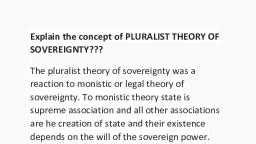
Explain the concept of PLURALIST THEORY OF, SOVEREIGNTY???, , The pluralist theory of sovereignty was a, reaction to monistic or legal theory of, sovereignty. To monistic theory state is, supreme association and all other associations, are he creation of state and their existence, depends on the will of the sovereign power., , The pluralist theory rejects this and tries to, establish that there is no single source of, authority that is all competent and, comprehensive., , Laski says that sovereignty is neither absolute, nor a unity. It is pluralist, constitutional and, responsible. State has no superior claim to an, individual's allegiance. It can justify itself as a, public service corporation. State exists to, coordinate functions of human association in
Page 2 :
the best interest., , Another exponent of pluralist theory Robert, M.Maclver propounds that state is one of the, several human associations, although it, exercises unique functions. Important feature, of the state is supremacy of law., , Pluralists believe that state enjoys a privileged, position because of its wider jurisdiction, which, covers all the individuals and associations, within its boundary. This does not mean that it, is superior to other associations. It is also true, that state has power to punish those who defy, its command but that does not mean that it is, absolute. The state must justify the exercise of, its special powers. Pluralist is divided and, limited., , The pluralist demand that the same must justify
Page 3 :
its claim to allegiance on moral grounds., Actually to them the management and control, of society must be shared by various, associations in proportion to their contribution, to the common goods. This theory stands for, the decentralization of authority., , The pluralist also rejects the distinction, between state and government. They insist on, a realistic political science and consider the, distinction between two as artificial., , The pluralists are not against the state but, would discard sovereign state with its absolute, and indivisible power., , The chief tenets of pluralist theory of, sovereignty are as follows.
Page 4 :
a) Pluralist sovereignty deals with political, aspects of sovereignty., , b) State is one of the several human, associations catering to various interests of, the individuals. c) State is arbiter over, conflicting interests of, , different associations., , d) State should compete with other human, associations to claim superior authority., , e) State was not absolute or supreme, legally., , f) | State is not the only source of, legislation or law.
Page 5 :
g) Lawis very antithesis of command., , h) The state is both the child and parent of, law., , i) He root of obedience of law isn't, coercion but the will to obey., , j) State and government are not, different., , The pluralist theory of sovereignty is also not, free from criticism. Critics maintain that, without establishment of a classless society,, sovereignty can neither be divided nor be