Notes of Genric Sem 1, Political Science authority notes.pdf - Study Material
Page 1 :
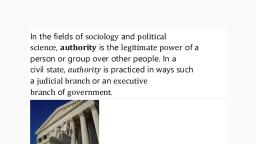
In the fields of sociology and political, science, authority is the legitimate power of a, person or group over other people. In a, civil state, authority is practiced in ways such, a judicial branch or an executive, branch of government., , The Supreme Court of the United States is the highest, judicial authority in the United States of America., In the exercise of governance, the, terms authority and power are inaccurate synonyms., The term authority identifies the political legitimacy,, which grants and justifies the ruler’s right to exercise, the power of government; and the, term power identifies the ability to accomplish an, authorized goal, either by compliance or by, obedience; hence, authority is the power to make, decisions and the legitimacy to make such legal, decisions and order their execution.
Page 2 :
Ancient understandings of authority trace back, to Rome and draw later from Catholic (Thomistic), thought and other traditional understandings. In, more modern terms, forms of authority include, transitional authority exhibited in for, example Cambodia, public authority in the form, of popular power, and, in more administrative terms,, bureaucratic or managerial techniques. In terms of, bureaucratic governance, one limitation of the, governmental agents of the executive branch, as, outlined by George A. Krause, is that they are not as, close to the popular will as elected representatives, are. The claims of authority can extend to national or, individual sovereignty, which is broadly or, provisionally understood as a claim to political, authority that is legitimated., Historical applications of authority in political terms, include the formation of the city-state of Geneva,, and experimental treatises involving the topic of, authority in relation to education, include Emile by Jean-Jacques Rousseau. As David, Laitin defines, authority is a key concept to be, defined in determining the range and role of
Page 3 :
political theory, science and inquiry. The relevance of, a grounded understanding of authority includes the, basic foundation and formation of political, civil, and/or ecclesiastical institutions or representatives., In recent years, however, authority in political, contexts has been challenged or questioned., There have been several contributions to the debate, of political authority. Among others, Hannah, Arendt, Carl Joachim Friedrich, Thomas, Hobbes, Alexandre Kojève and Carl Schmitt have, provided some of the most influential texts., In European political philosophy, the jurisdiction of, political authority, the location of sovereignty, the, balancing of notions of freedom and authority, and, the requirements of political obligations have been, core questions from the time, of Plato and Aristotle to the present., Most democratic societies are engaged in an, ongoing discussion regarding the legitimate extent, of the exercise of governmental authority. In, the United States, for instance, there is a prevailing, belief that the political system as instituted by, the Founding Fathers should accord the populace as
Page 4 :
much freedom as reasonable; that government, should limit its authority accordingly, known, as limited government., Political anarchism is a philosophy which rejects the, legitimacy of political authority and adherence to, any form of sovereign rule or autonomy of a nationstate. An argument for political anarchy is made, by Michael Huemer in his book The Problem of, Political Authority. On the other side, one of the main, arguments for the legitimacy of the state is some, form of the social contract theory developed, by Thomas Hobbes in his 1668 book, Leviathan, or, by Jean-Jacques Rousseau in his political writings, on the social contract., Since the emergence of the social sciences, authority, has become a subject of research in a variety, of empirical settings: the family (parental authority),, small groups (informal authority of leadership),, intermediate organizations such as schools,, churches, armies, industries and bureaucracies, (organizational and bureaucratic authority), and, society-wide or inclusive organizations, ranging from, the most primitive tribal society to the modern
Page 5 :
nation-state and intermediate organization (political, authority)., The definition of authority in contemporary social, science remains a matter of debate. Max Weber in his, essay "Politics as a Vocation" (1919) divided, legitimate authority into three types. Others,, like Howard Bloom, suggest a parallel between, authority and respect/reverence for ancestors., The political authority in the British context can be, traced to James VI and I of Scotland who wrote two, political treatises called Basilikon Doron and The Trve, Lawe of free Monarchies: Or, The Reciprock and Mvtvall, Dvtie Betwixt a free King, and his naturall, Subiectes which advocated his right to rule on the, basis of the concept of the divine right of kings, a, theological concept that has a basis in multiple, religions, but in this case, Christianity, tracing this, right to the apostolic succession., Sovereign kings and queens in the United Kingdom, and the Commonwealth Realms are considered the, foundations of judicial, legislative and executive, authority.
Page 6 :
The understanding of political authority and the, exercise of political powers in the American context, traces back to the writings of the Founding Fathers,, including the arguments put forward in The, Federalist Papers by James Madison, Alexander, Hamilton and the First Chief Justice of the United, States John Jay, and later speeches by the 16th, President of the United States Abraham Lincoln. "Our, government rests in public opinion," President, Abraham Lincoln said in 1856. In his 1854 Speech at, Peoria, Illinois, Lincoln espoused the proposition, “that each man should do precisely as he pleases, with all which is exclusively his own," a principle, existing "at the foundation of the sense of justice.", This sense of personal ownership and stewardship, was integral to the practice of self-government as, Abraham Lincoln saw it by a Republican nation and, its people. This was because, as Abraham Lincoln, also declared, "No man is good enough to govern, another man, without that other's consent., The U.S. President is called to give account to the, legislature for the conduct of the whole government,, including that of regulatory agencies. The President
Page 7 :
influences the appointments, the budgeting process, and has the right and capacity to review regulatory, rules on a case-by-case basis. Since the time of, the Reagan administration the President was, informed with a cost–benefit analysis of the, regulation. The creation of a regulatory agency, requires an act of the Congress which specifies its, jurisdiction, the related authority and delegated, powers. Regulatory authorities can be qualified as, independent agencies or executive branch agencies,, a choice which is the reason of struggle between the, Congress and the President as well as with the, American Courts. The latter's role is limited by the, authorities' power to regulate property, rights without the due process rights mandatorily, applied by the courts., , समाजशास्त्र और राजनीति विज्ञान के क्षेर में, अधिकार, ककसी व्यक्ति या समूह की अन्य लोगों पर िैि शक्ति, , है । एक नागररक राज्य में, न्यातयक शाखा या सरकार की