Notes of LH1 CHEMISTRY, Engineering Chemistry Instrumental Analysis.pdf - Study Material
Page 1 :
MODULE 5, INSTRUMENTAL METHODS OF ANALYSIS AND NANOMATERIALS, Instrumental methods of analysis and Nanomaterials, Instrumental methods of analysis: Theory, Instrumentation and applications of Colorimetry,, Flame Photometry, Atomic Absorption Spectroscopy, Potentiometry, Conductometry (Strong acid, with a strong base, weak acid with a strong base, mixture of strong acid and a weak acid with a, strong base), Nanomaterials: Introduction, size dependent properties (Surface area, Electrical, Optical,, Catalytic and Thermal properties). Synthesis of nanomaterials: Top down and bottom up, approaches, Synthesis by Sol-gel, precipitation and chemical vapour deposition, Nanoscale, materials: Fullerenes, Carbon nanotubes and graphenes – properties and applications., , COLORIMETRIC TITRATION, Introduction:, This method is useful to determine the concentration of unknown solution. The concentration of, the unknown solution is determined by measuring the absorbance of the light w.r.t known, concentration. The instrument name is Photoelectric Colorimeter., Theory: Theory of the colorimeter is explained by Beer – Lambert’s Law., Law of absorption: When light falls upon homogenous medium, a portion of the light is, reflected, a portion is absorbed, and reminder is transmitted. Io = It + Ia + Ir, Where Io = intensity of the incident light , Ir = intensity of the reflected light, Ia = intensity of the absorbed light, It = intensity of the transmitted light, When glass is used Ir = 0 negligible, Io = I a + It, A = log (Io / It), Lambert’s Law: The intensity of the monochromatic light decreases exponentially as, the thickness of the medium increases arithmetically., Beer’s law: the intensity of the monochromatic light decreases exponentially as the, concentration of the medium increases arithmetically., Beer-lambert’s law, Absorbance is directly proportional to concentration and thickness., A = € ct , € = molar absorption co-efficient., A = log = K t c, Procedure: Transfer exactly 1,2,3,4 &5 ml of standard, copper sulphate solution into different test tubes. Add 3ml, of ammonia solution into each of them and make up to the, mark with distilled water and shake well. Set the filter to, 620nm. Adjust the initial reading to zero by using blank, solution in the sample tube. Measure the absorbance for, each standard sample solution and plot graph of, absorbance v/s concentration of copper sulphate. Finally,, determine the concentration of test solution using the, calibration curve.
Page 2 :
Instrumentation:, Source: Tungsten bulb is used as a light source., Filter: It is a device for isolating monochromatic light., Sample: Sample is hold in glass cell (cuvette)., Photocell: Converts the emitted light into electrical signal., , Applications:, , In quantitative analysis: large number of metal ions, anions and cations compounds can, be determined by in this method, , , Photometric Titration i.e. equivalence point can also be determined, , Determination of the composition of colored complex, , Advantages:, , Can be determine the concentration of the colored solution, , It is very simple method, , Colorimeter gives most accurate value, , Used for lower concentration, FLAME PHOTOMETRY, Introduction:, Elements impart characteristic color with Bunsen flame. The flame photometry is based on the, measurement of intensity of the light emitted when a metal is introduced into a flame. The, intensity of the emitted light tells about the concentration of the element present., Principle:, When liquid sample containing metallic salt solution is introduced into a flame, the flowing, process is involved in that., , Solution containing the metal is aspirated into flame, , Solvent evaporates leaving behind a solid residue, , Salt is vaporized or converted into a gaseous state, , In the gaseous state salt is dissociates into constitute atoms, , Gaseous atoms get excited from ground state to excited state., , The exited atoms are unstable quickly emit photons & return to the lower energy level, , , The intensity of the emitted radiation is measured using flame, photometry. These steps are schematically represented as follows, + + M X (aq) flame M X evaporation MX(s) vaporization (g) dissociation(g)+X(g), excitation, M*(g), , emission flame, , hγ
Page 3 :
Relationship between ground, state & excited state atoms is given by Boltzmann equation, - E/RT, N1/N0 = ( g1/go) e, N1= atoms in excited state, N0= atoms in ground state, g1/go = ratio of statistical weights for ground & excited states., E = excitation energy K= Boltzmann constant, T= temperature., Procedure: Flame photometric estimation of sodium, Prepare 1ppm NaCl solution by weighing 2.52g of sodium chloride and dissolved one liter of, distilled water. Transfer 2, 4, 8, 10ml of standard NaCl solution into different standard flask. Set, the instrument to zero by using distilled water and hundred by using pure NaCl solution., Measure the emission intensities for other standard solutions. Draw a calibration curve by, plotting the emission intensity (y axis) and concentration of NaCl in ppm (x axis). From the, curve find out concentration of NaCl and calculate the amount of Na., Instrumentation:, , Applications:, It is used in the quantitative determination of metals in solution, especially alkali & alkaline earth, in the given sample. For Ex; a) Conc of calcium in hard water,, b) Conc of Na, K in urine, c) Conc of Ca and other elements to bio-glass and ceramic materials., POTENTIOMETRIC TITRATION, Aim: Determination of the weight of ferrous ammonium sulphate and ferrous iron in the given, solution by potentiometric titration method., Principle: In this titration the amount of substance in the solution is determined by measuring, the emf between two electrodes that are dipped into the solution. When the metal M is immersed, n+, in the solution containing its own ions M ions, the electrode potential is given by Nernst, equation,, o, n+, E=E + 0.0591log [M ], N, emf of the solution can be measured by combining reference electrode with indicator electrode., The electrode which responds to the change in the concentration of the ion in the solution is, called indicator electrode & reference electrode is one whose potential is constant., The titration of Mohr’s Salt solution with K2Cr2O7 in the presence of H2SO4 is a redox titration., Before the titration is started, the solution contains only ferrous ions in the solution. When a, 2+, small volume of the dichromate solution is added, equivalent small quantity of Fe ions are, 3+, 6+, 3+, converted into Fe ions. In the process, the Cr ion in dichromate is reduced to Cr ion., 2+, , 3Fe +cr, , 6+, , 2+, , 3Fe +Cr, , 3+
Page 4 :
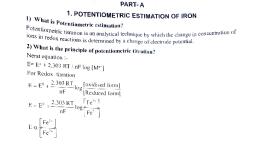
2+, , 3+, , In the presence of both Fe and Fe ions in the solution developing an electrode potential, 3+ 2+, which is picked up by a Pt wire [P+/Fe ;F ], whose electrode potential is given by, o, , 3+, , E=E + 0.0591 log [Fe ], 2+, N, [Fe ], The electrode potential of the indicator electrode depends upon the ratio of the concentrations of, 3+, oxidized and reduced species in the solution. As the titration proceeds, the concentration of Fe, 2+, goes on increasing and that of Fe goes on decreasing. As a result, the ratio in the above, expression for electrode potential goes on increasing and the increase in the value of the ratio, becomes very large near the end point. This results in the large increases in the electrode, potential and in turn, in the measured emf of the cell., 2+, 3+, 3+, 2+, At the equivalence point, all the Fe ions are converted into Fe ions, the Pt/Fe , Fe, 6+, electrode ceases to exist. But addition of a slight excess of dichromate solution introduces Cr, 3+, ions into the solution, which along with the Cr ions in the solution (formed during the, 2+, 6+, 3+, oxidation of Fe ) form a new oxidation reduction electrode, Pt/Cr , Cr ., After the equivalence point potential of the redox reaction is determined by the, equation, o, , 2-, , E=E + 0.0591 log [Cr2O7 ], 3+, N, [Cr ], Procedure:, Pipette out 25cm3 of FAS solution into a 50cm3 beaker. Add one test tube full of dil H2SO4., Immerse Pt. & calomel electrodes into the solution, & connect the electrodes to a Potentiometer., Fill the burette with K2Cr2O7solution .Add K2Cr2O7 solution from the burette with increment of, 0.5cm3, stir well and measure the potential after each addition. Continue the titration till the, potential indicates a rapid jump with a drop of titrant. Plot the graph of∆ E/ ∆V v/s vol. of, K2Cr2O7, ∆E/∆V, , Instrumentation, , Volume of K2Cr2O7, , A potentiometer consists of an indicator electrode (e.g.: Platinum), A standard reference, electrode (E.g.: Calomel electrode), & potentiometer to read the values directly as change in, potential., Applications:, 1. Coloured solution can also be titrated., 2. Acid-base titration can also be done in this method., 3. In this method Oxidation-reduction titrations can also be carried out., 4. Precipitation reactions can also be carried out potentiometrically.
Page 5 :
CONDUCTOMETRIC TITRATION, Conductance, is ease with which current flows through the solution. It is reciprocal of resistance., -1, C=1/R = Ω or mho or siemen, Theory:, The Conductance of the solution is explained by considering ohm’s law., According to ohm’s law the current flowing through the conductor is directly proportional to, voltage and inversely proportional to the resistance., I = V/R or, V=IR, The resistance of the any conductor is directly proportional to the length of inversely, proportional to the area of cross section of the conductor Therefore R = S (l/a) where S is, specific resistance, Therefore C = 1/R = 1/S (a/l), K (a/l), K = specific conductance, It is defined as the conductance of the solution which is place between two electrodes of area, 2, 1cm and 1cm apart, The conductance of the solution is depends on mobility of the ion and number of the ion, Types of conductance:, There are three type’s namely specific conductance, equivalence conductance, and molar, conductance., Specific conductance (K) is conductance of the solution which are placed between two, electrodes of area 1cm and at 1cm apart, K = 1/R (l/a) K = Siemen m, 2, , -1, , Equivalence conductance (λ) is the conductance of the solution when 1g equivalent weight, 2, of solution is placed between two electrodes of area 1cm at 1cm apart., Molar conductance (µ) is the conductance of the solution when 1g molecular weight of solute, 2, is placed between two electrodes of area 1cm at 1cm apart, Conductometric titration, Strong acid v/s strong base, HCl v/s NaOH, If the strong acid like HCl is titrated against a strong base, such as NaOH, the conductance first decreases due to, +, +, replacement of fast moving H ions by slow moving Na ions, HCl + NaOH, , NaCl + H2O, , After the neutralization point, conductivity rapidly rises with further addition of NaOH because, of continuous addition of fast moving OH ions. A plot of conductance against the volume of, base added is shown in the figure. The point of intersection of two curves gives the neutralization, point., Strong acid v/s weak base, HCl v/s NH4OH, Conductivity of the solution decreases due to the replacement, +, +, Of fast moving H ions by NH4 ions but after equivalence, point, conductivity almost remains constant, since NH4OH is, weak electrolyte and ionizes to small extent giving very small, conductivity., HCl + NH4OH, NH4Cl + H2O, A plot of conductance against the volume of base added is shown in the figure. The point of, intersection of two curves gives the neutralization point.
Page 6 :
Weak acid v/s Strong base, Consider the titration of acetic acid against NaOH., The conductance of the acid will be initially low since acetic, acid is a weak electrolyte. When NaOH is added to the acid,, the salt formed is highly ionized and the conductance increases., On complete neutralization of the acid, further addition of base, leads to an increases in the number of mobile OH ions. Hence, the conductance increases sharply., CH3COOH+ NaOH, CH3COONa + H2O, A plot of conductance against the volume of base added is shown in the figure. The point of, intersection of two curves gives the neutralization point., Weak acid v/s weak base, Consider the titration of acetic acid against NH 4OH. The conductance of, acid will be initially low since acetic acid is a weak electrolyte. When, NH4OH is added to acid salt is formed and the conductance, of the solution increases. On complete neutralization of acid, conductance does not change rapidly since NH4OH is a weak base., CH3COOH+ NH4OH, CH3COONH4 + H2O, A plot of conductance against the volume of base added is shown in the figure. The point of, intersection of two curves gives the neutralization point., Mixture of strong acid and weak acid v/s, strong base HCl, CH3COOH v/s NaOH, the strong acid like HCl is titrated against a strong base, such as NaOH, the conductance first decreases due to, +, +, replacement of fast moving H ions by slow moving Na, ions, HCl + NaOH, NaCl + H2O, The weak acid do not get neutralized initially, because of the well known common ion effect., +, In the presence of excess of H ions, the ionization of, the weak acid is suppressed and hence, weak acid, +, like CH3COOH ionizes gradually after the first end point and the available H ions are, neutralized giving the second end point., Because of common ion effect dissolution of acetic acid is suppressed. Hence it does not provide, +, H ions which required for neutralization., After the neutralization point of HCl, CH3COOH, conductivity rapidly rises with further addition, of NaOH because of continuous addition of fast moving OH ions. A plot of conductance against, the volume of base added is shown in the figure. The point of intersection of two curves gives, the neutralization point., Advantages:, , Mixture of acid can be titrated, , , Indicators are not used, , Very weak acids can be titrated, , Can be used with colored solution
Page 7 :
NANO MATERIALS, INTRODUCTION:, Nanotechnology is a multidisciplinary science and technology and, encompasses physical, chemical, biological, engineering and electronic processes. It is the study, deals with various structures of matter having dimensions of the order of billionth of a meter., These materials or particles are called as nano particle. Nano technology is the making of usage, and technique, in order to solve a problem to perform specific functions. The particles which are, smaller than about 100nm give rise to enhance properties of nano structures built from them., Matter arranged by exercising control over length of one to hundred nanometers and the, formulating structures exhibit characteristics that are specific to their size and dimensions, the, resulting materials are called nano materials., What are nanomaterials?, Nanoscale materials are defined as a set of substances where at least one dimension is, less than approximately 100 nanometers. A nanometer is one millionth of a millimeter approximately 100,000 times smaller than the diameter of a human hair. Nanomaterials, are of interest because at this scale unique optical, magnetic, electrical, and other, properties emerge. These emergent properties have the potential for great impacts in, electronics, medicine, and other fields., Classification of Nanomaterials, Nanomaterials have extremely small size which having at least one dimension 100 nm, or less. Nanomaterials can be nanoscale in one dimension (eg. surface films), two, dimensions (eg. strands or fibres), or three dimensions (eg. particles). They can exist in, single, fused, aggregated or agglomerated forms with spherical, tubular, and, irregular shapes. Common types of nanomaterials include nanotubes, dendrimers,, quantum dots and fullerenes. Nanomaterials have applications in the field of nano, technology, and displays different physical chemical characteristics from normal, chemicals (i.e., silver nano, carbon nanotube, fullerene, photocatalyst, carbon nano,, silica)., According to Siegel, Nanostructured materials are classified as Zero dimensional, one, dimensional, two dimensional, three dimensional nanostructures., Nanoparticles are particles between 1 and 100 nanometers in size. In nanotechonology a, particle is defined as a small object that behaves as a whole unit with respect to its, transport and properties. Particles are further classified according to diameter. Ultrafine, particles are the same as nanoparticles and between 1 and 100 nanometers in size. Coarse, particles cover a range between 2,500 and 10,000 nanometer. Fine particles are sized, between 100 and 2,500 nanometers. Nanoparticles research is currently an area of intense, scientific interest due to a wide variety of potential applications in biomedical, optical and, electronic fields
Page 8 :
SIZE DEPENDENT PROPERTIES, a) Surface area: Nanomaterials have a significant proportion of atoms existing at the surface., Properties like catalytic activity, gas adsorption and chemical reactivity depend on the surface, area. Therefore nanomaterials can show specific related properties that are not observed in bulk, materials., b) Electrical properties: the electronic bands in bulk materials are continuous due to, overlapping of orbitals of billion of atoms. But in the nanomaterials, very few atoms or, molecules are present so the electric band becomes separate and the separation between different, electric stated varies with the size of the nanomaterials. Hence, some metals which are good, conductors in bulk semiconductors and insulator as their size is decreased to nano level., c) Optical properties: Nanomaterials have particular optical properties as a result of the way, , light intersects with their fine nanostructures. The discrete electronic states of nanomaterials, allow absorption and emission of light at specific wavelength. Hence, nanomaterials exhibit, unique color different from bulk materials., , d)Thermal Properties: Decrease in size increases the surface energy, decreases the melting pt,, this is because surface atoms require less energy to move because they are in contact with less, number of atoms of the substance., Ex: Silicon nanowire possesses less thermal conductivity than bulk silicon., SYNTHESIS OF NANOMATERIALS, There are two methods of preparing nanomaterials. One is top-down approach & the other is, bottom-up approach., , , In top-down approach, the material is reduced from bulk size to nano scale., Examples, for top-down approach are ball milling method & nanolithography., , , In bottom-up approach, matter in atomic or molecular level gets assembled to form tiny, clusters, which grow to reach nano-size., , Examples for bottom-up approach are arc discharge method, chemical vapor deposition, physical, vapor deposition & sol gel method.
Page 9 :
Nanomaterial synthesis by SOL – GEL PROCESS:, Sol gel processes principle is conversion of precursor solution into gel via hydrolysis and, condensation reactions., The following steps are involved in the synthesis of nanomaterials by sol-gel process., , Nanoparticles, Examples: Zinc oxide nanoparticles, TiO 2 nanoparticles can be synthesized by this method., a) preparation of sol: In this method, metal alkoxide is used a precursor to, synthesis nanoparticles of a metal oxide. Metal alkoxide is dissolved in alcohol and, then water is added under acidic, neutral or basic conditions. Addition of water leads, to hydrolysis in which alkoxide ligand is replaced with a hydroxyl ligand., MOR + H 2 O→ MOH + ROH (hydrolysis), b) Conversion of sol to gel : The polycondensation reaction between MOH and MOR, results in the formation of an oxide – or alcohol – bridged network(gel)., MOH+ ROM → M- O –M +R-OH (Polycondensation), c) Aging of the gel: The reaction mixture is allowed to continue polycondensation, reactions until the gel transforms into a solid mass, accompanied by contraction, of the gel network and expulsion of solvent from gel pores., d) Removal of a solvent: The water and other volatile liquids are removal from the, gel network. If isolated by thermal evaporation, the resulting product is termed a, xerogel. If the solvent is extracted under supercritical conditions, resulting product is, termed an aerogel., e) Heat treatment: The sample obtained is calcined at high temperature (8000C), to obtain nanoparticles.Nanoparticles formed by sol-gel process commonly have a, size ranging from 1 to 100 nm., , 1., 2., 3., 4., , Advantages, Nanomaterials of high purity with good homogeneity can be obtained., Samples can be prepared at lower temperature., Easy to control synthesis parameters to control physical characteristics like shape and, size of resulting materials., Simple and inexpensive equipment.
Page 10 :
PRECIPITATION METHOD, Principle: The principle involved in the precipitation of precursor materials at constant pH via, condensation. Precipitation method can be used to prepare nanoparticles of metal oxides, metal, sulphides and metals., Process, a) In this method, an inorganic metal salt (such as nitrate, chloride or acetate of, metal) is dissolved in water (precursor solution)., b) Metal cations exist in the form of metal hydrate species, for example,2 (Al, (H O), 6, 3+, 3+, ) or (Fe(H 2 O) 6 ) ., c) These metal hydrates are added to precipitating agent like NaOH or NH4OH, it, changes the pH & causes condensation of precursor., d) Thus concentration of solution increases and reaches a critical level called super, saturation. At this concentration nucleus formation is initiated. The nucleus further, grows into, particles,, which gets, precipitate., The, precipitate, obtained, is filtrated,, washed, with water, air dried and finally calcined at high, temperature, , Advantages: The process is relatively economical., The wide range of single and multi components to oxide nano powders can be synthesized., CHEMICAL VAPOUR DEPOSITION (CVD):, CVD is a process where gaseous precursors react to form a solid coating on a heated substrate.
Page 11 :
NANO SCALE MATERIAL, Nano scale materials are defined as a set of substances where atleast one dimension is less than, approximately 100nm. A nanometer is one millionth of a millimeter. Nano materials are of, interest because of this scale unique optical, magnetic, electrical and other properties emerge., These emergent properties have the potential for great impacts in electronics, medicine and other, fields., FULLERENES: Fullerenes are class of molecules made of only, carbon atoms having closed cage like structure. Many number of, fullerene molecules with different carbon atoms like C60, C70, C74,, C76 etc.., have been prepared but C60 is more stable. The C60, molecule had spherical shape resembling a soccer ball (foot ball). The, most important fullerene is C60 containing 60 carbon atoms, which are commonly known as Buckminster fullerene. The name, of Buckminster fullerene comes from the name of an architect, Richard Buckminster fuller who had built the geodesic dome with, spherical shape. The C60 molecule consist of 12 pentagons and 20, hexagons. and each pentagon is surrounded by five hexagons and each, hexagon is surrounded by three hexagons . The chemical formula for, fullerene is C20+2n., , Properties of fullerenes, 1. Fullerenes are heat-resistant and unique, insoluble in water, dissolve in organic solvents., 2. In fullerenes, 12 pentagonal rings are necessary and sufficient to affect the cage closure., 3. Fullerenes C60 molecule can absorb more than 100 photons in a nano second and transfer, that energy (230V) to its vibrational energy., 4. Highest tensile strength of any known 2D structure or element., 5. Highest packing density of all known structures., 6. Impenetrable to all elements under normal circumstances, even to, a helium atom with energy of 5 eV., Applications:, 1. Fullerenes are extremely flexible and strong nature, therefore are being considered, for use in combat armor. It is used in electrographic imaging, solar cells, non linear, optical thin films., 2. Researchers have found that water-soluble derivates of fullerenes inhibit the HIV-1, protease (enzyme responsible for the development of the virus) and are therefore useful in, fighting the HIV virus that leads to AIDS., 3. Elements can be bonded with C 60 or other fullerenes to create more diverse material, including superconductors and insulators., 4. Used for the conversion of diamondUsed as gas sensors, temperature sensors, particle sensors, and detection of organic vapors., CARBON NANO TUBES:, Carbon nanotubes are allotropes of carbon with a cylindrical nanostructure having diameter of, 1nm and longer than a micrometer. It is one dimensional material like nano wires. CNT is made, up of graphite sheet. When the graphite sheet is rolled up hexagonally, it forms a tube like, structure is called as CNT. Types of CNT:, 1. Single-Walled CNT(SWCNTs): They are formed by rolling up of single, graphine layer. The diameter of SWCNT is 1-4nm and length can go up to few, micrometers.
Page 12 :
2. Multi-Walled CNT(MWCNTs):They consist of two or more concentric graphine, cylindres with vander wall’s forces between adjacent tubes. The diameter of, MWCNTs is in the range of 30-50nm and length can go up to few micrometers., , Properties and applications:, 1. CNTs exhibit high electrical and thermal conductivty. They have low density and very high, mechanical strength due to these properties they are used as electrode material for lithium ion, rechargeable batteries., 2. CNTs can emit electrons when subjected to high electrical field due to this property they are, used in the field emission X-ray tubes., 3. The CNTs are about 20 times stronger than steel and hence find applications in making, automobiles and aircraft body parts., 4. SWCNTs absorb radiation in the near IR range (700-1100nm) and convert it to heat. This, property is used in caner thermotherapy to selectivity kill cancer cells without affecting nearby, healthy tissues., GRAPHENES, Graphne is a semi-metal with small overlap between the valence and conduction bands. It is, an allotrope of carbon consisting of single layer of carbon atoms arranged in a hexagonal, lattice. Graphene has a sp2 hybridized planar honey comb lattice structure with zero energy, band gap. It is a pure carbon in the form of a very thin, nearly transparent sheet, one atom, thick. Graphene can be described as a one-atom thick layer of graphite., Properties:, Graphenes have high electrical conductivity, large surface area, high mechanical and thermal, stability., One of the useful properties of graphene is that it is zero-overlap semi-metal (with both holes and, electrons as charge carriers) with very high electrical conductivity., Applications, Pencil production, coatings, lubricants, paint production, batteries, high performance adsorbent, for water pollution, efficient photocatalyst, high performance fuel cell catalyst.



 Learn better on this topic