Notes of CS1 Class, CHEMISTRY & Chemistry & Chemistry chapter 2 - Study Material
Page 1 :
PREVIOUS HSE QUESTIONS AND ANSWERS OF THE CHAPTER “STRUCTURE OF ATOM”, 1. The quantum number which gives the energy of an electron in an atom is ……., (a), Principal quantum number (b) Azimuthal quantum number, (c) Magnetic quantum number, (d) Spin quantum number, (1), Ans: Principal quantum number, 2. What is photoelectric effect?, (2), Ans: It is the process of ejection of electrons from the surface of some metals, when light of suitable, frequency incident on them., 3. (a) Sketch the shape of 2s orbital., (1), (b) State Pauli’s exclusion principle., (1), (c) Write the values of all quantum numbers for the last electron in sodium atom. (2) [December 2020], Ans: (a), , (b) It states that no two electrons in an atom can have the same set of four quantum numbers., (c) The electronic configuration of sodium is 11Na – 1s2 2s2 2p6 3s1., Here the last electron is at 3s subshell., The values of different quantum numbers for 3s subshell are n = 3, l = 0, m = 0 and s = + ½ or – ½., 4. The number of radial nodes of 4p orbital is ……………, (a) 1, (b) 2, (c) 3, (d) 4, (1), Ans: 2, 5. Write any two characteristic properties of canal rays., (2), Ans: The nature of canal rays depends on the nature of gas present in the cathode ray tube. These are, positively charged gaseous ions. They are invisible and can be observed with the help of fluorescent or, phosphorescent materials., 6. (a) Write the n and l values of a 4d electron., (1), (b) Give the names of series of spectral lines of atomic hydrogen and their region in the electromagnetic, spectrum., (2), (c) State Hund’s rule of maximum multiplicity., (1), [March 2020], Ans: (a) For 4d electron, n =4 and l = 2, (b), Series, , Spectral, region, Lyman, Ultra violet, Balmer Visible, Paschen Infra red, , Series, , Spectral, region, Brackett Infra red, Pfund, Infra red, , Structure of Atom - Prepared by ANIL KUMAR K L, GHSS ASHTAMUDI, KOLLAM, Join Telegram Channel, https://t.me/hsslive, , Downloaded from www.Hsslive.in ®, , Page 1
Page 2 :
(c) It states that electron pairing takes place only after partially filling all the degenerate orbitals., 7. Represent the orbital with quantum numbers n = 5 and l = 3., (1), Ans: 5f, 8. The threshold frequency for a metal is 7.0 x 10¹⁴ s-1. Calculate the kinetic energy of an emitted electron, when radiation of frequency (ν) 1.0 x 10¹⁵ s-1 hits the metal., (2), 14 -1, Ans: Here threshold frequency (ν0) = 7.0 x 10 s and frequency of radiation (ν) = 1.0 x 10¹⁵ s-1, K.E of emitted electron = hν - hν0 = h(ν - ν0) = 6.626 x 10⁻³⁴ (1.0 x 10¹⁵ - 7.0 x 10¹⁴) = 19.878 x 10⁻²⁰ J, 9. What are the important observations and conclusions made by Rutherford from his alpha ray scattering, experiment? Give any two limitations of Rutherford’s nuclear model of atom., (4), [July 2019], Ans: The important observations made by Rutherford are:, (i), Most of the α– particles passed through the gold foil without any deviation., (ii), A small fraction of the α–particles was deflected by small angles., (iii), A very few α– particles bounced back (that is, deflected by nearly 180°)., Conclusions:, (i), Most space in the atom is empty., (ii), The positive charge of the atom is concentrated in a very small volume at the centre called nucleus., (iii), The volume occupied by the nucleus is negligibly small as compared to the total volume of the atom., Limitations: (i) Rutherford’s model cannot explain the stability of the atom., (ii) He cannot explain the electronic structure of atom., 10. The minimum value for the product of uncertainties in position and momentum of a moving microscopic, particle is equal to .........., (1), Ans: h/4π, 11. Mention two observations which could not be explained by wave nature of electromagnetic radiations. (2), Ans: Black body radiation, photoelectric effect (variation of heat capacity of solids with temperature, line, spectra of atoms etc.), 12. Explain quantum numbers. Give the importance of quantum numbers in Pauli’s Exclusion Principle. (4), Ans: Quantum Numbers are certain numbers used to explain the size, shape and orientation of orbitals. Or,, Quantum numbers are the address of an electron. There are four quantum numbers - Principal Quantum, number (n), Azimuthal Quantum number (Ɩ), Magnetic Quantum number (m) and Spin Quantum number (s), 1. Principal Quantum Number (n): It gives the size the orbit, the energy of electron in an orbit, the shell in, which the electron is found and the average distance between the electron and the nucleus., The possible values are 1, 2, 3, 4, 5 etc., 2. Azimuthal Quantum Number (Ɩ): It gives the shape of the orbital, the sub shell in which the electron is, located and the orbital angular momentum of the electron., The possible values of Ɩ are : Ɩ = 0, 1, 2, .......... (n-1)., 3. Magnetic Quantum Number (m or mƖ), It gives the orientation of orbitals in space. For a given ‘Ɩ’ value, there are 2Ɩ+1 possible values for m and, these values are – Ɩ to 0 to + Ɩ, 4. Spin Quantum Number (s or ms), It is the only experimental Quantum number and it gives the spin orientation of electrons. The values for s, may be +½ or -½. +½ represents clock-wise spin and-½ represents anticlock-wise spin., According to Pauli’s exclusion principle, no two electrons in an atom can have the same set of four quantum, numbers. i.e. an orbital can accommodate a maximum of only 2 electrons with opposite spin., , Structure of Atom - Prepared by ANIL KUMAR K L, GHSS ASHTAMUDI, KOLLAM, Join Telegram Channel, https://t.me/hsslive, , Downloaded from www.Hsslive.in ®, , Page 2
Page 3 :
13. Name the quantum number which gives the spatial orientation of an orbital with respect to standard set of, co-ordinate axes., (1), Ans: Magnetic Quantum number, 14. Write two important results observed during photoelectric effect. (2), Ans: (i) The electrons are ejected from the metal surface as soon as the beam of light strikes the surface., (ii) The number of electrons ejected is proportional to the intensity or brightness of light., (iii) For each metal, there is a minimum frequency called threshold frequency below which photoelectric, effect is not observed., (iv) The kinetic energy of the ejected electrons is directly proportional to the frequency of the incident, light. [Any 2 required], 15. Explain how, the different series of lines are formed in the hydrogen spectrum. Derive an equation to find, the wave number of a line in the hydrogen spectrum., (4), [August 2018], Ans: According to Bohr atom model, line spectrum is formed by the excitation (de-excitation) of electron, from one energy level to another., Consider two energy levels E1 and E2 in Hydrogen atom. The energy gap between the two orbits is given by, equation: ΔE = E2 – E1, But E1 = -RH and E2 = -RH, n12, n22, 2, Therefore, ΔE = RH [1/n1 – 1/n22], = 2.18 x 10⁻¹⁸ [1/n12 – 1/n22], The frequency associated with the absorption and emission of the photon can be given as, ν = ΔE = RH 1 – 1, h, h n12 n22, = 2.18 x 10⁻¹⁸ 1 - 1, 6.626 x 10⁻³⁴ n12 n22, = 3.29 x 10¹⁵ [1/n12 – 1/n22], The wave number (ῡ) = 1/ λ = ν = RH 1 - 1, c hc n12 n22, = 3.29 x 10¹⁵ 1 - 1, 3 x 10⁸, n12 n22, = 1.09677 x 10⁷ 1 - 1 m-1, n12 n22, , = 109677 1 - 1, n12 n22, , cm-1, , 16. How many angular nodes are present in a 5f-orbital?, (1), Ans: For f orbitals, no. of angular nodes = 3, 17. Give the postulates of Bohr model of hydrogen atom. Also write two merits and two limitations of this, model., (4), Ans: The important postulates of Bohr model of hydrogen atom are:, (i) The electron in the hydrogen atom can move around the nucleus in circular paths of fixed radius and energy., These paths are called orbits or stationary states or allowed energy states., (ii) The energy of an electron in an orbit does not change with time. However, when an electron absorbs energy,, it will move away from the nucleus., Structure of Atom - Prepared by ANIL KUMAR K L, GHSS ASHTAMUDI, KOLLAM, Join Telegram Channel, https://t.me/hsslive, , Downloaded from www.Hsslive.in ®, , Page 3
Page 4 :
(iii) The radius of orbits can be given by the equation: rn = a0 n2 where a0 = 52.9 pm., (iv) The energy of electron in an orbit is given by the expression: En = -RH (1/n2), where n = 1,2,3…… and RH is a, constant called Rydberg constant. Its value is 2.18x10⁻¹⁸ J., (v) The frequency of radiation absorbed or emitted when transition occurs between two stationary states that, differ in energy by ΔE, is given by:, ν = ΔE = E2 – E1, h, h, (vi) The angular momentum of an electron is an integral multiple of h/2π. i.e. mevr = nh, 2π, Merits:, (i) It could explain the stability of atom, (ii) It could explain the line spectra of hydrogen atom and hydrogen like ions., Demerits: (i) It could not explain the fine spectrum of hydrogen atom., (ii) It could not explain the spectrum of atoms other than hydrogen., 18. Represent graphically, the variation of probability density (ψ2(r)) as a function of distance (r) of the electron, from the nucleus for 1s and 2s orbitals., (2), [March 2018], Ans:, , 1s, 2s, 19. a) Cathode rays are rays moving from cathode to anode. Give any two properties of cathode rays., b) Write the electronic configuration of Cr. (1), c) Draw the shapes of s and p orbitals., (2), [July 2017], Ans: a) (i) Cathode rays start from cathode and move towards the anode., (ii) They are invisible, but their behaviour can be observed with the help of fluorescent or, phosphorescent materials. (2), b) 24Cr: [Ar] 3d54s1 OR 1s2 2s2 2p6 3s2 3p6 3d5 4s1, (1), c), , (2), , s orbital, p orbital, (2), 20. a) i) Write the electronic configuration of chromium (z = 24), (1), ii) Find the number of electrons in the subshell with azimuthal quantum number Ɩ =2. (1), Structure of Atom - Prepared by ANIL KUMAR K L, GHSS ASHTAMUDI, KOLLAM, Join Telegram Channel, https://t.me/hsslive, , Downloaded from www.Hsslive.in ®, , Page 4
Page 5 :
iii) Represent the orbital with quantum numbers n = 1 and l = 0 (1), b) Give the mathematical representation of Heisenberg’s uncertainty principle and its one important, significance. (2), [March 2017], 5 1, 2, 2, 6, 2, 6, 5, 1, Ans: a) (i) 24Cr: [Ar] 3d 4s OR 1s 2s 2p 3s 3p 3d 4s (1), (ii) Ɩ = 2 denotes d subshell, which can accommodate a maximum of 10 electrons., (1), (iii) 4s, (1), b) Δx. Δp ≥ h/4π. This principle rules out the existance of definite paths or orbits for electrons. (2), 21. Bohr was the first to explain the structure of hydrogen atom and spectrum., a) Give the main postulates of Bohr model of atom., (2), b) Calculate the wavelength of the first line in Lyman series of the hydrogen spectrum (R = 109677 cm-1)., (3), Ans: a) Refer the answer of Qn. No. 11, b) For the first line in Lyman series, n1 = 1 and n2 = 2, Wave number, ῡ = 1/ λ = 109677 (1/n12 -1/n22) = 109677 (1/12 – 1/22) = 109677 x ¾ = 82257.75 cm-1, Wave length (λ) = 1/ ῡ = 1/82257.75 = 1.21 x 10⁻⁵ cm = 121 nm, (3), 22. a) There are some rules governing the filling of electron in orbitals. State and explain Hund’s rule of, maximum multiplicity., (2), b) Quantum number gives the address of electrons. Explain the quantum number which determines:, i) Distance of electron from nucleus., ii) The orbital angular momentum of electron. (3), [September 2016], Ans: a) It states that electron pairing takes place only after partially filling all the degenerate orbitals., For example the electronic configuration of N is 1s2 2s2 2px1py1pz1 and not 1s2 2s2 2px2py1., b) (i) Principal Quantum number, (ii) Azimuthal or subsidiary Quantum number, 23. Atomic orbitals are precisely distinguished by what are known as Quantum numbers., a) Name the four quantum numbers., (2), b) Represent the orbitals given below:, i), n = 1, l = 0, ii) n = 2, l = 1 (2), c) The number of unpaired electrons present in Ni is ………. (Atomic number of Ni = 28), i), 2, ii) 0, iii) 1, iv) 3 (1), [March 2016], Ans: a) Principal Quantum number (n), Azimuthal Quantum number (Ɩ), Magnetic Quantum number (m) and, Spin Quantum number (s), b) (i) 1s, (ii) 2p, c) 2, 24. The quantum numbers provide / valuable information regarding electrons in an atom., a) Which one of the following statements is CORRECT about quantum numbers?, i), The principal quantum number can have fractional values., ii), The azimuthal quantum number defines the three dimensional shape of the orbital., iii), The magnetic quantum number determines the size of the orbital., iv), Spin quantum number gives information about the spatial orientation of the orbital with respect, to standard set coordinate axes. (2), Structure of Atom - Prepared by ANIL KUMAR K L, GHSS ASHTAMUDI, KOLLAM, Join Telegram Channel, https://t.me/hsslive, , Downloaded from www.Hsslive.in ®, , Page 5
Page 6 :
b) A photon has a wavelength of 3.5 A0. Calculate its mass (Given h = 6.626 x 10⁻³⁴ Js. Velocity of light =, 3 x 10⁸ m/s), (2), Ans: a) (ii) The azimuthal quantum number defines the three dimensional shape of the orbital., b) From the de Broglie’s equation, λ = h/mv, m = h/ λv = 6.626x10⁻³⁴/(3.5x10-10x3x108) = 6.31x 10⁻³³kg, 25. The uncertainty principle contributed significantly in the formulation of the quantum mechanical model of, atom., a) Which one of the following statements is CORRECT about the uncertainty principle?, i) The exact position and the exact momentum of an electron in an atom can be determined, simultaneously., ii) It is a consequence of the dual behavior of matter and radiation., iii) It is significant only for motion of microscopic objects and is negligible for that of macroscopic, objects., iv) It supports the existence of definite paths or trajectories of electrons and other similar particles. (1), b) An electron is moving with a velocity of 2.5 x 10⁶ m/s. lf the uncertainty in its velocity is 0.1%. Calculate, the uncertainty in its position. (Planck’s constant, h = 6.626 x 10⁻³⁴ Js. Mass of the electron = 9.1 x 10⁻³¹, kg)., (2), [October 2015], Ans: a) It is significant only for motion of microscopic objects and is negligible for that of macroscopic objects., c) Here v = 2.5x10⁶. Uncertainty in velocity (∆v) = 0.1% of 2.5x106 = 2.5x10³, h = 6.626 x 10⁻³⁴ Js,, m = 9.1 x 10⁻³¹ kg., We know that ∆x.m.∆v = h/4π, So, ∆x = h, =, 6.626 x 10⁻³⁴, = 0.023 x 10⁻⁶ m, 4π.m. ∆v, 4 x 3.14 x 9.1 x 10-31 x 2.5 x 103, 26. a) The number of protons, electrons and neutrons in a species are equal to 17, 18 and 18 respectively., Which of the following will be the proper symbol of this species?, i) 1735Cl, ii) 1735Cl–, iii)1736Cl, iv) 1736Cl–, (1), b) i) Give any 2 postulates of Rutherford’s nuclear model of an atom., (2), ii) Write the two main drawbacks of Rutherford’s atomic model., (2), 35 –, Ans: a) 17 Cl, b) i) The important postulates of Rutherford’s nuclear model of an atom are:, All the positive charge and most of the mass of the atom are concentrated in an extremely, small region called nucleus., Electrons are revolving round the nucleus with a very high speed in circular paths called orbits., Electrons and the nucleus are held together by electrostatic forces of attraction. [Any 2], ii) Drawbacks: (i) Rutherford’s model cannot explain the stability of the atom., (ii) He cannot explain the electronic structure of atom., 27. a) Representation of the orbital with quantum numbers n = 3, l = 1 is ………….., i) 3s, ii) 3d, iii) 3p, iv) 1s, (1), b) i) Which of the following sets of quantum numbers are NOT possible?, 1) n = 2, l = 2, ml = 0, ms = + ½, 2) n=1, l = 0, ml = 0, ms = - ½, Structure of Atom - Prepared by ANIL KUMAR K L, GHSS ASHTAMUDI, KOLLAM, Join Telegram Channel, https://t.me/hsslive, , Downloaded from www.Hsslive.in ®, , Page 6
Page 7 :
3) n = 3, l = 2, ml = -3, ms = + ½, 4)n = 2, l = 1, ml = 1, ms = + ½, (2), ii) Justify your answer., (2), [March 2015], Ans: a) 3p, b) i) n = 2, l = 2, ml = 0, ms = + ½, n = 3, l = 2, ml = -3, ms = + ½, ii) When n =2, the values of l are 0 and 1. i.e. l cannot be 2, When l = 2, the values of ml are -2, -1, 0, +1 and +2. i.e. ml cannot be -3., 28. a) Write the subshell-wise electronic configurations of the following elements:, i), Cu (Z = 29), ii) Cr (Z = 24) give reason for the extra stability of these atoms., (2), b) Canal rays were discovered by discharge tube experiments conducted in a modified cathode ray tube., Give any two characteristics of canal rays. (1), c) A microscope with suitable photons is employed to locate an electron in an atom within a distance of 0.4, A0. What is the uncertainty involved in the measurement of its velocity? (2), [August 2014], 10 1, 2, 2, 6, 2, 6, 10, 1, Ans: a) i) 29Cu: [Ar] 3d 4s OR, 1s 2s 2p 3s 3p 3d 4s, ii) 24Cr: [Ar] 3d54s1 OR, 1s2 2s2 2p6 3s2 3p6 3d5 4s1, This is because half-filled and completely filled electronic configurations have extra stability., b), The nature of canal rays depends on the nature of gas present in the cathode ray tube. These are, positively charged gaseous ions. They are invisible and can be observed with the help of fluorescent or, phosphorescent materials., c) Here ∆x = 0.4 A0 = 0.4x10⁻¹⁰ m, h = 6.626 x 10⁻³⁴ Js, m = 9.1 x 10⁻³¹ kg, ∆v = ?, We know that ∆x.m.∆v = h/4π, So, ∆v = h, =, 6.626 x 10⁻³⁴, = 0.145 x 10⁷ m/s, 4π.m. ∆x, 4 x 3.14 x 9.1 x 10-31 x 0.4 x 10-10, 29. a) The number of electrons, protons and neutrons in a species are equal to 18, 16 and 16 respectively., Assign the proper symbol to the species., (1), b) Write any two drawbacks of the Rutherford model of atom., (2), c) Among the following electronic configurations, which one is correct? Substantiate your answer., , (2), 32, , Ans: a) X, , [March 2014], , 2-, , 16, , b) Refer question no. 22(b)., c) iii) is correct. This is because according to Hund’s rule, the electron pairing occurs only after partially, filling all the degenerate orbitals., 30. a) A large number of orbitals are possible in an atom. Using s, p, d or f notations describe the orbital with, the following quantum numbers. i) n = 4, l = 0, ii) n = 3, l = 2 (1), b) The Balmer series of lines in the hydrogen spectrum appear in the visible region of the electromagnetic, spectrum. Calculate the wave number of the second line in the Balmer series. (Rydberg constant for, Hydrogen is 109677 cm-1), (2), Structure of Atom - Prepared by ANIL KUMAR K L, GHSS ASHTAMUDI, KOLLAM, Join Telegram Channel, https://t.me/hsslive, , Downloaded from www.Hsslive.in ®, , Page 7
Page 8 :
c) Bohr model of hydrogen atom contradicts dual behaviour of matter and Heisenberg’s uncertainty, principle. Justify., (2), [September 2013], Ans: a) i) 4s ii) 3d, b) For the second line in Balmer series, n1 = 2 and n2 = 4, Wave number, ῡ = 1/ λ = 109677 (1/n12 -1/n22) = 109677 (1/22 – 1/42) = 109677 x 3/16 = 20564.4 cm-1, c) Bohr model did not consider the wave character of the electron. Also, the concept of orbit is against, Heisenberg uncertainty principle since both the position and the velocity of the electron in an orbit can, be determined simultaneously., 31. Photoelectric effect was first observed by Hertz., a) The number of electrons ejected in the photoelectric effect is proportional to ………….. of light used., (frequency, intensity), (1), b) Select the correct statement related to the photoelectric effect:, i), Threshold frequency is the maximum frequency required to photoelectric emission from a, particular metal., ii), The kinetic energy of the photoelectrons is directly proportional to the frequency of incident, light., iii), Work function is same for all metals., (1), [March 2013], Ans:intensity, b) ii) The kinetic energy of the photoelectrons is directly proportional to the frequency of, incident light., 32. The general features of the structure of a hydrogen atom and hydrogen like species were quantitatively, explained by Niels Bohr., a) Write any postulate of the Bohr’s model of hydrogen atom. (1), b) Calculate the radius of the second orbit of Li2+. (Express answer in nm). (2) [March 2013], Ans: a) Refer question number 11., b) Radius, rn = a0n2/z, Here a0 = 52.9 pm, n=2 and z = 3 (for Li), So rn = 52.9 x 22/3 = 70.53 pm, 33. The dual behaviour of matter was proposed by French physicist de Broglie., a) State the dual behaviour of matter., (1), b) A moving electron has a de Broglie wave length of 7 x 10⁻⁷ m. Calculate its kinetic energy. (Planck’s, constant = 6.626 x 10⁻³⁴ Js, mass of an electron = 9.1 x 10⁻³¹ kg) (2), [March 2013], Ans: a) Matter has both particle nature and wave nature. This is known as dual behaviour of matter., b) From the de Broglie’s equation, λ = h/mv, v = h/ λ.m = 6.626 x 10⁻³⁴/(7x10-7 x 9.1 x 10-31) = 0.104 x 10⁴ m/s, K.E = ½ mv2 = ½ x 9.1 x 10-31 x (0.104x104)2 = 0.049 x 10 -23 kJ/mol, 34. a) In order to specify the size, energy, shape and orientation of orbitals and spin of the electrons, we need 4, quantum numbers., i), Write the 4 quantum numbers., (1), ii), Represent the orbital with the following quantum numbers, n = 4 and l = 0., (1), b) State the rules behind the electronic configuration in an atom. (3), [September 2012], Ans: a) i) Ref. qn. No. 17(a), Structure of Atom - Prepared by ANIL KUMAR K L, GHSS ASHTAMUDI, KOLLAM, Join Telegram Channel, https://t.me/hsslive, , Downloaded from www.Hsslive.in ®, , Page 8
Page 9 :
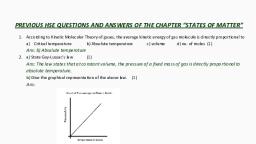
ii), 4s, b) 1. Aufbau principle: It states that the orbitals are filled in the increasing order of their energies., 2. Pauli’s Exclusion Principle: It states that no two electrons in an atom can have the same set of four, quantum numbers., 3. Hund’s rule: It states that electron pairing takes place only after partially filling all the degenerate, orbitals., 35. The photon has a momentum as well as a wavelength., a) Which property of matter is revealed in the above statement? (1), b) A photon has a mass of 8.6 x10⁻³⁰ kg. Calculate its wavelength. (Planck’s constant = 6.626 x 10⁻³⁴ Js (2), [March 2012], Ans: a) Dual behaviour of matter, b) For photon, velocity (v) = 3 x 10⁸ m/s, From the de Broglie’s equation, λ = h/mv, = 6.626 x 10⁻³⁴/(8.6x10-30 x 3x108) = 0.257 x 10⁻¹² m = 0.257 pm, 36. Heisenberg’s uncertainty principle rules out the existance of definite paths for electrons and other similar, particles., a) State Heisenberg’s uncertainty principle. (1), b) Calculate the uncertainty in the velocity of a cricket ball of mass 130 g, if the uncertainty in its position is, of the order of 1.2 A0., (2), [March 2012], Ans: a) It states that “it is impossible to determine simultaneously, the exact position and exact, momentum (or velocity) of a moving microscopic particle like electron”., b) We know that ∆x.m.∆v = h/4π. Here m = 130g = 130 x 10-3 kg, So, ∆x = h, =, 6.626 x 10⁻³⁴, = 0.145 x 10⁻²¹ m, 4π.m. ∆v, 4 x 3.14 x 130 x 10-3 x 1.2 x 10-10, 37. The electrons in an atom are designated by a set of quantum numbers labeled as n, l, m and s., a) Give the values of n, l, m and s for the valence electron of sodium atom (Atomic number = 11) (2), b) Which of the following set of quantum numbers are not allowed?, i), n = 3, l = 3, m = -3, s = +½, ii), n = 2, l = 1, m = 0, s = -½, iii), n = 1, l = 0, m = 0, s = +½, iv), n = 0, l = 0, m = 0, s = +½, (2), c) State Pauli’s exclusion principle. (1), [October 2011], 2, 2, 6, 1, Ans: a) The electronic configuration of sodium is 11Na – 1s 2s 2p 3s ., Here the last electron is at 3s subshell., The values of different quantum numbers for 3s subshell are n = 3, l = 0, m = 0 and s = + ½ or – ½., b) i) n = 3, l = 3, m = -3, s = +½ and iv) n = 0, l = 0, m = 0, s = +½, c) Ref. qn. No. 28 (b), 38. Based on his α-ray scattering experiment, Rutherford proposed the nuclear model of an atom., a) Give the main postulates of Rutherford’s atom model. (2), b) Write the important demerits of Rutherford model., (1), 4 -1, c) The threshold frequency, ν0 for a metal is 6.2 x 10 s . Calculate the K.E of an ejected electron when the, radiation of frequency, ν = 8.7 x 10⁴s-1 strikes the metal., (2), [March 2011], Structure of Atom - Prepared by ANIL KUMAR K L, GHSS ASHTAMUDI, KOLLAM, Join Telegram Channel, https://t.me/hsslive, , Downloaded from www.Hsslive.in ®, , Page 9
Page 10 :
Ans: a) and b) Ref. qn. No. 20 (b), c) K.E of emitted electron = hν - hν0 = h(ν - ν0) = 6.626 x 10⁻³⁴ (8.7 x 10⁴ – 6.2 x 10⁴)= 16.565 x 10⁻³⁰ J, 39. During Rutherford’s α-ray scattering experiment, it was observed that most of the α-particles passed, through the Gold-foil without any deflection, a small fraction deflected by small angles and very few, bounced back., a) What are the main conclusions made by Rutherford? (1½), b) Give the atom model proposed by him. (1½), c) What are the main drawbacks of this model and how Niels Bohr overcame these defects in his model?, (2), [September 2010], Ans: Ref. qn. No. 3 & 20 (b., Bohr overcame these defects by assigning fixed circular paths for electrons., 40. Niels Bohr was the first to explain quantitatively the general features of hydrogen atom structure and its, spectrum., a) Give the main postulates of Bohr’s model of atom., (2), b) Find the maximum number of emission lines, when the excited electron of hydrogen atom in n =6,, drops to the ground state (n = 1)., (1½), c) Calculate the wave number of radiation due to transition of an electron from 4 th orbit to 2nd orbit, (RH = 109677 cm-1) (1½), [March 2010], Ans: a), Ref. qn. No. 11, b), The maximum no. of emission lines = n(n-1)/2 = 6(6-1)/2 = 15., c), Ref. qn. No. 24(b), 41. Dual nature of matter was proposed by Louis-de-Broglie., a) Calculate the de Broglie wave length associated with an electron with velocity 1.6 x 10 6 m/s (3), b) State Pauli’s exclusion principle and Hund’s rule of maximum multiplicity., (2) [March 2009], Ans: a) From the de Broglie’s equation, λ = h/mv, = 6.626 x 10⁻³⁴/(9.1 x10-31 x 1.6 x 106) =0.455 x 10⁻⁹m= 0.455 nm, b), Ref. qn. No. 28 (b), 42. Quantum numbers give the address of an electron. Explain all the four quantum numbers. (4), [March 2008], Ans: Ref. qn. No. 6, *******************************************************************************, , Structure of Atom - Prepared by ANIL KUMAR K L, GHSS ASHTAMUDI, KOLLAM, Join Telegram Channel, https://t.me/hsslive, , Downloaded from www.Hsslive.in ®, , Page 10



 Learn better on this topic