Page 1 :
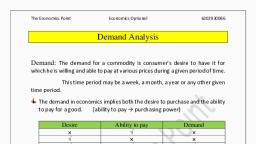
DemandDemand refers to the quantities of goods that, consumers are willing and able to purchase at, various prices, during a given period of time., Law of DemandThe law of demand states that other factor, being constant ,price and quantity demanded, of any goods and services are inversely related, to each other .When the price of a product, increase .The demand for the same product will, fall., Price, 50, 45, 40, 35, 35, 30, 25, , Quantity Demanded, 1, 2, 3, 5, 7, 9, 12
Page 2 :
20, 15, , 15, 20, graph, , 60, 50, 40, 30, , graph, , 20, , 10, 0, , 1, , 2, , 3, , 5, , 7, , 9, , 12, , 15, , 20, , Quantity, Demand Function –, Demand function refers to the functional, relationship between quantity demanded for a, commodity & factor affecting it., Where, Qdx = Quantity demanded of goods
Page 3 :
Px = Price of goods X, Py = Price of related goods, Y= Income level of consumer, T= Taste and preference of consumer, Ex= Expected Income, Ep= Expected Price, Adv= Advertisement Cost, Shift In Demand, Shift of Demand occurs when determinants of, demand changes .When Taste and preference, and income are altered the basic relations, between price and Quantity demanded, changes(Shift0

Page 4 :
Types of Demand, Price Demand, It is the demand for different quantities of a, product or service that consumers intend to, purchase at a given price and time period, assuming other factors, such as prices of the, related goods, level of income of consumers, and preferences remain unchanged., Price demand is inversely proportional to the, price of a product or service. As the price of a
Page 5 :
product or service rises, its demand falls and, vice versa. Therefore, price demand indicates, the functional relationship between the price of, a product or service and quantity demanded., Income Demand, It is a demand for different quantities of a, commodity or service that consumers intend to, purchase at different levels of income assuming, other factors remain the same. Generally, the, demand for a commodity or service increases, with an increase in the level of income of, individuals except for inferior goods. Therefore,, demand and income are directly proportional, to normal goods whereas the demand and, income are inversely proportional to inferior, goods., Cross Demand, It refers to the demand for different quantities, of a commodity or service whose demand
Page 6 :
depends not only on its own price but also the, price of other related goods and services. For, example, tea and coffee are considered to be, the substitutes of each other. Thus, when the, price tea increases, people switch to coffee., Consequently, the demand for coffee increases., Thus, it can be said that tea and coffee have, cross demand., Individual Demand and Market Demand, This is the classification of demand based on, the number of consumers in the market., Individual demand, refers to the quantity of a, commodity or service demanded by an, individual consumer at a given price at a given, time period. For example, the quantity of sugar, that an individual or household purchases in a, month is their individual or household demand., The individual demand of a product is, influenced by the price of a product, income of, customers and their tastes and preferences. On
Page 7 :
the other hand, Market demand is the, aggregate of individual demands of all the, consumers of a product over a period of time at, a specific price while other factors are constant., For example, there are four consumers of, sugar. These four consumers consume 30, kgs,40 kgs,50 kgs and 60 kgs of sugar, respectively in a month. Thus, the market, demand for sugar is 180 kgs in a month., Joint Demand, It is the quantity demanded for two or more, commodities or services that are used jointly, and are thus demanded together. For example,, car and petrol, bread and butter, pen and refill, etc, are commodities that are used jointly and, are demanded together. The demand for such, commodities changes proportionately. For, example, a rise in the demand for cars results in, the proportionate rise in the demand for petrol., In the above example, an increase in the price
Page 8 :
of cars will cause a fall in the demand of not, only cars but also of petrol., Composite Demand, It is the demand for commodities or services, that have multiple uses. For example, the, demand for steel is a result of its uses for, various purposes like making utensils, pipes,, cans etc. In the case of a commodity or service, having composite demand, a change in the, price results in a large change in the demand., This is because the demand for the commodity, or service would change across its various, usages. In the above example, if the price of, steel increases, the price of other products, made of steel also increases. In such a case,, people may restrict their consumption of, products made of steel., Direct and Derived Demand
Page 9 :
Direct demand is the demand for commodities, or services meant for final consumption. This, demand arises out of the natural desire of an, individual to consume a particular product. For, example, the demand for food, shelter, clothes, and vehicles is direct demand as it arises out of, the biological, physical and other personal, needs of consumers. Derived demand refers to, the demand for a product that arises due to the, demand for other products. It is applicable to, goods such as raw materials, intermediate, goods, machines and equipment. Apart from, this, the factors of production land, labour and, capital also have derived demand. For example,, the demand for labour in the construction of, buildings is a derived demand.