Notes of 12thEM(F), Physics Wave Optics - Study Material
Page 1 :
10/36, , Pradecp's Fundamental Physics COD) Repay, , aa HUYGENS PRINCIPLE, REFLECTION, { AND REFRACTION OF LIGHT, , Formulae used, , 1, Speed of light in vacuum, c = v 2 = 3 x 10⁸ m/s, , 2. Refractive index of a medium, , ¢ _ Veloflightinvacuum yA,, Ss — = S ALN, v_ vel.of lightinmedium ~ y)’ 4’, , -. Wavelength in medium, 7’ = a (freq. v is same), Mm, , 3. When light travels from medium 1 to 2, then, according to Snell’s law, ‘hb = “, , sinr, 4. Optical path in vacuum = 1. x path in medium,, Units used, , ¢,v in m/s ; A, 0’ in metre ; vin Hz ; thas no units., , , , Example }f The absolute refractive index, of air is 1-0003 and wavelength of yellow light in, vacuum is 6000 A. Find the thickness of air column, which will contain one more wavelength of yellow, light than in the same thickness of vacuum., , Solution. Let thickness ¢ of vacuum contain n, waves and same thickness of air contain (n+ 1) waves., , , , , , “Wah 6000, t 1-0003¢, ——+l1=, 6000 6000, t + 6000 = 1.0003 ¢, 0-0003 + = 6000, , a =2x10⁷A=2mm, , Example #] A light wave has a frequency, of 5 x 10¹⁴ Hz. Find the difference in its, wavelengths in alcohol of refractive index 1-35 and, , glass of refractive index 1-5., Solution. Here, v = 5 x 10!4 Hz, , 3x10⁸, , = 4.445 x 10⁻⁷ m, , v, c 3x10⁸, oe ag, Sv Mv 15x5x10!, =4.0x 10⁻⁷ m, , Ny — ey = (4-445 x 10-7 - 4.0 x 10⁻⁷) m, = 0-445 x 107 m= 445A, , INTENSITIES OF MAXIMA, AND MINIMA, , a, , Formulae used, al, » BF, , 2. When sources are coherent, interference occurs., , 2., 1. “in4, , fax _ (a+b)?, Trin (a—b)?, 3. Intensity at any point, where phase difference, is >, T= kR? =k (a2 +b? +2 ab cos 6), , T=k ++ 2Ji, 1, cos 9), If 1, = 1, =/, then, Tp = k. 21(1 + cos 9) =k. 4 Icos? 6/2, 4. When sources are incoherent, no interference, Occurs. Resultant intensity at any point, T=1\+h=k(a2+b2), Units used. Often we deal with ratios of identical, quantities. They have no units., , , , Exampte f] Two plane monochromatic, waves propagating in the same direction with, amplitudes A and 2 A and differing in phase by, 1/3 superimpose. Calculate the amplitude of the, resulting wave, (CBSE Sample Paper 2003), , Solution. Here, a = A and b = 2A,6= 17/3,, , R=?, , R= yar +2 +2abcosd, =a? +447 4242 Acos n/3, , = baa HAS CAG, , Scanned with CamScanner
Page 2 :
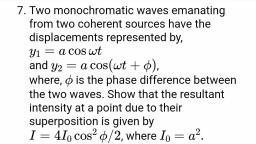
WAVE OPTICS, , examplef] Ina Young’s double slit, experiment, the intensity of light at a point on the, screen where the path difference is 4 is K units., Find the intensities at a point, where path diff. is, (i) N4 (i) 3 (iii) M2. (CBSE 2014, 2012), , Solution. From J = 1, +1, +2 Vi 1, cos, , if 1) = 1, = Ip, then, , T= Ig + 1p +2 Ip cos b=2 Ip (I + cos >), , =4 Ip cos? $/2, When path difference is 2, > = 20, 1=4 I) cos? m=4 [y= K, , 20, (i) When path difference = 1/4, o= 7+ =W2, 2, 1 K, = 24 =41,| = | =2ly =—, 1=4 I) cos m4 fz] 0-3, , (ii) When path difference = 3, > =2 7/3, , ly K, 1 =4 Ip cos? (2 1/3) 415( 5) =I =, , (ii?) When path difference = : ,O=7, , 1=4 Ip cos? W2=0, Example 8 Two coherent monochromatic, light beams of intensities J and 4] are superposed., What will be in maximum and minimum possible, intensities ? (IIT 2000), Solution. Here, /; = / and I, =41, As sources are coherent,, , =I, +1, +2yhl, cos, When 6 = 0, intensity is maximum, , * Inax =E+41 +2414 =91, When 6 = 17, intensity is minimum, , Dain =1+414+2J1x41 cost, =51-41=1, , ‘Example 6 In Young’s double slit experiment using monochromatic light of wavelength A,, the intensity of light at a point on the screen where, path diff. is 1. is K units. Find the intensity of light, at a point where path difference is 3., , (CBSE 2014), , Solution. Here [p = K, where path diff. is 0., , 1 =, where path diff. = 1/3, , 10/37, , 20, Phase diff., = 3 =120°, , From 1 = Ig cos” o/2, 2 2, 120° (3) = | =KI-| =KA, I x (co "| 3, , ‘Example {] The ratio of intensities of, , minima to maxima in Young’s double slit, experiment is 9 : 25. Find the ratio of width of, , , , , , , , , , two slits. (CBSE 2014), Tani 9 Ww,, Solution. Here, —™* rr t=?, , Tmax. 5 Wy, Inin, (a= bY _ 9, Tmax (a+b)? 25, , a-b_3, , a+b 5, , Z_, , b 23, , 44, 5, , b, , Wy, , , , jExample f] Light waves from two, , coherent sources arrive at two points on a screen, , with path differences 0 and 4/2. Find the ratio of, , intensities at the points. {CBSE 2017 (C)], Solution. Let J, = 1, = Ip, , (i) path diff. = 0, phase difference $ = 0, + Tpel tht 21, I, cos, = [gt l+2 Ip cos 0°=41y, , (ii) path diff. 1/2, phase difference 4’ = 2" = x, 2, , Ipal+1,+ 2 fi, Ty cos @”, , = Ig + Ip +2 Ig (- 1) = Zero., Ip 41, R, —k =—© - infinite, , Tr Zero, , Scanned with CamScanner
Page 3 :
10/38, , YOUNG'S DOUBLE, SLIT EXPERIMENT, , Formulae used, 1. Positj ‘ e — a D, , + Position of bright fringes is given by * = aha, , a, where n= 1, 2, 3... for Ist, 2nd, 3rd... bright fringes., 2. Position of dark fringes is given by, x=(2n =n22,, 2d, , where n = 1, 2, 3, ... for first, second, third, ... dark, fringes., , : . Hs AD, 3. Width of each bright/dark fringe B= 7, , 4. When the entire apparatus is immersed in a, transparent medium of refractive index 1, fringe, , ,_ND_2D_B, width, B i ud mi, 5. Angular width of interference fringes., ook, Dd, , Units used. Distances x, d, D, wavelength A, fringe, width B all are in metre ; @ is in degrees ;, n is a number., , (Ex:, , , , =xampleb) Laser light of wavelength, 630 nm incident on a pair of slits produces an, interference pattern where bright fringes are, separated by 8-1 mm. Another light produces the, interference pattern, where the bright fringes are, separated by 7-2 mm. Calculate the wavelength, of second light. [CBSE 2009 (C)], , Solution. Here, 4, = 630 nm, B, = 8-1 mm, Ay =?, B=7:2 mm, , 2, , x Fi, As B= AD therefore, —2 — Po = a2 3, d , B81 9, , x630nm = 560 nm, , \o| 00, , 8, hy =Gh=, , (Exampie[{) Two slits are made 1 mm, apart and the screen is placed 1 m away. What is, , the fringe separation when blue green light of, , wavelength 500 nm is used ?, NCERT Solved Example, , 4) Funda tal Physic, Pradecp's Fundamen— =, , s (XT) Repay, Solution. Here, d = 1 mm = 103mD=1 m,, 4 = 500 nm = 500 x 10°? m=5 x 10⁻⁷ m, Fringe separation = fringe width, B = ?, , , , , , -1, hate — 5x0" xl sx 10-~4 m=05 mm, d 10-8, , Example ff] In Young’s double slit, experiment, the two slits 0-15 mm apart are, illuminated by light of wavelength 450 nm. The, screen is 1:0 m away from the slits. Find the, distance of second bright fringe and second dark, fringe from the central maximum. How will the, fringe pattern change if the screen is moved away, from the slits ? (CBSE 2010), , Solution. Here, d = 0:15 mm = 1-5 x 10⁴m, 2 = 450 nm = 450 x 10°? m, D=1-0m, , Distance of 2nd bright fringe, , x, = 2D 2x 450x107? x 1-0, 2d 15104, =6x 10³ m=6mm, , Distance of 2nd dark fringe, , As D is increased, fringe width of each fringe, AD)., p= a increases., , ‘Example [9] In YDSE, slits are separated, by 0-24 mm and the screen is kept 160 cm away, from slits. If fringe width is measured to be 0-4 cm,, calculate the wavelength of light used., , [CBSE 2007 (C)], , Solution. Here, d = 0-24 mm = 0:24 x 103 m, , D = 160 cm = 1-60 m,, B=0-4cem=04x 102m, A=?, , From B= Ap, d, , 1 = Bd _ 04x10? x0:24x 109, D 16, , =6x 10⁷m, , Scanned with CamScanner
Page 4 :
WAVE OPTICS, , FRESNEL DISTANCE, , IV, , 2, 5 7 2 v, Formula used, Fresnel distance, Zp = =, , Units used. Aperture a, wavelength A and Fresnel, distance Zp, all are in metre., —_————, , Example [§] Light of wavelength 5 x 10⁷ m, , is diffracted by an aperture of width 2 x 10™ m., , For what distance travelled by the diffracted, , beam does the spreading due to diffraction, become greater than width of the aperture ?, , (CBSE 2000), , Solution. Here, 4 = 5 x 10⁻⁷ m,, , , , a=2x 10³m, 2 32, 5 a’ _ (2x10~), Fr 1 Distance, Z; =7-=, ‘esne: stance, F X 3x10⁷, =8m, , Example [4 For what distance is ray, optics a good approximation when the aperture is, 3 mm wide and wavelength is 500 nm ?, , NCERT Solved Example, , Solution. Here, a= 3mm =3x 1073 m,, a= 500nm=5x 10⁷m, Fresnel distance, Zp = ?, 2 32, - (3x107") =18m, 5x1077, , a, PUR, , DIFFRACTION OF LIGHT, AT A SINGLE SLIT, , Wa, y, Formulae used., 1. Condition for diffraction minima is, asin @ =nA, where n = 1, 2, 3, ...-for Ist,, 2nd, 3rd dark bands respectively., 2. Condition for diffraction maxima is, asin @ = (2n + 1) /2, where n= 1, 2, 3..., 2nd, 3rd, bright bands respectively., 2DA_2f%, , 3. Width of central maximum, 2x= a, 4. Angular width of central maximum in radian,, , 29=2%, a, , 10/39, , 5. In diffraction at a circular aperture, angular, , 1-222, , spread, @=——, ee d, , Units used. a, x, f, D and } are in metre and nis a, pure number., , exampte [HA slit of width ‘a’ is illuminated by light of wavelength 5000 A. For what, value of ‘d’ will the first maximum fall at an angle, of diffraction of 30°. (CBSE 2006), Solution. Here, 4 = 5000 A =5 x 10⁻⁷ m,, d=2,n=1,0=30, , For maxima of diffraction,, , r, dsin@=(2n+1) a, , _ nth _3x5x107, ““Jsin@ —-2sin30°, , =15x10%m, , Exampte [J A parallel beam of light of, 600 nm falls on a narrow slit and the resulting, diffraction pattern is observed on a screen 12m, away. It is observed that the first minimum is at a, distance of 3 mm from the centre of the screen., Calculate the width of the slit. (CBSE 2013), Solution. Here, 4 = 600 nm = 6 x 10⁻⁷ m,, D=12m,n=1,x=3mm=3x 10⁷ ma=?, For first minimum, a sin 8 =n A, , « (5), D, ga kD Sxl07 x12, , % 3x10³, = 024mm, , =24x 104m, , Example 17} Determine the angular, separation between central maximum and first, order secondary maximum of the diffraction, pattern due to a single slit of width 0-25 mm when, light of wavelength 5890 A falls on it normally., , Solution. Here, 8 = ?, , d=0-25 mm = 0-25 x 103 m, = 5890 A = 5890 x 10719 m, As is clear from Fig. 10.37,, , Scanned with CamScanner
Page 5 :
"FIGURE 10.37, , , , , } First oder, max., , , , angular separation between central maximum and first, order secondary maximum is, , ga2 r_gu3h _3x5890x10710, 2d 2d 2x 025x107, = 3-534 x 10° radian, Example A laser beam has a, wavelength of 7 x 10⁻⁷ m and aperture 107? m., The beam is sent to moon at a distance of 4 x 10⁵, km from earth. Find the angular spread and areal, spread of the beam on reaching the moon., Solution. Here, 4=7 x 10⁻⁷ m,a=10?m, D=4~x 10° km=4x 10⁸m, For diffraction at a circular aperture,, 122% _ 1:22x7x1077, “ad (10%, = 8-54 x 10> radian, Areal spread = (D 6)?, = (4 x 108 x 8-54 x 10°)? = 1:197 x 10° m?, Example ff) A screen is placed 2m away, from the single narrow slit. Calculate the slit width, , if the first minimum lies 5 mm on either side of, the central maximum. Incident plane waves have, , a wavelength of 5000 A., , Solution. Here, distance of the screen from the, D=2m,a=?2.x=5mm=5x 10⁷m,, 2 = 5000 A = 5000 x 107!°m, , For the first secondary minima,, , angular spread = 8 =, , slit,, , 02 te, sin “aD, , -10, gx Dh, OT wx tm, x 5x10, Example {Q) Two spectral lines of sodium, , Dp, and D; have wavelengths of approximately, 1, , Pradecp's Fundamental Physics (XI) eran, , A and 5896 A. A sodium lamp sends incident, to a slit of width 2 micrometre, 4, 2m from the slit. Find the spacing, f two sodium lines as, (CBSE 2013, 2006 (Cy, , 5890, plane wave on, , screen is locate:, between the first maxima 0}, , measured on the screen., , Solution. Here,, Ay = 5890 A = 5890 x 10-19 m,, , a=2um=2x10%m, Ay = 5896 A = 5896 x 10-9 m, D=2m, , For the first secondary maxima,, , , , , , sin @= a all, 2a D, 34, D _3A,D, o and 2 = Qa, , <. Spacing between the first secondary maxima, of two, sodium lines, , 3D, =X Hy og eo), , _ 3x 2 (5896 — 5890) x107!0, , 2x2x10-6 =9x10⁻⁴m, , Example ffl Ina single slit diffraction, experiment, first minimum for red light (660 nm), coincides with first maximum of some other, wavelength A’. Calculate 1’., , Solution. Here, A, = 660 nm ; A’ =?, For diffraction minima,, , asin@=n, sing =,, a, , ir, a, , , , For first minima of red light, sin @ =, , For diffraction maxima, asin @ = (2n +1) a, eS, , «. for first maxima of 2’,, , 3n", , asin @’ =3N ; sin 0’ =——,;, 2 2a, , As the two coincide, therefore, sin 6’ = sin 8, , , , or N= ; (660) = 440nm, , Scanned with CamScanner



 Learn better on this topic