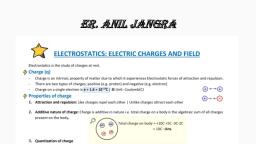
Notes of STEM 12 A, General Physics GenPhys2_12_Q3_Mod1.pdf - Study Material
Page 1 :
Senior High School, NOT, , General Physics 2, Quarter 3 – Module 1, Electric Charge and Electric Field, , Department of Education ● Republic of the Philippines
Page 2 :
General Physics 2 - Grade 12, Alternative Delivery Mode, Quarter 3 - Module 1: Electric Charge and Electric Field, First Edition, 2020, Republic Act 8293, section 176 states that: No copyright shall subsist in any, work of the Government of the Philippines. However, prior approval of the government, agency or office wherein the work is created shall be necessary for exploitation of such, work for profit. Such agency or office may, among other things, impose as a condition, the payment of royalty., Borrowed materials (i.e., songs, stories, poems, pictures, photos, brand names,, trademarks, etc.) included in this book are owned by their respective copyright holders., Every effort has been exerted to locate and seek permission to use these materials, from their respective copyright owners. The publisher and authors do not represent, nor claim ownership over them., Published by the Department of Education – Division of Cagayan de Oro, Schools Division Superintendent: Dr. Cherry Mae L. Limbaco, CESO V, Development Team of the Module, Author/s:, , Glenmark A. Dal, , Content Evaluator: Mai A. Dal, Language Evaluator: Pinky Babiera Dela Calzada, Layout and Design:, , Arian M. Edullantes, , Management Team, Chairperson:, Cherry Mae L. Limbaco, Ph.D., CESO V, Schools Division Superintendent, Co-Chairperson:, , Rowena H. Para-on, Ph.D., Assistant Schools Division Superintendent, , Members, , Lorebina C. Carrasco, OIC-CID Chief, Jean S. Macasero, EPS- Science, Joel D. Potane, LRMDS Manager, Lanie O. Signo, Librarian II, Gemma Pajayon, PDO II, , Printed in the Philippines by, Department of Education – Division of Cagayan de Oro City, Office Address:, Fr. William F. Masterson Ave., Upper Balulang, Cagayan de Oro, Telefax:, (08822)855-0048, E-mail Address:,
[email protected]
Page 3 :
Senior High School, , General Physics 2, Quarter 3 – Module 1, Electric Charge and Electric Field, , This instructional material was collaboratively developed and reviewed, by educators from public schools. We encourage teachers and other education, stakeholders to email their feedback, comments, and recommendations to the, Department of Education at
[email protected]., We value your feedback and recommendations., , Department of Education ● Republic of the Philippines, , FAIR USE AND CONTENT DISCLAIMER: This SLM (Self Learning Module) is, for educational purposes only. Borrowed materials (i.e. songs, stories, poems,, pictures, photos, brand names, trademarks, etc.) included in these modules are, owned by their respective copyright holders. The publisher and authors do not, represent nor claim ownership over them.
Page 4 :
Table of Contents, What This Module is About ....................................................................................................................... i, What I Need to Know .................................................................................................................................. i, How to Learn from this Module............................................................................................................... ii, Icons of this Module ................................................................................................................................... ii, What I Know ................................................................................................................................................iii, , THIRD QUARTER, Lesson 1: Electric Charge, What Is It: Law of Charges ......................................................................................... 1, What Is It: Conductors and Insulators ..................................................................... 2, What Is It: Types of Charging .................................................................................... 3, What I Have Learned ................................................................................................... 4, What I can do .................................................................................................................. 5, , Lesson 2: Coulomb’s Law, What Is It: Coulomb’s Law ....................................................................................... 6, What I Have Learned: ............................................................................................... 8, , Lesson 3: Electric Forces and Electric Field, What Is It: Electric Forces and Electric Field ...................................................... 10, What I Have Learned: ............................................................................................... 14, , Summary .................................................................................................................................................... 15, Assessment: (Post-Test) ...................................................................................................................... 16, Key to Answers ......................................................................................................................................... 17, References ................................................................................................................................................. 18
Page 5 :
What This Module is About, This module demonstrates your understanding on the concepts of Electric, Charges and Electric Field. It specifically discusses about Electric Charges, Coulomb’s, Law, and Electric Forces and Electric Field., This module will help you explore the key concepts on topics that will help you, answer the questions pertaining to direct-current circuits., This module has three (3) lessons:, •, •, •, , Lesson 1 – Electric Charge, Lesson 2 – Coulomb’s Law, Lesson 3 – Electric Forces and Electric Field, , What I Need to Know, At the end of this module, you should be able to:, , 1. Describe using a diagram charging by rubbing and charging by induction, STEM_GP12EM-IIIa-1;, 2. Explain the role of electron transfer in electrostatic charging by rubbing STEM_GP12EMIIIa-2;, 3. Describe experiments to show electrostatic charging by induction STEM_GP12EM-IIIa-3;, 4. Calculate the net electric force on a point charge exerted by a system of point charges, STEM_GP12EM-IIIa-6;, 5. Describe an electric field as a region in which an electric charge experiences a force, STEM_GP12EM-IIIa-7; and, 6. Calculate the electric field due to a system of point charges using Coulomb’s law and the, superposition principle STEM_GP12EM-IIIa-10, , i
Page 6 :
How to Learn from this Module, To achieve the objectives cited above, you are to do the following:, •, , Take your time reading the lessons carefully., , •, , Follow the directions and/or instructions in the activities and exercises diligently., , •, , Answer all the given tests and exercises., , Icons of this Module, What I Need to, , This part contains learning objectives that, , Know, , are set for you to learn as you go along the, module., , What I know, , This is an assessment as to your level of, knowledge to the subject matter at hand,, meant specifically to gauge prior related, knowledge, This part connects previous lessons with that, , What’s In, , of the current one., , What’s New, , An introduction of the new lesson through, various activities, before it will be presented, to you, , What is It, , These are discussions of the activities as a, way to deepen your discovery and understanding of the concept., , What’s More, , These are follow-up activities that are intended for you to practice further in order to, master the competencies., , What I Have, , Activities designed to process what you, , Learned, , have learned from the lesson, , What I can do, , These are tasks that are designed to showcase your skills and knowledge gained, and, applied into real-life concerns and situations., , ii
Page 7 :
What I Know, ., Multiple Choice. Select the letter of the best answer among the given choices., 1. Which of the following is TRUE about electric charge?, A) It can be lost., B) It is created from a chemical reaction., C) It can be destroyed., D) It can be transferred from atom to atom., 2. Which of the following is the least effective conductor?, A) nickel, B) iron, C) oil, , D) mercury, , 3. Which of the following is FALSE?, A) Electric field lines never intersect., B) The electric field lines produced by a positive charge are directed radially outward., C) The electric field lines produced by a negative charge are directed radially inward., D) A static charge never produces an electric field., 4. What is the direction of the electric field at the test point on the -x-axis, 50 cm from the, charge q = -5.00 nC which is located at the origin?, A) eastward, B) westward, C) northward, D) southward, 5. An electron traveling horizontally from North to South enters a region where a uniform, electric field is directed downward. What is the direction of the electric force exerted on the, electron once it has entered the field?, A) downward, B) upward, C) to the east, D) to the west, 6. The electric field has a magnitude of 3.0 N/C at a distance of 60 cm from a point charge., What is the charge?, A) 1.4 nC, B) 120 pC, C) 36 mC, D) 12 mC, 7. What is the electric field strength at a point 50 cm from a charge q = + 5.00 nC?, A) 180 N/C, B) 360 N/C, C) 540 N/C, D) 720 N/C, , 8. A 1.65 nC charge with a mass of 1.5 x 10⁻¹⁵ kg experiences an acceleration of 6.33 x 10⁷, m/s2 in an electric field. What is the magnitude of the electric field?, A) 14.95 N/C, B) 29.35 N/C, C) 57.55 N/C, D) 2.67 x 10⁻¹⁹ N/C, 9. Three point charges are located on the x-axis. The first charge, q1 = +10 µC, is at x = -1.0, m. The second charge, q2 = +20 µC, is at the origin. The third charge, q3 = - 30 µC, is, located at x = +2.0 m. What is the net force on q2?, A) 6.3 N to the negative x-direction, B) 3.15 N to the positive x- direction, C) 1.50 N to the negative x- direction, D) 4.80 N to the positive x- direction, 10. What is the magnitude of the net electric field at (+1.0 m, 0) due to the three charges in, number 9?, A) 198, 256 N/C B) 297, 348 N/C, C) 395, 425 N/C, D) 472, 500 N/C, , iii
Page 8 :
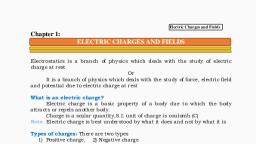
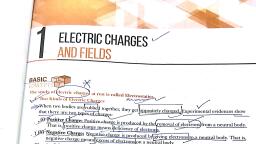
Lesson, , 1, , Electric Charge, , What is it, The term electricity came from the Greek work elektron, or amber. It is given the name, electricity by Sir Wilhelm Gilbert because amber had been the first substance known by the, ancients to exhibit electrification by rubbing. A plastic comb rubbed with a piece of fur can, attract little bits of paper. This ability to attract resembles that of a magnet. However, the, attraction of magnets is limited to objects made of iron, while amber attracts all substances., This attractive force is known as electrostatic force., , 1.1, , LAW OF CHARGES, , Atoms have electric charges inside them. In the center of each atom is the nucleus., This is made up of protons (carriers of positive charges) and neutrons (uncharged particles)., In the outer part of the atom are found the orbiting electrons (carriers of negative charges)., The most precise value of the mass of proton is 1.67262171(29) x 10-27 kg, while that of the, electron is 9.1093826(16) x 10-31 kg. The most precise value of the mass of neutron is, 1.67492728(29) x 10-27 kg. The most precise value of the magnitude of the charge of an, electron or a proton, which is denoted by e, is 1.60217653(14) x 10-19 Coulomb, C. The, numbers in parentheses are the uncertainties in the last two digits. Note that the masses of, the proton and neutron are nearly equal and are roughly 2000 times the mass of the electron., Over 99.9% of the mass of any atom is concentrated in its nucleus. Normally, atoms have zero, net charge. They are electrically neutral because they have an equal number of protons and, electrons. But electrons do not always stay in the atoms, instead they can be removed by, rubbing., When a plastic comb is rubbed with fur and held near a pith ball, the pith ball is attracted, to the comb. The pith ball swings away from the comb after touching the comb. If a glass rod, rubbed with silk is brought near the pith ball, it will react just as it did with the comb. It was, contended that something, a charge, had been added to the comb or the rod to attract the pith, ball. This charge is called an electric charge., The experiments described above and many others like them have shown that there, are exactly two kinds of electric charges: the kind on the plastic comb rubbed with fur and the, kind on the glass rod rubbed with silk. Benjamin Franklin (1706-1790) suggested calling these, two kinds of charge negative and positive, respectively, and these names are still used. The, plastic rod and the silk have negative charge; the glass rod and the fur have positive charge., Two positive charges or two negative charges repel each other. A positive charge and, a negative charge attract each other., , 1
Page 9 :
The above statement is the same as saying, “Like charges repel while unlike, charges attract.”, , Figure 1.1 Experiments in electrostatics. (a) Negatively charged objects repel each other. (b), Positively charged objects repel each other. (c) Positively charged objects and negatively charged, objects attract each other., , 1.1.1 Electric Charge is Conserved, Contained in the previous discussion are two very important principles. First is the, principle of conservation of charge:, “The algebraic sum of all electric charges in any closed system is constant.”, If we rub together a plastic rod and a piece of fur, both initially uncharged, the rod, acquires a negative charge (since it takes electrons from the fur) and the fur acquires a positive, charge of the same magnitude (since it has lost as many electrons as the rod has gained)., Hence the total electric charge on the two bodies together does not change. In any charging, process, charge is not created nor destroyed; it is merely transferred from one body to, another., The second principle is:, “The magnitude of charge of the electron or proton is a natural unit of charge.”, Every observable amount of electric charge is always an integer multiple of this basic, unit. We say that charge is quantized. A familiar example of quantization is money. When you, pay cash for an item in a store, you have to do it in one-cent increments. Cash cannot be, divided into amounts smaller than one cent, and electric charge cannot be divided into, amounts smaller than the charge of one electron or proton., , 1.2 CONDUCTORS AND INSULATORS, Electric charges are more easily moved in some materials. This characteristic led to, the classification of materials into two groups – conductors and insulators. Materials whose, 2
Page 10 :
electric charges are free to move within are called conductors. In some materials, electric, charges are not free to move within. Such materials are called insulators., Most metals are good conductors, while most nonmetals are insulators. Within a solid, metal such as copper, one or more outer electrons in each atom become detached and can, move freely throughout the material. The motion of these negatively charged electrons carries, charge through the metal. The other electrons remain bound to the positively charged nuclei,, which themselves are bound in nearly fixed positions within the material. In an insulator there, are no, or very few, free electrons, and electric charge cannot move freely through the, material. Some materials called semiconductors are intermediate in their properties between, good conductors and good insulators. Certain materials known as superconductors become, perfect conductors at very low temperatures., , 1.3 TYPES OF CHARGING, 1.3.1 Charging by Conduction, Conductors can be charged by conduction. Conduction is the transfer of electrons from, a charged object to another object by direct contact. In the conduction process, a body with, one type of charge produces the same type of charge on a conductor., , Figure 1.2 Copper is a good conductor of electricity; nylon is a good insulator. (a) The copper wire, conducts charge between the metal ball and the charged plastic rod to charge the ball negatively., Afterward, the metal ball is (b) repelled by a negatively charged plastic rod and (c) attracted to a, positively charged glass rod., , 1.3.2 Charging by Induction, There is a different technique in which the plastic rod can give another body a charge, of opposite sign without losing any of its own charge. This process is called charging by, induction. Induction is the movement of electrons to one part of an object by the electric field, of another object. In the induction process, the opposite type of charge is produced., Figure 1.3 shows an example of charging by induction. An uncharged metal ball is, supported on an insulating stand. When you bring a negatively charged rod near it, without, actually touching it, the free electrons in the metal ball are repelled by the excess electrons on, the rod, and they shift toward the right, away from the rod. They cannot escape from the ball, because the supporting stand and the surrounding air are insulators. So, we get excess, negative charge at the right surface of the ball and a deficiency of negative charge (that is, a, net positive charge) at the left surface. These excess charges are called induced charges., , 3
Page 11 :
Not all of the free electrons move to the right surface of the ball. As soon as any, induced charge develops, it exerts forces toward the left on the other free electrons. These, electrons are repelled by the negative induced on the right and attracted toward the positive, induced charge on the left. The system reaches an equilibrium state in which the force toward, the right on an electron, due to the charged rod, is just balanced by the force toward the left, due to the induced charge. If we remove the charged rod, the free electrons shift back to the, left, and the original neutral condition is restored., , Figure 1.3 Charging by induction, , Electrostatic charging can be dangerous, but it can be beneficial in a variety of practical, applications. Paper and clothes often stick together because of static cling, and an, electrostatic discharge can start a fire or cause an explosion in the presence of a flammable, gas. On the other hand, some practical applications of electrostatic charging include the, electrostatic dust precipitators, attracting droplets of sprayed paint to a car body and attracting, toner particles to charged regions of the imaging drum in a copying machine., , What I Have Learned, , Instruction: Answer the following questions. Write your answer in a clean sheet of intermediate, or yellow paper., 1. What will be your charge if you scrape electrons from your feet while scuffing across, the rug?, , 2. How do particles with the same charge react?, , 3. What are the two ways of charging? Briefly explain each way., , 4. Why does a rubbed inflated balloon when brought near your arm, but not touching it,, causes the hairs on your arm to raise?, , 4
Page 12 :
What I can do, Deflecting water, Instructions:, 1. Rub a comb vigorously with a piece of cloth (using it to comb your hair repeatedly would, also do)., 2. Bring it close to, but not touching, a vertical unbroken thin stream of water (a laminar, flow)., 3. Observe what happens. Write your observation/s and the answer to the following, questions in your activity notebook., Questions:, 1. What causes the stream of water to deflect (bend)?, , 2. Why would humid conditions help in the loss of charge?, , 5
Page 13 :
Lesson, , 2, , Coulomb’s Law, , What is it, Matter is made up of atoms containing, electrically charged particles. Many properties, of matter result from the electrical forces of, attraction and repulsion among the particles., Among these properties are the formation of, molecules, cohesion, and adhesion., In 1784, Charles Agustin de Coulomb, (1736-1806), a French physicist, discovered, the nature of these electrical forces exerted by, bodies upon one another. He used a torsion, balance similar to the one used 13 years later, by Cavendish to study the much weaker, gravitational interaction. For point charges,, charged bodies that are very small in, comparison with the distance r between them,, Coulomb found that the electric force is, proportional to 1/r2. That is, when the distance, is doubled, the force decreases to ¼ of its, initial value; when the distance is halved, the force increases to four times its initial value., , The, electric, force, between two point charges also, depends on the quantity of, charge on each body, which we, will denote by q or Q. In his, experiment, Coulomb found that, the forces that two point charges, q1 and q2 exert on each other are, proportional to each charge and, therefore are proportional to the, product q1q2 of the two charges., Thus, Coulomb established what, we now call the Coulomb’s Law, which states that:, , “The magnitude of the electric force between two point charges is directly, proportional to the product of the charges and inversely proportional to the square of, the distance between them.”, 6
Page 14 :
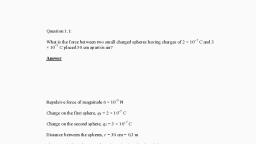
In mathematical terms, the magnitude F of the force that each of two point charges q1, and q2 a distance r apart exerts on the other can be expressed as, , 𝐹=𝑘, , |𝑞1 𝑞2 |, 𝑟2, , =, , 1, , |𝑞1 𝑞2 |, , 4𝜋𝜀0, , 𝑟2, , Eqn. 1.2.1, , where k is a proportionality constant whose numerical value depends on the system of units, used. The approximate value of k is 9.0 x 10⁹ N∙m2/C2. The constant Ɛ0 has a value of 8.854, x 10-12 C2/N∙m2. The absolute value bars are used in Eqn. 2.1 because the charges q1 and q2, can either be positive or negative, while the force magnitude F is always positive., The direction of the forces the two charges exert on each other are always along the, line joining them. When the charges have the same sign, either both positive or both negative,, the forces are repulsive; when the charges have opposite signs, the forces are attractive. The, two forces obey Newton’s third law; they are always equal in magnitude and opposite in, direction, even when the charges are not equal in magnitude., , Sample Problems:, 1. Two charges are on the x-axis. Charge q1 = +25 nC is at x = 4.00 cm while charge, q2 = -75nC is at x = 7.00 cm. Find the magnitude and direction of, a) the electric force that q1 exerts on q2; and, b) the electric force the q2 exerts on q1., Illustration:, , +q1, 0, , 4 cm, , -q2, 7 cm, , Solution:, Free-body diagram:, , ⃑⃑⃑⃑⃑⃑⃑⃑⃑⃑, 𝐹1𝑜𝑛2, , q2, , q1, , ⃑⃑⃑⃑⃑⃑⃑⃑⃑⃑, 𝐹2𝑜𝑛1, , Since the two charges have opposite signs, the force is attractive. Charge q1 will tend to pull, q2 towards its location and, simultaneously, charge q2 will tend to pull q1 towards its location., a) ⃑⃑⃑⃑⃑⃑⃑⃑⃑⃑, 𝐹1𝑜𝑛2 =, , 1, 4 0, , q1 q 2, r, , 2, , = (9.0× 10⁹ 𝑁 ∙ 𝑚2 /𝐶 2 ), , |(+25𝑥10−9 𝐶)(−75𝑥10−9 𝐶)|, (0.03𝑚)2, , b) Remember that Newton’s third law applies to the electric force so,, ⃑⃑⃑⃑⃑⃑⃑⃑⃑⃑, 𝐹2𝑜𝑛1 = 0.019 N, eastward, , 7, , = 0.019𝑁, westward
Page 16 :
What I Have Learned, , Instruction: Solve the following problems completely and neatly. Write your solution in a clean, sheet of intermediate or yellow paper., 1. Three point charges are arranged on a line. Charge q3 = +5.00 nC and is at the origin., Charge q2 = -3.00 nC and is at x = +4.00 cm. Charge q1 is at x = +2.00 cm. What is q1, (magnitude and sign) if the net force on q3 is zero?, , 2. Two point charges are placed as follows: charge q1 = -1.50 nC is at y = +6.00 m and charge, q2 = +3.20 nC is at the origin. What is the total force (magnitude and direction) exerted by, these two charges on a negative point charge q3 = -5.00 nC located at (2.00 m, -4.00 m)?, , 9
Page 17 :
Lesson, , 3, , Electric Forces and Electric Field, , What is it, When two electrically charged particles in empty space interact, how does each one, know the other is there? What goes on in the space between them to communicate the effect, of each one to the other? We can begin to answer these questions, and at the same time, reformulate Coulomb’s law in a very useful way, by using the concept of electric field., , Electric Field, Whenever you have a source charge q1 placed anywhere in space, it will be, surrounded by a region such that if you will put any other charge q2 at any field point P in this, region, charge q2 will be acted upon by an electric force, Fe. We call this region around q1 the, electric field of q1. The strength of this field is operationally defined as the ratio of the electric, force Fe to the charge q2 placed at that point in the field. The magnitude of the electric field is, , 𝐸=, , 𝐹𝑒, 𝑞2, , Eqn. 1.3.1, , The electric force is a vector quantity and so is the electric field. The direction of the electric, field is along the line connecting the field point P and the source charge q1. The field lines, produced by positive charges are directed radially outward while that of negative charges are, directed radially inward., , 10
Page 18 :
Note that Fe is actually the electric force between the interacting charges q 1 and q2., Incorporating Eqn. 1.2.1 to Eqn. 1.3.1 we will have, , 𝐸=𝑘, , 𝑞1, 𝑟2, , In general, the magnitude of the electric field is, , 𝐸=𝑘, , |𝑞|, 𝑟2, , Eqn. 1.3.2, , where q is the source charge (source of the electric field) and r is the distance between the, source charge and any field point P surrounding it., , 11
Page 19 :
Sample Problems:, 1. A positive charge of 10-8 coulombs (C) experiences a force of 0.25 N when located at a, certain point in an electric field. Find the intensity (magnitude) of the electric field at that, point., Solution:, Using Eqn. 1.3.1 we have,, 𝐸=, , 𝐹 0.25 𝑁, =, = 2.5 × 10⁷ 𝑁/𝐶, 𝑞 10−8 𝐶, , 2. A positive charge, q = +20 nC, is on the y-axis at y = +4.00 cm. (a) Determine the magnitude, and direction of the electric field at the origin. (b) What will be the magnitude and direction, of the electric field at the origin if the charge is -20 nC?, Solution:, (a), , The charge is positive so the electric field lines are directed radially outward. At the origin, the, field line extends downward so the direction of the electric field is southward., The magnitude of the electric field is given by Eqn. 1.3.2., , 𝐸=𝑘, , |𝑞|, 109 𝑁 ∙ 𝑚2 20 × 10−9 𝐶, =, (9.0, ×, )(, ) = 112,500 𝑁/𝐶, (0.04 𝑚)2, 𝑟2, 𝐶2, , (b) If the charge is -20 nC, the field lines are directed radially inward towards the charge. So,, the electric field line at the origin will be directed upward (northward). The magnitude of, the electric field has the same value as when the charge is positive., , 12
Page 21 :
What I Have Learned, , 1. A particle has charge -3.00nC., a) Find the magnitude and direction of the electric field due to this particle at a point 0.250m, directly above it., , b) At what distance from this particle does its electric field have a magnitude of 12.0 N/C?, , 2. Point charge q1 = -5.00 nC at the origin and point charge q2 = +3.00 nC is on the x-axis at x, = 3.00 cm. Point P is on the y-axis at y = 4.00 cm., , , , , , a) Calculate the electric fields E1 and E 2 at point P due to the charges q1 and q2. Express, your results in terms of unit vectors., , b) Use the results of part (a) to obtain the resultant field at P, expressed in unit vector form., , 3. A +2.00 nC point charge is at the origin, and a second -5.00 nC point charge is on the xaxis at x = 0.800 m., a) Find the electric field (magnitude and direction) at each of the following points on the xaxis: i) x = 0.200 m; ii) x = 1.20 m; iii) x = -0.200 m., , b) Find the net electric force that the two charges would exert on the electron placed at, each point in part (a)., , 14
Page 22 :
Summary, The fundamental entity in electrostatics is electric charge., Charge cannot be created or destroyed. It can only be transferred from one body to another, by friction or rubbing., There are two ways of charging an object. It can be through direct contact, which is called, conduction. Another way of charging does not need direct contact and we call it charging by, means of induction., There are two kinds of charges – positive and negative., Like charges repel while unlike charges attract., Materials that permit electric charge to move within them are called conductors while those, that do not are called insulators. Most metals are good conductors while most nonmetals are, good insulators., Coulomb’s law governs the interaction of charges. The electrostatic force between charges q1, and q2 is directly proportional to the magnitude of the product of the charges and inversely, proportional to the square of the separation distance between them. The direction of the force, is always along the line connecting the charges. If the charges are both positive or both, negative the force is repulsive; if the charges have opposite signs, the force is attractive. The, force of interaction obeys Newton’s third law of motion., , The strength of the field at a particular point is directly proportional to the magnitude of the, charge producing the field and inversely proportional to square of the distance between the, field point and the location of the charge. The closer is the field point from the source charge,, the stronger is the field strength., , 15
Page 23 :
Assessment: (Post-Test), Multiple Choice. Select the letter of the best answer from among the given choices., 1. Which of the following is TRUE about electric charge?, A) It can be lost., B) It is created from a chemical reaction., C) It can be destroyed., D) It can be transferred from atom to atom., 2. Which of the following is the most effective conductor?, A) iron, B) water, C) oil, , D) wood, , 3. Which of the following is FALSE?, A) Electric field lines never intersect., B) The electric field lines produced by a positive charge are directed radially outward., C) The electric field lines produced by a negative charge are directed radially inward., D) A static charge never produces an electric field., 4. What is the direction of the electric field at the test point on the -x-axis, 50 cm from the, charge q = +5.00 nC which is located at the origin?, A) eastward, B) westward, C) northward, D) southward, 5. An electron traveling horizontally from North to South enters a region where a uniform, electric field is directed downward. What is the direction of the electric force exerted on the, electron once it has entered the field?, A) downward, B) upward, C) to the east, D) to the west, 6. The electric field has a magnitude of 3.0 N/C at a distance of 30 cm from a point charge., What is the charge?, A) 1.4 nC, B) 30 pC, C) 36 mC, D) 12 mC, 7. What is the electric field strength at a point 50 cm from a charge q = + 5.00 nC?, A) 180 N/C, B) 360 N/C, C) 540 N/C, D) 720 N/C, , 8. A 1.65 nC charge with a mass of 1.5 x 10⁻¹⁵ kg experiences an acceleration of 6.33 x 10⁷, m/s2 in an electric field. What is the magnitude of the electric field?, A) 14.95 N/C, B) 29.35 N/C, C) 57.55 N/C, D) 2.67 x 10⁻¹⁹ N/C, 9. Three point charges are located on the x-axis. The first charge, q1 = +10 µC, is at x = -1.0, m. The second charge, q2 = +20 µC, is at the origin. The third charge, q3 = - 30 µC, is, located at x = +2.0 m. What is the net force on q2?, A) 6.3 N to the negative x-direction, B) 1.50 N to the negative x- direction, C) 3.15 N to the positive x- direction, D) 4.80 N to the positive x- direction, 10. What is the magnitude of the net electric field at (+1.0 m, 0) due to the three charges in, number 9?, A) 198, 256 N/C B) 297, 348 N/C, C) 472,500 N/C, D) 655, 490 N/C, , 16
Page 25 :
References:, , Canva. Accessed December 24, 2020. https://www.canva.com/education, Practical and Explorational Physics by Alicia L. Padua and Ricardo M. Crisostomo, pp. 245-256, Sears and Zemansky’s University Physics with Modern Physics Technology Update by Hugh, D. Young and Roger A. Freedman, 13th edition, pp. 709-734, The Basics of Physics by Arsenia V. Ferrer and Julieta dela Peña, pp. 288-298, , 18
Page 26 :
For inquiries and feedback, please write or call:, Department of Education – Bureau of Learning Resources (DepEd-BLR), DepEd Division of Cagayan de Oro City, Fr. William F. Masterson Ave Upper Balulang Cagayan de Oro, Telefax:, ((08822)855-0048, E-mail Address:,
[email protected], , FAIR USE AND CONTENT DISCLAIMER: This SLM (Self Learning Module) is, for educational purposes only. Borrowed materials (i.e. songs, stories, poems,, pictures, photos, brand names, trademarks, etc.) included in these modules are, owned by their respective copyright holders. The publisher and authors do not, represent nor claim ownership over them., 19



 Learn better on this topic