Page 1 :
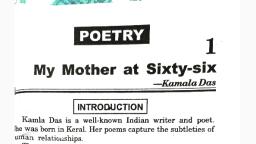
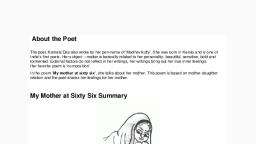
oe OE aT AIS biti ni te, , 1, , My Mother at Sixty-six, —Kamala Das, ———— ee, , INTRODUCTION, , Kamla Das is a well-known Indian writer and poet., the was born in Keral. Her poems capture the subtleties of, uman relatiouships., , The poet was driving to Cochin with her mother. Her, tother was old and looked weak and sickly. Kamla Das, as pained. She thought that her mother might not live, ng. ;, , She wanted to forget all about this. But at the airport, 1e realised her duty to her mother. She wished to give her, , ype and moral support. She smiled and assured her mother, iat she would see her again soon., , SUMMARY, , Kamla Das was driving to Cochin from her parent’s, use. Her sixty-six year old mother was with her. She, tked at her mother. She was dozing. Her mouth was, en. Her face was pale and colourless like that of a corpse., tis pained her. She thought her end was not far, vay. But she did not wish to think about it. So she looked, side., , By contrast, the scens uti (, eerful. Young trees too seemed, minting away.
Page 5 :
Le, er, , FLAMINGO (ENGLISH : CORE) — XI 229, , Q. 2. Why are the young trees described, as, ‘sprinting’ ?, wre tet at atest ge aat aera?, _ Ans. The poet was travelling by car. The young trees, along the road appeared to be sprinting past them., Q. 3. Why has the poet brought in the image of the, merry children ‘spilling out of their homes’?, mated | wetted meet a ur & frac ar fr at, weqa fara? ‘, Ans. The poet did not want to think of her sickly mother., , She looked out. The happy carefree children presented a, contrast. It was a good diversion., , Q. 4. Why has the mother been compared to the late, winter’s moon’?, , at at geet vit aq @ ure @ at at wy?, , Ans. In winter, in the misty sky the moon looks dim,, van and sickly. The mother also looked like that., , Winter is a symbol of old age also. The mother is old, ind weak. The comparison is apt., , Q. 5. What do the parting words of the poet and her, mile signify?, , waket # fag & we sit Gear a aa wer 87, , Ans. The poet feels sad to think that her mother might, have her for ever. Now she does not keep this thought, way. She realises her duty to mother. She gives her mother, ‘moral support to her mother. She does not want her, , tother lonely and unwanted., , ye