Notes of 12, Chemistry revision capsule - Study Material
Page 1 :
Quick Reference, FORMULA BOOK, CHEMISTRY, HashLearn, On-Demand, DOWNLOAD ON, now, Google play, Tutoring
Page 2 :
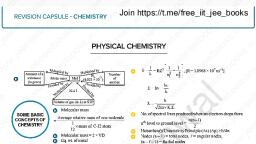
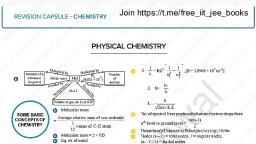
www.JEEBOOKS.IN, REVISION CAPSULE - CHEMISTRY, PHYSICAL CHEMISTRY, 1, [R=1.0968 x 10⁷ m-1, 1, Multiplied by, Multiplied by, = RZ?, .2, Amount of a, substance, Number, of, entities, ni, Molar mass, Mol, (6.023 x 10, (in gram), Multiplied by, Volume of gas (in L) at STP, Divided by, Divided by, Divided by, he, E = hv =, 22.4 L, V2mxK.E., Molecular mass, No. of spectral lines produced when an electron drops from, SOME BASIC, CONCEPTS OF, CHEMISTRY, Average relative mass of one molecule, n(n-1), nh level to ground level =, 1, x mass of C-12 atom, 12, Heisenberg's Uncertainty Principle (Ax) (Ap) 2 h/4n, Nodes (n – 1) = total nodes, l= angular nodes,, (n - l- 1)= Radial nodes, Molecular mass = 2 x VD, Eq. wt. ofmetal, wt. of metal, h, Orbital angular momentum : Je (l+1)-, Vece+1)h, x1.008, wt. of H2 displaced, (i), % ionic character, wt. of metal, Eq. wt. of metal =, Actual dipole moment, wt. of oxygen combined, CHEMICAL, BONDING, x100, Calculated dipole moment, wt. of metal, x35.5, (ii) Dipole moment is helpful in, predicting geometry and polarity, of molecule., wt. of chlorine combined, Molecular formula=(Empirical formula),, Energy of electron in species with one, Fajan's Rule : Following factors are helpful in increasing, covalent character in ionic compounds, (i) Small cation, (iii) High charge on cation/anion, (iv) Cation having pseudo inert gas configuration (ns?p°d!0), e.g. Cu*, Ag*, Zn+2, Cd+2, M.O. theory:, Bond order = ½(N-N, (ii) Higher the bond order, higher is the bond dissociation, energy, greater is the stability, shorter is the bond length., Formal charge (F.C.) on an atom in a Lewis structure, = [total number of valence electrons in the free atoms], - [total number of non-binding (lone pair) electrons], electron., -2n?me*z?, E-, n?h?, (ii) Big anion, АТОМІС, STRUCTURE, For energy in SI system,, -2n²me*z?, E,= n'h?(4t€o), -1312z?, (i), E, =, -kJ mol, n2, nh, mvr =, 2n, n'h?, 4n mZe?, 2, n', Å, r=, = 0.529, 1, - [total number of bonding (shared) electrons], Total energy of electron in the nth shell, Relative bond strength : sp'd2 >dsp2 >sp >sp? >sp >p-p, (Co-axial) >s-p>s-s>p-p(Co-lateral), kZe?, e?, =K.E. + P.E. = kZ-, 2,, kZe?, In, HashLearn, Download on, now, On-Demand Tutoring, Google play, 2.
Page 3 :
REVISION CAPSULE - CHEMISTRY, www.JEEBOOKS.IN, VSEPR theory, (i) (LP-LP) repulsion>(LP-BP)>(BP-BP), (ii) NH →Bond Angle 106° 45' because (LP-BP) repulsion, > (BP-BP) H,0 → 104° 27'because (LP-LP) repulsion >, (LP-LB)> (BP-ВP), Hybridisation :, Buffer solution {Henderson equation} :, (1) Acidic, pH =pK, + log {Salt/Acid}., For maximum buffer action pH=pK,, Range of buffer pH=pK, +1, (ii) Alkaline → pOH=pK,+log {Salt/Base} for max. buffer, action pH 3D 14 -рК,, Range pH = 14-pK, ±1, number of valence electrons of central atom, 1, + number of monovalent atoms attached to it, Moles / lit of Acid or Base Mixed, (iii) Buffer Capacity =, Change in pH, + negative charge if any - positive charge if any,, Relation between ionisation constant (K,) and degree of, ionisation(a):-, Kp=K.(RT), ang where An,-lp-"R, a, K; =, (1-a)V, a?c, (Ostwald's dilution law), Free Energy Change (AG), (a) If AG =0 then reversible reaction, would be in equilibrium, K. =0, (b) If AG=(+) ve then equilibrium will, be displaced in backward, direction; K. <1, (1-a), CHEMICAL, It is applicable to weak electrolytes for which a <<1 then, EQUILIBRIUM, a= /K; V, or V↑Cat, C, Common ion effect: By addition of X mole/L of a common, ion, to a weak acid (or weak base) a becomes equal to, (c) If AG = (-) ve then equilibrium will shift in forward, direction; K>1, (a) K. unit → (moles/lit)An, (b) K unit > (atm)An, Reaction Quotient and Equilibrium Constant, Consider the following reversible reaction, A+B C+D, Ka, or, X, X, [where a = degree of dissociation], (i) If solubility product > ionic product then the solution is, unsaturated and more of the substance can be dissolved in it., (ii) If ionic product > solubility product the solution is super, saturated (principle of precipitation)., Salt of weak acid and strong base :, [C][D], [A][B], Kp, Kw, pH= 0.5 (pK,+ pK, + log c); h=, :K=, Ka, (h = degree of hydrolysis), Case I: If Q. <K, then : [Reactants]> [Products], then the system is not at equilibrium, Case II : If Q. =K, then : The system is at equilibrium., Case III : If Q.>K, then : [Products] > [Reactants], The system is not at equilibrium., A relationship between the equilibrium constant K, reaction, quotient and Gibb's energy., AG=AG°+RT In Q, At equilibrium AG=0 and Q=K then, AG° = -RT In K., :. AG° =-RT In K., Le-Chatelier's prinċiple, Increase of reactant conc. (Shift reaction forward), Salt of weak base and strong acid :, pH= 0.5 (pK- pK,- log c); h=, K, xc, Salt of weak acid and weak base :, KW, pH = 0.5 (pK, + pK,- pK, ); h =, VK, x K,, Unit of rate constant:, k = moll-n lit"-1 sec-1, Order of reaction It can be fraction,, zero or any whole number., O Molecularity of reaction is always a, whole number. It is never more than three., It cannot be zero., CHEMICAL, (i), (ii) Decrease of reactant conc. (Shift reaction backward), (iii) Increase of pressure (from more moles to less moles), (iv) Decrease of pressure (from less moles to more moles), (v) For exothermic reaction decrease in temp. (Shift, forward), (vi) For endothermic increase in temp. (Shift backward), KINETICS, First Order Reactions :, 2.303, k =, a, 0.693, log10 (a -x), & t/12, k, (i) Lewis Acid (e pair acceptor) →, CO2, BF3, AICI3, ZNCI,, normal, cation, (ii) Lewis Base (e pair donor) →, NH,, ROH, ROR, H,O, RNH,,, normal anions, [A], = [A],e-kt, Second Order Reactions :, When concentration of A and B taking same., IONIC, EQUILIBIRIUM, X, k, =, a(а - х), Dissociation of Weak Acid and Weak, When concentration of A and B are taking different -, Base, (1), Weak Acid, K, = Cx2/(1-x) or K, =Cx2; x<<1, 2.303, b(a -x), (ii) Weak Base, K= Cx2/(1- x) or K = Cx2; x<<1, log, t(a - b), a(b-x), HashLearn, Download on, now, On-Demand Tutoring, Google play, 3
Page 4 :
REVISION CAPSULE - CHEMISTRY, www.JEEBOOKS.IN, Entropy(s) : Measure of disorder or randomness, AS= ES,-ESR, a, Zero Order Reaction : x= kt and, 2k, The rate of reaction is independent of the concentration of, the reacting substance., Time of nth fraction of first order process,, Arev, = 2.303 nR log, T, V2, = 2.303 n R log, Vị, AS =, P2, Free energy change : AG= AH-TAS, AG°=-nFE°ll, -AG= W(maximum) – PAV, AGvstem, 1, =-TAStotal, 2-303, log, k, 1, ΔΗ ΔS, AG, Reaction characteristics, Always negative Reaction is spontaneous at, all temperature., Always positive Reaction is nonspontaneous, at all temperature, Spontaneous at low temp. &, non spontaneous at high, temperature, [A],, Amount of substance left after 'n' half lives =, 2", -Ea, Arrhenius equation : k = Ae Fa/RI, slope, Negative at low, temperature but, positive at high, temperature, Positive at low, 2.303R, and Temperature Coefficient, k2, log, T-T, Ea, k1, It has been found that for a chemical reaction with rise in, temperature by 10 °C, the rate constant gets nearly doubled., 2.303, TT2, Non spontaneous at low, temp. & spontaneous at high, temp. but, negative at high temp., temperature, k = PZ ABe, -Ea/RT, O Oxidant itselfis reduced (gives O2), Or Oxidant e (s) Acceptor, Reductant itself is oxidised (gives H,), Or reductant >e (s) Donor, O (i) Strength of acid c O.N, (ii) Strength of base oc 1/O.N, O (i) Electrochemical Series:- Li, K, Ba,, Sr, Ca, Na, Mg, AI, Mn, Zn, Cr, Fe, Cd, Co,, Ni, Sn, Pb, H,, Cu, Ag, Pt, Au., m=Z.I.t, OXIDATION -, Degree of dissociation : a=, Neg, ELECTRO-, REDUCTION, CHEMISTRY, Specific conductance, 1, K=-, = Gx ==Gx cell constant (G*);, R.a, a, Kx1000, Kx1000, (ii) As we move from top to bottom in this series, (a) Standard Reduction Potential ↑, (b) Standard Oxidation Potential, (c) Reducing Capacity, (d) IP ↑, %3D, m, M, eq, N, Kohlrausch's law: A x+yhB, Nernst Equation, [Products], log10, 0.0591, (e) Reactivity, E= E°-, [Reactants], First Law of Thermodynamics :, AE=Q+W, Expression for pressure volume work, W=-PAV, nE°, & E°,, Cell, right+ E'left & K., & AG° =-NFE° cell=-2.303 RT logK., = E°, = antilog, THERMO-, 0.0591, DYNAMICS, Maximum work in a reversible expansion :, AG=-nFE,, cell, aAG, V2, W=-2.303n RT log, & W., =+NFE° & AG= AH+ T, max, Vị, Calculation of pH of an electrolyte by using a calomel, P, =-2.303 nRT log P., Ecell -0.2415, electrode : pH, 0.0591, W., 2 W:, irr, rev, Thermodynamic efficiency of fuel cells :, qy =cAT = AU, q, = c,AT = AH, Enthapy changes during phase transformation, (i), -AG -nFE, n=, AH, AH, Enthalpy of Fusion, (ii), For H,-O, fuel cells it is 95%., Heat of Vapourisation, (iii) Heat of Sublimation, Enthalpy : ΔΗ-ΔΕ+ PAV-ΔΕ + Δn,RI, Kirchoff's equation:, AET, = AET, +ACy (T2-T) [constant V], P=KH. X, number of equivalents, Normality (N), volume of the solution in litres, number of moles, AHT, = AHT, +ACp (T,-T) [constant P], Molarity (M) =, volume of the solution in litres, HashLearn, Download on, now, On-Demand Tutoring, Google play, 4
Page 5 :
REVISION CAPSULE - CHEMISTRY, www.JEEBOOKS.IN, O Raoult's law, Z (compressibility factor) =, PV, :Z=1 for ideal gas, Characteristics of an ideal solution:, nRT, SOLUTION AND, (i) AsolV=0, Relative lowering of vapour pressure, (ii) AH=0, 8a, , Pc =, a, a, 27b2 Vc = 3b, T,, Available space filled up by hard, spheres (packing fraction):, COLLIGATIVE, TC, 27RB, %3D, bR, PROPERTIES, P – PA, po, - P, SOLID AND, Simple cubic=, =0.52, 6., Po, n+ nB, LIQUID STATE, Colligative c Number of particles/ ions/ moles of solute, properties, Depression of freezing point, AT,= Kạm, Elevation in boiling point with relative lowering of vapour, bcc =, = 0.68 fcc =, 8, =0.74, 6., pressure, hcp=, = 0.74, 6., 1000K p° -p, AT, (M, =mol. wt. of solvent), M1, p°, diamond=, = 0.34, 6., Osmotic pressure (P) with depression in freezing point AT,, Radius ratio and co-ordination number (CN), dRT, P = AT; x, Limiting radius ratio, CN, Geometry, 1000KF, [0.155-0.225], [0.255-0.414], [0.414-0.732], [0.732–1], [Plane triangle], [Tetrahedral], [Octahedral], [bcc], 3, Relation between Osmotic pressure and other colligative, properties:, 6., 8, PA-PA, IT =, dRT, (i), Relative lowering of vapour pressure, Atomic radius r and the edge of the unit cell:, Pure elements :, PÅ, MB, dRT, (ii) T = AT x, 1000K, Elevation in boiling point, 3a, Vza, ; fcc =, 4, a, Simple cubic=r=, ; bcc r=, 4, dRT, (iii) n= ATf x, Depression in freezing point, Relationship between radius of void (r) and the radius, of the sphere (R):r (tetrahedral) = 0.225 R;r (octahedral), 1000KF, Observed colligative property, Normal colligative property, Normal molar mass, =0.414 R, i =, Observed molar mass, Paramagnetic : Presence ofunpaired electrons [attracted by, magnetic field], Ferromagnetic : Permanent magnetism [↑↑↑1], Antiferromagnetic: Net magnetic moment is zero [↑V↑], n, Degree of association a = (1-i), n-1, i-1, & degree of dissociation (a) =, n -1, Ideal gas equation : PV=nRT, (i) R=0.0821 liter atm. deg- mole, Ferrimagnetic : Net magnetic, moment is three [↑v↑↑], Emulsion : Colloidal soln. of two, SURFACE, CHEMISTRY &, COLLOIDAL, (ii) R = 2 cals. deg.mole, -1, immiscible liquids [O/W emulsion,, W/O emulsion], Emulsifier : Long chain, hydrocarbons are added to, stabilize emulsion., GASEOUS, (iii) R=8.314 JK-1 mole, Velocities related to gaseous state, STATE, STATE, 3PV, 3RT, 3P, RMS velocity=, M, M, d., Lyophilic colloid : Starchy gum, gelatin have greater affinity, for solvent., 2RT, Average speed =, 8RT, & Most probable speed =, M, Average speed = 0.9213 x RMS speed, RMS speed = 1.085 x Average speed, MPS =.816 x RMS; RMS = 1.224 MPS, MPS :A.V. speed: RMS =1:1.128 :1.224, Lyophobic colloid : No affinity for solvent, special methods, are used to prepare sol. [e.g. As, S,, Fe(OH), sol], Preparation of colloidal solution :, (i) Dispersion methods (ii) Condensation method., 1, Rate of diffusion oc, Coagulating power c, density of gas, Flecculating value, van der Waal's equation, Properties of colloidal solution :, (i) Tyndall effect (ii) Brownian movement, (iii) Coagulation (iv) Filtrability., n'a, P+, (V– nb) = nRT for n moles, v2, HashLearn, Download on, now, On-Demand Tutoring, Google play



 Learn better on this topic