Notes of 12, Chemistry amines - Study Material
Page 1 :
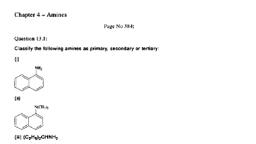
Class- XII-CBSE-Chemistry, , Amines, , CBSE NCERT Solutions for Class 12 Chemistry Chapter 13, Back of Chapter Questions, , 13.1., , Classify the following amines as primary, secondary or tertiary:, , (i), , (ii), (iii), , (C2 H5 )2 CHNH2, , (iv), , (C2 H5 )2 NH, , Solution:, Primary: (i) and (iii), −N atom is attached with one carbon or one alkyl group., Secondary: (iv), −N atom is attached with two carbons or two alkyl groups., Tertiary: (ii), −N group attached with three carbons or three alkyl group., 13.2., , (i), , Write structures of different isomeric amines corresponding to the, molecular formula, C4 H11 N., , (ii), , Write IUPAC names of all the isomers., , (iii), , What type of isomerism is exhibited by different pairs of amines?, , Solution:, (i), (ii): The structures and their IUPAC names of different isomeric amines, corresponding to the molecular formula, C4 H11 N is given below:, 4, , (a), , 3, , 2, , 1, , CH3 − CH2 − CH2 − CH2 − NH2, Parent carbon chain = 5 membered (pent), , Practice more on Amines, , Page - 1, , www.embibe.com
Page 3 :
Class- XII-CBSE-Chemistry, , Amines, , IUPAC Name: 2-Methylpropan-2-amine, (e), , CH3 − CH2 − CH2 − NH − CH3, IUPAC Name: N-Methylpropanamine (2o amine), 3, , (f), , 2, , 1, , CH3 − CH2 − CH2 − NH − CH3, IUPAC Name: N-Ethylethanamine (2o amine), , (g), , IUPAC Name: N-methylpropan -2-amine (2o amine), (h), , IUPAC Name: N, N-Dimenthylethanamine (3o amine), (iii), , The pairs (a) and (b), (e) and (g) exhibit position isomerism because only, the position of functional group (−NH2 ) is changed., The pairs (a) and (c), (a) and (d), (b) and (c), (b) and (d) exhibit chain, isomerism because the parent carbon chains are different., The pairs (e) and (f), (f) and (g) exhibit metamerism., All primary amines exhibit functional isomerism with secondary and, tertiary amines and vice-versa., , 13.3., , How will you convert, (i), , Benzene into aniline, , (ii), , Benzene into N, N −dimethylaniline, , (iii), , Cl– (CH2 )4–Cl into hexan−1, 6 −diamine, , Solution:, (i), , Practice more on Amines, , Page - 3, , www.embibe.com
Page 9 :
Class- XII-CBSE-Chemistry, , Amines, , R − NH2 (Primary amine) + HNO2 → R − OH + H2 O, Nitrous acid (HNO2 ) is a mono basic weak acid which is used to, distinguish primary, secondary and tertiary amine., , When secondary amines react with HNO2 , no gas is produced, we get a, yellow oil (nitrosamine)., , Concept Insight: Primary aliphatic amines react with nitrous acid to form, diazonium salt which being unstable liberate nitrogen gas., 13.9., , Convert, (i), , 3 −Methylaniline into 3 −nitrotoluene., , (ii), , Aniline into 1,3,5 − tribromobenzene., , Solution:, (i), , Practice more on Amines, , Page - 9, , www.embibe.com
Page 13 :
Class- XII-CBSE-Chemistry, , Amines, , At pH 9-10 in the presence of base phenol and diazonium salt, coupling, reaction takes place and forms an azo dye., Aliphatic amines give a brisk effervescence under similar conditions due, to the evolution of N2 gas., 0-5 °C, , CH3 CH2 − NH2 + HONO → C2 H5 OH + N2 ↑ +H2 O, (iv), , Nitrous acid can be used to distinguish aniline and benzylamine. Nitrous, acid is prepared in situ from a mineral acid and sodium nitrate. Benzylamine, on reaction with nitrous acid forms an unstable diazonium salt. The unstable, diazonium salt gives alcohol with the evolution of nitrogen gas., , On the other hand, aniline reacts with nitrous acid at a low temperature to, form a stable diazonium salt. Nitrogen gas is not evolved in this case., , (v), , Carbylamine test is used to distinguish between aniline and, N −methylaniline. Primary amines, when heated with chloroform and, ethanolic potassium hydroxide, form foul-smelling isocyanides or, carbylamines. Aniline gives positive Carbylamine test because it is a, primary aromatic amine. However, N −methylaniline (secondary amine), does not., , Practice more on Amines, , Page - 13, , www.embibe.com
Page 14 :
Class- XII-CBSE-Chemistry, , Amines, , 13.12. Account for the following:, (i), , pK b of aniline is more than that of methylamine., , (ii), , Ethylamine is soluble in water whereas aniline is not., , (iii), , Methylamine in water reacts with ferric chloride to precipitate hydrated, ferric oxide., , (iv), , Although amino group is o, and p– directing in aromatic electrophilic, substitution reactions, aniline on nitration gives a substantial amount of, m −nitroaniline., , (v), , Aniline does not undergo Friedel-Crafts reaction., , (vi), , Diazonium salts of aromatic amines are more stable than those of aliphatic, amines., , (vii), , Gabriel phthalimide synthesis is preferred for synthesising primary amines., , Solution:, (i), , pK b = −logk b, If the basic character is more then k b value is high and pK b value is less., , Aniline undergoes resonance. So, the electrons on the nitrogen atom are, delocalised over the benzene ring. Therefore, the electrons on the nitrogen, atom are less available to donate. So, the basic character is less., , Practice more on Amines, , Page - 14, , www.embibe.com
Page 15 :
Class- XII-CBSE-Chemistry, , Amines, , In methylamine, due to the +I effect of the methyl group (electron-donating, group), the electron density on the N −atom increases and lone pair of, nitrogen is not involved in delocalisation. Thus, the basic character, increases., , K b value, , pK b value, , (ii), , Ethylamine, on addition with water, forms intermolecular H −bonds with, water. Hence, it is soluble in water., , But aniline does not form H −bonds with water to a very large extent due, to the presence of a large hydrophobic −C6 H5 group. Hence, aniline is, insoluble in water., , (iii), , Practice more on Amines, , Page - 15, , www.embibe.com
Page 16 :
Class- XII-CBSE-Chemistry, , Amines, , Amines are more basic than water because the lone pair donor atom in, amine is nitrogen and in water is oxygen. And nitrogen is less, electronegative atom than oxygen.N can easily donate lone pair and +I, effect of −CH3 group, methylamine is more basic than water. Therefore, in, water, methylamine produces OH − ions by accepting H + ions from water., +, , CH3 − NH2 + H − OH → CH3 − NH3 + OH−, (Base), , (Acid), , (Salt), , Ferric chloride (FeCl3 ) dissociates in water to form Fe3+ and Cl− ions., FeCl3 ⟶ Fe3+ + 3Cl−, Then, OH − ion reacts with Fe3+ ion and forms a precipitate of hydrated, ferric oxide., 2Fe3+ + 6OH − ⟶, , Fe2 O3 . 3H2 O, Hydrated ferric oxide (ppt), , (iv), , Nitration is carried out in an acidic medium. In an acidic medium, the, aniline is protonated to give anilinium ion. +NH3 group shows −I effect, (electron-withdrawing group). So, it is meta directing., , (v), , Aniline does not undergo Friedel-crafts reaction:, Friedel-Crafts reaction takes place in the presence of AlCl3 . But AlCl3 is a, lewis acid due to vacant orbital availability while aniline is a strong base., So, an acid-base reaction will take place. Thus, aniline reacts with AlCl3 to, form a salt., , Due to the positive charge on the nitrogen atom (shows −I effect and it is, meta directing), electrophilic substitution in the benzene ring is deactivated., Hence, the Friedel-Crafts reaction will not take place in aniline., (vi), , The aromatic diazonium ion undergoes resonance., , Practice more on Amines, , Page - 16, , www.embibe.com
Page 20 :
Class- XII-CBSE-Chemistry, , Amines, , Again, in C6 H5 NHCH3 , −C6 H5 group is directly attached to the, nitrogen atom. However, it is not so in C6 H5 CH2 NH2 . The lone pair, of nitrogen is not involved in delocalisation. Thus, in C6 H5 NHCH3 ,, the −R effect of −C6 H5 group decreases the electron density over, the nitrogen atom. Therefore, C6 H5 CH2 NH2 is more basic than, C6 H5 NHCH3 ., Hence, the increasing order of the basic strength of the given, compounds is as follows:, , (iv), , The basic strength mainly depends upon the electron-donating group (+I, effect) because there is no solvation effect in the gas phase. More is the +I, effect, stronger is the base. Also, the more the number of alkyl groups, the, higher is the +I effect. Therefore, the given compounds can be arranged in, the decreasing order of their basic strengths in the gas phase as follows:, (C2 H5 )3 N > (C2 H5 )2 NH > C2 H5 NH2 > NH3, , (v), , The boiling points of compounds depend on the hydrogen bonding present, in the compound. The more extensive the H −bonding in the compound, the, higher is the boiling point. (CH3 )2 NH contains only one H −atom whereas, C2 H5 NH2 contains two H −bonding than (CH3 )2 NH. Hence, the boiling, point of C2 H5 NH2 is higher than that of (CH3 )2 NH., Boiling point ∝ force of attraction ∝ H- bond, Force of attraction between C2 H5 OH is also H-bond. C2 H5 OH forms, stronger H −bonds than C2 H5 NH2 and (CH3 )2 NH., , Practice more on Amines, , Page - 20, , www.embibe.com
Page 23 :
Class- XII-CBSE-Chemistry, , Amines, , (iv), , (v), , (vi), , Practice more on Amines, , Page - 23, , www.embibe.com
Page 24 :
Class- XII-CBSE-Chemistry, , Amines, , (vii), , (viii), , 13.15. Describe a method for the identification of primary, secondary and tertiary amines., Also, write chemical equations of the reactions involved., Solution:, Hinsberg’s test is used to identify and distinguish primary, secondary and tertiary, amines. In the Hinsberg’s test, the amines are allowed to react with Hinsberg’s, reagent, benzenesulphonyl chloride (C6 H5 SO2 Cl). Different types of amines react, differently with the Hinsberg’s reagent., Primary amines react with benzenesulphonyl chloride to form, N −alkylbenzenesulphonyl amide which is soluble in alkali., , Due to the presence of a strong electron-withdrawing sulphonyl group in the, sulphonamide, the H −atom attached to nitrogen can be easily released as a proton., Therefore, it is acidic and dissolves in an alkali., Secondary amines react with Hinsberg’s reagent to give a sulphonamide which is, insoluble in alkali., Practice more on Amines, , Page - 24, , www.embibe.com
Page 25 :
Class- XII-CBSE-Chemistry, , Amines, , There is no H −atom attached to the N −atom in the sulphonamide. Therefore, it is, not acidic and is insoluble in an alkali., Tertiary amines do not react with Hinsberg’s reagent at all., 13.16. Write short notes on the following:, (i), , Carbylamine reaction, , (ii), , Diazotisation, , (iii), , Hofmann’s bromamide reaction, , (iv), , Coupling reaction, , (v), , Ammonolysis, , (vi), , Acetylation, , (vii), , Gabriel phthalimide synthesis., , Solution:, (i), , Carbylamine reaction, Carbylamine reaction is used as a test for the identification of primary, amines. When aliphatic and aromatic primary amines are heated with, chloroform (CHCl3 ) and ethanolic potassium hydroxide (KOH),, carbylamines (or isocyanides) are formed. These carbylamines have very, unpleasant odours. Secondary and tertiary amines do not respond to this, test., General reaction:, , Where R = Alkyl group, −R Should not be −CH3 because CH3 − NC (Methyl isocyanide) is formed,, which is a poisonous gas., For example,, , Practice more on Amines, , Page - 25, , www.embibe.com
Page 27 :
Class- XII-CBSE-Chemistry, , Amines, , For example,, , (iv), , Coupling reaction:, The reaction in which two aromatic rings are joined through the −𝑁 =, 𝑁 −bond is known as coupling reaction. Arenediazonium salts such as, benzene diazonium salts react with phenol or aromatic amines to form, coloured azo compounds., , 𝐷𝑖𝑙 𝑁𝑎𝑂𝐻 at 𝑝𝐻 = 8.5 to 9.5 reacts with −𝐻 of phenol group. Due to this, phenoxide ion is formed. It activates the ring. When the phenoxide ion, reacts with a diazonium salt, it results in the formation of azo dye. This, reaction is called coupling reaction., , Practice more on Amines, , Page - 27, , www.embibe.com
Page 28 :
Class- XII-CBSE-Chemistry, , Amines, , It is observed that the para-positions of phenol and aniline are coupled, with the diazonium salt. This reaction proceeds through electrophilic, substitution., (v), , Ammonolysis, When an alkyl or benzyl halide is reacted with an ethanolic solution of, ammonia, it undergoes nucleophilic substitution reaction in which the, halogen atom is replaced by an amino group (−NH2 ). This process of, cleavage of the carbon-halogen bond is known as ammonolysis., , This substituted ammonium salt when treated with a strong base such as, sodium hydroxide, amine is obtained., , Though primary amine an as the major product, this process produces a, mixture of primary, secondary and tertiary amines, and also a quaternary, ammonium salt as shown., , (vi), , Acetylation, Acetylation (or ethanoylation) is the process of introducing an acetyl, group into a molecule., , Practice more on Amines, , Page - 28, , www.embibe.com
Page 29 :
Class- XII-CBSE-Chemistry, , Amines, , Aliphatic and aromatic primary and secondary amines undergo acetylation, reaction by nucleophilic substitution when treated with acid chlorides,, anhydrides or esters. This reaction involves the replacement of the hydrogen, atom of −NH2 or > NH group by the acetyl group, which in turn leads to, the production of amides. To shift the equilibrium to the right-hand side, the, HCl formed during the reaction is removed as soon as it is formed. This, reaction is carried out in the presence of a base (such as pyridine) which is, stronger than the amine., , When amines react with benzoyl chloride, the reaction is also known as, benzoylation. And this is followed by an electrophile substitution reaction, For example,, , (vii), , Gabriel phthalimide synthesis, Gabriel phthalimide synthesis is a very useful method for the preparation, of aliphatic primary amines. It involves the treatment of phthalimide with, , Practice more on Amines, , Page - 29, , www.embibe.com
Page 30 :
Class- XII-CBSE-Chemistry, , Amines, , ethanolic potassium hydroxide to form potassium salt of phthalimide. This, salt is further heated with an alkyl halide, followed by alkaline hydrolysis, to yield the corresponding primary amine., , 13.17. Accomplish the following conversions:, (i), , Nitrobenzene to benzoic acid, , (ii), , Benzene to m-bromophenol, , (iii), , Benzoic acid to aniline, , (iv), , Aniline to 2,4,6 −tribromofluorobenzene, , (v), , Benzyl chloride to 2 −phenylethanamine, , (vi), , Chlorobenzene to 𝑝 −chloroaniline, , (vii), , Aniline to p-bromoaniline, , (viii) Benzamide to toluene, (ix), , Aniline to benzyl alcohol., , Solution:, (i), , Nitrobenzene to benzoic acid:, , Practice more on Amines, , Page - 30, , www.embibe.com
Page 31 :
Class- XII-CBSE-Chemistry, , Amines, , (ii), , (iii), , Practice more on Amines, , Page - 31, , www.embibe.com
Page 32 :
Class- XII-CBSE-Chemistry, , Amines, , (iv), , (v), , Practice more on Amines, , Page - 32, , www.embibe.com
Page 33 :
Class- XII-CBSE-Chemistry, , Amines, , (vi), , (vii), , Practice more on Amines, , Page - 33, , www.embibe.com
Page 34 :
Class- XII-CBSE-Chemistry, , Amines, , (viii), , (ix), , 13.18. Give the structures of A, B and C in the following reactions:, (i), (ii), (iii), (iv), (v), Practice more on Amines, , Page - 34, , www.embibe.com
Page 35 :
Class- XII-CBSE-Chemistry, , Amines, , (vi), Solution:, (i), , (ii), , (iii), , Practice more on Amines, , Page - 35, , www.embibe.com
Page 36 :
Class- XII-CBSE-Chemistry, , Amines, , (iv), , (v), , (vi), , Practice more on Amines, , Page - 36, , www.embibe.com
Page 37 :
Class- XII-CBSE-Chemistry, , Amines, , 13.19. An aromatic compound ‘A’ on treatment with aqueous ammonia and heating forms, compound ‘B’ which on heating with Br2 and KOH forms a compound ‘C’ of, molecular formula C6 H7 N. Write the structures and IUPAC names of compounds, A, B and C., Solution:, It is given in the question the compound ‘C’ having the molecular formula, C6 H7 N, is formed by heating compound ‘B’ with Br2 and KOH. Reaction with Br2 or KOH, is a Hoffman bromamide degradation reaction and is given by an amide. The, formed product is an amine (one carbon down amide). Therefore, compound ‘B’ is, an amide and compound ‘C’ is an amine. The only amine having the molecular, formula, C6 H7 N is aniline, (C6 H5 NH2 )., Therefore, compound ‘B’ must be benzamide, (C6 H5 CONH2 ), Further, benzamide is formed by heating compound ‘A’ with aqueous ammonia., Therefore, compound ‘A’ must be benzoic acid., The given reaction occurs in the following sequence:, , 13.20. Complete the following reactions:, (i), , C6 H5 NH2 + CHCl3 + alc. KOH ⟶, , (ii), , C6 H5 N2 Cl + H3 PO2 + H2 O ⟶, , Practice more on Amines, , Page - 37, , www.embibe.com
Page 39 :
Class- XII-CBSE-Chemistry, , Amines, , (vi), , (vii), , 13.21. Why cannot aromatic primary amines be prepared by Gabriel phthalimide, synthesis?, Solution:, Gabriel phthalimide synthesis is used for the preparation of aliphatic primary, amines. It involves nucleophilic substitution (SN 2) of alkyl halides by the, phthalimide., , But aryl halides do not undergo nucleophilic substitution with the anion formed, by the phthalimide because positive charge on the benzene ring is highly unstable, due to the double bond character., , Hence, primary aromatic amines cannot be prepared by this process., Practice more on Amines, , Page - 39, , www.embibe.com
Page 40 :
Class- XII-CBSE-Chemistry, , Amines, , 13.22. Write the reactions of, (i), , aromatic amines with nitrous acid, , (ii), , aliphatic primary amines with nitrous acid., , Solution:, (i), , Aromatic amines react with nitrous acid (prepared in situ from NaNO2 and, a mineral acid such as HCl) at 273 − 278 K to form stable aromatic, diazonium salts due to the double bond character., , (ii), , Aliphatic primary amines react with nitrous acid (prepared in situ from, NaNO2 and a mineral acid such as HCl) to form unstable aliphatic, diazonium salts, which further produce alcohol and HCl with the evolution, of N2 gas., , 13.23. Give plausible explanation for each of the following:, (i), , Why are amines less acidic than alcohols of comparable molecular, masses?, , (ii), , Why do primary amines have higher boiling point than tertiary amines?, , (iii), , Why are aliphatic amines stronger bases than aromatic amines?, , Solution:, (i), , Amines undergo protonation to give amide ion., , Practice more on Amines, , Page - 40, , www.embibe.com
Page 41 :
Class- XII-CBSE-Chemistry, , Amines, , R − NH2 →, (Acid), , R + NH-2, , Amide ion, (Conjugate base), , + H+, , Similarly, alcohol loses a proton to give alkoxide ion., R − OH →, Alcohol, (Acid), , R − O−, Alkoxide ion, (Conjugate base), , + H+, , Acidic strength ∝ stability of conjugate base or anion, Stability of conjugate base or anion ∝ negative charge density on anion ∝, electronegativity of atom, In an amide, ion, the negative charge is on the N-atom, whereas, in an, alkoxide ion, the negative charge is on the O-atom. Since O is more, electronegative than N, O can accommodate the negative charge more easily, than N. As a result, the amide ion is less stable than the alkoxide ion i.e.,, the conjugate base amide is less stable then alkoxide ion. Hence, amines are, less acidic than alcohols of comparable molecular masses., (ii), , In a molecule of a tertiary amine, there are no H-atoms. Whereas, in the, primary amines, two hydrogen atoms are present. Due to the presence of Hatoms, primary amines undergo extensive intermolecular H-bonding., , (Tertiary amine), Very less hydrogen bonding in tertiary amine due to steric hindrance of, alkyl group (-R)., To break the hydrogen bond, extra energy is required to separate the, molecules of primary amines. Hence, primary amines have higher boiling, points than tertiary amines., (iii), , Due to the -R effect of the benzene ring, the electrons on the N-atom are, less available in case of aromatic amines. Therefore, the electrons on the, , Practice more on Amines, , Page - 41, , www.embibe.com
Page 42 :
Class- XII-CBSE-Chemistry, , Amines, , N-atom in aromatic amines cannot be donated easily. This explains why, aliphatic amines are stronger bases than aromatic amines., Aromatic amine:, , For aliphatic amine R → NH2 , R exerts +I effect. Charge density on, nitrogen increases; hence, basic character increases., , Practice more on Amines, , Page - 42, , www.embibe.com



 Learn better on this topic