Notes of Class 12, Chemistry aldehydes and ketones.pdf - Study Material
Page 1 :
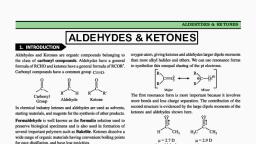
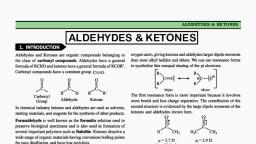
ALDEHYDES & KETONES, , , , , , 1, INTRODUCTION, , Aldehydes and Ketones are organic compounds belonging to, the class of carbonyl compounds. Aldehydes have a general, formula of RCHO and ketones have a general formula of RCOR’., Carbonyl compounds have a common group C=O., , Oo Oo Oo, , a a:, Kas ay RR, Group Aldehyde Ketone, , In chemical industry ketones and aldehydes are used as solvents,, starting materials, and reagents for the synthesis of other products., , Formaldehyde is well known as the formalin solution used to, preserve biological specimens and is also used in formation of, several important polymers such as Bakelite. Ketones dissolve a, wide range of organic materials having convenient boiling points, for easy distillation, and have low toxicities., , , , Many other ketones and aldehydes are used as flavourings and, additives to foods, drugs and other products., , Benzaldehyde is the primary component of almond extract, and (—), carvone gives spearmint chewing gum its minty flavour., , 2. PHYSICAL PROPERTIES, , The carbonyl carbon atom is sp” hybridized and bonded to three, other atoms through coplanar sigma bonds oriented about 120°, apart. The unhybridized p orbital overlaps with a p orbital of, oxygen to form a pi bond., , , , , , , , , , , , , , , , Foe, R,, 120° C—0EQ, R, 120', Functional Group | Length Energy, 745 kJ/mol, Ketone C=O bond | 1.23 | Lag eat hoy, 611 kJ/mol, Alkene C=O bond | 1.34A (146 kcal/mol), , , , , , , , , , oxygen atom, giving ketones and aldehydes larger dipole moments, than most alkyl halides and ethers, We can use resonance forms, to symbolize this unequal sharing of the pi electrons., , BS, C:, , RZ, Major, The first resonance form is more important because it involves, more bonds and less charge separation. The contribution of the, second structure is evidenced by the large dipole moments of the, ketones and aldehydes shown here., , , , Minor, , o o, It Mt, H~ CH, H,C~ CH,, n=2.7D n=29D, Acetaldehyde Acetone, , The positively polarized carbon atom acts as an electrophile (Lewis, acid), and the negatively polarized oxygen acts as a nucleophile, (Le Se)., , 2.2 Boiling Point >, , Ketones and aldehydes have no O—H or N—H_ bonds,, however, so their molecules cannot form hydrogen bonds with, each other. Their boiling points are therefore lower than those of, alcohols of similar molecular weight., , , , , , The ketone and the aldehyde are more polar and higher-boiling, than the ether and the alkane, but lower-boiling than the hydrogenbonded alcohol., , CH,CH,CH,CH, CH,—O—CH,CH,, , Butane, BP OPC, , CH,CH,—-C—H, , Propanal, BP 4eC, , Methoxyethane, BP S°C, , CH,—C—CH, CH,CH,CH;—OH, , L-Propanol, BP 97?C, , Acetone, BP 56°C, , [ 2.3 Solubility >, , , , , , , , 2.1 Dipole Moment >, , The double bond of the carbonyl] group has a large dipole moment, because oxygen is more electronegative than carbon, and the, bonding electrons are not shared equally. In particular, the less, tightly held pi electrons are pulled more strongly toward the, , Although pure ketones and aldehydes cannot engage in hydrogen, bonding with each other, they have lone pairs of electrons and, can act as hydrogen bond acceptors with other compounds having, O—H or N—H bonds. For example, the -OH hydrogen of water, or an alcohol can form a hydrogen bond with the unshared, electrons on a carbonyl oxygen atom.

Page 2 :
6° 6°, 8e 0. 5@ 88 -OL 9, H sll R, 360", set aol, R R’ R H, , Because of this hydrogen bonding, ketones and aldehydes are, good solvents for polar hydroxylic substances such as alcohols., They are also remarkably soluble in water. Acetaldehyde and acetone, are miscible (soluble in all proportions) with water. Other ketones, and aldehydes with up to four carbon atoms are fairly soluble in, water. These solubility properties are similar to those of ethers and, alcohols, which also engage in hydrogen bonding with water., , 3. PREPARATION OF CARBONYL COMPOUNDS, , , , Alkenes, , 1. Ozonolysis, , 2. Oxidative Cleavage, 3. Wacker Process, , 4. Oxo Process, , , , , , , , , , , , , , , , , , , , , , |Alkynes, , 1. Acid Catalysed Hydration}, hare Oxidation] |]? Hydroboration Oxidation, Alkyl Halides Cyanides, Hydrolysis of 1. Stephen's Reaction, Gem-Dihalides 2. Grignard Reagent, , , , , , , , , , , , , , , , , , , , , , , , , , Alcohols Carboxylic Acids, , 1. PCC/PDC/Collin's Reagent] | and Derivatives, , 2. MnO, 1. Distillation of Ca Salts of, 3. Cu, A Fatty Acids, , 4. HIO,/Pb(OAc), 2. Rosenmund Reaction, , 5. KMnO,, K,Cr,0, 3. Acyl Chloride and RMgX, 6. Oppenaeur Oxidation, , , , , , 3.1 Alkanes >, , Controlled oxidation of alkanes under high temperature and, pressure in the presence of a catalyst gives carbonyl compounds., , Molybdenum Oxide, , CH, +0, eben ow, HCHO + H,0, , [32 Alkenes >, [32.1 Ozonolysis >, , , , , , , , Alkenes can be oxidized to aldehydes and ketones if reacted with, O, and then reduced with Zn or dimethyl! sulphide, (CH,),S. Ifa, reducing agent is not used, the aldehyde formed cannot be isolated, as it is further oxidized to carboxylic acids., , (1) 0,, (2) Z/1,0), , , , , , Oo Oo, CH,, (0,, ——_——_—_, QcH—s—cH, H H, +, es ee, 0 0, +, (CH,),S=0, , 3.2.2 Oxidative Cleavage >, , Strong oxidizing agents such as acidic K,Cr,O, or alkaline KMnO,,, cause oxidative cleavage of double bond to form ketones and, carboxylic acids,, , Exampl, , , , , , CH,, , , , COOH
Page 3 :
O: ), CH, CH,, , , , | 3.2.3 Wacker Process >, , It is the industrial method to prepare acetaldehyde., , , , PACl, CuCl,, , CH=CH, + 40, Sg —* CHyCHO, , 3.2.4 Oxo Process, , This reaction is also called hydroformylation. Carbon mono-oxide, and H, under high pressure is passed over catalyst Co(CO),., , H, “s co + CO+H, 20K. Pressure ale haere, 7 2 Co(CO), 1 |, water gas, , Product formed is a mixture of isomeric chain (predominant) and, branched chain aldehydes,, , Peete, 100°-150°C, , CH,=CH, + CO + H; ——————* CH,CHO., , Catalyst, Example -7, , CH,—CH=CH, + CO + H), , 370K,, Pressure, Catalyst, , , , CH,, CH,—CH,;—CH,—CHO + CH—CHO, CHy, (Major) (Minor), , 3.3 Alkynes, , [3.3.1 Acid Catalyszed Hydration in presence of Mercurie Salt ), , This reaction follows Markovnikov addition., , , , , , , , 0°, I, R—CH—C—R', , OH, , H,0,n®, HCm=CH ———> H,C=CH, , HgS0,, , , , CH,CHO, OH, , ey HOH —_, CHy—CmsCH SSG CHy—C=CH,, 0, CH,—C—CH,, , 3.3.2 Hydroboration Oxidation >, , This reaction follows Anti-Markonikoy addition. The reagent that, , , , , , can be used are BH, or Sia,BH (Disiamylborane)., , OH i, , () BH, THE, —R', , , , (2) H,O,, OH, , , , 0, I., R—C—CH,—R', , , , OH, (1) BH. THE, , , , CH,—C=C—CH, CH,—CH=C—CH,, , oO, , (2) H,0,, on?, , CH,—-CH,—C—CH,, , ent, , (1) Sia, BH, H =, , , , CH,—C CHy—CH=CH, , (2) H,0,, OH, , OH, , CH,CH,CHO